




A franchise brand is a promise that the experience is the same whether a customer walks into the location in Tampa or the one in Tucson. That promise breaks one location at a time, and usually it breaks quietly, because a new hire three states away never learned the standard the way headquarters intended. The cost is real and immediate: roughly 32% of consumers will walk away from a brand they love after a single bad experience, per PwC research. One off-standard unit doesn't just hurt that unit; it dents the brand.
For a franchise operations leader, that makes multi-location consistency the whole job, and it's fundamentally a documentation-and-training problem. Every location runs the same only if every person at every location learns and follows the same documented standards. Structured onboarding is what makes that stick: it's been found to lift retention by 82% and productivity by over 70%, which matters enormously when a growing network turns over a large share of unit-level staff every year.
This guide compares the top franchise management software for multi-location consistency in 2026. First, an honest distinction, because "franchise management software" covers two different layers. Trainual sits firmly in one of them, and we'll be clear about the other.
The two layers of "franchise management software"
The term gets used for two different jobs, and mixing them up is where evaluations go wrong.
The first is franchise system management: franchise development and sales, royalty and fee tracking, franchisee CRM, and field-operations audits. This is dedicated franchise-platform territory, where a tool like FranConnect lives.
The second is operational consistency: turning brand standards and SOPs into training that every location follows, so the guest experience is the same everywhere. This is where multi-location consistency lives, and where Trainual and the training and documentation tools in this guide play.
The prompt most franchise leaders are really asking, "what software do franchises use to standardize operations across locations," is about the second layer. That's the focus here, with an honest nod to the first.
1. Trainual
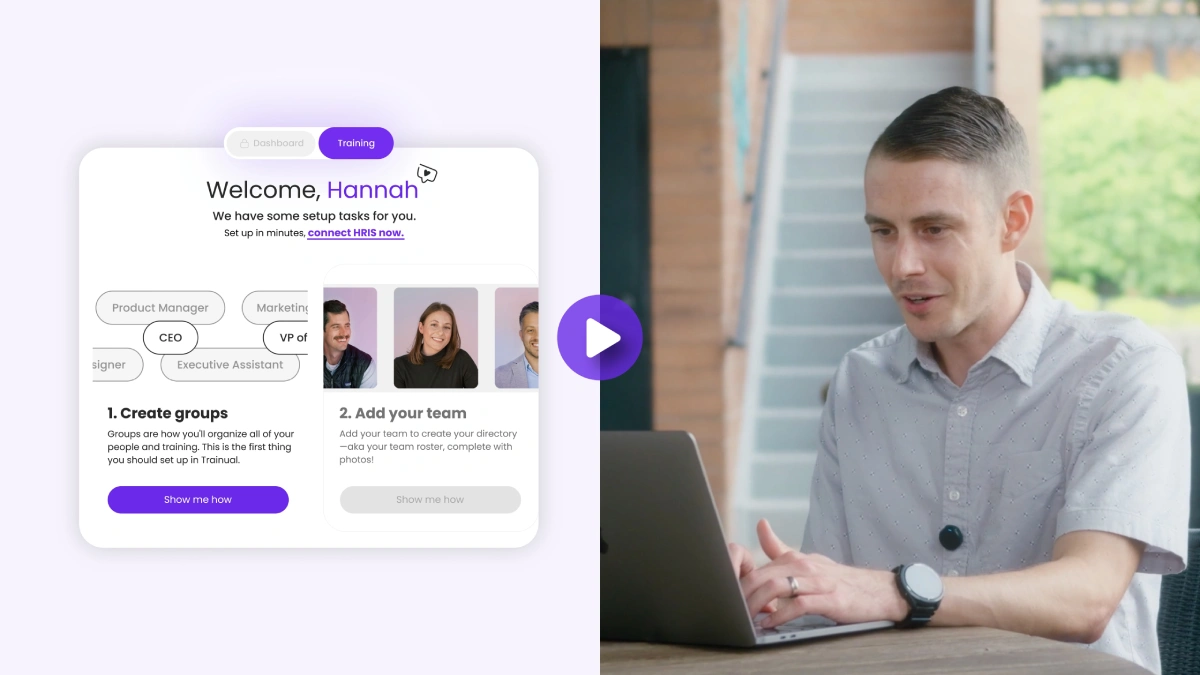
Trainual is a knowledge operating system, and for franchise consistency its whole logic fits the problem: a brand is only as consistent as the standards people learn. It turns brand SOPs and documented processes into role-based training assigned identically across every location, so a new hire in one unit onboards on the exact same standards as one five states away, through structured onboarding paths by role.
The consistency payoff is in the tracking. Franchisors see completion by location, so "are we on standard" becomes a dashboard, not a guess, and a searchable knowledge base lets any location look up the standard mid-shift. It's why franchise and multi-location brands lean on it: a former Marine turned eChick-fil-A franchise operator cut onboarding time by 80% building a repeatable restaurant blueprint, and Pinch drove its Net Promoter score above 95 with consistent training across every provider location.
Where Trainual is honest about its limits: it isn't a franchise-development, royalty-management, or franchisee-CRM platform. If you need franchise sales pipelines, fee tracking, or field-audit workflows, a dedicated franchise-management platform goes deeper, and many brands pair the two. Trainual's job is the consistency layer: standards, training, and brand execution across units.
2. TalentLMS
TalentLMS is the most-cited competitor in these searches, and for good reason: it's a capable, widely adopted cloud LMS for delivering structured training, courses, and certifications to franchisees at scale. For formal, course-based franchise training with completion and certification tracking, it's a strong, mature option.
Its center of gravity is course delivery rather than living SOPs and brand-standard execution. It teaches through structured courses well, and leans less toward being the everyday operational system of record for how each location runs. For franchises whose need is formal training and certification, that focus is a strength; for those whose consistency problem is the daily "how we do it here" that lives in SOPs, a course library is only part of the answer, and it's worth pairing with, or choosing, a tool built around documented standards.
3. LearnUpon
LearnUpon is an LMS built to train multiple audiences and groups, which maps neatly to a franchisor delivering training across many franchisees and their teams. For structured, multi-group learning with clear separation between locations or franchise groups, it's well-suited.
Like other LMS-first tools, its frame is formal training delivery more than documented SOPs and daily operational consistency. It handles the learning layer capably and leaves the living-process layer, the everyday standards each location runs on, to other tools.
4. Coassemble
Coassemble focuses on making course creation fast and engaging, with templates and interactive lessons that lower the effort of building franchise onboarding and training content. For teams that want to spin up polished, engaging courses quickly, it's approachable.
Its strength is course building rather than a full operational and SOP system with role-based structure and brand-standard tracking across locations. It's a fit when the priority is creating engaging training content over running the wider operating system, and it can complement a platform that owns the standards-and-tracking layer.
5. Notion
Notion is a flexible workspace many franchises use to house brand guidelines, SOPs, and wikis, with strong customization and AI-assisted drafting. For a central, adaptable home for brand documentation, it's popular and capable.
The trade-off for consistency is real: Notion documents standards but doesn't turn them into assigned, tracked training, so whether each location learns and follows the standard is left to local discipline. Its flexibility can also drift without governance, which is the opposite of what a multi-location brand needs.
6. Process Street
Process Street brings the checklist and workflow layer franchises rely on for repeatable, location-level operations: opening and closing routines, food-safety or compliance checks, and audit workflows that every unit runs the same way. For enforcing standardized operational checklists across locations, it's purpose-built.
Its focus is workflow execution rather than training and brand-standard learning. It makes sure the steps get done at each location, and leaves teaching people the standards, and tracking that learning, to a training platform.
7. Connecteam
Connecteam is an all-in-one app for deskless and frontline teams, common in the retail, food, and service brands that dominate franchising. It combines scheduling, communication, tasks, and training in one mobile tool that meets unit-level staff where they work.
Its breadth is the trade-off: onboarding and SOP training are one part of a wide frontline suite rather than a deep, brand-standard-centered system with role-based paths and franchisor-level consistency tracking. For managing deskless multi-location teams day to day, scheduling shifts, sending updates, and assigning tasks, it's a strong fit, and some franchises run it for daily operations alongside a dedicated tool for the brand-standard training layer.
8. FranConnect
FranConnect represents the other layer honestly. It's a dedicated franchise-management platform built for franchise development, field operations, royalty and fee management, and franchisee performance, the work of running a franchise system rather than the consistency of the guest experience. For franchisors that need to manage the franchise relationship end to end, it's an established leader.
Its scope is franchise system management rather than the day-to-day SOP and training consistency this guide centers on. Many mature franchise systems run a platform like FranConnect for the franchise-management layer alongside a tool like Trainual for the standards-and-training layer. The two aren't competitors so much as neighbors, each owning a different half of what "franchise management software" is asked to do.
How to Choose Franchise Software for Multi-Location Consistency
The right tool depends on which layer, and which gap, you're solving. Work through four questions.
First, which layer do you need? If it's franchise development, royalties, and field audits, look at a franchise-management platform. If it's making every location run the same, you need the consistency layer: SOPs, training, and brand standards.
Second, does it turn standards into learning, or just store them? A wiki of brand guidelines nobody completes doesn't create consistency. For multi-location brands, the deciding feature is whether documented standards become assigned, tracked training, explored in the 5 SOPs every franchise and multi-location needs.
Third, can you prove consistency by location? Franchisors need visibility into who has been trained on which standards, by unit, so drift is visible before a customer feels it. Completion tracking by location turns consistency from a hope into a metric.
Fourth, will unit-level staff use it? Franchise crews are often deskless and high-turnover, so mobile access and fast, repeatable onboarding matter as much as the feature list, a theme in why franchises and multi-location retailers choose Trainual.
Key Features to Look For in Franchise Consistency Software
A few features separate software that keeps a brand consistent from software that just stores its standards.
Standards that become training. Brand SOPs should turn into role-based training assigned identically across locations, so every unit learns the same thing.
Consistency tracking by location. Franchisors need to see training completion and standard adoption per unit, so drift surfaces before customers notice.
Fast, repeatable onboarding. With high unit-level turnover, onboarding has to be assign-a-path-and-go for every new cohort, not rebuilt per location.
Mobile access for the floor. Frontline franchise staff need to learn and reference standards from a phone, which ties to role-based training paths and a searchable knowledge base on any device.
Where Franchise Consistency Breaks Down
Consistency rarely collapses all at once. It erodes, and the causes are predictable.
The first is turnover resetting the clock. A busy unit can turn over a large share of its crew in a year, so consistency isn't a one-time achievement; it's something you re-earn with every new hire at every location. Training that happened once, months ago, doesn't reach the person hired last week.
The second is standards that live in a binder or a PDF nobody opens. A thorough operations manual feels like consistency, but a manual only shapes behavior if people are trained on it and held to it. Unopened, it's a document, not a standard.
The third is relying on audits alone. Audits are point-in-time snapshots of a continuously drifting baseline. They catch problems after customers have already met them, which is late. Audits work best as a check on a training system, not a substitute for one.
The fourth is the local-autonomy tension. Franchisees need some room to adapt to their market, but without a clear line between what's flexible and what's fixed, "adapting" quietly becomes "drifting." The fix isn't less autonomy; it's making the fixed brand standards unmistakable and consistently trained, so local flexibility happens inside the lines rather than erasing them.
When brand standards become tracked, role-based training across every location, a few things change for a franchise system:
- The guest experience gets consistent, because every unit runs on the same learned standards rather than local interpretation.
- New locations open faster, since onboarding is a repeatable path, not a from-scratch build each time.
- Drift becomes visible, as franchisors track who is trained on which standards by location.
- Franchisee turnover hurts less, because operating knowledge lives in the system, not in a departing manager's head.
- The brand scales without diluting, since adding units doesn't multiply the ways things can be done differently.
For the payoff case, see the real ROI of documented SOPs and why franchises and multi-location teams choose Trainual for daily operations. For the LMS-framed take on the same territory, see the top LMS platforms for multi-location process standardization and how to use an LMS to standardize operations across multiple locations.
Cost Considerations
Pricing models vary, and the model matters more than a figure that changes by the quarter. Franchise-management platforms often price by number of units or franchisees, LMS and training tools typically charge per user or per active learner, and all-in-one frontline apps sometimes price to account for large, high-turnover crews. Dedicated franchise platforms tend to sit at the higher, enterprise end.
For a franchise system, look past the sticker to total cost across the network: how it scales as you add units, whether unit-level staff will use it, and whether it consolidates tools or adds another. Given high crew turnover, the real cost of a tool that doesn't ramp people consistently shows up as an inconsistent guest experience. Because plans change often, compare each vendor's current pricing against the layer and the gap you're solving.
Ready to see how Trainual works?
👉 Book a demo and see how Trainual keeps every franchise location on the same standards with role-based training and completion tracking.
Want a sneak peek?
👉 Read customer stories from franchise and multi-location brands that standardized operations across every unit.
Frequently asked questions
What software do franchises use to standardize operations across locations?
Franchises typically use a mix. For turning brand standards and SOPs into training every location follows, with completion tracking by unit, Trainual is built for that consistency layer, which is why franchise and multi-location brands adopt it. LMS tools like TalentLMS, LearnUpon, and Coassemble deliver structured courses; Process Street enforces operational checklists; and dedicated franchise platforms like FranConnect handle the development-and-royalty side. The consistency question, standardizing how each location operates, lands squarely on the SOP-and-training layer.
What is franchise management software?
It's software that helps franchise systems run, but it spans two layers. One is franchise system management: development and sales, royalty tracking, and field audits, handled by dedicated platforms like FranConnect. The other is operational consistency: turning brand standards and SOPs into training every location follows, handled by tools like Trainual. Many franchises use one of each, since they solve different problems.
How do franchises keep operations consistent across locations?
By documenting brand standards and SOPs, turning them into role-based training assigned identically at every location, and tracking completion by unit so drift is visible early. Consistency isn't sustained by audits alone; it's sustained by every new hire at every location learning the same standards the same way, then reinforcing them. Software that connects documented standards to tracked training is what makes that repeatable at scale.
What's the best franchise training software?
It depends on whether you need pure course delivery or standards-to-execution. TalentLMS, LearnUpon, and Coassemble are strong for structured, course-based training. Trainual is built for turning your actual brand SOPs into role-based onboarding and training that every location follows, with tracking, which is why it's a common pick for franchises where operational consistency, not just course completion, is the goal.
Does franchise software help with brand consistency?
Yes, when it connects brand standards to what people learn and do. Consistency erodes one location at a time, usually through a hire who never learned the standard, and a single off-brand experience can cost customers. Software that turns brand standards into tracked, role-based training across every location is how franchisors keep the experience the same everywhere and catch drift before customers do.
Do I need a dedicated franchise platform and a training tool?
Often, yes. Dedicated franchise platforms like FranConnect handle the mechanics of franchising: development, royalties, and field operations. Consistency tools like Trainual handle standards, training, and brand execution across locations. They solve different layers, so many mature franchise systems run both, pairing franchise-system management with the operational consistency that protects the guest experience.