




When your company operates across multiple sites or remote teams, maintaining consistent processes, onboarding, and compliance can get complicated fast. The right learning management system (LMS) turns that chaos into clarity.
An LMS is a platform that centralizes content storage, delivery, and tracking for training and compliance across an organization. In 2026, more companies are moving to multi-tenant LMS solutions that unify training, SOPs, and policy distribution across every branch and department.
Below is a quick comparison of the best LMS platforms for multi-location businesses — each offering tools for cross-location standardization, centralized operations, and continuous alignment.
Trainual
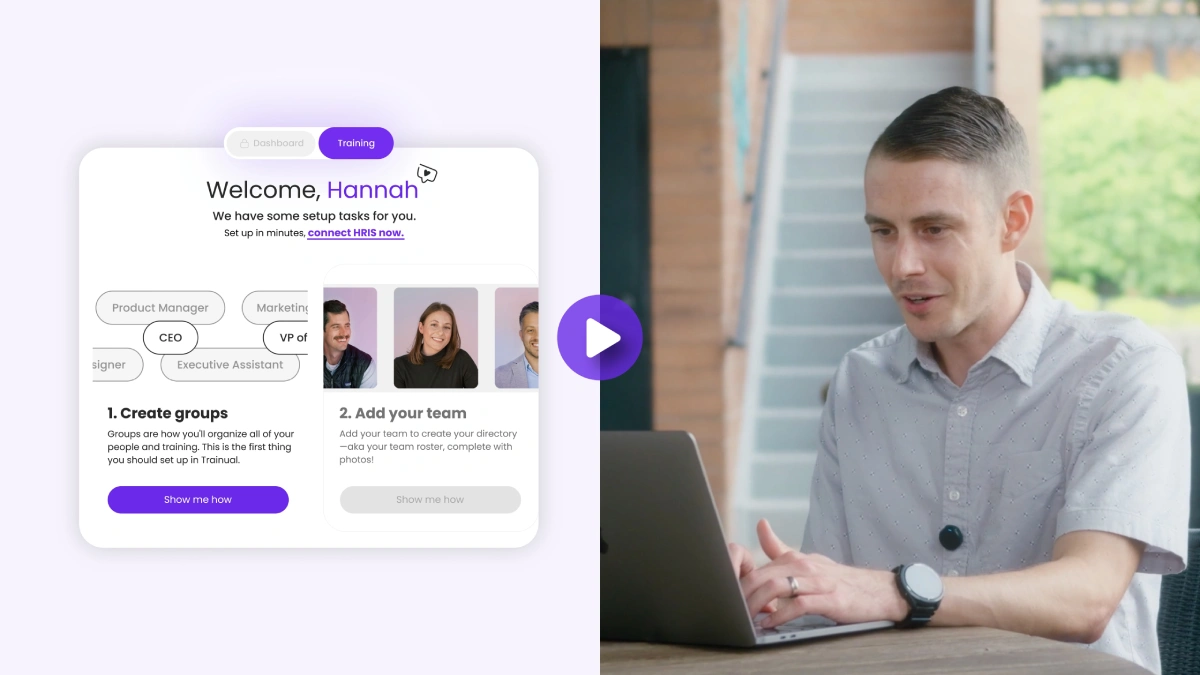
Trainual is built for growing organizations that need a faster, clearer way to standardize operations across multiple locations. It turns scattered process knowledge, SOPs, and onboarding materials into searchable, role-based playbooks that keep every team aligned.
AI-powered SOP creation helps leaders document procedures quickly, while role-based content assignment ensures each employee sees exactly what's relevant to them. Features like interactive org charts, microlearning videos, and integrations with HR and payroll tools make implementation simple.
The payoff? Faster onboarding, less manager hand-holding, and measurable consistency across every site — perfect for businesses that want speed, clarity, and flexibility without enterprise bulk. As an all-in-one playbook platform, Trainual helps you organize chaos and scale your culture across every location.
Docebo
Docebo stands out as an AI-driven enterprise LMS designed for large organizations that manage training across many entities or regions. Its AI engine automates content recommendations, updates, and analytics, helping enterprises maintain consistent learning at scale.
Extended-enterprise portals let companies train employees, customers, and partners from a single system. With strong automation, role-based learning paths, and e-commerce modules, Docebo fits organizations that need high scalability and multi-audience management. Pricing is quote-based, reflecting its enterprise focus.
Absorb LMS
Absorb LMS is a flexible platform for enterprises that need deep customization across regions or brands. It’s known for an intuitive interface, strong mobile performance, and built-in authoring tools for easier course deployment.
Multi-tenant support allows separate branded portals for each location or business unit, all managed centrally. With advanced analytics, reporting dashboards, and offline mobile access, Absorb helps monitor compliance and adoption company-wide. It’s on the higher pricing end but suited for organizations standardizing training across complex structures.
SAP Litmos
SAP Litmos focuses on speed and compliance — ideal for distributed teams that need fast rollout with minimal setup. It offers prebuilt courses, automated certification tracking, and robust compliance management tools.
For global businesses, Litmos includes multi-language support and engagement features like gamification. The tradeoff is limited customization without added services, but its quick setup and large course library make it appealing for teams that need compliance running immediately.
LearnUpon
LearnUpon delivers strong multi-portal management for organizations running both internal and external training programs. Each location or audience can have its own branded portal, while head offices maintain unified visibility over performance metrics.
Its user experience is clean and well-rated, and customer support consistently ranks high (G2 4.6/5). With role-based assignments, centralized reporting, and automation, LearnUpon is a solid fit for teams coordinating learning across regions and audiences.
Workday Learning
Workday Learning is built for large enterprises where HR integration drives training strategy. The system ties employee data directly to learning paths — automating course assignments based on promotions, onboarding, or compliance needs.
It’s best for organizations already using Workday’s HR or payroll systems that want tight connectivity between workforce planning and learning. Implementation can be complex, but the integration depth is ideal for enterprises managing thousands of employees globally.
360Learning
360Learning enables collaborative learning — a model where employees co-create lessons and share expertise to keep procedures current. This peer-driven model helps capture best practices from every site and scale them quickly across locations.
Teams can author courses directly in the platform, accelerating SOP documentation and sharing. Pricing starts around $8 per user for smaller teams, with a free trial available. For organizations prioritizing knowledge sharing and engagement, 360Learning builds a strong sense of community learning.
iSpring Learn
iSpring Learn is a simple, budget-friendly LMS built for small to midsize businesses needing quick deployment. It’s cloud-based, supports automated delivery, and includes core features for onboarding, partner training, and certification.
Setup is fast — often within a day — and pricing starts around $3.58 per user monthly. You’ll trade off some advanced analytics and branding flexibility, but for fast-moving teams that need straightforward control over process documentation and training, iSpring delivers solid value without heavy IT effort.
How to choose the best LMS for multi-location process standardization
Selecting the right LMS starts by mapping your structure: how many locations, how roles vary, and how centralized you want oversight. The steps below can help guide your decision.
Prioritize multi-portal and multi-tenant support
Multi-tenant functionality lets you manage multiple portals — each reflecting a region or subsidiary — under one roof. This keeps local customization while maintaining universal control. For example, a retailer can use region-specific branding while sharing global SOPs and safety policies.
Evaluate role-based training and certification features
Role-based training assigns content by job title, responsibilities, or location. Automated certification and recertification workflows are essential for compliance. Choose systems that can auto-assign or renew mandatory modules — so local teams stay current without constant admin.
Check integrations with HRIS and payroll systems
Direct HR and payroll integrations streamline onboarding and keep employee records synced system-wide. Look for platforms that offer single sign-on (SSO), real-time roster updates, and open APIs to eliminate duplicate data management.
Consider analytics, reporting, and automation capabilities
Analytics turn training data into operational insight. Seek dashboards that track completion rates and compliance by region or department. Many modern systems now use AI-driven automation — triggering reminders, forecasting skill gaps, and scheduling refreshers automatically.
Pilot test deployment before full rollout
Before scaling across all locations, test with one team or site. Track setup time, data syncing, and real-world mobile use. Early pilots help confirm scalability and surface process tweaks before full launch.
Frequently asked questions
What key features should an LMS have for multi-location standardization?
It should include multi-portal management, role-based learning paths, automation, and strong analytics to keep every team operating the same way everywhere.
How can an LMS help enforce uniform processes across different sites?
By centralizing SOPs and automating delivery, an LMS ensures each location follows the same playbook while tracking completion for accountability.
What is the best approach to rolling out an LMS across multiple locations?
Start small with a pilot, confirm reporting and mobile access work smoothly, then expand organization-wide with tuned configurations.
How important are integrations with HR and payroll systems in an LMS?
They’re key for automating onboarding and access control while cutting manual data entry and errors.
What makes AI-powered personalization valuable for distributed teams?
It tailors learning to each role and progress level, helping dispersed teams stay skilled, aligned, and productive.
For more insights on building training systems that scale clarity, consistency, and culture, explore Trainual’s demo.