






The Definitive Guide to Choosing an LMS for Change Management at Growing Companies
New hires every month. New SOPs every quarter. New roles each time the team grows past another threshold. For growing companies, change isn't a project with a start date and an end date — it's the default state of operating. Yet most change management tools were built for big enterprises running 18-month transformations. The gap between what those tools are designed for and what growing companies need shows up in stalled rollouts, half-adopted process updates, and SOPs that go stale before they reach the team. Growing companies are choosing LMS platforms that handle continuous change because the alternative is a manager tax that compounds with every restructure. In this guide, we'll show you how to choose the right LMS for change management — from defining your metrics to running a pilot that proves real lift.
Understanding the role of change management in an LMS
An LMS built for change management does more than version documents. The right system absorbs the realities of growing-company change — SOPs evolving, roles shifting, headcount thresholds breaking the operational rhythm — without requiring a services engagement for every restructure. It versions process updates with audit-grade acknowledgment tracking, automates content reassignment as roles evolve, rolls out changes through the surfaces the team already uses, and surfaces where adoption is stalling before it becomes a problem.
Compared with running change on email blasts, Slack threads, and "manager remembers to update training" workflows, an integrated approach delivers:
- Auditable distribution — every SOP update tracked, every acknowledgment timestamped per person.
- Automatic reassignment — role changes trigger content reassignment without manual reconfiguration.
- Rollout where the team works — change announcements land in Slack, mobile, and the platform inbox.
- Adoption visibility — AI surfaces stall signals before they become audit findings.
The result: faster change distribution, higher adoption, and an operating layer that scales as the company grows.
Defining your success metrics for change management
Before comparing platforms, define what success looks like. Clear metrics keep the evaluation focused on operational lift, not change-management theater.
Common change management success metrics include:
Identify current gaps — process updates that never reached half the team, role changes that didn't trigger content reassignment, operational rhythm designed for a 30-person team still in place at 80 — and set concrete goals like "Cut time-to-distribute a change from 21 days to 3" or "Lift acknowledgment rate from 30% to 85%." These benchmarks become the baseline for evaluating any platform.
Essential features of an LMS for change management
Not every learning platform handles the realities of compounding change. To genuinely shift how change rolls out, focus on features that combine version control, automatic reassignment, and the rollout and adoption-tracking layers that turn updates into action.
Core features to look for:
- Version control with re-acknowledgment — every SOP version tracked; required readers re-prompted automatically.
- Automatic role-based content reassignment — promotions and restructures update assignments without manual reconfiguration.
- Rollout via existing surfaces — change announcements land in Slack, Teams, mobile push, or the platform inbox.
- Adoption tracking with AI insights — system surfaces stalled changes with evidence and recommended next action.
- Operational rhythm that scales with the team — meetings, goals, scorecards, and updates evolve as the company grows past each headcount threshold.
The goal isn't enterprise change governance built for 18-month transformations. It's a system designed for the realities of growing fast.
Mapping technical requirements and integration needs
Selecting an LMS for change management isn't only about features — it's about fit with your stack and the change cadence your team actually runs. Begin with a quick audit.
Common connections include:
- HRIS for role data that drives automatic content reassignment when promotions and transitions happen.
- SSO for seamless logins across the team.
- Slack or Microsoft Teams for change rollout notifications and acknowledgment reminders.
- Existing documentation tools to support migration without losing content during the transition.
Also review mobile compatibility for non-desk teams, your real change cadence (weekly, monthly, quarterly), and security standards like SOC 2. A clear technical audit prevents the integration gaps that derail most change rollouts.
Evaluating LMS platforms: what to look for in demos and trials
A real evaluation tests vendor promises against the realities of continuous change. Always include working managers and at least one operations leader in your demos.
Targeted demo questions to ask:
- "Update an SOP in front of me. Walk through how every required reader gets prompted, how the audit trail works, and what happens when someone hasn't acknowledged in 48 hours."
- "A new manager gets promoted from IC. Show me how their content assignment changes automatically based on the new role chart — without anyone manually updating it."
- "Show me how the platform surfaces a change that isn't being adopted. What evidence does it cite, and what next action does it recommend?"
Apply the "coffee shop test": if a working manager can update an SOP, push the change to required readers across Slack and mobile, and see acknowledgment progress from a phone in five minutes, the platform fits how change actually rolls out at growing companies. Capture findings in a comparison matrix.
Piloting your LMS: measuring time-to-distribute and adoption
Before rolling out company-wide, pilot the shortlisted platform on one real upcoming change for 30 days. Skipping this step is how teams end up with a $30K/year contract and the same scattered change management.
During the pilot:
- Pick one real change (process update, policy rollout, new tool adoption) and run it through the platform.
- Track time-to-distribute and acknowledgment rate against the team's previous baseline.
- Measure adoption two weeks in — whether team members are actually following the new process, not just acknowledging it.
Teams running this pilot typically see time-to-distribute drop from 2-3 weeks to 2-3 days, acknowledgment rates climb from under 30% to over 80%, and change-related manager interruptions drop by half within 30 days.
Scaling your LMS usage beyond one rollout
The right LMS doesn't stop at the first change. Once a single rollout has flowed cleanly — versioned, assigned, acknowledged, adopted — the same system can carry every subsequent change, plus the operational rhythm shifts that come with growing past each headcount threshold.
Many teams begin with one process change and one rollout flow, then expand to AI-powered SOP creation for closing the documentation backlog, automatic role evolution support as the org changes, and the operational rhythm that scales alongside the team. Over time, the platform becomes both a training system and the operating layer that absorbs change as the default state, not the exception.
How Trainual handles change management for growing companies
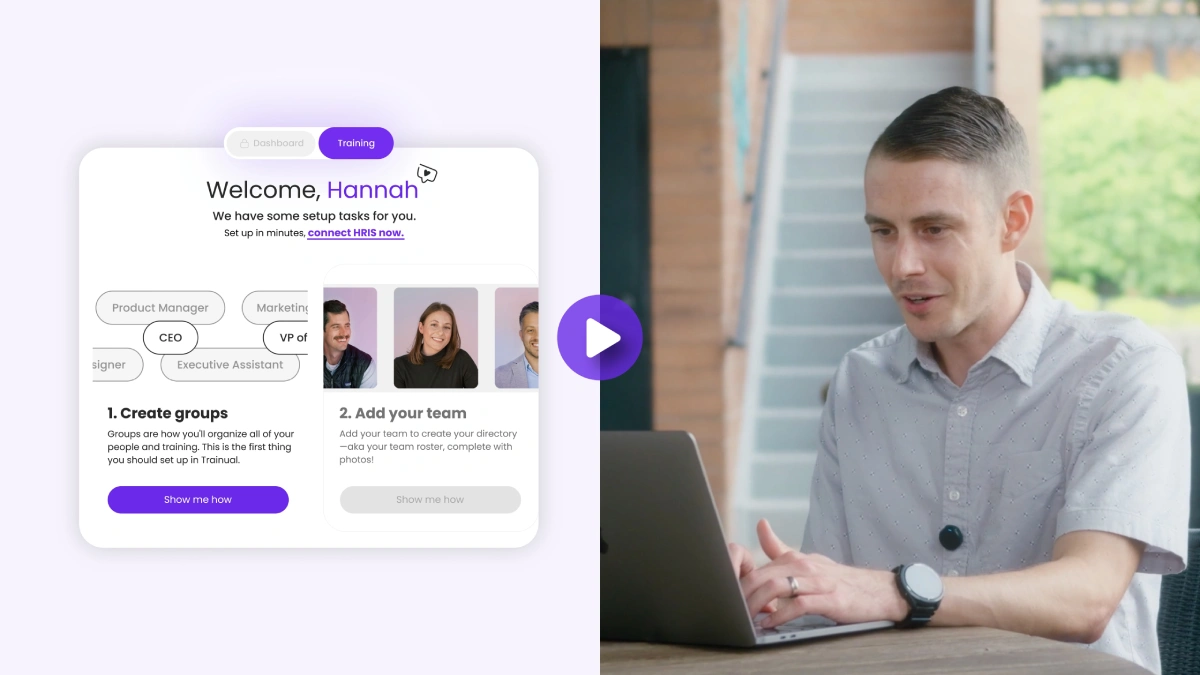
Trainual combines version-controlled SOPs, automatic role-based reassignment, integrated rollout, and operational rhythm in one platform built for growing teams. Its version history tracks every SOP update with acknowledgment timestamped per person, the role chart drives automatic content reassignment when roles change, and integrations with Slack, Microsoft Teams, and HRIS systems push changes through the surfaces the team already uses.
A mobile-first interface keeps change rollouts accessible across non-desk teams. AI features turn existing Looms, docs, and recordings into structured SOPs in minutes — so the change management system isn't limited by what's been written down. Operations Suite scales the operational rhythm — meetings, goals, scorecards, async updates — as the team grows past each threshold, with Team Pulse AI surfacing change adoption stalls automatically.
For teams looking to move from change management designed for static enterprises to a system built for the realities of growing fast, Trainual offers a connected operating layer where every restructure, SOP update, and role transition gets absorbed without breaking the rhythm.
Frequently asked questions
How do I start evaluating LMS platforms for change management?
Audit your last three process changes — count how long it took for every required reader to acknowledge and how many actually changed behavior. Those numbers are the baseline every vendor pitch should be measured against.
What core features matter most for change management at growing companies?
Prioritize version control with re-acknowledgment, automatic role-based reassignment, rollout via existing communication surfaces, adoption tracking with AI insights, and operational rhythm that scales with the team.
How does change management connect to training in an LMS?
The right LMS links every process change to the training path or SOP that addresses it — so the change announcement triggers the training response in the same workflow.
What are common pitfalls to avoid?
Buying enterprise change governance built for episodic transformations when the team's real problem is continuous change. The platforms designed for big static enterprises rarely fit growing companies where change is the default state.
How do I ensure successful adoption?
Pilot one real upcoming change on the new platform, measure time-to-distribute and acknowledgment rate against a baseline, and expand only after the numbers prove the system handles continuous change at the cadence the team actually runs.