





The Definitive Guide to Choosing an LMS for Role Clarity and Responsibility Management
Ask any team member: what do you own? If the answer takes more than 60 seconds and includes uncertainty about three things, role clarity is a problem. Most growing teams have it — and most LMS platforms only solve half of it. They handle role-based access control well: who can do what inside the platform. But access control isn't role clarity. Real role clarity is about the human side — what someone owns, what they're accountable for, who they hand off to, how their work connects to the team's outcomes. Growing companies are choosing LMS platforms that treat roles as a strategic operating tool, not just a permissions group. In this guide, we'll show you how to choose the right LMS for role clarity and responsibility management — from defining your metrics to running a pilot that proves real clarity.
Understanding the role of an LMS in clarity and responsibility management
An LMS built for real role clarity does more than tag users with permissions. The right system carries documented role descriptions readable by the team member, automatic content assignment by role, an org chart that visualizes reporting structure, profiles showing the whole person, and the operational accountability layer that ties roles to the goals, scorecards, action items, and updates each role actually owns.
Compared with running role clarity on offer letters, intuition, and "ask your manager" workflows, an integrated approach delivers:
- Documented roles — every role has a current description with responsibilities, ownership areas, and KPIs.
- Automatic content assignment — the right hire at the right role gets the right training on day one.
- Org structure visualization — who reports to whom, who works with whom, who hands off to whom.
- Operational accountability per role — goals owned, scorecards reviewed, action items assigned, updates submitted.
The result: faster onboarding, fewer manager interruptions on ownership questions, and an operating layer where every team member knows what they own.
Defining your success metrics for role clarity
Before comparing platforms, define what success looks like. Clear metrics keep the evaluation focused on operational lift, not RBAC feature checklists.
Common role clarity success metrics include:
Identify current gaps — direct reports who can't answer "what do you own" without uncertainty, roles with no documented description, handoffs that didn't go cleanly during recent promotions — and set concrete goals like "Lift role description coverage from 30% to 90%" or "Cut manager time on ownership questions by 50%." These benchmarks become the baseline for evaluating any platform.
Essential features of an LMS for role clarity and responsibilities
Not every learning platform produces real role clarity. To genuinely shift the team's understanding of who owns what, focus on features that combine documented roles, automatic assignment, org visualization, and the operational layer that ties roles to the work each person actually does.
Core features to look for:
- Role definition as a documented operating tool — readable by the team member, not just an admin tag.
- Automatic role-based content assignment — training, SOPs, and policies assigned by role on day one.
- Org chart and people directory — visual structure plus profiles, skills, and contact info per person.
- Profiles showing the whole person — role, training progress, and operational accountability in one view.
- Operational accountability per role — goals, scorecards, action items, and updates tied to the role chart.
- Role evolution support — promotions and restructures trigger automatic content reassignment.
The goal isn't sophisticated permission groups. It's a system where every team member can answer "what do I own" from the platform without asking their manager.
Mapping technical requirements and integration needs
Selecting an LMS for role clarity isn't only about features — it's about fit with your stack and the source-of-truth systems that hold role data today. Begin with a quick audit.
Common connections include:
- HRIS for job title, department, and manager-to-direct-report mapping that drives role data.
- SSO for seamless logins across the team.
- Slack or Microsoft Teams for role-related notifications and assignment prompts.
- Existing documentation (job descriptions, SOPs, org charts) to support migration without losing institutional context.
Also confirm where current role descriptions live and what coverage looks like today. Most growing companies have 20-40% role description coverage at most. A platform that makes closing that gap easy is worth more than one that only enforces assignment.
Evaluating LMS platforms: what to look for in demos and trials
A real evaluation tests whether the platform produces clarity or just permissions. Always include both managers and individual contributors in your demos — the human-layer experience is the truest test.
Targeted demo questions to ask:
- "Show me a role in the platform. What does the documented description look like — responsibilities, ownership, KPIs?"
- "A new hire starts. Walk me through how they see their own role, find their assigned content, and understand who they hand off to."
- "Someone gets promoted from IC to manager. Show me how their role assignment changes — the content reassignment, the new responsibilities, the new reporting relationships."
Apply the "coffee shop test": if a team member can open the platform on a phone, find their own role description, see what they're accountable for this week, and review the training paths tied to their role in under three minutes, the platform produces clarity. Capture findings in a comparison matrix.
Piloting your LMS: measuring "what do you own" answer time
Before rolling out company-wide, pilot the shortlisted platform with one team for 30 days. Pick the team with the most ownership ambiguity — cross-functional, newly restructured, or fast-growing — they'll surface the strongest signal.
During the pilot:
- Document every role on the pilot team with responsibilities, ownership areas, and KPIs.
- Map relevant training paths, SOPs, and policies to each role.
- Track "what do you own" answer time before and after, and count manager hours saved on ownership questions.
Teams running this pilot typically see "what do you own" answer time drop from 2-3 minutes of qualified uncertainty to under 30 seconds of confident answer, manager interruptions on ownership questions cut by half, and onboarding ramp time variance compress within 30 days.
Scaling your LMS usage beyond one team
The right LMS doesn't stop at one team's role chart. Once roles are clear and content is assigned correctly on the pilot team, the same system can carry the rest of the company, the operational accountability layer that ties roles to the work, and the delegation and succession workflows that compound when role clarity becomes the default.
Many teams begin with one team's role documentation, then expand to multi-team consistency, operational accountability via goals and scorecards per role, and AI-surfaced answers to "who owns this" pulled from the role chart and SOPs. Over time, the platform becomes both a training system and the operating layer where every team member can answer what they own.
How Trainual delivers role clarity and responsibility management
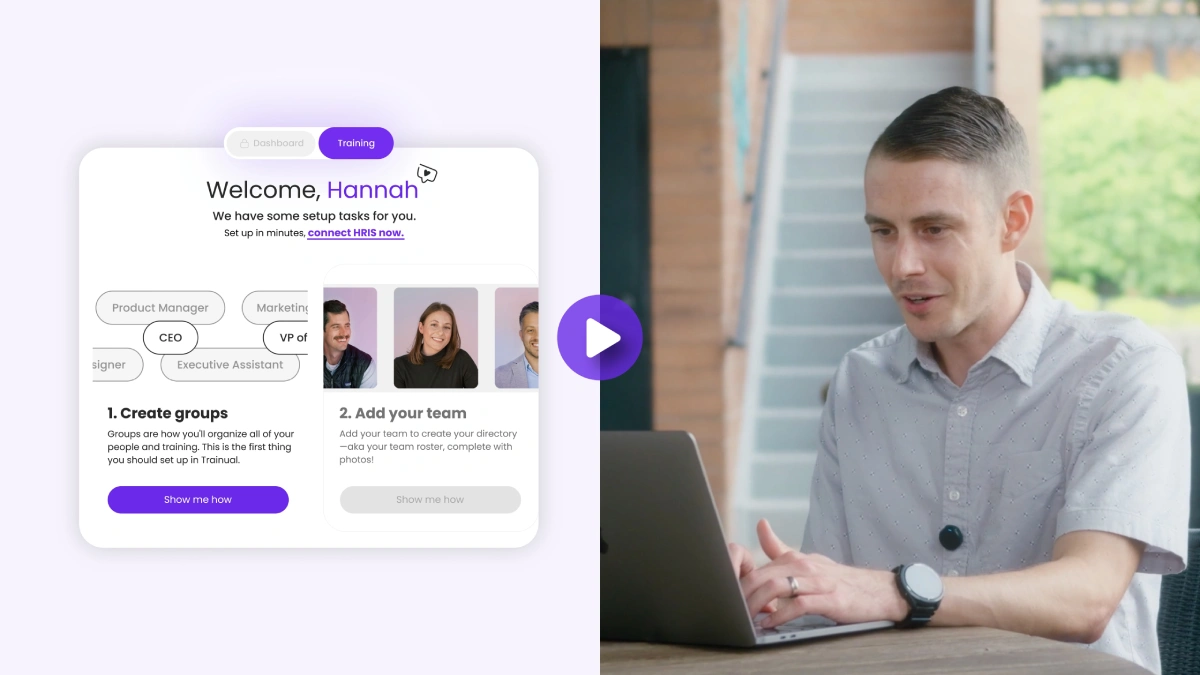
Trainual combines documented role descriptions, automatic content assignment, org visualization, whole-person profiles, and operational accountability in one platform built for growing teams. Its Roles & Responsibilities feature treats the role chart as a strategic operating tool — each role documented with responsibilities, ownership areas, KPIs, and contributions, readable by the team member from their own profile.
The org chart and people directory cover the visual structure and human layer. Profiles show role, training progress, and operational accountability — goals, scorecards, action items, and updates — in one view per team member. Delegation tools make handing off responsibilities easier by documenting the role first, training the new owner, and confirming the transfer completes. Operations Suite ties operational accountability to roles, and the AI Assistant answers "who owns this" with citations from the role chart and SOPs.
For teams looking to move from RBAC and inferred role definitions to a system where every team member can answer "what do I own" with confidence, Trainual offers a connected operating layer where roles, training, accountability, and delegation reinforce each other.
Frequently asked questions
How do I start evaluating LMS platforms for role clarity?
Run the "what do you own" test on three direct reports — time their answers and note the uncertainty. Count your current role description coverage. Those numbers are the baseline every vendor pitch should be measured against.
What core features matter most for role clarity in an LMS?
Prioritize role definition as a documented operating tool, automatic role-based content assignment, org chart and people directory, profiles showing the whole person, operational accountability per role, and role evolution support.
How is role clarity in an LMS different from RBAC?
Role-based access control (RBAC) defines who can do what inside the platform. Role clarity defines what someone owns and is accountable for in the company. Most LMS platforms cover RBAC; few cover real role clarity as a strategic operating layer.
What are common pitfalls to avoid?
Buying for permissions depth without documented role descriptions. The most sophisticated RBAC fails to produce clarity when nobody has written down what each role actually owns.
How do I ensure successful adoption?
Pilot with one team that currently has the most ownership ambiguity, measure "what do you own" answer time against a 30-day baseline, and expand only after the team can answer clearly without asking their manager.