




Most growing businesses have the same three problems: people aren't sure how the work should be done, the actual work shifts from the defined expectations, and nobody can see whether the team is actually getting better.
If you're comparing Trainual and Strety, you're probably running on EOS® (or something like it) and feeling at least one of those right now. Priorities slip between quarters. The leadership team is aligned in the L10, but the people doing the work aren't always sure how it's supposed to get done.
Strety is EOS software built to run the Entrepreneurial Operating System: Level 10 meetings, the V/TO™, Rocks, Scorecards, the Accountability Chart™, and the People Analyzer™. It's an official EOS Worldwide licensee, and it has added projects, docs, performance reviews, and surveys around that core.
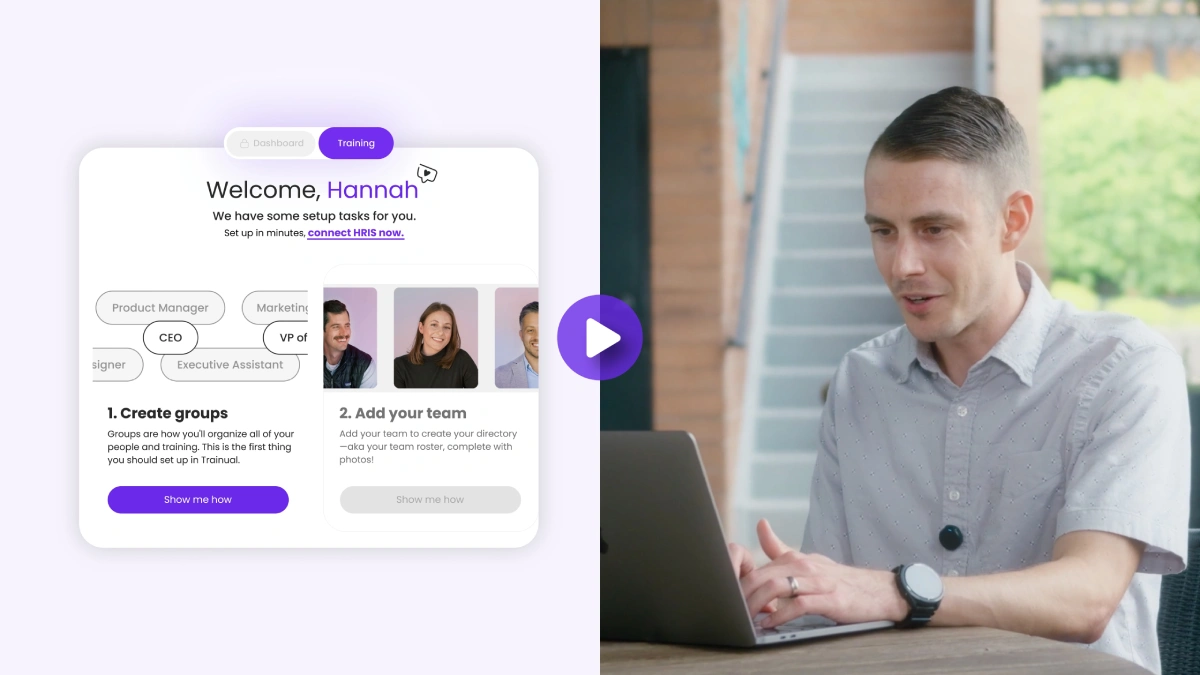
Trainual is one platform that solves all three problems. It's where your team learns how you do things (the training suite), runs the day to day against that standard (the operations suite), and improves (the performance suite).
So before we get into features: how are you handling this today in the business?
Trainual is a G2 Leader in Training Management, SOP Software, Onboarding, and Knowledge Management, with a 4.7 rating across 2,000+ reviews on G2, Capterra, GetApp, and Trustpilot. Strety holds a strong 4.9 on G2 across 25 reviews.
Trainual vs. Strety: the short answer
Strety is the stronger fit when your main need is a pure EOS implementation for the leadership team, especially inside Microsoft Teams or alongside an EOS Implementer. Trainual is the stronger fit when you need the whole team to know how the work is done, execute against that standard every day, and get better over time, with training, operations, and performance in one system.
Key takeaways
- Strety covers the EOS toolkit plus projects, docs, 1:1s, performance reviews (including 360s and Quarterly Conversations™), and engagement surveys.
- Trainual covers training, operations, and performance: SOPs and training paths, meetings, goals, and scorecards, plus performance reviews built on the same data.
- Both run meetings, goals, scorecards, to-dos, an accountability chart, docs, review cycles, and an AI connection to ChatGPT. The difference is what sits underneath: Strety runs on the EOS model, Trainual runs on the documented, trained standard.
- Strety has no training paths, quizzes, completion tracking, course library, or legally binding e-signatures in its public product and help pages.
- Trainual isn't EOS-branded and doesn't include the V/TO, People Analyzer, 360 reviews, project boards, or engagement surveys.
What is Strety?
Strety is EOS software for leadership teams and growing businesses, launched in 2022 by a small, self-funded team. It runs the core EOS tools (Level 10 meetings, Rocks, Scorecards, Issues and IDS, To-Dos, the V/TO, the Accountability Chart, and the People Analyzer), and adds "Power Ups" for project management, docs, 1:1s and performance reviews, and engagement surveys. It's an official EOS licensee, offers a free Coach role for EOS Implementers, and integrates deeply with Microsoft Teams.
What is Trainual?
Trainual is business operations and SOP software for growing teams. It combines three suites in one platform: the training suite (SOPs, process documentation, onboarding, training paths, testing, and roles), the operations suite (meetings, goals, scorecards, KPIs, decisions, and team updates), and the performance suite (review cycles, expectations, growth areas, and feedback). Because all three share one data layer, reviews pull from real work, goals connect to the processes behind them, and Trainual AI answers questions from how your company actually runs.




📌 Can Strety document SOPs and processes?
Yes. Strety Docs has a real editor with text, images, video embeds, file uploads, and cloud links, and you can attach Docs to seats and core processes. What Strety doesn't have is the upkeep layer: owner verification reminders, learner flags routed to the owner, or pushing an update that requires the team to re-complete it. Trainual is built for documentation that stays current.
Give Strety credit: putting your core processes next to your Rocks and seats is a smart EOS move, and assigning a Doc automatically creates a To-Do for the assignee to read it.
The question to ask is what happens to a document three months after someone writes it. That's where Trainual goes further:
- Living documentation. Build processes, policies, and SOPs with images, embedded video, and flowcharts that make complex steps easy to follow.
- Owners who get reminded. Content owners are prompted to re-verify their material before it goes stale.
- Flags that route to the right person. Anyone can flag something outdated from inside the page, and that flag goes straight to the person accountable for it.
- Updates everyone actually sees. Change a process, push it out, and require the team to re-complete it, so everyone works from the current version.
- Version history you can trust. See how content changed and restore what worked before.
Strety holds the process. Trainual keeps it owned, verified, and in front of the team.
🚀 Can Strety onboard and train employees?
No. Strety has no learning management system: no training paths, knowledge checks, completion tracking, or course library. In Strety, onboarding means attaching Docs to a seat and running a project of tasks, and a Doc assignment is a read acknowledgement, not a test. Trainual assigns training by role, confirms understanding with quizzes, and shows who's finished.
Strety coordinates the work around a new hire well: Docs on the seat, a project board of onboarding tasks, and 1:1s to check in.
Coordinating the tasks around a new hire isn't the same as training the new hire. Trainual covers the whole arc, from day one to every process change after:
- Training assigned by role. Bundle the right processes, policies, and SOPs into reusable onboarding and training paths and assign them automatically by role, department, or location.
- Knowledge that's tested and tracked. Add knowledge checks, set due dates and time estimates, and see completions and scores by person, team, or location.
- Ready-made expertise. Roll out 400+ expert-built HR, compliance, and development courses, plus SCORM uploads, without building every course yourself.
Strety confirms the new hire opened the Doc. Trainual confirms they learned it, and proves it stuck.
🤝 How do Strety and Trainual handle roles and accountability?
Both platforms have an accountability chart with roles on each seat, and both let you attach documentation to a role. Strety adds the EOS People Analyzer™ for right person, right seat. Trainual adds an interactive directory, a hub for the tools each role uses, and the Delegation Planner™ for moving responsibilities when roles change.
Strety speaks fluent EOS here, and that matters to teams running the model. The Accountability Chart and People Analyzer are the right vocabulary, and Docs on each seat is a genuinely useful touch.
A seat on a chart says who owns it. It doesn't answer what happens when that person is out, promoted, or gone. Trainual treats roles as a living system tied to your people and the work they own:
- Roles tied to real responsibilities. The roles and responsibilities builder lists the outcomes each job owns, with the SOPs and training behind each one, and bulk-assigns training to everyone in that role.
- Charts and a directory that reflect reality. An org chart and accountability chart built from your people, plus an interactive directory with profiles, responsibilities, and connected content.
- One place for the tools, too. A centralized hub for the software, systems, and equipment each role uses: what it is, who owns it, and how to get access.
- A plan for when work moves. The Delegation Planner™ lets you shift responsibilities for leave, a promotion, or a departure, and see exactly what training the next person needs.
Strety shows who sits in each seat. Trainual shows what they own, how it's done, and who takes it next.
When someone walks out the door, the chart still shows their box. The question is whether the way they did the job left with them.
🎯 Which is better for L10 meetings, Rocks, and Scorecards: Trainual or Strety?
For a pure EOS implementation, Strety is deeper: it's EOS-licensed, uses the full EOS vocabulary, and has an EOS Pure toggle. Trainual's operations suite runs the same weekly rhythm (meetings, goals, scorecards, to-dos, and updates) without EOS branding, on top of the SOPs, roles, and training your team already uses, so you don't need a second tool.
Strety's L10 flow with issue voting and IDS, Rocks with milestones, Scorecards with calculated metrics, and To-Dos that roll over are purpose-built for the EOS rhythm, by people who run EOS themselves.
Trainual is not only a training tool. Its operations suite brings the execution layer into the same system as your documentation, training, and roles:
- Meetings with follow-through. Run meetings and agendas with decisions and action tracking, so open action items roll forward until they're done.
- Goals that ladder up. Set company and team goals with clear owners and due dates, nested under company-wide objectives.
- Scorecards in context. Track scorecards and KPIs next to the processes and people responsible for hitting them.
- Updates that stay searchable. Recurring team updates on your cadence, with a searchable history you can ask questions of.
- Stop managing on gut. Team Pulse surfaces the off-track scorecard, the stalled goal, or the recurring blocker before you go looking for it.
In Trainual, a Rock to migrate the CRM isn't just a status. It links to the SOPs, the training, and the people who own the work, so "are we on track?" and "does the team know how to do this?" stop being two separate questions.
🌱 How do Strety and Trainual handle performance reviews?
Both run structured reviews. Strety's performance tools center on the EOS People Component: 1:1 agendas, Quarterly Conversations™, 360 reviews, custom review cycles, and People Analyzer results linked to reviews. Trainual's performance suite builds reviews on the SOPs, responsibilities, goals, and daily activity already in Trainual, links every growth area to training, and drafts reviews with AI.
Give Strety credit: asynchronous reviews, 360 feedback, and an HR Center that tracks participation across the company are real strengths, and they tie neatly into EOS.
The difference is the evidence underneath. Strety asks whether someone is the right person in the right seat. Trainual's performance suite shows what they actually did in it, and what to learn next:
- Reviews that write themselves. Reviews assemble over the whole cycle from documented responsibilities, goal progress, scorecards, updates, and feedback, so the first draft is ready in minutes and review time is a recap, not a scramble.
- Expectations everyone can see. Define what good looks like at every level, built on the roles and responsibilities you've already documented, so you review against the standard, not a generic rubric.
- Self and manager reviews in one place. See where you and a report see progress differently before the conversation, and roll every cycle into a permanent packet on each person's profile.
- Growth areas tied to real training. Every growth area links to the exact courses and SOPs that close the gap, and carries forward across cycles instead of resetting.
- Feedback on the record. Capture praise the moment great work happens, give private feedback in real time, and let people request feedback, all ready when review season comes around.
Strety asks whether they're right for the seat. Trainual shows what they did in it, and what to learn next.
Strety keeps the People Component on track. Trainual turns a cycle of real work into the review, and the growth plan that comes after it.
🦺 Does Strety offer e-signatures for policies and compliance?
No. Strety lets you assign a Doc and have people acknowledge they've read it, which is a read receipt rather than a legally binding signature. Trainual offers legally binding e-signatures on any policy or document, with a per-document, reportable record, plus completion and score tracking you can export for an audit.
A read receipt is useful for confirming a policy reached someone. Most audits ask a harder question: can you prove they attested to the current version, months later? Trainual is built for that:
- Sign-off that counts. Built-in, legally binding e-signatures attach a dated signature to the exact content.
- Re-sign when it changes. Update your harassment-prevention or cybersecurity policy, push it out, and require everyone to sign the new version.
- Completion as a record. Testing, tracking, and reporting show who completed required training and how they scored, ready to export when someone asks.
- Courses that stay current. The expert-built course library covers harassment prevention, cybersecurity, and workplace safety, and updates as regulations change.
Strety shows the policy reached them. Trainual shows they signed the current version.
Acknowledging you've seen a document is one thing. Attesting to it, with proof you can hand an auditor, is another.
🤖 How does Trainual's AI compare to Strety's AI?
Strety's AI centers on EOS execution: an AI Assistant that scribes L10s and captures to-dos, AI suggestions for Rocks, Scorecards, and Processes, and an MCP connector that brings your EOS data into ChatGPT and Claude. Trainual AI works across everything your team knows, does, owns, and tracks. It builds training and quizzes, answers from your SOPs with sources, reads across goals and meetings, and works inside ChatGPT, with a Claude integration submitted.
Give Strety credit: its AI Assistant frees the scribe to participate, and its MCP lets people update a Rock or prep an L10 from the chat window they already use.
Most AI tools know the internet. Trainual AI knows how your company works:
- AI content creation. Describe the training you need and Trainual builds it, with steps, structure, and a quiz, ready to assign the same day. Import Google Docs or Word files and it structures them into training-ready steps.
- Edits to what already exists. Tell the assistant what to change and it proposes inline edits you review and approve before anything saves.
- Answers and insights across the business. Ask a question in plain language and get a source-linked answer from your processes, policies, roles, goals, meetings, and team activity: what came out of the last meeting, which goals are slipping, or who hasn't finished their training.
- Trainual inside ChatGPT, with Claude on the way. Trainual is live in ChatGPT. The read-only app covers all three suites, follows each person's Trainual permissions, and works on any plan, so your team can pull SOPs, goals, and review context into the AI assistant they already use every day. We've also submitted a Claude integration for review.
- Connectors to the tools you already use. AI connectors pull knowledge from Google Drive, OneDrive, SharePoint, Notion, Confluence, and Dropbox, and each person only sees what they already have access to.
- Custom agents on your source of truth. For technical teams, API, webhooks, and an MCP server let custom AI agents work from the same knowledge your team trusts.
Strety's AI helps you run the meeting. Trainual's AI helps everyone know how to do the work, wherever they ask.
Strety's AI helps you run the meeting. Trainual's AI answers the questions your team asks the other 40 hours of the week, the ones that aren't about the meeting at all.
🔌 Can you use Trainual and Strety together?
Yes, but most teams end up paying twice for the same meetings, goals, scorecards, and reviews. Trainual replaces the tools that overlap with what its suites do, including Strety's EOS execution layer and review tools, and connects to the systems that run everything else, like payroll, your CRM, and project management.
Here's a simple way to map it:
- What Trainual replaces: SOP docs and wikis (training suite), meeting, goal, scorecard, and business operating system tools like Strety (operations suite), and standalone review tools or the review module in your HRIS (performance suite).
- What Trainual connects to: payroll and HRIS like ADP, Gusto, and BambooHR (users sync automatically), Slack, Google Workspace and Microsoft 365, and project management tools.
Payroll runs your paychecks. Your project management tool runs your projects. Your CRM runs your pipeline. Trainual runs your people: how they're trained, how they operate day to day, and how they grow.
If your leadership team is committed to a by-the-book EOS implementation with an Implementer, running Strety for the leadership L10 while the rest of the team trains and operates in Trainual can make sense. Just know that the second you're running meetings, goals, and reviews in both, you're maintaining two systems of record.
⭐️ Where does Strety have the edge?
This isn't one tool being better at everything. Strety is a capable, thoughtfully built platform, and it's the stronger fit when the work revolves around a pure EOS implementation:
- EOS-pure, EOS-licensed. The full toolset by name (V/TO, IDS, People Analyzer, Quarterly Conversations), an EOS Pure toggle, and a free Coach role for EOS Implementers.
- Microsoft Teams, natively. Strety runs as an app in Teams, creates Issues and To-Dos from Teams chat, and syncs two ways with Microsoft To Do and Planner.
- More review formats. 360 reviews, Quarterly Conversations, and an HR Center for review participation across the company.
- Project management and task sync. Kanban project boards, plus To-Do sync with Asana, Monday, ClickUp, Todoist, Procore, and major PSAs like ConnectWise, HaloPSA, and Autotask.
- Engagement surveys. Customizable surveys and eNPS come included.
- AI in ChatGPT and Claude today. Strety's MCP reads and writes EOS data from both assistants.
- Simple, low-cost pricing. About $13 per user per month, month to month, with free Observer seats and a 30-day free trial.
If that's your world, a leadership team running pure EOS inside Teams where training isn't the bottleneck, Strety is worth a serious look.
💰 How much does Strety cost compared to Trainual?
Strety (as of September 2026): Strety costs about $13 per user per month (USD), billed monthly with no contract. A 15-person team runs about $195 per month plus tax, and the average per-user rate drops as you add people. Everything is included in the seat price, except the BrightGauge integration. Observer and Coach seats are free, nonprofits get 40% off, and there's a 30-day free trial with no credit card.
Trainual: Trainual pricing depends on team size, plan (Core, Pro, Premium, or Enterprise), and which suites you run. Every plan includes guided implementation, with a one-time $1,000 implementation fee. Because the training, operations, and performance suites share one platform, you're replacing several tools rather than adding one.
👉 Choose Trainual if…
- You run on EOS (or something like it) and want the cadence and a way to train the team on how every priority actually gets done, in one system.
- You need documentation that stays accurate, with clear owners and a way for the team to flag what's outdated.
- You want onboarding and training assigned by role, tested, and tracked, with proof of who finished.
- You want performance reviews built on documented responsibilities and a cycle of real work, with growth areas that link to training.
- You need compliance that holds up: legally binding attestation on any policy, plus the courses to back it.
- You want fewer tools, not one more.
👉 Choose Strety if…
- You want a dedicated, EOS-pure tool with the full framework by name and an EOS Implementer working inside it.
- Your team lives in Microsoft Teams and you want EOS running natively inside Microsoft 365.
- You want 360 reviews, Quarterly Conversations, and engagement surveys alongside your EOS cadence.
- Project boards for your Rocks, with PSA or task-tool sync, are a core requirement, and training isn't your bottleneck.
💡 Know what you're solving for
Go back to the three problems. Strety is strong on the middle one at the leadership level: keeping the L10 tight, the Rocks visible, and the scorecard honest, so the work doesn't drift from the plan.
But when a Rock slips, it's rarely because no one knew it was a Rock. It's usually because the process behind it was never written down clearly, the person responsible was never fully trained on it, or nobody could see whether the team was getting better at it until the next Quarterly Conversation. Strety can show you the number turned red. The cause usually lives in the layers underneath: the documented standard, the training on it, and the record of how each person is growing against it.
That's the real fork. One path treats alignment as a meeting problem. The other treats it as an operating problem: make sure every person knows how the work is done, runs the day to day against that standard, and improves, and let the meetings and scorecards sit on top of that.
So the question to sit with is the one from the top: how are you handling this today in the business?
❓ Frequently asked questions
What is the difference between Trainual and Strety?
Strety is EOS software that runs a leadership team's operating cadence (Level 10 meetings, Rocks, Scorecards, the V/TO, and the Accountability Chart) and adds docs, projects, performance reviews, and surveys. Trainual is business operations and SOP software that documents how work gets done, trains the team on it, runs meetings, goals, and scorecards against that standard, and runs performance reviews on the same data.
Is Strety official EOS software?
Yes. Strety is an official EOS Worldwide licensee and supports a pure EOS implementation, with the V/TO, Level 10 meetings, Rocks, Scorecards, IDS, the Accountability Chart, the People Analyzer, and Quarterly Conversations. It also offers a free Coach role so EOS Implementers can work inside a client's account.
Does Strety have training or an LMS?
No. Strety has no learning management system: no training paths, knowledge checks, completion tracking, or course library. In Strety, onboarding means attaching Docs to a seat and running a project of tasks, and assigning a Doc creates a read-and-acknowledge To-Do. Trainual assigns training by role, tests comprehension with quizzes, and tracks who has completed what.
Does Strety have SOPs or process documentation?
Yes. Strety Docs supports text, images, video embeds, file uploads, cloud links, and comments, and Docs can be attached to seats and core processes. Trainual adds the upkeep layer Strety doesn't have: owner verification reminders, learner flags routed to the owner, and pushing updates that require re-completion.
Can Trainual run EOS meetings, Rocks, and Scorecards?
Yes. Trainual's operations suite runs structured meetings with captured decisions and action items, goals nested under company-wide objectives, scorecards that track KPIs, and recurring team updates. It isn't EOS-branded, but it covers the same weekly rhythm, and it connects each goal to the SOPs, training, and people behind it.
Does Strety do performance reviews?
Yes. Strety offers 1:1 agendas, Quarterly Conversations, 360 reviews, custom review cycles, and People Analyzer results linked to reviews, tracked in an HR Center. Trainual's performance suite runs self and manager reviews built on documented responsibilities and a cycle of real work, links growth areas to training, captures feedback and praise, and drafts reviews with AI.
Does Strety offer e-signatures?
No. Strety lets you assign a Doc and have people acknowledge they've read it, which is a read receipt rather than a legally binding signature. Trainual offers legally binding e-signatures on any policy or document, with a reportable record and the ability to require re-signing when a policy changes.
How much does Strety cost in 2026?
As of September 2026, Strety costs about $13 per user per month in USD, billed monthly with no contract. A 15-person team runs about $195 per month plus tax, and the per-user rate drops as you add people. Observer seats are free, nonprofits get 40% off, and there's a 30-day free trial.
Does Strety integrate with ChatGPT or Claude?
Yes. The Strety MCP connects Strety to ChatGPT, Claude, and other MCP-compatible tools, so you can read and update Rocks, Scorecards, Issues, To-Dos, and Docs from the chat window. It's included in every Strety plan.
Does Trainual integrate with ChatGPT or Claude?
Yes. Trainual is live in ChatGPT through a read-only app that covers the training, operations, and performance suites, follows each person's Trainual permissions, and works on any plan. Trainual has also submitted a Claude integration for review. Trainual also offers AI connectors for Google Drive, SharePoint, Notion, and more, plus an MCP server for custom AI agents.
Can Trainual replace Strety?
For most teams, yes. Trainual's operations suite covers meetings, goals, scorecards, KPIs, decisions, and action items, and its performance suite covers review cycles and feedback, with SOPs and training on the same platform. Teams that rely on Strety's EOS-licensed tools, 360 reviews, project boards, engagement surveys, or Microsoft Teams app should weigh those specifically.
What are the best alternatives to Strety?
Common Strety alternatives include Trainual, Ninety, Align, Bloom Growth, and Success.co. Ninety, Bloom Growth, and Success.co focus on EOS, and Align focuses on Scaling Up. Trainual is the alternative for teams that want the operating cadence plus SOPs, training, and performance reviews in one platform.
Is Trainual only a training tool?
No. Trainual runs three suites in one platform: the training suite for SOPs and onboarding, the operations suite for meetings, goals, and scorecards, and the performance suite for reviews, growth areas, and feedback.
🏆 Our pick: Trainual
Strety is the right call for a leadership team that wants a focused, EOS-pure platform to run its cadence, especially inside Microsoft Teams and alongside an EOS Implementer.
But for most growing companies, where processes change, roles evolve, and the knowledge for doing the work lives in people's heads, Trainual is the stronger fit. It combines training, operations, and performance in one connected system, so the standard you set is the one the team is trained on, measured against, and reviewed on.
👉 Want to see it in action? Book a demo, or browse customer stories, reviews, and FAQs first.