





Imagine it's 9pm on a Sunday. You're on the couch trying to truly rest for the first time all week, and your phone buzzes. A new hire — three weeks in — is asking how to handle a customer escalation. You type out the answer. Five minutes later, your VP of operations pings about a vendor question only you know. Then a Slack DM from a regional manager about whether her team can take Friday off for a holiday. By the time you set the phone down, an hour has passed, your spouse is asking if you're going to come to bed, and you remember you haven't even thought about next quarter's strategy yet.
That's the founder bottleneck. And if you're reading this, you already know it intimately — because every founder of a scaling company hits this wall. The company runs on you. Your knowledge is the operating manual. And every single hire makes it worse, not better, until you fix the underlying system.
This guide is for the founders and owner-operators of 50+ person companies trying to escape that loop. It covers what training software really needs to do for a founder (which is different from what HR or ops leaders need), the most common mistakes founders make when they try to fix it, and the 30-day plan to start getting out of the work — without losing the standards that make your company yours.
The founder's particular kind of training and ops pain
Most articles about training software are written for HR leaders or operations teams. They're useful, but they miss the founder's reality: you're not optimizing a department. You're trying to extract yourself from being the company's nervous system.
The pain shifts as you scale, but the underlying problem stays the same:
- 25-50 employees. You're the help desk. Every new hire is onboarded by you (even when you delegate it, you're the final answer to "how does the founder really want this done?"). Vacations are stressful. Decision-making slows because everything routes through your inbox.
- 50-200 employees. Now you're the bottleneck on growth itself. You can't hire faster than you can train. New leaders can't onboard without your input. The company has multiple processes — but they all reference your judgment as the source of truth.
- 200+ employees. The bottleneck has metastasized. You have layers of management, but those managers still escalate to you because the company never built the operating system that lets them act autonomously. Every new region, every new product line, every new department head requires founder time you don't have.
At every stage past 25 employees, the underlying problem is the same: the company runs on the founder's brain, and the founder can't figure out how to get the brain into the company.
What training software for founders really needs to do
This is where most software gets it wrong. A training platform optimized for HR is built around compliance acknowledgments, employee lifecycle, and policy management. A platform optimized for L&D is built around course completion and skill gaps. Neither solves the founder's problem, which is structural: turning founder-knowledge into company-knowledge that runs without the founder.
Here's what the right tool really does for a founder.
1. Get your knowledge out of your head — without it being a six-month project
Founders don't have six months. The right tool lets you capture knowledge as you do the work — recording a screen as you handle a customer escalation, dictating a process while you walk into the office, or AI-converting an existing document into structured training in minutes. The bar for documenting has to be lower than the bar for being interrupted again.
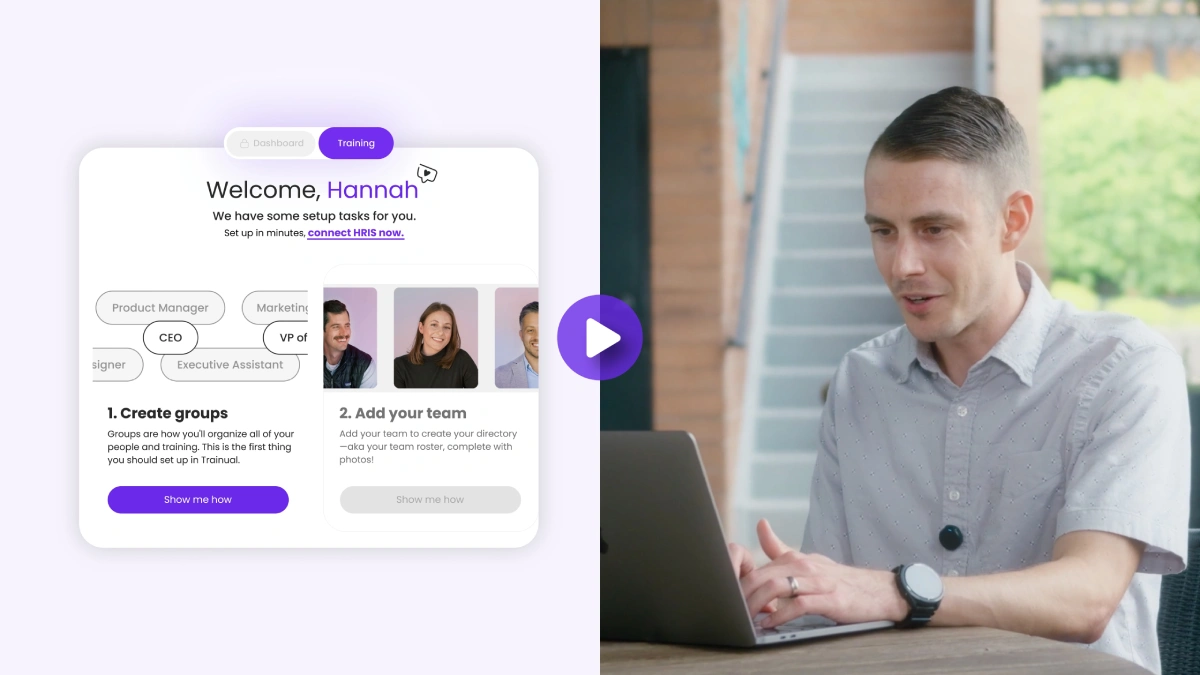
Trainual's AI-powered SOP creation drops a process from "blank page" to "first draft" in minutes. Combined with screen recording, voice-to-text, and importing your existing docs, the documentation effort shifts from "I need to carve out a Friday" to "I'll capture this while I'm doing it once anyway."
2. Make every team member self-sufficient — without lowering your standards
The fear most founders have isn't documenting the work. It's that documenting the work means accepting a lower standard than the one in your head. Won't the team take shortcuts? Won't they miss the nuance?
Good training software solves this with three structural features:
- Role-based assignment. Your operations lead doesn't need to see your customer support SOPs, and vice versa. Trainual's role chart ensures every person sees exactly what's relevant to their job — your standards, not a watered-down generic version.
- AI-powered knowledge search. Every team member can ask the platform a question about how your company does something and get the answer pulled directly from your documentation — with a link back to the source. They stop asking you. They start asking the system that has your knowledge in it.
- Sign-offs and accountability. Every SOP and policy can require an e-signature. You know who's read the playbook and who hasn't. The standards aren't aspirational — they're tracked.
3. Connect training to roles, responsibilities, and ownership
Most founders don't really have a problem with training in isolation. They have a problem with the whole system: who owns what, what happens when ownership changes, who's accountable for which outcomes. Training software that solves the founder's problem doesn't sit in a silo — it connects to the role chart, the organizational chart, and the delegation system so that when you hand off a responsibility, the training, ownership, and accountability all transfer in one move.
This is what separates Trainual from a course-based LMS. The training is the entry point into a connected system — not a deliverable on its own.
4. Hold up when you're not paying attention
Founders' time is the scarcest resource at the company. If keeping the training platform current requires the founder's daily attention, the platform is making the bottleneck worse, not better. The right tool has built-in mechanisms for keeping content fresh without you driving every update:
- Inline content flagging — when a team member spots something out of date, they flag it inside the document. The owner gets notified and updates it.
- Verification reminders — content owners get scheduled prompts to review their material on a quarterly cadence, even if you never look.
- Version history — every change is captured, attributed, and reversible without you stepping in.
You should be able to take a two-week vacation and come back to a system that's still accurate.
5. Show you what's working without forcing you to dig for it
The whole point is freeing your time. So the reporting layer needs to surface the things you truly care about — completion rates by role, where the team is getting stuck, which content is going stale — without requiring you to live in the dashboard. The best founder-focused tools push the right data to you (weekly digest, completion exceptions, audit-ready reports) so you stay in the strategic seat instead of the operational one.
What founders typically get wrong when they try to fix this
The pattern is so consistent we can almost predict it. Founders who try to escape the bottleneck without the right system tend to make the same five mistakes.
Mistake #1: Trying to document everything in one heroic sprint
You finally block off a weekend. You write 40 documents. You feel triumphant. By Tuesday, three of them are out of date. By Friday, your team has reverted to asking you questions because the documents aren't searchable, aren't connected to roles, and aren't part of how anyone works in practice. The fix: document gradually, through the work, and put the documents in a system that's connected to how the team operates. Don't sprint. Build the habit, like the founder of Ironsmith Fire who dedicates his first hour every morning to writing down what he answered the previous day.
Mistake #2: Hiring a "head of operations" before fixing the underlying knowledge problem
You hire a head of ops to take the load off. They're great. They build processes, document workflows, set up systems. But they're working from your scattered knowledge, and a year later you realize: now there are two people the company depends on, not just you. The fix: the system has to exist before the person. The head of ops should walk into a documented operating system, not be tasked with creating one from scratch. The right training and operations platform is the system they walk into.
Mistake #3: Choosing software optimized for a different problem
You buy an LMS because someone told you growing companies need an LMS. But what you really needed was a place to document how your company runs. The LMS is optimized for course completions; you needed an operating system for your team's knowledge. Six months later you're back where you started, with $30,000 in software costs. The fix: match the tool to the actual problem. If your problem is "the company runs on me," you need training software designed for operational training — not a course-delivery LMS. We break down the difference in 5 signs you need a modern LMS, not an enterprise one.
Mistake #4: Documenting the work without documenting the "why"
Your SOPs explain what to do, step by step. But the new hire still keeps escalating to you because they hit a situation that doesn't match the SOP exactly, and they don't know how to apply judgment. The fix: every SOP needs a "why" section — the principle the procedure is protecting. When the team understands the why, they can navigate edge cases without escalating. This is exactly the structure Scott Payne built into his Chick-fil-A operator playbook before opening — every role had seven sections including "the why of the role" before the procedural detail.
Mistake #5: Not modeling the behavior you want from the team
If the founder doesn't use the system, the team doesn't use the system. If the founder still answers every question directly instead of redirecting to the documented answer, the team learns that asking the founder is the path of least resistance. The fix: founders have to redirect, not respond. When a team member asks you something already documented, the right answer is "search for X in the platform — and ping me if it's not clear." Every time you redirect, you reinforce the behavior. Every time you just answer, you reinforce the bottleneck. The psychology of training adoption goes deeper into why this works.
What 30 days of getting out of the work looks like
You don't need a six-month transformation. You need a 30-day momentum sprint that proves the system can work, then a system that compounds from there.
Week 1: Audit the bottleneck
Pull up your last 30 days of Slack DMs, emails, and meetings. Tag every interaction by category: routine question you've answered before, a new decision that needs you, a strategic conversation, a status update. Most founders find 60-70% of their interaction load is routine. That's your documentation backlog, ranked by frequency.
Week 2: Document the top 5
Pick the five most-frequent routine questions or workflows. Document them — not perfectly, just usably. Use AI to draft, screen recordings to capture nuance, and existing chat threads as raw material. Drop them into a system the team can search.
Week 3: Redirect, don't respond
For the next week, when anyone asks you a question that's been documented, the only acceptable answer is: "I just put that in the platform — search for X." No exceptions. Yes, it feels like extra work the first time. By the end of the week, the team has rewired their default behavior.
Week 4: Measure and expand
How many fewer questions did you field? How many things did you decide vs. how many things were decided autonomously? You should already see a meaningful drop. Expand the documentation to the next 5-10 workflows. Repeat the redirect-don't-respond loop.
Month 2 and beyond
By month 3, you should be spending meaningfully less time being the help desk and meaningfully more time on strategy. The compounding kicks in around then — every documented workflow takes a question off your plate forever, not just once.
Quick wins to start this week
Quick win #1: Schedule your "knowledge dump" hour
Block one hour, recurring weekly. During that hour, document one thing you answered three or more times in the past week. By the end of a quarter, that's 13 documented workflows you'll never answer again. The founder of Ironsmith Fire built this exact habit into his morning — 8am to 9am, every day.
Quick win #2: Audit your interrupters
For one week, track every interruption by category: routine question, new decision, strategic conversation, status update. The categories that dominate are the categories you have a documentation problem in.
Quick win #3: Pick the one document that would buy you back the most time
Most founders can name it instantly. The customer escalation playbook. The new hire onboarding plan. The quarterly review process. Document that one this week. Don't try for ten.
Quick win #4: Have your most senior hire review and verify
Once you have a draft, hand it to your most senior team member. Their feedback tells you whether you've captured the nuance — and they often catch the unstated rules you assumed everyone already knew.
Quick win #5: Set the "search before asking" rule
Tell the team explicitly: from this date forward, the expectation is to search the platform first, then ask. This is the cultural shift that makes the documentation pay off. Without it, you're just creating a parallel knowledge system nobody uses.
How to measure that the bottleneck is breaking
Tracking founder time recovery is how you know the system is working — not in feelings, in data.
1. Weekly hours on routine vs. strategic work
Audit your calendar quarterly. Set a baseline. Track the trendline. The goal is shifting from majority-routine to majority-strategic.
2. Repeat-question volume
Log how often the same question comes back from the team. A falling number means the team is using the system — and you're not.
3. New hire ramp speed (without your direct involvement)
Track time-to-productivity on new hires. The benchmark isn't "did they ramp" — it's "did they ramp without requiring meaningful founder time."
4. Vacation tolerance
The blunt test. Take a two-week vacation. Don't check Slack. What broke? What didn't? The gap between "I worry about it breaking" and "it does break" tells you exactly where the system is and isn't holding up.
5. Team decision velocity
How often does a decision wait on you that didn't need to? Each one is a missing SOP, a missing policy, or missing role clarity. Track the count. Drive it down.
What founder-stage companies have built (and what you can copy)
The pattern repeats across every founder-led company that's broken the bottleneck:
- Trailstone Insurance cut onboarding from 3-5 days to 1.5 days, replaced their scattered Google Drive, and scaled across multiple states — with the founder still building the playbook, but the playbook now running the company.
- ProTec Building Services built 600+ SOPs across 9 offices, with the founder going through training himself and a culture of continuous improvement that runs without him in every loop.
- Ironsmith Fire's founder Justin Smith writes SOPs for the first hour of every workday — 23 years of life-safety expertise being downloaded into a system the company will run on long after he's not in it daily.
- Sterling, a fully remote tax and accounting firm, doubled team size by building a cloud-first operating system that lets the founder focus on growth instead of training every new tax preparer personally.
You can see this pattern across 5 companies with measurable Trainual ROI. Different industries, different sizes — same shift: founder knowledge becomes company knowledge.
Stop being the bottleneck. Start running the company.
The hard truth about scaling a company past its founder-driven phase: you cannot solve the bottleneck through more discipline, better hiring, or working harder. You solve it by building a system that holds the company's knowledge — instead of holding it in your head.
Trainual was built for exactly this transition. Document the way your company really runs. Connect every SOP to the role responsible for it. Train new hires through a structured onboarding system that doesn't require you in every loop. Use AI-powered search so your team can find the answer instead of asking you. And delegate with confidence, knowing the person stepping in has the playbook you'd want them to have.
The founders who break the bottleneck don't work harder. They build the system once — and then run the company they always wanted, instead of running every loop in it.
Ready to see what's possible?
👉 Book a demo and see how Trainual helps founders extract themselves from the help-desk loop and build a company that runs on a system instead of running on them.
Want proof?
👉 Browse customer stories from founders who built operating systems instead of staying the bottleneck.
Frequently asked questions
Is Trainual right for early-stage founders, or is it for bigger companies?
Trainual is designed for founders running companies from 25 employees on up — the stage where the founder bottleneck becomes acute and stays that way as you scale. Earlier than that, you usually don't need software; you need a few documented procedures in any tool. Once you cross 25 employees, the founder bottleneck is the single biggest threat to your growth — and that's where Trainual is built to help.
How is this different from Notion or Confluence?
Notion and Confluence are wikis — great for static information, but missing the structural features that solve the founder bottleneck. They don't have role-based assignment (everyone sees everything), don't have completion tracking (you can't see who's read what), don't have e-signatures (no compliance trail), and don't connect to org structure or delegation. They're storage; Trainual is an operating system. We've documented 5 companies that replaced these exact tools with Trainual.
Can I use this if I'm not technical?
Yes. The platform was designed for founders and operators, not IT departments. Most founders have their first SOPs documented and a team onboarded within a week. The AI assist makes documenting feel like a conversation, not a writing project.
What if I don't have time to document anything?
That's the founder bottleneck talking. The reality: every routine question you answer is documentation deferred. The fix isn't finding three uninterrupted days to write — it's documenting through the work, capturing the answer the next time someone asks instead of just typing the reply. Most founders find that 15 minutes a day, sustained for a quarter, breaks the bottleneck.
Is this just for founders, or for the whole team?
The whole team uses it daily — that's the point. The founder builds and maintains; the team executes from it. New hires onboard through it. Managers run their teams through it. The platform becomes the company's operating system, with every role connected to the procedures and policies they need.
How long until I see results?
Most founders report meaningful interrupt reduction within 30 days of going live, with significant time recovery within 90. The pattern in 5 companies cutting onboarding time shows similar timelines — measurable change within the first quarter, compounding from there.
What if my team resists using a new tool?
This is the most common founder concern, and it's solvable. Two pieces have to be true: the founder has to use it themselves (and redirect questions to it instead of answering them directly), and the platform has to be searchable and mobile-accessible so finding the answer is faster than asking. Get both right, and adoption follows. We dig into the psychology of training adoption for the deeper "why."