





Ever sit through a demo of an enterprise LMS, watching a sales rep click through 47 modules — SCORM 2004 compliance reporting, ILT session management, certification expiration workflows, multi-tier admin permissions — and realize halfway through that 80% of what they're showing you is for a company that has nothing in common with yours? You're a 75-person company. You hire 10 people a quarter. You need new hires to onboard fast, find SOPs without asking your senior people, and stay current when policies change. Instead, you're being pitched a platform built for a Fortune 500 with a 50-person L&D department and 12 federal compliance frameworks. By the end of the demo, you're not closer to a decision — you're more confused, more overwhelmed, and quietly wondering if any of this software is built for companies like yours.
That's not a buyer problem. That's an LMS market problem. The category was built around enterprise compliance training in the 2010s, and most platforms still operate like it's 2015 — even though the way growing companies train, onboard, and operate has changed dramatically. The old-school LMS was designed for the L&D department managing thousands of employees through annual courses. The modern LMS is designed for a 50-person company that needs to ramp a new hire by Friday.
The data backs it up. The global LMS market is projected to reach $30.51 billion in 2026 and grow to nearly $54.86 billion by 2031. 83% of organizations currently leverage an LMS — but 37% are actively planning to replace the one they have. 52% of LMS users cite poor integration with the rest of their stack as their biggest dissatisfaction. The market is huge, but the fit gap between enterprise platforms and growing companies is huger.
This guide walks through the 5 signs you've outgrown the enterprise LMS model — and what a modern LMS for growing teams really looks like.
What "enterprise LMS" really means
Before getting into the signs, it helps to understand what we mean by "enterprise LMS" — because the term is often used loosely.
An enterprise LMS is a platform built around the assumptions of large companies: a dedicated L&D department, thousands of employees, complex compliance requirements, established training infrastructure, and the budget to support all of it. Common names in the category include SAP SuccessFactors, Cornerstone OnDemand, Workday Learning, Saba Cloud, and similar platforms. They're built for compliance training, certification tracking, formal courseware, ILT (instructor-led training) management, and SCORM-tracked completion at scale.
That model works — for the company it was designed for. The problem is that growing companies (25-500 employees) have inherited the same software model without inheriting the same problem to solve. A 75-person company doesn't have a dedicated L&D department. It doesn't run annual compliance courses for 5,000 employees. It doesn't need ILT session management. What it needs is a platform that helps a senior person document how the work gets done, gets new hires ramped up, and keeps the team current when things change.
That's a different problem. That's what a modern LMS solves.
Modern LMS vs. enterprise LMS at a glance
The pattern is clear. Enterprise LMS is optimized for scale and compliance. Modern LMS is optimized for velocity and clarity. Different problems. Different solutions. Picking the wrong one means paying for a platform built for someone else's company.
Sign #1: You're paying for features no one uses
The trap. You bought an enterprise LMS during a growth spurt because it had every feature on the comparison spreadsheet. Two years in, you realize 80% of those features are sitting unused. Your team uses the platform for onboarding videos, basic SOPs, and the occasional compliance course. The advanced certification workflows, the gamification engine, the AI-driven adaptive learning paths, the LXP discovery experience — all of it is dormant. But you're still paying enterprise prices for the full suite.
Why it happens. Enterprise LMSs were sold on feature breadth. Buyers said "we might need it eventually" and signed a multi-year contract. The features never get adopted because growing teams don't have the L&D bandwidth to roll them out. So the company pays for capabilities that exist only in the admin panel.
The data. Among 560 LMS platforms analyzed, only 68 were identified as AI-leaders despite over 80% of buyers reporting demand for embedded AI features. The gap between what LMSs claim and what they deliver is significant. Growing teams pay for a feature spreadsheet they'll never fully use.
The modern LMS approach. Build for the 5-10 things growing teams genuinely need: documentation, role-based content, AI search, structured onboarding, version history, mobile access. Skip the rest. The price comes down. The complexity comes down. The platform finally gets used.
Sign #2: Onboarding the LMS takes longer than the work itself
The trap. You bought an enterprise LMS in Q1. It's now Q3 and you're still in implementation. Your IT team has been on weekly calls with the vendor. Your HR lead has spent three months mapping legacy training content. Your senior team has been pulled into "training the trainers" sessions. The platform isn't even live yet, and you've already spent more time on the LMS rollout than you've spent training the people the LMS is supposed to help.
Why it happens. Enterprise LMSs are built for organizations with dedicated implementation teams and existing L&D infrastructure. The deployment assumes you have months of internal bandwidth to spare. Growing companies don't. The result is implementation that drags on, training content that never gets migrated, and a platform that goes live in a half-finished state.
The data. Industry analysts consistently flag implementation timelines as a top friction point. 37% of organizations are actively planning to replace their current LMS — and a major reason is that the platform never fully landed in the first place.
The modern LMS approach. Self-serve setup. Content imports that take hours, not months. Pre-built templates for common roles and processes. Implementation that means "your team starts using it next week," not "your team starts using it next quarter."
Sign #3: Your team avoids the LMS instead of using it
The trap. Your enterprise LMS is technically deployed. Your team has accounts. The compliance courses are loaded. But when an actual question comes up — how do we handle this customer scenario, where's the SOP for X — nobody opens the LMS. They Slack a senior team member instead. The platform exists but doesn't get used. The information stays in people's heads, just like before.
Why it happens. Enterprise LMSs were built for formal learning — completing courses, passing assessments, generating compliance reports. They weren't built for the moment of work. The interface is dense, the navigation is confusing, the search is weak, and the content lives in a structure that makes sense to the L&D admin but not to the team member trying to find an answer in 10 seconds.
The data. Ease of use is the #1 reason buyers cite when reviewing LMS platforms — and the most common complaint is that the LMS feels designed for compliance reporting, not for the team. When a platform isn't fast enough to be useful in the moment, the team stops opening it.
The modern LMS approach. Design for the moment of work, not the moment of compliance. Searchable content that returns answers, not modules. Mobile access that works during a customer call. Role-based content that surfaces what's relevant. The platform gets used because it's faster than asking a colleague.
Sign #4: Your IT team is involved in every content update
The trap. A policy changes. The new policy needs to push to every relevant team member. You go to update the LMS — and realize the content is locked behind a SCORM authoring tool that only your IT team or instructional designer can edit. So you submit a ticket. The ticket sits for two weeks. By the time the policy update is live in the LMS, your team has been operating on the old version for half a month.
Why it happens. Enterprise LMSs separated content authoring from content delivery for good reasons in 2010 — when training content was expensive, formal, and infrequent. But the side effect is that updating content became a multi-step, IT-dependent process. For growing companies where policies, products, and processes change constantly, that lag is unacceptable.
The data. 60% reduction in admin costs is one of the most-cited benefits of replacing legacy LMS systems with modern alternatives. The hidden cost of an LMS isn't the license — it's the IT time spent maintaining content nobody can update on their own.
The modern LMS approach. Content authored and edited directly in the platform by the people who own the work. AI-powered drafting so updates take minutes, not hours. Version history that captures every change automatically. The IT team stops being the content-update bottleneck.
Sign #5: Compliance is the only reason anyone logs in
The trap. You audit your LMS usage. The data is clear: the platform gets used heavily once a year — when annual compliance training is due — and barely used the other 51 weeks. Sexual harassment training, OSHA refreshers, security awareness courses — those get done. Everything else? Crickets. Which means you're paying for a platform that operates like a compliance kiosk, not a training system.
Why it happens. Enterprise LMSs were originally built for compliance. Most still are, even when they market themselves as "modern." The product roadmap is shaped by what regulated industries need: audit trails, certification expiration tracking, multi-jurisdiction compliance frameworks. Onboarding, SOPs, role-based training, and knowledge sharing are afterthoughts.
The data. Compliance is the #1 driver of LMS adoption, cited by 73% of organizations. That's the legacy. But growing teams need way more than compliance — they need onboarding that ramps people up, SOPs that get used daily, and knowledge sharing that prevents senior employees from being the help desk.
The modern LMS approach. Compliance as one feature, not the whole platform. The same system handles new hire onboarding, SOPs, role-based training, AI-powered knowledge search, and yes — compliance. The team uses it daily, not annually, because it solves daily problems.
What a modern LMS looks like
A modern LMS is built around how growing companies really work — not how Fortune 500 L&D departments operate. It looks something like this:
- Documentation lives in one searchable platform — not scattered across drives, wikis, and Slack threads
- AI-powered SOP creation turns rough notes or recordings into structured docs in minutes
- AI search returns answers to natural-language questions, not lists of matching modules
- Role-based content assignment automatically pushes the right content to the right team members
- Mobile-native access so field, remote, and traveling team members can use it from any device
- Version history captures every change with a timestamp — no IT ticket required
- HRIS, Slack, and SSO integrations out of the box, not as a six-month implementation project
- Structured onboarding paths that get new hires productive in weeks, not months
- Compliance built in — not as the only purpose, but as one of many
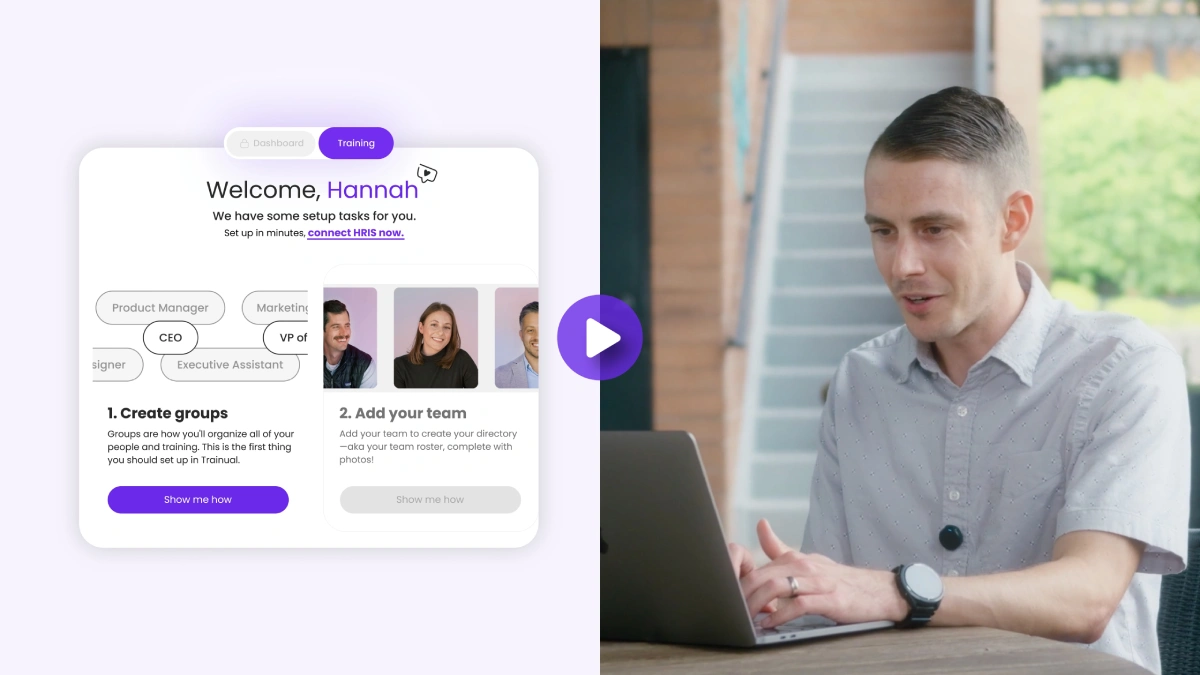
That's Trainual. It's an LMS, but built for your company and team.
What to look for when choosing an LMS as a growing company
If you're shopping for an LMS right now, here are five buyer criteria that matter more than feature spreadsheets.
1. Does it deploy in days or months?
Implementation time tells you everything. If the answer is "3-6 months with our implementation team," you're looking at an enterprise LMS. If the answer is "you can be up and running this week," you're looking at a modern one. Neither is wrong — but only one fits a growing company.
2. Can the people who own the work edit the content?
Open the demo and ask: who can edit a policy or SOP after launch? If the answer involves "your admin" or "your instructional designer," the content will go stale. If the answer is "the senior employee who owns that work," the content stays current.
3. Is search fast enough to use during a customer call?
In the demo, ask the rep to search for a real piece of content — a specific policy, a process, an FAQ. Watch what happens. If they navigate through a folder structure to find it, the platform isn't built for the moment of work. If they type a natural-language question and get an answer, it is.
4. Does it work on mobile?
If your team has any field, remote, or distributed component, mobile isn't optional. Open the platform on your phone during the demo. If it feels like a desktop site shrunk down, the platform wasn't designed for how growing teams really work.
5. What's the pricing transparency?
Modern LMS vendors publish pricing. Enterprise LMS vendors don't — and they price by negotiation, which means the price depends on how much they think you can pay. If you can't see the pricing on the website, that tells you who the platform was built for.
Frequently asked questions
What's the difference between an LMS and an enterprise LMS?
An LMS is any learning management system. An enterprise LMS is a specific category of LMS built for large organizations with dedicated L&D departments — typically focused on compliance training, certification tracking, and formal courseware at scale. Modern LMS platforms like Trainual serve a different category: growing companies (25-500 employees) that need onboarding, SOPs, role-based training, and knowledge sharing in one platform — without the implementation burden or feature bloat of enterprise tools.
How do I know if I've outgrown my current LMS?
The signs are usually obvious once you look. You're paying for features no one uses. Your team avoids the platform instead of using it. Your IT team is the bottleneck for every content update. Implementation took longer than expected and never fully finished. The platform gets used annually for compliance and ignored the rest of the year. Any one of these is a yellow flag. Multiple is a red flag.
Is Trainual an enterprise LMS?
No. Trainual is a modern LMS purpose-built for growing companies — typically 25-500 employees. It includes the core capabilities growing teams use day-to-day (documentation, AI-powered SOP creation, role-based training, mobile access, integrations) without the enterprise-level complexity, implementation time, or pricing of platforms like SAP SuccessFactors or Cornerstone. Trainual is for the company that wants an LMS to work for the team — not for the L&D department running it.
What if my company is going to grow into enterprise size eventually?
Two things to know. First, modern LMS platforms scale with you — Trainual works for 25-person companies and continues to work for companies that grow into 500+. Second, the enterprise LMS model isn't necessarily where you want to land anyway. Many large companies are now actively replacing legacy enterprise LMSs with modern alternatives because the old model — heavy implementation, IT-dependent updates, compliance-only usage — is broken even at scale. Pick the platform that fits how you operate today, not the one that fits where you might be in 10 years.
How much should a modern LMS cost?
A modern LMS for growing teams should have transparent, accessible pricing — typically published on the website with annual or monthly tiers. Enterprise LMS pricing is opaque, negotiated, and often six-figure annual contracts. The price gap between modern and enterprise LMS is significant — but the value gap is even bigger when you factor in implementation time, internal bandwidth, and the features you'll use day-to-day.
Pick the LMS built for company and team
Most LMS shopping is some version of the same exhausting story. You sit through enterprise demos, get pitched compliance reporting workflows, and walk away wondering if any of this software is built for companies like yours. The answer is yes — but it's not the enterprise LMS. It's the modern one.
Trainual is the modern LMS for growing companies. Documentation, AI-powered SOP creation, role-based training, mobile access, version history, integrations — all in one platform built for how 25-500 person companies operate. Not a Fortune 500 L&D suite. Not a compliance reporting kiosk. The system your team will use, every day, because it solves the problems you have.
If you're paying for features no one uses, watching your team avoid the LMS, or waiting weeks for IT to update content — you've outgrown the enterprise model. The good news: the modern model is here, it works, and it's built for you.
Ready to see how a modern LMS works?
👉 Book a demo and see how Trainual is built for growing teams — not enterprises.
Want a sneak peek?
👉 Read customer stories from growing companies who replaced their enterprise LMS with something that fits.