





Picture this: it's a Tuesday in late September. Your senior operations lead — the one who's been at the company eight years, knows every vendor by first name, can quote contract terms from memory, and has personally trained half the team — sends a message asking for a 1-on-1. They tell you they've accepted an offer. Their last day is in two weeks. You congratulate them genuinely. You walk back to your desk. And then it hits you. They don't have anything documented. Eight years of how the company works lives inside their head. Two weeks isn't enough. You don't even know what you don't know.
That's the scenario every growing company is one resignation away from. Most never see it coming. The senior employee is dependable. They've always been there. The institutional knowledge they hold is invisible until it's gone. And then suddenly, three months after their last day, the company is still discovering things they used to handle that nobody knew they handled.
This guide walks through what happens when a senior employee quits without documenting anything — the cascade of operational, financial, and cultural costs — and what to do if you're in that situation right now.
What's really walking out the door
Three layers of knowledge leave with a senior employee. Each one creates different problems.
Most companies only think about the first layer. The second and third are often more expensive, and they're invisible until the senior employee is gone.
The cascade: what the first 90 days look like
Three phases. Each one compounds the cost of the previous.
Phase 1: Days 1-30 — operational gaps emerge
In the first month after the senior employee leaves, the team discovers gaps daily.
- A vendor calls about a contract renewal nobody knew was coming up
- A monthly process the senior employee ran doesn't get done because nobody knew it was their job
- A client escalation needs context the senior employee had — and the inheritor has to start from zero
- The team realizes the senior employee was a bottleneck for several decisions, and now those decisions stall
Most companies absorb this phase. The team rallies. People work overtime. Things get done.
Phase 2: Days 31-60 — knowledge gaps surface
In the second month, the gaps shift from operational to knowledge-based.
- A question comes up about why a specific process exists. Nobody knows.
- A client reference falls through because the senior employee was the relationship owner
- The new hire who was supposed to be ramped up by the senior employee is now ramping under someone else, slower
- Decisions that the senior employee used to make autonomously now require multiple meetings
The team starts to feel the cost. Senior employees pull longer hours. Junior employees feel under-supported. The work is getting done — but more slowly, more painfully, and less consistently.
Phase 3: Days 61-90 — strategic gaps appear
By month three, the gaps have moved upstream. Strategic decisions that depended on the senior employee's institutional knowledge are now being made with incomplete information.
- A vendor renegotiation goes badly because nobody had the full history
- A product decision gets revisited because the team can't remember why the original decision was made
- A new hire who was supposed to inherit a senior process is now redefining it from scratch — usually less effectively
- A client relationship that was personality-driven shows signs of erosion
By 90 days, the company has typically absorbed most of the operational cost. The strategic cost is just starting to show.
Why most companies don't see this coming
Three reasons the cascade catches companies off guard.
Senior employees feel permanent. They've been there for years. They show up reliably. The mental model is "they'll be here when we need them." Until they aren't.
Knowledge is invisible until it's gone. The company can't see what's in someone's head. The cost of losing that knowledge is impossible to estimate accurately. So nobody invests in capturing it.
Documentation feels lower priority than the work. Senior employees are senior because they're producing. Asking them to stop producing for a week to document what they know feels like trading something tangible for something abstract. Until the resignation hits.
The companies that solve this don't wait. They build documentation into the way work happens — not as a special project, but as part of how senior employees operate.
What to do if you're in this situation right now
If a senior employee just resigned and nothing is documented, here's the playbook for the next two weeks.
Day 1: Triage what's at risk
In the first 24-48 hours after the resignation, run a triage:
- List every recurring process the senior employee owns
- List every vendor or client relationship they hold
- List every recent decision they've made or are mid-stream on
- List every team member they're actively training or mentoring
This is your triage list. Don't try to capture everything. Prioritize by risk: what hurts most if it's lost?
Days 2-3: Block their calendar for documentation
Talk to the senior employee. Be direct: their last two weeks are about transferring knowledge, not finishing in-flight work. Block 4-6 hours per day on their calendar specifically for documentation. Reframe their job for the next two weeks — they're a knowledge transfer specialist, not an operator.
Most senior employees will agree to this if asked clearly. They don't want their work to fall apart either.
Days 4-10: Capture, don't write
The temptation is to ask the senior employee to write SOPs. Don't. Writing is the slowest possible way to capture knowledge.
Instead, capture by recording. For each item on the triage list:
- Block 30 minutes
- Record the senior employee walking through the process, decision, or relationship
- They explain it as if to a new employee — including context, edge cases, history
- The recording lives in your documentation platform
Recording is faster than writing, captures tacit knowledge naturally, and creates a permanent asset even before formal documentation exists.
Days 11-12: AI-draft the structured versions
Take the recordings and run them through AI-powered SOP creation. The AI structures each recording into a first-draft SOP. You're not getting publish-ready content yet — you're getting structured starting points for review.
Days 13-14: Review and verify
The senior employee reviews each AI-drafted SOP. They add what AI missed, fix what's inaccurate, and approve.
Then a second person — ideally the inheritor of the work — reads each one and tries to mentally execute it. Where do they get confused? Those are the gaps the senior employee needs to close before they leave.
After day 14: Maintain the system
The senior employee is gone. The documentation isn't done. Maintenance has to happen for it to stay alive:
- Each SOP gets an ongoing owner (the inheritor)
- Quarterly review for accuracy
- Version history tracks every change
- New context gets added as the inheritor learns more
The two weeks of crisis documentation isn't the end. It's the start of the documentation system that should have existed all along.
How rushed documentation compares to ongoing documentation
Two ways companies handle a senior employee's departure.
The pattern is clear. Crisis documentation captures most of the surface-level knowledge but misses the contextual layer. Ongoing documentation captures all three layers, lives in the system, and survives any single departure.
Common mistakes when handling a senior employee's departure
Mistake #1: Asking them to write SOPs
The fix: Recording is faster, captures more context, and creates a permanent asset even before formal documentation. AI structures the recording into draft SOPs.
Mistake #2: Trying to document everything
The fix: Triage by risk. What hurts most if it's lost? Document those first. Most things on the "everything" list don't matter as much as you think.
Mistake #3: Letting them keep doing in-flight work for two weeks
The fix: Reframe their last two weeks as knowledge transfer. The in-flight work matters less than the knowledge transfer if the in-flight work is going to need to be redone anyway by someone without context.
Mistake #4: Skipping the verification step
The fix: A second person — ideally the inheritor — verifies every SOP before the senior employee leaves. Gaps surface immediately when there's still time to close them.
Mistake #5: Treating it as a one-time event
The fix: The two weeks of documentation is the start, not the end. Build the maintenance loop. Every SOP gets an ongoing owner. The system stays alive.
What rolling this out should look like (preventatively)
The best version of this playbook is one you never have to run. Build the system before someone resigns.
Week 1: Identify your senior employees with the most institutional knowledge
These are the people whose departure would hurt most. Score by tenure, role criticality, and how many junior employees depend on them.
Week 2: Capture their highest-risk processes
Block 30 minutes per process. Record the walkthrough. Use AI-powered SOP creation to draft. Review and refine.
Week 3: Publish, assign, and verify
Move the SOPs into your documentation platform. Assign by role. Have second-person verification.
Week 4: Set the cadence
Monthly: 30 minutes of new documentation per senior employee. Quarterly: review existing SOPs for accuracy. Annual: deep audit of what's covered.
Month 2 and beyond
The documentation system is part of how senior employees work. The next resignation is a non-event because the knowledge is already captured.
Quick wins you can implement this week
Quick win #1: Identify your top 3 institutional knowledge holders
The 3 people whose departure would hurt most. Document them first.
Quick win #2: Capture one process from your most senior employee
Block 30 minutes. Record. AI-draft. Review. The first one is the hardest.
Quick win #3: Set up the documentation platform
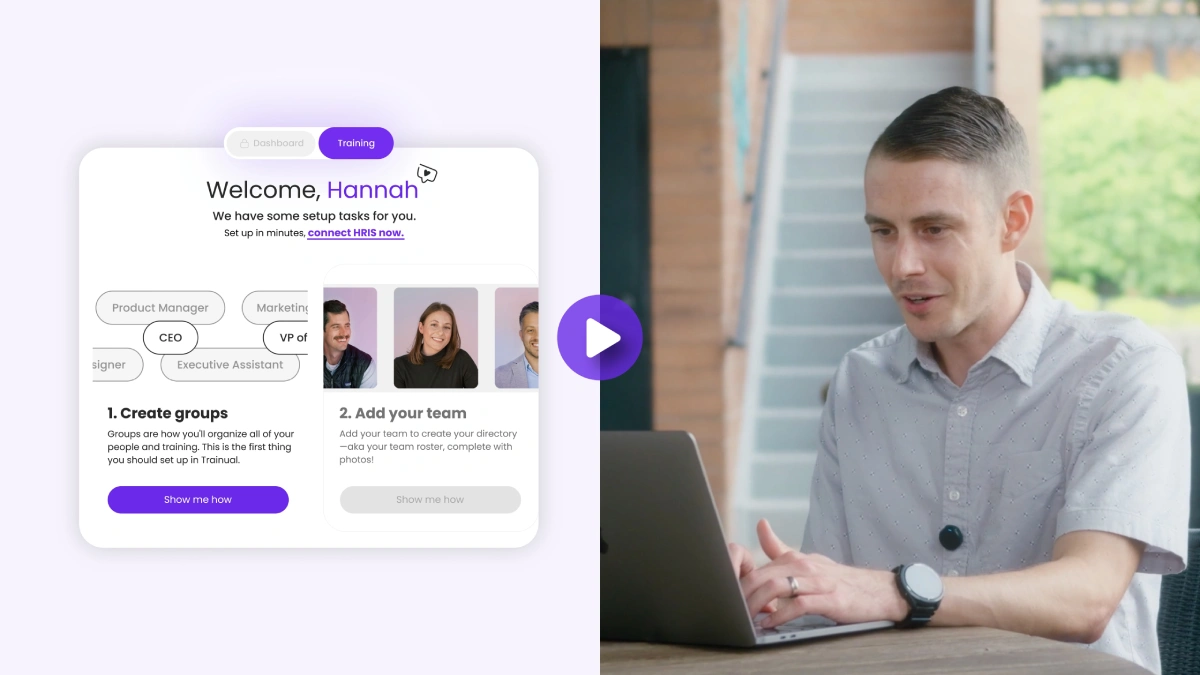
If you don't have a single source of truth for SOPs, get one. Trainual gives you AI-powered SOP creation, role-based assignment, and version history.
Quick win #4: Add documentation to senior employee 1-on-1s
One question per 1-on-1: "What did you document this week?" The cadence is what makes it stick.
Quick win #5: Run the triage exercise on your most critical role
If they resigned tomorrow, what would you lose? List it. That's your priority documentation list.
How to measure success
1. Coverage on critical roles
What percentage of your most senior employees have documented their high-risk processes? Aim for 100% within two quarters.
2. Time from resignation to recovered productivity
When a senior employee leaves, how long until the team is back to baseline productivity? Falling = documentation is working.
3. Knowledge gap incident rate
How many "we don't know how this works" incidents happen in the 90 days after a senior departure? Falling toward zero is the goal.
4. Documentation freshness
What percentage of senior employee documentation has been reviewed or updated in the last quarter?
5. Inheritor confidence at 30 days
When someone inherits a process, how confident are they in their first 30 days? The documentation is doing its job if they're confident, slow if they're not.
Frequently asked questions
What should I do in the first 48 hours after a senior employee resigns?
Triage. List every recurring process they own, every relationship they hold, every recent decision they've made or are mid-stream on, and every team member they're training. That's your priority list. Don't try to capture everything — prioritize by what hurts most if it's lost.
Should I ask the senior employee to write SOPs?
No. Writing is the slowest way to capture knowledge. Have them record walkthroughs instead. Recording is 5-10x faster, captures tacit knowledge naturally, and creates a permanent asset. Use AI-powered SOP creation to structure the recordings into drafts.
How much of their last two weeks should be documentation?
Most of it. Reframe their last two weeks as knowledge transfer, not finishing in-flight work. Block 4-6 hours per day for documentation specifically. The in-flight work matters less than the knowledge transfer.
What if they don't want to spend their last two weeks documenting?
Most senior employees will agree if asked clearly. They don't want the work to fall apart either. If they refuse, the company has bigger problems — but in that case, prioritize the highest-risk items and capture what you can.
How do I prevent this in the future?
Build documentation into the way senior employees work. Monthly: 30 minutes of new documentation per senior employee. Quarterly: review for accuracy. Annual: deep audit. The next resignation becomes a non-event because the knowledge is already captured.
Don't let knowledge walk out the door.
The hardest version of this scenario is the preventable one. A senior employee with eight years of institutional knowledge resigns. The company has two weeks. Most of what they know never gets captured. Three months later, the company is still recovering.
The fix isn't a heroic two-week documentation sprint. It's building documentation into how senior employees operate, every month, before any resignation hits.
Trainual gives growing companies the operating system to do that. AI-powered SOP creation so senior employees can document at speed. Role-based content assignment so knowledge connects to the right people. Version history so documentation stays alive. Searchable knowledge base so the team can find answers in seconds.
Ready to see how Trainual works?
👉 Book a demo and see how Trainual prevents knowledge from walking out the door.
Want a sneak peek?
👉 Read customer stories from teams who've protected their institutional knowledge with Trainual.