




Your team isn't ignoring your processes because they're lazy. They're ignoring them because their brains are working exactly as designed.
That's the uncomfortable truth behind every manager who's ever wondered why employees keep asking the same questions, skipping the documentation, or defaulting to the loudest voice in the room instead of the system you spent weeks building. It's not a motivation problem. It's not a culture problem. It's a habit problem — and there's a century of psychology that explains exactly why it happens and, more importantly, how to fix it.
So let's talk about the psychology of employee training: what's actually happening in your team's heads, and how you can use it to your advantage.
First, understand the habit loop
Charles Duhigg, in The Power of Habit, introduced a framework that should be required reading for every manager. He calls it the habit loop: a three-part neurological cycle that governs virtually every behavior a person repeats.
Here's how it works:
- Cue — A trigger that tells the brain to initiate a behavior
- Routine — The behavior itself
- Reward — The outcome that reinforces the loop
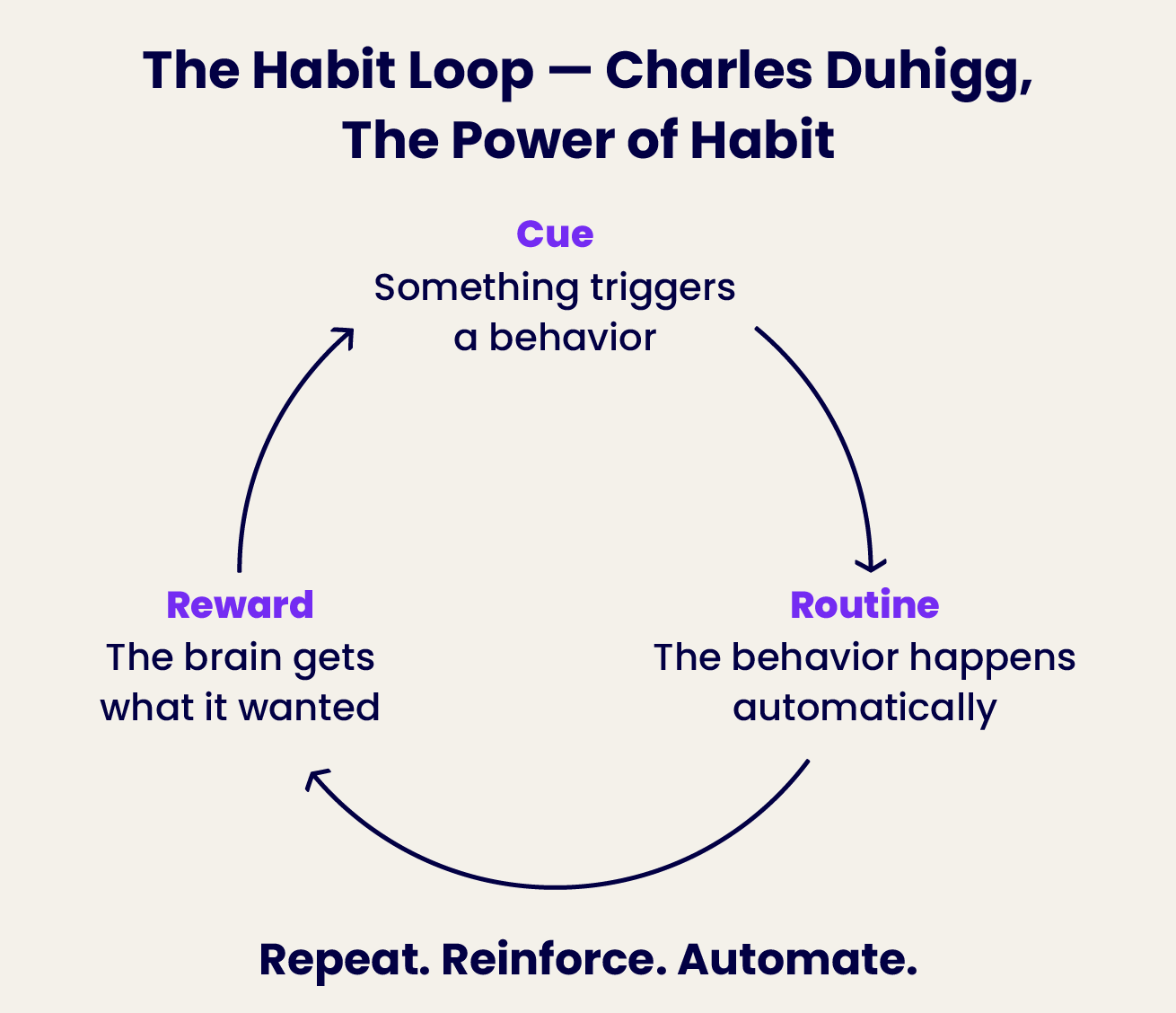
The kicker? Once a habit loop is established, the brain essentially goes on autopilot. It stops decision-making and starts pattern-matching. That's a feature, not a bug — your brain is conserving energy. But it's also why behavior change is so hard. You're not just asking someone to do something different. You're asking them to override an automatic neurological process.
Now apply this to your team.
The default loop you're fighting
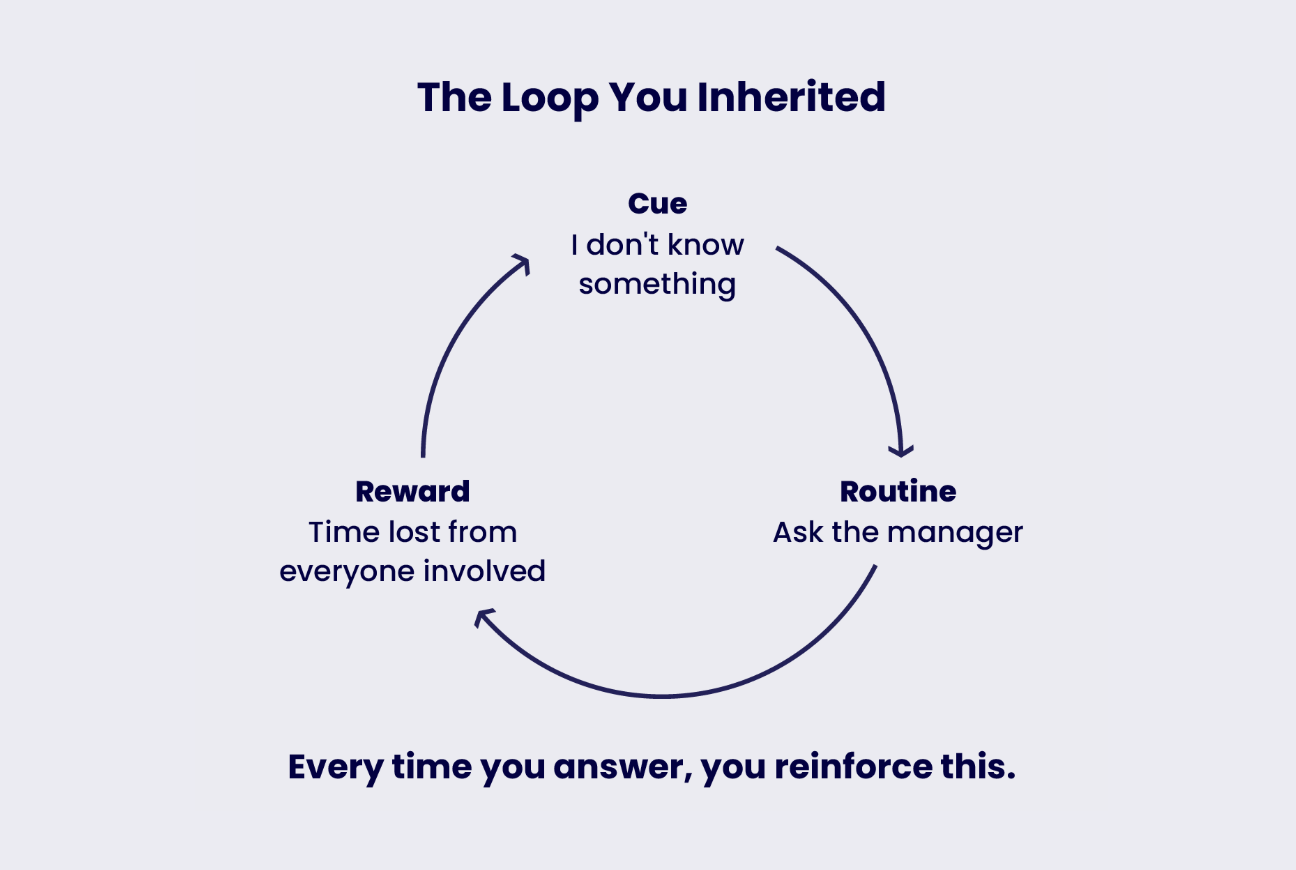
When an employee doesn't know something, here's the loop that's already running:
- Cue: Not knowing an answer
- Routine: Ask the manager
- Reward: Getting the answer fast and easy — great for them, quietly maddening for you
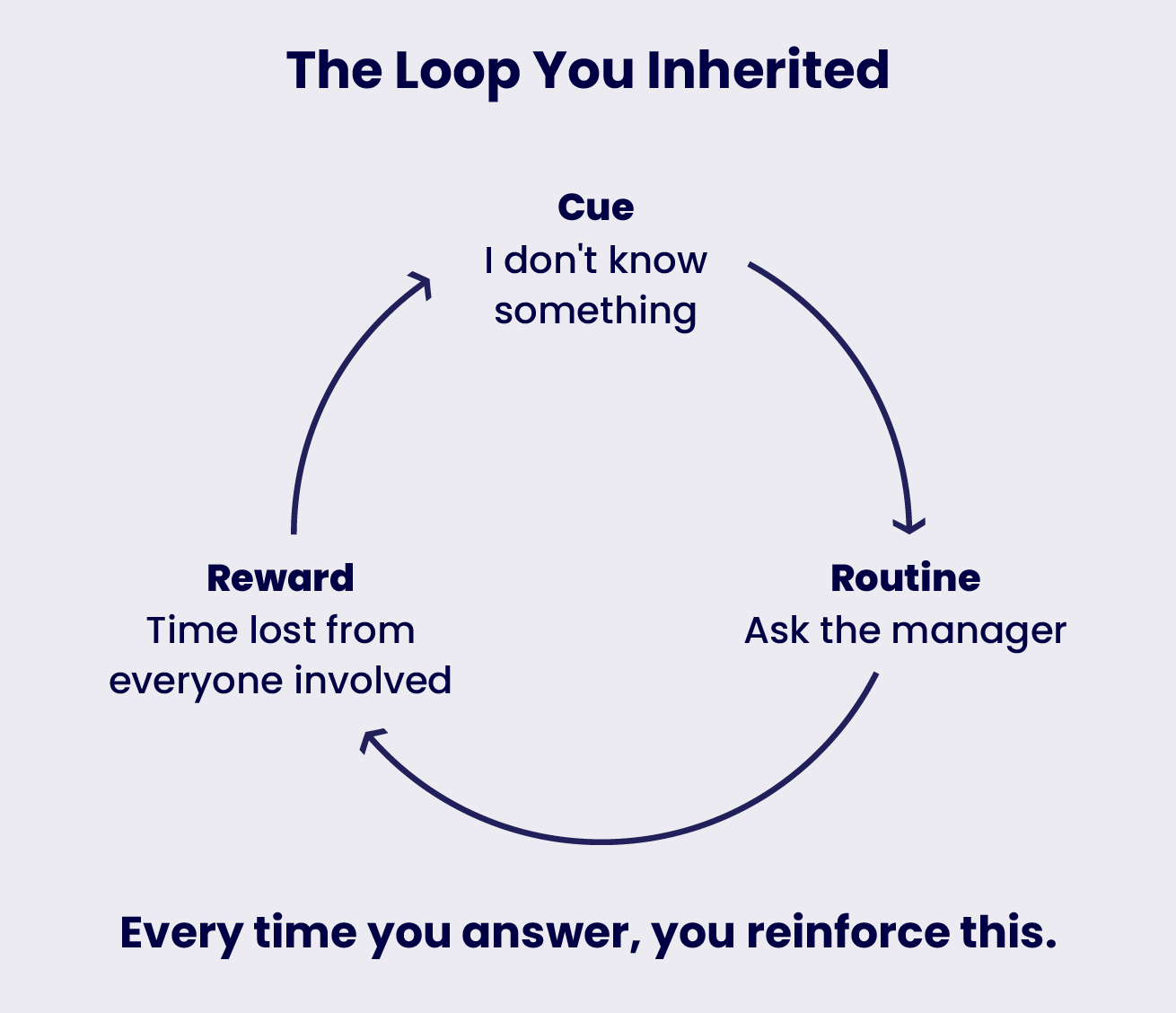
This loop is deeply grooved. It was probably there before you were their manager. It gets reinforced every single time it works — which, if you're answering their questions, is every single time.
Here's the hard question: are you accidentally maintaining the loop you want to break?
Every time you answer a question that lives in your documentation, you're handing out a reward for the wrong routine. You're not being helpful. You're being a cue.
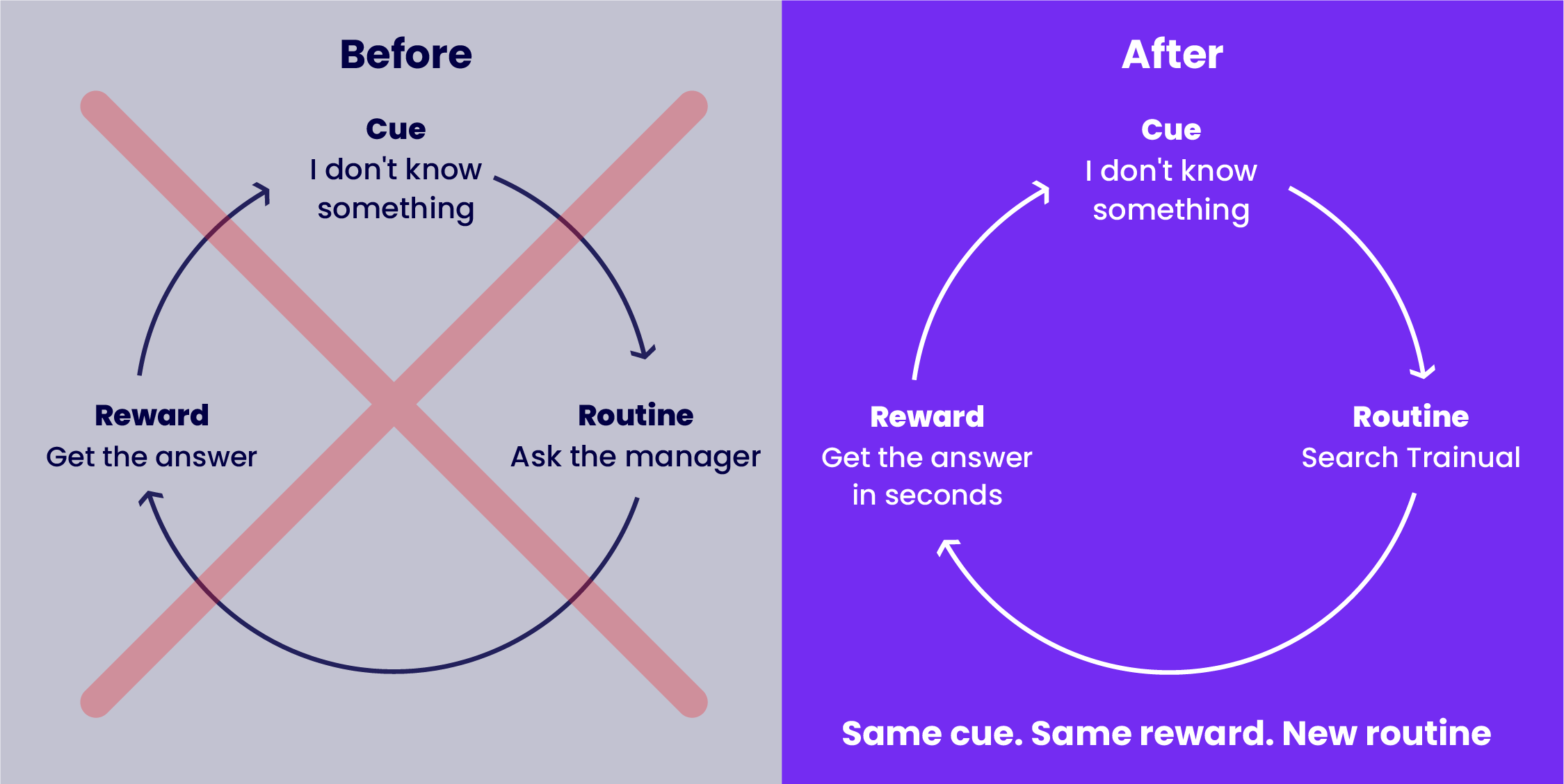
The goal of effective employee training isn't just to transfer information. It's to replace the routine while keeping the same cue and the same reward. The cue stays: "I don't know something." The reward stays: "I get the answer quickly." The routine changes: instead of asking you, they open the system.
That's the shift. Everything else is tactics.
The hidden cost: Task switching and the attention tax
Here's a cost most managers never put on the board: every time an employee interrupts you with a question, both of you lose.
Psychologists who study cognitive load and attentional focus have documented what's called the task-switching penalty — the mental cost of moving from one type of work to another. Research from the American Psychological Association suggests that switching tasks can cost as much as 40% of productive time, because the brain doesn't instantly context-switch. It lingers. It takes time to re-engage. The residue of the previous task bleeds into the next one.
So when your employee walks over to ask you something mid-deep-work, you're not just spending 90 seconds answering. You're spending 15 minutes getting your focus back. Multiply that by five interruptions a day, across a team of ten, and you're not looking at a training problem anymore. You're looking at a structural drain on your organization's most finite resource: attention.
This is why getting the habit loop right isn't a "nice to have." It's a leverage play. When your team has a reliable system to find answers without interrupting you or each other, the whole operation gets faster — not because people are working harder, but because they're losing less.
The psychology behind why behavior change feels hard
Before we get to solutions, let's name the other forces working against you — because understanding them is half the battle.
Mental shortcuts (And how to use them)
Your team's brains are heuristic machines. They don't evaluate every decision from scratch; they find the fastest path to an outcome. That's why "just Google it" beats out a six-tab internal wiki every time. Ease wins.
This is actually good news for how managers can change team habits. The key is to reframe your training system as the shortcut — not as something management is "implementing," but as the tool that makes their job easier. If your documentation is harder to find than asking you, fix that. The system should create less friction than the behavior you're trying to replace.
When employees perceive a tool as a shortcut, adoption stops being a training problem and starts being a UX problem. Solve for ease and you solve for adoption.
Loss aversion
Psychologists Daniel Kahneman and Amos Tversky established that people feel the pain of a loss about twice as strongly as the pleasure of an equivalent gain. What this means for you: "Here's a great system that will make things better" is a weaker motivator than "Here's what you're losing every time you don't use it."
Time lost hunting for answers. Opportunities lost due to inconsistent onboarding. Money left on the table because your team is winging it instead of following what works. Frame your training system around what employees are currently losing — not just what they stand to gain. Loss is the more powerful lever.
Social proof
People look to each other to calibrate behavior, especially in new or ambiguous situations. If one respected team member visibly uses a system and gets recognized for it, others follow. If no one seems to use it, the unspoken message is that it's optional — or that it doesn't matter.
Early adopters aren't just early adopters. They're social proof engines. Find them. Celebrate them publicly. Let the loop spread.
How to change the routine: The manager’s playbook
Now for the part that matters: what you actually do about it.
1. Use implementation intentions
Psychologist Peter Gollwitzer's research on implementation intentions is one of the most practical tools in behavioral science. The concept is simple: instead of setting a vague goal, you script an if-then behavior in advance.
"When I don't know the answer to something, I will check the system before asking anyone."
That's it. It sounds almost too simple. But the research consistently shows that if-then intentions significantly increase follow-through because they attach the new routine directly to an existing cue. You're not adding a new habit. You're redirecting an existing one.

Build this into onboarding. Say it out loud in team meetings. Put it in Trainual and have people sign off on it. Better yet, build a short quiz that walks employees through the basic psychology of habit loops — because the more aware someone is of their own default tendencies, the easier it is to consciously override them. The more explicitly the if-then pairing is stated and reinforced, the faster the new routine takes hold.
2. Reward the right behavior (Operant conditioning)
B.F. Skinner's work on operant conditioning is the backbone of behavior change at work: behaviors that get reinforced get repeated. Behaviors that don't, fade.
Most managers know this in theory and ignore it in practice.
If you want employees to use your documentation and training systems, you have to visibly reward it. That means:
- Calling it out publicly when someone references the system in a meeting
- Tying process adherence to performance reviews where it makes sense
- Building recognition into your 1:1s: "I noticed you found that answer yourself — that's exactly what we're going for"
Here's a wrinkle from Skinner's research that most people miss: variable rewards are more powerful than consistent ones. Slot machines don't pay out every time, and that's precisely why they're hard to walk away from. You don't need to praise every instance of good behavior. Unpredictable reinforcement — the surprise shout-out, the unexpected bonus, the random recognition — actually creates stronger habit formation than a predictable reward every time.
Don't overthink this. Just catch people doing it right, and say something.
3. Lower friction aggressively
You cannot win a friction war against "ask the manager." That loop is fast, reliable, and socially rewarding. Your system has to be just as easy — ideally, easier.
That means:
- Your documentation has to be searchable, organized, and actually maintained
- Employees shouldn't need four clicks to find a process they use weekly
- The system should work where your team already works — not as a separate destination they have to go out of their way to visit
The less effort the new routine requires, the faster it becomes the default. Design for laziness. That's not a knock on your team — that's just how behavior change works.
4. Change the identity, not just the behavior
James Clear, in Atomic Habits, argues that the most durable behavior change comes from identity-level shifts, not outcome-level goals. People who say "I'm trying to run more" quit. People who say "I'm a runner" run.
The workplace equivalent: stop framing training adoption as a compliance task and start framing it as a marker of professional excellence. "This is how great operators on this team work. This is what high performers here look like."
When using the system becomes part of what it means to be good at the job, the psychology of employee training stops being a management problem and starts being a culture trait.
The system that makes the psychology work
All of this assumes one thing: that your training content is actually good enough — and accessible enough — to be worth building a habit around. That's where the rubber meets the road for most teams.
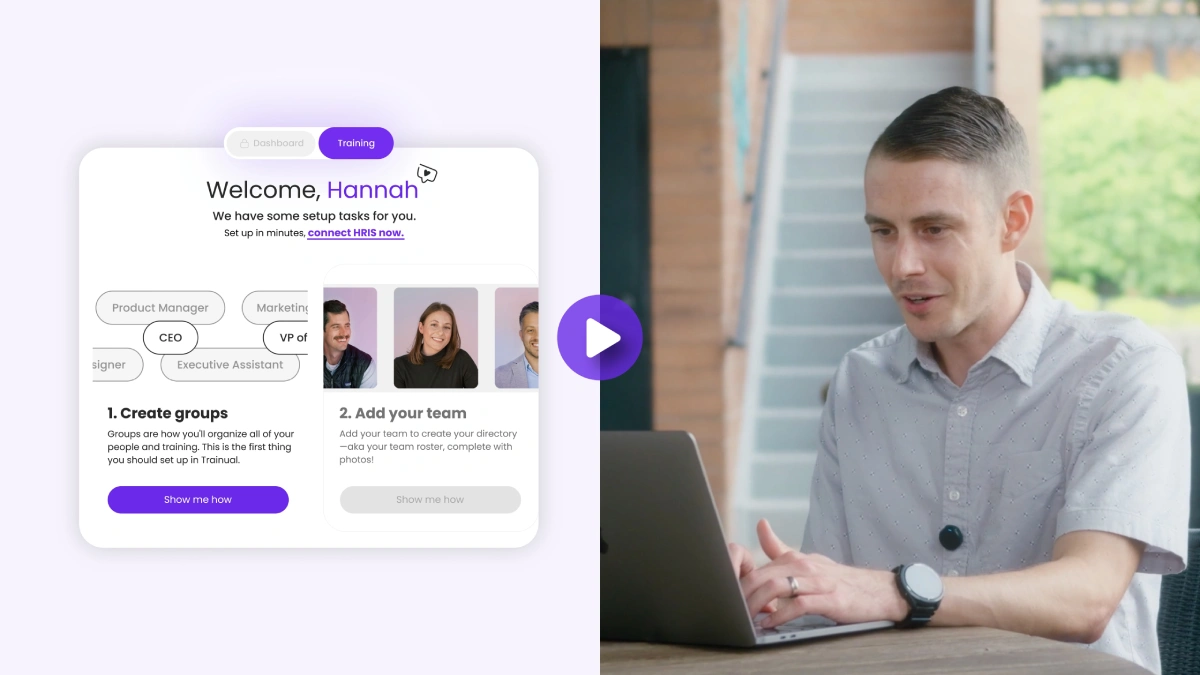
Here's how Trainual is built specifically to support every loop we've talked about.
Loop #1: The one you want your team running.
Employee has a question → searches Trainual → gets the answer in seconds.
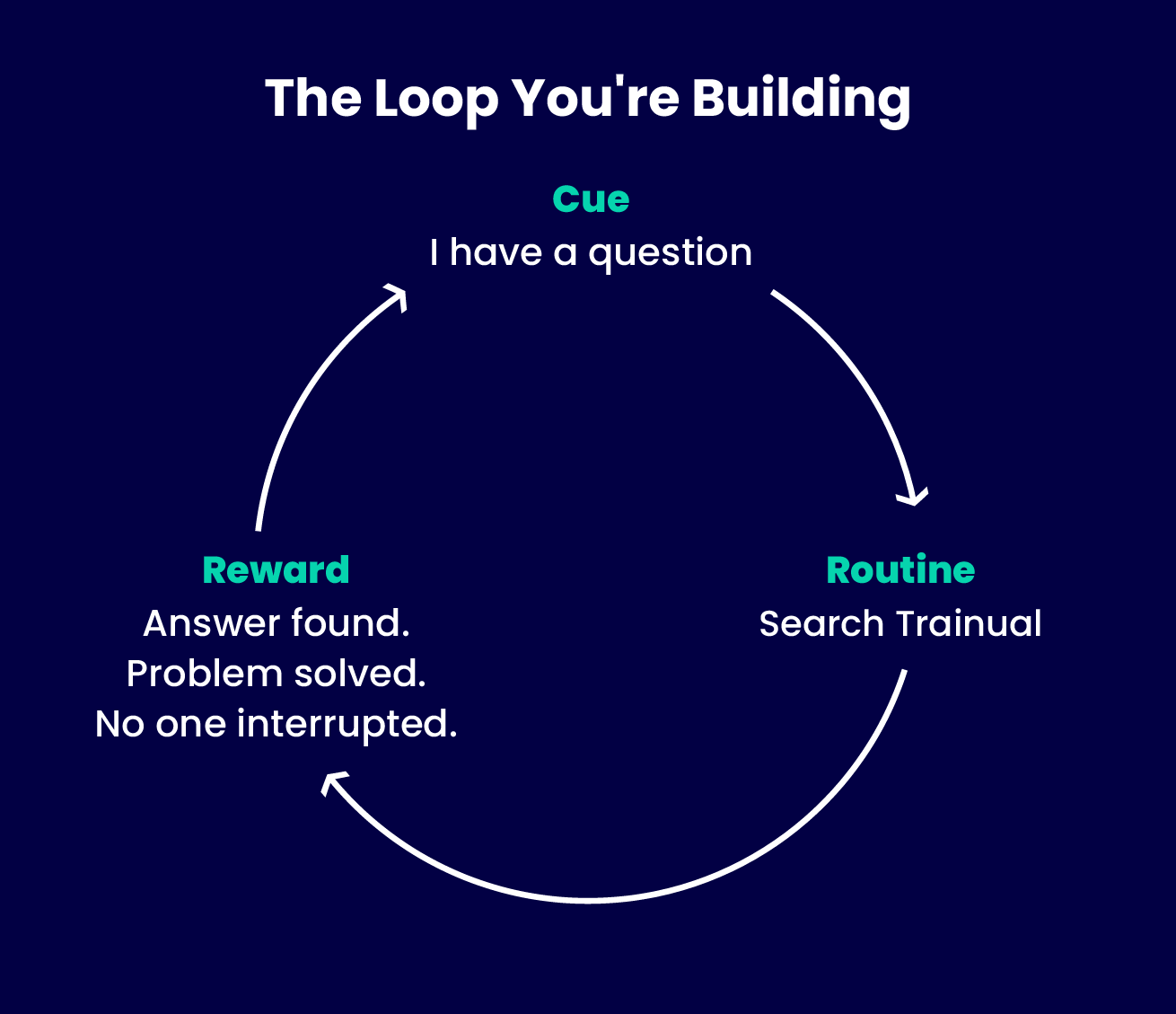
Trainual's AI-powered search means employees don't need to know exactly where something lives. They type the question in plain language and the answer surfaces. That's the friction elimination we talked about. The system has to be faster and easier than asking you — and this is how it gets there.
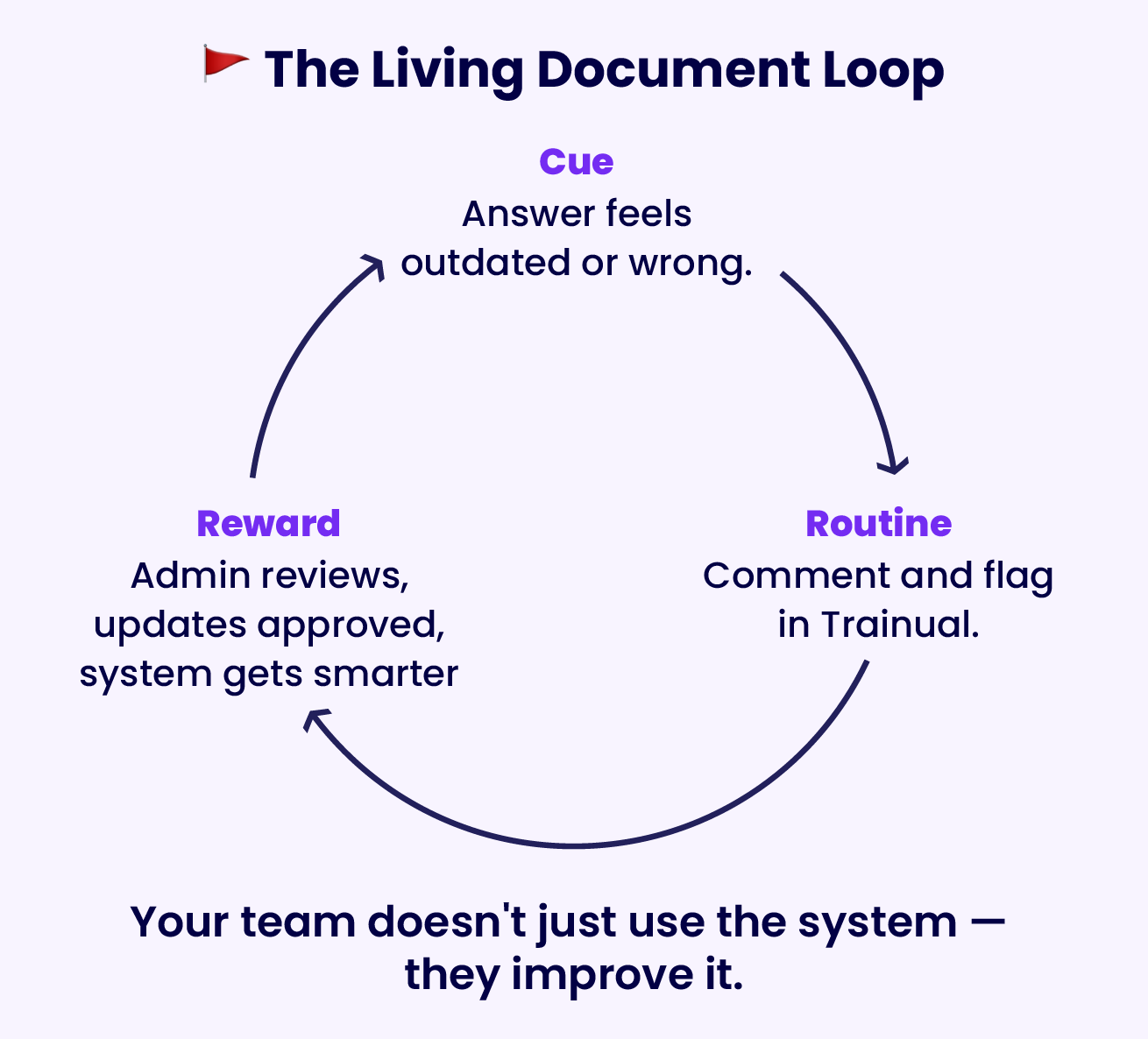
Loop #2: The feedback loop that keeps everything current.
What if the answer is in Trainual, but it's out of date? (It happens. You're not perfect. Nobody is.) Trainual lets employees comment directly on a training module in real time and flag it for an admin to review and approve. So instead of a wrong answer spreading silently through the team, it gets caught and corrected fast. The system improves itself — and employees become active participants in maintaining it, not just passive consumers of it.
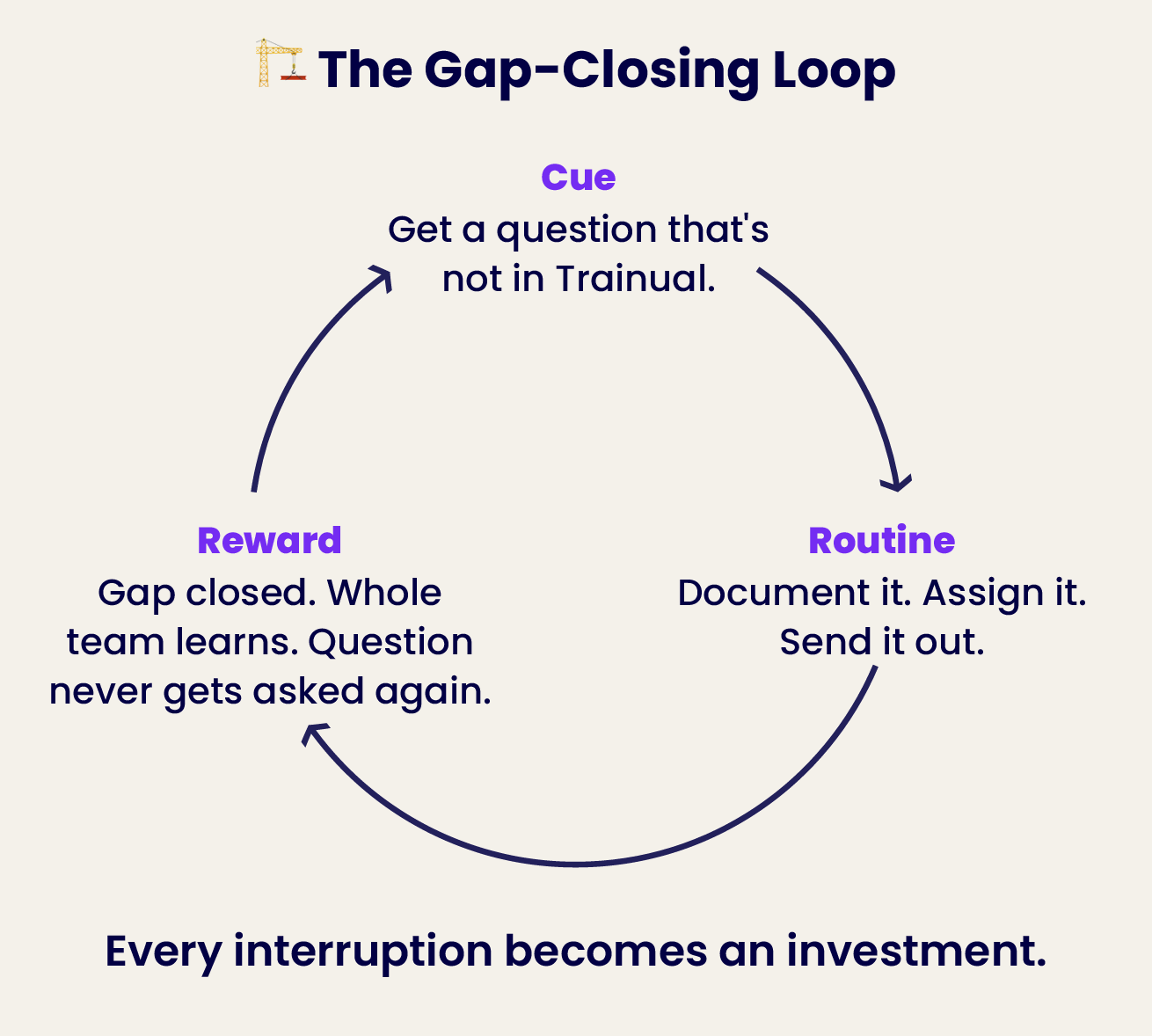
Loop #3: The one that closes knowledge gaps automatically.
You get a question that isn't in Trainual yet. Instead of just answering it, that becomes a trigger: document it in Trainual, then push it out to the team. Every undocumented question is a gap in your system — and a chance to close it. Over time, this loop builds a knowledge base that gets more complete with every question your team asks. The gap shrinks. The interruptions shrink with it.
How to roll it out without it dying on the vine.
This is where most implementations fail. Not because the system is bad, but because the rollout is passive. Managers send a Slack message, maybe host one training session, then wait for adoption to materialize. It doesn't.
Do this instead.
1. Model it out loud. In your next team meeting, when a question comes up, open Trainual in front of everyone and find the answer together. Don't just tell your team to use it — show them, in real time, that it works. First-hand demonstration is one of the most powerful adoption drivers in behavioral science. It collapses the gap between "this is a tool we have" and "this is a tool that works."
2. Reward contribution publicly. When someone updates a module, shout them out in it — literally put their name in the training. When someone flags an outdated process and gets it fixed, call it out in your next team meeting. You're running operant conditioning plays here, and you're running them on the behavior that multiplies value: not just using the system, but improving it.
3. Make it everyone's. The teams that see the fastest adoption — and the ones Trainual consistently sees outperform on process adherence — are the ones that treat the system as a shared asset, not a top-down mandate. When employees have a hand in building and maintaining it, they're invested in it. Bring a competitive edge to that. Gamify contributions. Build a little healthy rivalry around who's keeping their section sharpest. Fun and competition aren't unprofessional — they're behavioral science in a better outfit.
The goal isn't compliance. It's culture. And the teams that build both simultaneously are the ones that stop running the old loops for good.
TL;DR — what managers can actually do this week
You don't need a psychology degree to put this to work. You need a system and a few intentional habits of your own:
- Identify the default loop — Where are your team's autopilot behaviors? What cue triggers them? What's the reward?
- Stop rewarding the wrong routine — Every question you answer that lives in your docs reinforces the old loop. Redirect instead of respond.
- Script the if-then — Build "when I don't know something, I check the system" into onboarding, team norms, and sign-offs
- Create a quiz — Make employees aware of their own cognitive tendencies; awareness is the first step to override
- Celebrate the right behavior publicly — Operant conditioning works. Use it deliberately
- Reduce friction relentlessly — If your system isn't easier than asking you, it won't win
- Invoke loss aversion — Show the team what bad habits are costing them in time, focus, and momentum
- Build social proof early — Find your early adopters and put a spotlight on them
- Shift the identity — Make using the system part of what it means to be great at the job here
Want to see what this looks like in practice?
👉 Read how real teams have embedded this into their culture with Trainual.
Ready to Build the Loop That Actually Sticks?
The psychology is clear. The blueprint exists. What most teams are missing is a system clean enough, searchable enough, and well-maintained enough to actually win the friction war.
That's exactly what Trainual is built for.