





Most companies under 100 employees don't have a dedicated trainer or an HR department — and they don't need one to train new hires well. The mistake is treating training as someone's spare-time job, so it falls to whoever's free and looks different every time. The fix is to stop relying on a person's availability and build a small system instead: document how each job is actually done once, make it self-serve so new hires learn without pulling a senior employee off their work, put one part-time owner in charge of keeping it current, and track who has completed what. Here's how to do that.
It's the busiest week of the year and you just hired someone. So you pull your best technician off their route to train them — which means for the next week you're effectively down two people, not up one. The new hire learns whatever that technician happens to remember to cover; next month, when someone else does the training, the next hire learns a different version. This is what training looks like when it's "whoever's free." It works at ten people. It quietly gets expensive at seventy.
Why sub-100 companies don't have a dedicated trainer — and don't need one
A 200-person company can justify a full-time trainer or an L&D team. A growing company of 75 usually can't, and shouldn't force it. At that size the knowledge of how each job is done already lives in your team; what's missing isn't a trainer, it's a way to get that knowledge out of people's heads and in front of new hires without a senior employee having to stop and explain it every time.
So the goal isn't to hire for training. It's to make training something that doesn't depend on any one person being free.
What breaks when training is "whoever's free"
- It costs your best people. The person who trains is usually your most capable one — so every new hire pulls your strongest performer off revenue work.
- Every hire learns a different version. Without a written source of truth, the training is only as complete as whoever happened to deliver it that week.
- It gets skipped under pressure. When things are busy — exactly when you're hiring — "we'll train them properly later" becomes never.
- You can't see the gaps. No one can say what a new hire has and hasn't been shown, so the holes only appear when something goes wrong.
How to train new hires without a dedicated trainer
1. Document how each job is actually done — once
Start with the roles you hire into most. Capture the real steps, tools, and decisions of the work — documented SOPs, not a job description. Done once, this becomes the source of truth every future hire trains from, so no one re-explains it from scratch.
2. Make the training self-serve
New hires should be able to work through most of it on their own time in a self-serve onboarding path — reading, watching, clicking — instead of sitting beside a senior employee for a week. Self-serve is what frees your best people from being the training program.
3. Assign a part-time owner, not a trainer
Pick one person to own keeping the material current. It doesn't need to be their whole job, and it doesn't need to be a manager — often the best choice is someone with an eye for making things clear. You need an owner, not a headcount.
4. Give each role its own path
A new salesperson and a new technician shouldn't get the same training. Role-based paths mean people spend time only on what their job needs — which also makes self-serve realistic instead of overwhelming.
5. Use AI to draft, a human to make it real
An AI assistant is genuinely good at turning a rough brain-dump of how a job works into a first draft, which kills the blank-page problem. But a raw AI document isn't something you hand your team — someone still has to check it and put it somewhere trackable.
6. Track completion and close the gaps
Keep a simple record of who has finished what, so nothing gets silently skipped. When a new hire can't find something they needed, that's not a failure — it's a map of what to document next.
Where a tool fits — and where a doc is enough
Be honest about your stage. For your first few hires, a shared doc and a checklist genuinely work, and adding software before you need it just creates overhead.
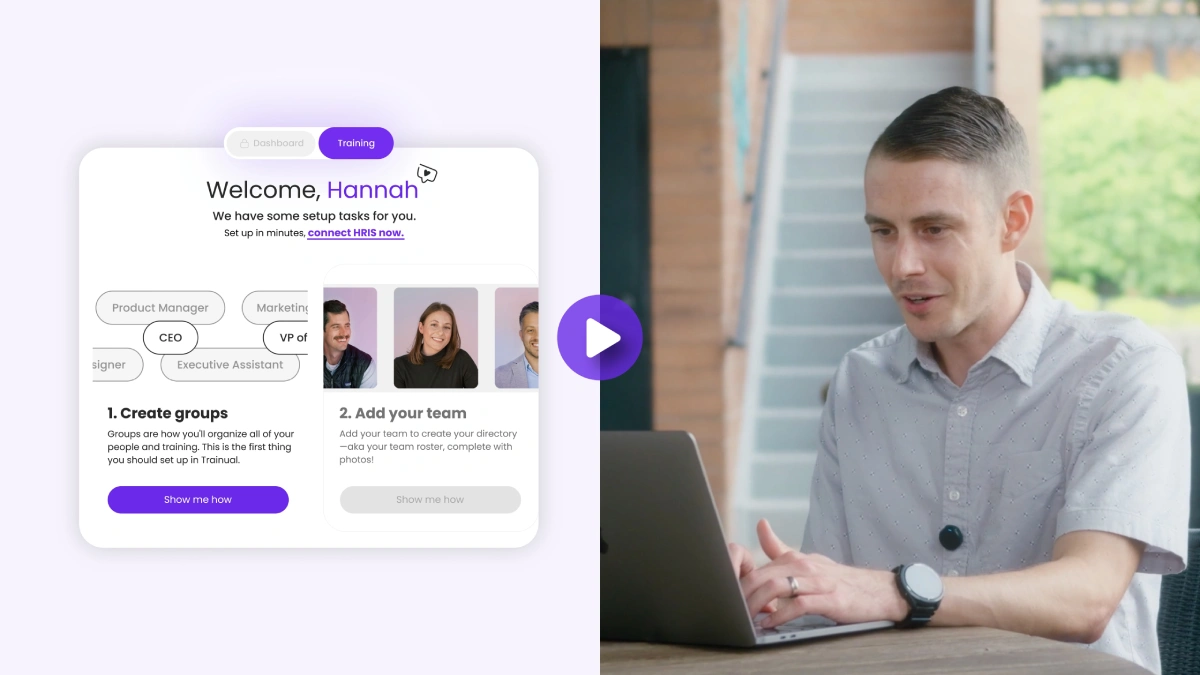
What a doc can't do is make training self-serve at scale or tell you who's actually completed it — and those are the two things that matter once training is happening often enough to hurt. That's where a tool starts to pay for itself. Trainual is built for exactly this: document each role once, hand new hires a self-serve path they can work through on their own (about 90% of it on their phone, for teams that are rarely at a desk), and see who's completed what without chasing anyone.
Debug Pest Control is a good example of how little "dedicated" this has to be. They didn't hire a trainer — they handed training to Thomas, a part-time hire brought on for social media who turned out to have a knack for it, and let him build it out. Technicians now reach the field in three to four weeks instead of six to eight, and new hires call it the best training they've had.
Frequently asked questions
How do you train new employees when you don't have a dedicated trainer?
Stop relying on a person's availability and build a small system instead. Document how each job is actually done once, make the training self-serve so new hires learn on their own time, put one part-time owner in charge of keeping it current, and track who has completed what. Most companies under 100 employees train this way successfully without ever hiring a dedicated trainer.
Who should be responsible for training at a small company?
A part-time coordinator — often someone who already knows the business and has an eye for making things clear — who owns keeping the material current, while the how-to knowledge comes from the people who do each job. You need an owner, not a trainer. Leaving it to "whoever's free" makes training inconsistent and pulls your most senior people off their work.
Do you need an HR department to train and onboard employees?
No. Onboarding and training are about capturing how the work is done and making it easy to learn, neither of which requires an HR function. Most companies under 100 employees have no HR department and still train well by documenting their processes, giving each role a clear path, and tracking completion. An HR or payroll system handles records and pay; it doesn't teach someone how to do the job.
How long does it take to train a new hire at a small business?
Plan for the first 90 days, not the first day. Day one is logistics and access; the first week covers the team, tools, and shape of the role; real competence usually lands in the first 30 to 90 days. When training is documented and self-serve, that ramp gets shorter and far more consistent from one hire to the next.
Can you use AI to help train new employees?
Yes, for the drafting. AI is very good at turning a rough brain-dump of how a job is done into a first draft of a training module, which removes the blank-page problem. But a raw AI document isn't training your team can rely on — a person still needs to check it for accuracy and put it somewhere trackable.