




Wilderness Medical Staffing
Picture a clinic in an Alaskan village in February. It's fifty below. There is no road out — the only way anyone leaves is by air, and the weather decides whether that's today or Thursday. Inside, there is one clinician. Not one on call, not one of several. One. The nearest higher level of care is a flight away, and for the next several hours, whatever walks through that door is theirs to handle.
Now go back three weeks and 2,000 miles, to a laptop in Spokane, where someone was working through a state licensing requirement and a collaborative practice agreement so that clinician could legally be in that room at all.
That's the whole business. Those two scenes are the same event.
TL;DR
- 26 internal employees, fully remote, place providers into 200+ client sites across six states — roughly 90% of the work in Alaska
- Founded in 2010 by a nurse practitioner who had been the only provider for hundreds of miles; her son Ethan McWilliams is now acting president
- ★ 61 subjects, 277 topics, 1,514 documented steps live in Trainual — roughly 58 steps per employee
- ★ 93% utilization — the documentation isn't shelfware
- Grew from 7 to 26 people with Trainual as the system of record for six-plus years
- Replaced Microsoft Word as the process library
- Eight department playbooks — business development, recruiting, staffing, operations, marketing, accounting, HR, and compliance & risk management — each owned by the leader of that department
- Rebuilt playbooks department by department during a Salesforce migration in under a year, using Loom videos instead of retyping long processes
- Trainual links embedded in Salesforce help text, so the process appears in the field at the moment of doubt
- Award: Coolest Use of Trainual, Playbook 2026
"We have to be very organized in order to make an assignment a success. If we don't follow — business licenses for the states the providers are going to, or collaborative plans, or whatever it is for that assignment — the provider is not going to go on assignment. So the rural and remote communities we're serving aren't going to have that medical care if things are slipping through the cracks on our end." — Jade King, Operations Director, Wilderness Medical Staffing
Read that again, because it's easy to hear it as an operations problem. It isn't. It's a sentence about what happens to a village when a form doesn't get finished.
The woman who lived it first
Wilderness Medical Staffing exists because Mary Ellen Doty spent nearly two decades as a nurse practitioner in bush Alaska, often the only provider for hundreds of miles. She took a job in a village that had almost no access to proper medical care, and what happened there changed the direction of her life.
"It was life-changing for her, life-changing for them. And she's made this her life mission to serve Alaska."
She started the company in 2010 to fix what she'd seen from the inside: communities that needed clinicians and couldn't get them, and clinicians who wanted that work and had no way in. She's written about those years in a memoir, Medicine at 50 Below. She still speaks about rural care the way someone does when they've been the only one in the room:
"Every provider is grateful to see those aircraft land. We know they will get our patient to a higher level of care." — Mary Ellen Doty, Founder
The family is still at the head of it: her son Ethan McWilliams — named to Staffing Industry Analysts' 40 Under 40 in 2023 — is acting president. Today Wilderness Medical Staffing places physicians, nurse practitioners, physician assistants, and CRNAs into critical access hospitals, rural health clinics, and tribal health organizations across Alaska, Montana, Washington, Wyoming, Idaho, and Colorado — more than 200 client sites, roughly 90% of the work in Alaska.
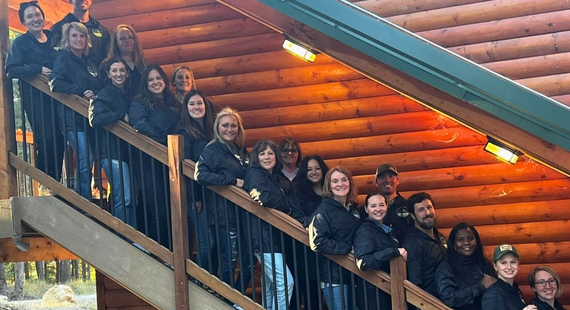
The internal team that runs all of it: 26 people, working fully remote.
Every Monday, they hear what it was for
This is the part that explains the company. Once a week, the whole team gets on a call and Mary Ellen tells a "why story" — something that actually happened to one of their providers in the field.
"She gets stories from providers in the field and they tell us what they're doing. They save babies' lives. They save lives all the time — and we wouldn't know if we weren't collecting these stories."
Twenty-six people who spend their days on credentialing, licensure, and travel logistics sit down every Monday and hear the far end of the chain. Not a metric. A baby.
"What we do is not — we're not a factory. We're not clocking in and clocking out. We're truly, truly helping people who need help. What we do every day matters."
That's the culture Trainual is documenting. Not workflows — the specific, checkable steps between a clinic that has nobody and a clinic that has someone good.
Which is why they don't send just anyone
The care only counts if the person delivering it can actually function up there. Wilderness Medical Staffing screens for two things, and the second one is the one most agencies skip:
"We really only take like the best of the best providers — very heavy recruiting process. We have very amazing recruiters to make sure that we're getting not only people that are fantastic clinically, but are good personality fits. Because it's a different culture up there. People need to be culturally sensitive. So when you get a provider from Wilderness Medical Staffing, you can know that you're getting the best."
A brilliant clinician who can't meet a community where it is does not help that community. Screening for that is a process too — and processes that live in someone's head don't survive growth.
What it looked like before: a folder of Word documents
Jade joined about eight years ago, when Wilderness Medical Staffing had seven employees. Trainual came in roughly six to seven years ago, brought in by leadership and adopted across the team from there.
"Literally, I had everything in Word. Literally, Microsoft Word is where I had our processes documented. That's like actually embarrassing to say."
It isn't embarrassing — it's the default. Word documents are where most growing companies keep their process until the seams show. At seven people, a folder holds. At 26 people across six states, with requirements that shift by state and by assignment — a one-week fill and a twelve-month posting are not the same paperwork — it doesn't.
★ Keep the 1,514 in mind. Whatever fraction of that existed back then, it lived in a folder of documents that had to be opened, scrolled, and trusted to be the current version.
And nobody at Wilderness Medical Staffing sits near anybody else. The whole internal team is remote. There is no walking over to ask, no overhearing the right answer. Whatever isn't written down has to be chased, scheduled, or guessed at. Guessing is the expensive option, and the cost doesn't land on the company. It lands on a clinic.
A playbook per department, owned by the department
Eight departments, eight playbooks: business development, recruiting, staffing, operations, marketing, accounting, HR, and compliance & risk management. Each one belongs to the leader of that department, who is accountable for keeping it current.
That last one is worth sitting with. A dedicated compliance and risk management playbook is not standard equipment at a 26-person company. It's standard equipment when the consequence of getting compliance wrong is a clinic without a clinician.
★ Inside those eight playbooks: 61 subjects, 277 topics, and 1,514 individual documented steps. That's the real size of what this team knows how to do — 58 documented steps for every person on staff, written down, in one place, current.
"I make sure that everything my team is in charge of within our role of the company is documented. They have a question, the answer should be in Trainual. I should be able to send a link."
For operations, that means every step of every assignment type is written down. The two Jade names are the ones that stop a placement cold. State licensure: a provider licensed in Washington is not thereby licensed in Alaska, and the requirement travels with the state, not the clinician. And collaborative practice agreements — the documented arrangement governing how an advanced practice provider works with a collaborating or supervising physician, which is required in some states and for some credentials and not others, and is written to the specifics of each. Neither is a form anyone can fill out from memory on a Friday afternoon. Both are the difference between a clinician who boards the plane and one who doesn't.
"New employees — obviously we're going to be helping them along the way, but ideally they should go through every step of that playbook and know how to do it."
Asked which playbook mattered most, Jade wouldn't play along:
"I couldn't choose. Every department has their own playbook and we couldn't get rid of any of them."
What has to happen before anyone flies
Some of the sequence is public, because Wilderness Medical Staffing documents it for the providers themselves. It runs roughly like this:
- Screen. Nurse practitioners and PAs need a minimum of two years' experience, emergency medicine preferred. Physicians need a completed residency. Everyone needs an active state medical license, and everyone goes through Wilderness Medical Staffing's own screening on top of that.
- Match, with the full picture. Before a provider accepts anything, Wilderness Medical Staffing walks them through job responsibilities, pay, patient volume, staffing mix, location details, and living arrangements. No one arrives in a village surprised by what the job is.
- License for the destination. The license has to be current in the state the assignment is in — which is separate work from wherever the provider already practices.
- Collaborative practice agreement, where one is required. Depends on the state and the credential.
- Orient to the specific site. Not general orientation — that clinic, that community, that staffing mix, so the provider can work from day one instead of week two.
- Get them there. Travel and housing into places where the nearest road may not exist and the weather sets the schedule.
Six steps, every one of them a place where a missed detail means a clinic goes unstaffed. All of it lives in Trainual.
The move that won the award
Less than a year ago, Wilderness Medical Staffing migrated onto Salesforce — which, for a 26-person team, meant rebuilding essentially every playbook in Trainual while continuing to place providers.
The rebuild ran the way the playbooks are owned: each department's manager redid their own. Jade took Operations.
Loom killed the wall of text. Instead of retyping long multi-step processes in a new system's language, she recorded them.
"The amount of work that we've had to do in Trainual within the last year is crazy. Those Loom videos — instead of typing out everything, all of our long processes, a five-minute video has been super helpful."
Then she wired Trainual into Salesforce itself. Salesforce lets admins attach help text to a field — the little info bubble you click when you're not sure what goes in the box. Most companies write two sentences there. Jade put Trainual links there instead.
"There's helpful links that we can have — the little blue dot. So instead of just putting like help text there, I've actually just been including a link to the Trainual page. So if they're working on a business license, instead of writing out just a couple of sentences about a business license, there's a Trainual link that takes you to the page with much more information."
Follow that forward. Someone on the ops team is filling in a state business license field on a Tuesday. They're not sure. In the old version of this company, that's a Slack message, a wait, a best guess, or a step quietly done wrong. Now it's one click to the full procedure — not a summary, the whole thing — surfaced at the exact moment of doubt, without anyone having to remember the documentation exists.
★ And it works, which is the part most companies never get to. Wilderness Medical Staffing runs 93% utilization in Trainual. That's the number that separates a documented company from a company that has documentation — most process libraries get written once, celebrated briefly, and then quietly abandoned while everyone goes back to asking each other. This one is load-bearing.
That's why this one took Coolest Use of Trainual. Plenty of companies build a good playbook. Fewer make it unavoidable. And when the downstream cost of a guess is a provider who doesn't board the plane, unavoidable is the only standard worth hitting.
"I would fight for Trainual"
Asked what she'd say to an operator worried about the hours it takes to document a business properly, Jade doesn't dodge:
"My first thought is the investment of time. It does take a lot of time to document Trainual and all of our processes. But the benefits — they outweigh it so much more."
And then, unprompted:
"I never want to see Trainual go in our company. I would fight for it, to be honest with you. It's honestly just such a blessing. Every one of us in the company recognizes that Trainual is a special company."
What's next
Wilderness Medical Staffing is expanding across the U.S., with international placement on the longer horizon. (The stated big-hairy-audacious version, courtesy of leadership: staff the International Space Station. Nobody's ruling it out.)
Closer in, Jade wants to point Trainual outward — at the providers themselves. Not onboarding. A short, publicly shared briefing so a clinician flying into a village for the first time arrives knowing something about the community, the culture, and the conditions before the plane door opens.
Which is the same instinct that won the award, aimed one step further down the chain. A five-minute video, watched at a gate in Seattle, by someone about to spend six months as the only provider for hundreds of miles.
Want to see how other teams built their playbooks? Explore more customer stories.
See how Trainual turns what your team already knows into something anyone can follow — and how teams like Wilderness Medical Staffing keep it current as they grow. Book a demo.