





Ever walk into your second office or franchise location, watch how a routine workflow gets handled, and realize halfway through that this isn't quite the same workflow your HQ team runs? The steps are similar. The outcomes are mostly the same. But the small differences — how a senior employee handles a customer escalation, the order of operations on opening procedures, the exact wording of the team's customer communication — have drifted just far enough that the experience customers get at this location isn't quite the experience customers get at HQ. Both locations are doing their best. Both have good people. But two different operating systems are quietly running under one logo.
That's the multi-location standardization problem most growing companies live in. The processes that worked at one location don't survive the journey to two, three, five, or fifty. Each new location adopts the central playbook, then evolves it slightly to fit local realities, then evolves it some more, until the central playbook isn't really central anymore. By the time you've spotted the drift, the cost has already shown up in customer experience, employee retention, and the quiet sense that scaling is harder than it should be.
The data is consistent. 70% of change initiatives fail. Multi-location companies are particularly exposed because changes have to land cleanly across every site. Brand consistency drives 23% higher revenue growth for organizations that achieve it. Companies with strong onboarding processes — including consistent multi-location ramp-ups — see new-hire retention increases of up to 82%.
This guide walks through how a learning management system (LMS) — used the right way — turns multi-location operations from a hope-it-stays-consistent problem into a verifiable, trackable, scalable system. Not just centralized SOPs. A real operating system where every location runs on the same playbook, every change reaches every site, and every new opening spins up on proven processes.
Why operations drift across locations
At one location, operations are simple — the senior team is in the same building, decisions get made in the same room, processes evolve organically. At two locations, things get harder. The second location adopts the playbook but adapts it in small ways. At five locations, the small adaptations compound. By ten, you have ten different operating systems sharing a logo.
The pattern is consistent. The reason isn't bad management. It's that informal standardization doesn't scale. Each location has good people making reasonable decisions in their context. The problem is that the context varies, the decisions vary, and the resulting operations vary — all without anyone deciding to drift.
The cost of that drift shows up everywhere:
- Customer experience inconsistency across locations
- Employee retention drops at locations where ramp-up quality is weaker
- New location openings that take 6 months instead of 6 weeks because the playbook isn't documented
- Compliance gaps when policies evolve at HQ but not at remote locations
- Senior employees stretched thin trying to be the consistency layer themselves
- Acquisition integration that fails because acquired teams can't be onboarded onto the central operating system
A good LMS — used as the central operating layer — fixes this. Here's how.
What an LMS does for multi-location standardization
An LMS turns multi-location operations from informal coordination into a structured operating system. Here's what changes:
The combination is what closes the multi-location drift gap. Without it, every location quietly evolves its own playbook. With it, every location runs on the same one.
The 6-step framework for using an LMS to standardize operations
Here's the framework — start to finish.
Step 1: Define the central operating system
Before standardizing across locations, define what the central operating system actually is. The non-negotiable processes. The required workflows. The customer experience standards. The compliance requirements. The role expectations.
Be specific. Vague standards drift. Specific standards stick. "Customer greeting standard" is too vague. "Customer greeting includes acknowledgment within 30 seconds, name use if available, and a follow-up question to confirm needs" is what every location can actually execute against.
For most multi-location companies, the central operating system is 30-50 core SOPs. That's the foundation every location runs on.
Step 2: Document everything in one platform
Move every central SOP, policy, and playbook into one searchable, role-based platform. One source of truth. Not "the master version is at HQ and each location keeps a copy." Not "the SOPs are on the shared drive but the most recent version is on Slack." One platform. One source. Period.
This is the single most important step. The change isn't a folder of docs. It's a versioned, dated, accessible operating system that every location accesses identically.
Step 3: Assign content by role across locations
Use role-based assignment so every team member sees the content that applies to their role, regardless of location. A shift lead in your Phoenix store sees the same shift lead playbook as a shift lead in Denver. A field tech in your second office sees the same procedures as a field tech in your flagship.
The role becomes the addressing system. Location is just where the role happens to be.
Step 4: Allow local customization within central guardrails
Total standardization is rarely the goal. Some location-specific variation is appropriate — local laws, regional customer preferences, language requirements, market-specific pricing. The trick is structuring the central operating system so it accommodates local variation without losing standardization.
The pattern: central SOPs cover the non-negotiable parts. Location-specific addendums cover the local customization. Both live in the same platform, both are versioned, and the team in each location sees exactly what applies to them.
Step 5: Track completion and consistency by location
Use the LMS reporting to track rollout and adoption by location. Which locations have completed the core training? Which are lagging? Which have lower completion rates that might predict execution drift?
The dashboard makes drift visible. Without it, leadership has no idea whether the new policy actually landed at the third location until something goes wrong.
Step 6: Build the new-location playbook
The biggest payoff of a standardized operating system is that opening new locations becomes dramatically easier. The new location's team doesn't have to figure out how to operate — they just enroll in the central operating system and follow the path.
Document the new-location opening playbook explicitly. Week 1: enroll the team in core training. Week 2: complete role-specific paths. Week 3: shadow at an existing location. Week 4: open. The playbook becomes the asset that compounds — every new opening uses the same proven process.
Common mistakes to avoid
The framework works. The implementation is where teams stumble.
Mistake #1: Letting each location maintain their own version
The trap: Each location keeps a "local copy" of the SOPs that they update on their own.
The fix: One source of truth. Central platform. Local addendums for legitimate location-specific variation, but the core operating system is centralized.
Mistake #2: Documenting standards at the task level instead of the outcome level
The trap: SOPs that prescribe every micro-step. Locations rebel because the steps don't match local realities.
The fix: Document outcomes and key process anchors. Allow flexibility in execution as long as the outcome holds. Standardize what matters; let locations adapt what doesn't.
Mistake #3: Skipping change management for distributed teams
The trap: HQ rolls out a new policy. The HQ team adapts. The remote locations get the email but don't truly internalize. Six months later, two operating systems exist.
The fix: Use version history and acknowledgment tracking to verify every location has acknowledged every meaningful change. The dashboard tells you who's on the new version and who isn't.
Mistake #4: Underinvesting in the new-location opening playbook
The trap: Each new location is a new project that has to be figured out from scratch. Opening time increases as the company grows.
The fix: Build and refine the new-location opening playbook explicitly. Each opening should make the next one faster, not slower.
Mistake #5: Letting the platform go stale
The trap: The central operating system gets built once. Six months later, it doesn't reflect the company's actual operations because changes have happened in real life but not in the platform.
The fix: Set quarterly review cadence. Owners assigned to every key area of content. The platform evolves as the company evolves.
What rolling this out should look like
Software is half the job. Rollout is the other half.
Week 1: Audit current operations across locations
Visit (or interview leaders at) each location. Document the core processes as they're actually being executed. The drift inventory is the foundation for the standardization work to come.
Week 2: Define the central operating system
Decide what's non-negotiable. Document the 30-50 core SOPs. Get senior leadership aligned on the standards.
Week 3: Move everything to the platform
Migrate the core operating system to a single platform. Set up role-based assignment. Configure version history.
Week 4: Roll out to one location first
Pilot with the location that's closest to standard. Get feedback. Refine the content. Document what worked and what needs adjustment.
Month 2
Roll out to additional locations. Track completion and acknowledgment by location.
Month 3
Build the new-location opening playbook based on the pilot. Begin tracking the metrics that matter — execution consistency, opening time, customer experience consistency.
Quick wins you can implement this week
You don't need a full rollout to see value.
Quick win #1: Audit one process across locations
Pick one critical process. Visit (or interview) two locations to see how they actually execute it. The drift you find is the starting point for the standardization work.
Quick win #2: Document one critical SOP centrally
Pick the highest-stakes process — the one where consistency matters most. Document it cleanly in your central platform. Push it to every affected role across every location.
Quick win #3: Identify the 5 most critical role types
Pick the 5 roles that most directly drive customer experience or operational consistency. Their playbooks are your highest-priority documentation backlog.
Quick win #4: Build the day-one ramp for a new-location hire
Document what every new hire at every location should complete in their first day. That's your foundation for every future opening.
Quick win #5: Set up location-based reporting
Make sure your LMS can report completion, acknowledgment, and consistency by location. The visibility is what makes drift addressable.
How to measure multi-location standardization success
You can't fix what you can't measure.
1. Customer experience consistency
Track customer-facing metrics — CSAT, NPS, review scores — by location. A narrowing spread between top and bottom performing locations is direct evidence standardization is working.
2. Time to open new locations
Track the time from "we're opening" to "the new location is fully operational." A measurable drop is direct evidence the playbook is compounding.
3. New hire ramp-up time by location
Track how long it takes new hires at each location to reach productivity. Equivalent ramp time across locations means the system is working.
4. Acknowledgment rate per change
When a change rolls out, track how quickly each location reaches full acknowledgment. Slow locations are early warning signs of drift.
5. Compliance audit results
For regulated industries, the strongest measure: how clean are your audits at every location? Equivalent audit results across sites means the system is delivering.
Run every location on one playbook
Most growing multi-location companies have an operations drift problem they can't see clearly until it's hard to fix. Each location runs reasonably. Each location's operations evolve in small ways. The cumulative drift quietly fragments the company. Customer experience varies. Retention varies. Opening new locations gets harder, not easier.
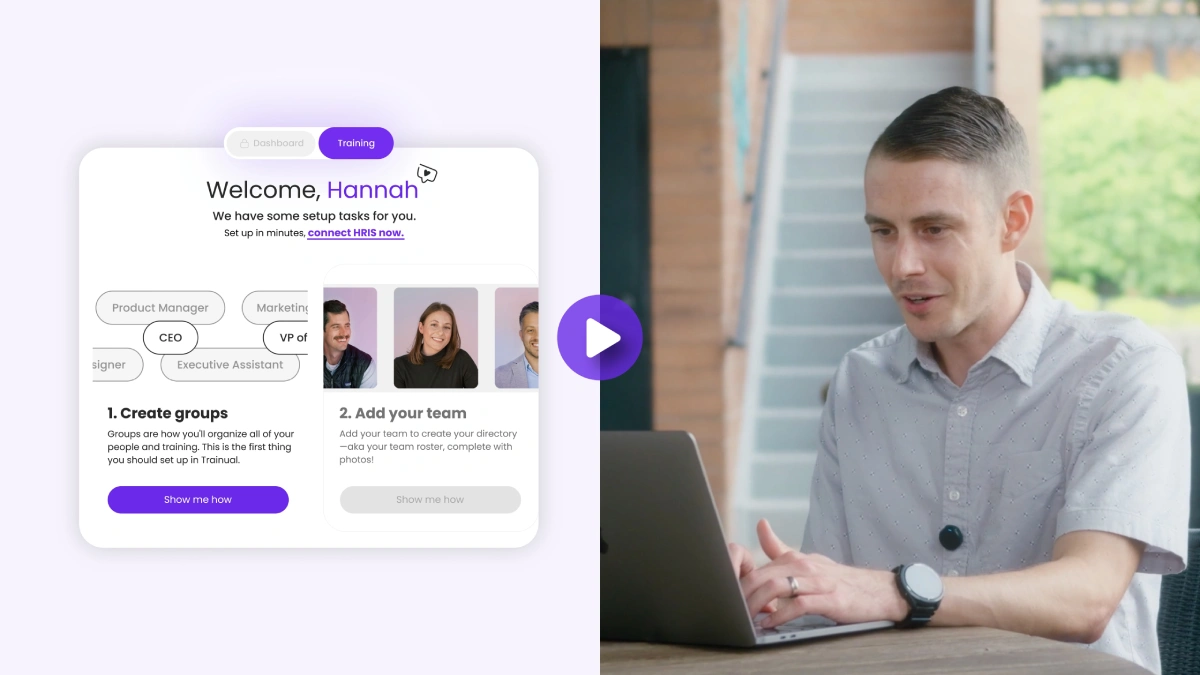
Trainual gives multi-location companies the operating system to fix this. One platform that's the source of truth for every location. Role-based assignment that pushes the right content to the right team members regardless of site. Version history that ensures every location is on the latest version. Reporting dashboards that make drift visible before it becomes a problem. The new-location playbook that compounds with every opening.
Imagine a company where every location runs on the same proven operating system, every customer gets the same experience regardless of which site they visit, and every new opening spins up on a playbook that works. That's what's possible when multi-location operations run on a system instead of running on memory.
Ready to see how Trainual works?
👉 Book a demo and experience how Trainual standardizes operations across every location.
Want a sneak peek?
👉 Explore real customer stories from multi-location companies who've built one shared operating system.