





It's 5:55 AM on a Saturday in June. Your district manager is in his car heading to the third of four stores he's covering this weekend. The newest location — a 90-day-old store with a fresh GM — just texted: "How do we close out the deposit when the POS shows variance and the cash drawer doesn't?" Two of his stores hit their Friday numbers and two missed by a meaningful margin. The franchisor's corporate brand audit team is coming on Tuesday and at least two stores still haven't refreshed their summer signage rotation. A senior GM at the flagship location just put in two weeks notice — recruited by a competitor concept. By 7:00, the DM has answered the cash-drawer question over text, missed the brand audit prep call he was supposed to be on, and realized he hasn't slept more than five hours any night this week.
This is what daily operations look like at most growing multi-location operators — whether you're a franchise of one concept or a multi-unit independent. Not chaotic — exactly — but held together by district managers and a handful of senior GMs who carry the whole operation in their heads. The opening checklists, the brand standards, the cash-handling protocols, the way the senior DM trains a new GM, the unwritten rules about which suppliers are reliable. It all works. Until you scale past 5-10 units, or a senior person leaves, or corporate changes a brand standard mid-quarter.
Then the cracks show. Brand audit scores drop at the locations the DM couldn't visit. New GMs ramp slowly and ask the same questions every week. Margin variances widen because nobody documented the inventory-management workflow consistently. Customer experience drifts location to location. And the area developer or multi-unit owner is burning weekends trying to hold the system together.
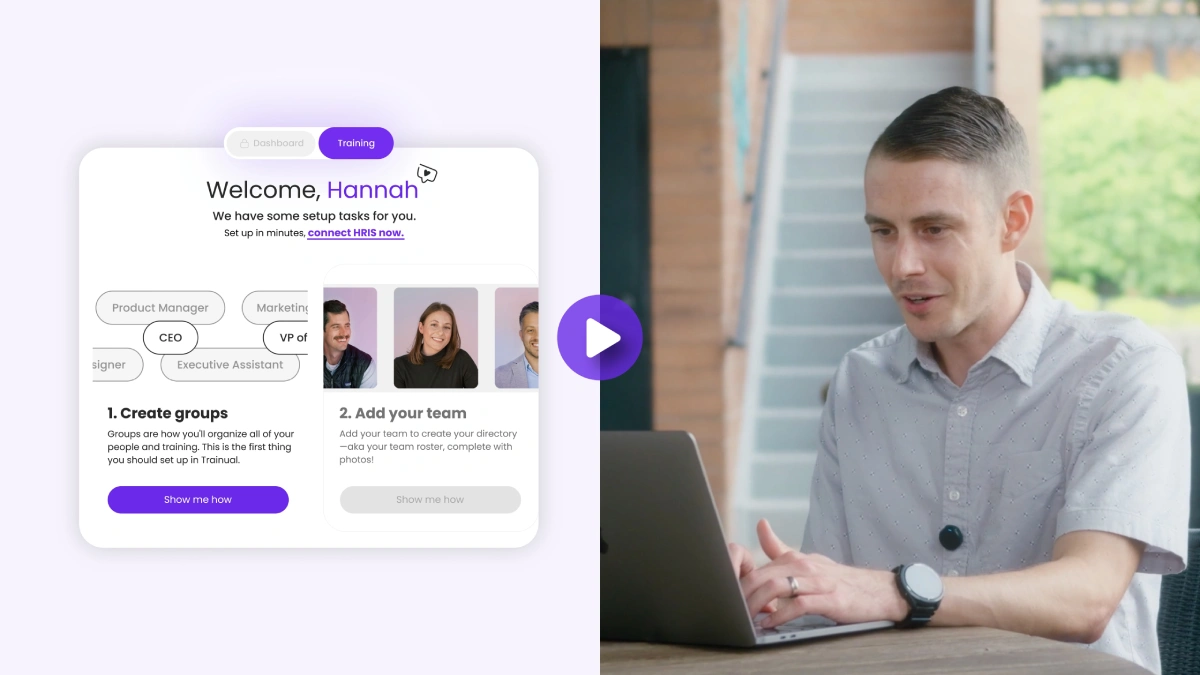
This is why franchises and multi-location operators are increasingly choosing Trainual to run daily operations — not as a replacement for the POS or the back-office systems, but as the connective tissue that ties every store, every GM, every shift, every region into one operating system. This guide covers why multi-location operations fall apart faster than most industries' operations do, what the right daily operations system has to handle, and how to roll it out across a multi-unit operation without disrupting the existing locations.
The Real Cost of Multi-Location Operations Running on Guesswork
Multi-location operating is one of the most operationally complex environments in business — every additional unit multiplies coordination load, not just sales. Three realities make daily operations harder here than in single-location operating:
- Brand consistency breaks faster than you can rebuild it. When you have one location, the founder's standards are the standards. When you have five, you have a DM holding the line. When you have fifteen, the DM can't be at every store every day, and brand standards drift unless they're documented and trained against in a system. The customer who has a great experience at location 1 and a mediocre experience at location 8 doesn't think "well, location 8 has new staff" — they think the brand is inconsistent.
- Manager turnover is the silent killer. Every GM departure means a 90-day re-ramp during which the location underperforms and the DM has to backfill knowledge gaps personally. Industry research consistently shows that 20.5% of new hires leave in the first 90 days across industries. In multi-unit operations, where GMs are the operating ceiling for each location, a 20% rate on GM hires means real revenue impact every quarter.
- The DM job becomes impossible past a certain unit count. A district manager can hold 4-6 stores in their head. Past that, the DM becomes a bottleneck — and the operation slows to the speed of whatever the DM can personally cover. Every question that should be answered by documentation ends up as a text to the DM. Every brand standard that should be self-enforcing through training becomes a DM intervention. The operation can't scale past the DM's bandwidth without a system that absorbs the coordination load.
And the underlying problem is the same one every multi-unit operator hits: the operations live in the DM's head, not in a system. When the senior DM takes a week off, brand standards drift at her stores. When a regional manager leaves, an entire region's operational rhythm has to rebuild. The operation runs on memory and scattered know-how — and there's a ceiling on how big you can get on those alone.
We've covered the broader pattern in what happens when your senior employee quits without documenting and the playbook in how to document institutional knowledge before your senior employees leave. The cleanest version of the fix on record is the ProTec Building Services story — 9 offices, 600+ SOPs, one operating system, and a process engineer hired specifically to keep it running. For broader proof, the 5 multi-location companies scaling operations with Trainual round-up covers the pattern across multiple industries.
What Daily Operations Need to Do for a Multi-Location Operation
The right operations system for multi-location isn't a POS. It isn't a back-office accounting platform. Those are operational tools — and you already have them. What's missing is the layer above them: the operating cadence that connects every store to every region, every GM to every shift lead, every brand standard to the documented version of it.
1. Morning Store Huddles and Weekly DM Reviews That Drive Each Day and Week
The best multi-location operations run a tight pre-shift huddle at every store and a weekly DM-to-GM review. Done right, these cover the day's targets, brand standard reminders, shift assignments, and exceptions to escalate. Done poorly — or skipped — and stores drift away from brand standards.
A solid daily operations system supports recurring meeting agendas, action items captured in writing, GM-to-shift-lead handoffs, and a clear escalation path for brand or operational exceptions. Trainual's Operations Suite handles meeting agendas, recurring formats, and action item tracking in one place.
2. Scorecards by Role That Everyone Can See
Sales per location vs. target. Brand audit score. Customer satisfaction by location. GM retention. New GM ramp time. Labor cost percentage. Mystery shop scores. These aren't end-of-quarter metrics — they're the daily and weekly signal that tells you whether each location is healthy.
The right system supports role-based scorecards — shift leads see their shift metrics, GMs see store-level rollups, DMs see district rollups, area developers and multi-unit owners see brand-wide views. Each role has its own scorecard.
3. Action Items That Don't Fall Through the Cracks
A store needs a new POS terminal. A brand audit corrective action is due Tuesday. A GM needs counseling on labor variance. A new product launch needs rollout coordination. In most multi-location operations, these things live in DM text chains, in someone's email, in the area developer's notebook, or in a head. They get lost.
Trainual's Operations Suite captures action items inside meetings and assignments — with owners, due dates, and follow-through tracked. No more "I thought you were handling the audit corrective."
4. Async Updates That Replace Status Meetings
DMs can't lose hours per week to status calls. GMs can't either — they're supposed to be on the floor. The best multi-location operations run async updates instead — written end-of-shift or end-of-week summaries from GMs that capture what happened, what's outstanding, and what needs DM attention. DMs review on their schedule, decisions happen in writing.
Covered further in how to use an LMS for team accountability tracking and reporting.
5. Operational Documentation That Connects to Training
This is the structural advantage course-based LMS platforms can't match. Your operational SOPs (opening checklist, closing checklist, cash handling, brand standards, mystery shop response, brand audit prep) and your training content (new GM ramp paths, shift lead development, brand training, food safety where applicable, OSHA, multi-unit consistency training) are the same content seen from two angles.
When process documentation and structured training paths live in the same system, you maintain content once and use it twice. Covered in why franchises and multi-location retailers choose Trainual and top 7 LMS platforms for multi-location process standardization in 2026.
Five Operations Mistakes Multi-Location Operators Make (and How to Fix Them)
Mistake #1: Running daily ops through GroupMe, text chains, and store-by-store Slack
The problem: critical operational information lives in a dozen channels — a GroupMe for the DM team, a separate one for GMs in one region, individual text chains per store, an old Slack instance that some GMs use and others don't. When something breaks, nobody knows where the answer is.
The fix: consolidate operational information into a single searchable knowledge base. Group texts and Slack stay for in-the-moment coordination — but the persistent operational record lives in one place.
Mistake #2: Letting goals live in spreadsheet rollups nobody updates
The problem: someone built a beautiful multi-location KPI rollup in January. By March it's three weeks behind on data entry. By July nobody opens it. The team can't tell you which location is at risk on brand audit, which GMs are over labor budget, or where retention is weakest.
The fix: scorecards in a system connected to the operating cadence. Tied to roles via the role chart.
Mistake #3: Action items captured in DM meeting notes nobody opens
The problem: every Monday DM call generates a notes doc. By Friday nobody remembers who agreed to send the corrective-action plan to the franchisor. The franchisor flags it on the next audit cycle.
The fix: action items in the operating system with owners, due dates, leadership visibility.
Mistake #4: Async updates replaced by daily DM calls
The problem: an area developer or multi-unit owner feels disconnected, so a daily 30-minute DM check-in goes on the calendar. DMs spend hours per week on status calls instead of being in stores. Multiply by 5 DMs × cost per hour and the meeting habit costs real margin.
The fix: async updates replace daily status calls. Real meetings happen for decisions, not for status.
Mistake #5: Operations and training in separate systems
The problem: your opening checklists live in a Google Drive folder, your brand training lives in the franchisor's separate LMS, your food safety training lives in a third compliance platform, your new GM ramp lives in a senior DM's brain. Maintaining them is a part-time job. New GMs get one version of the opening checklist in training and a different version at the store.
The fix: collapse training and operations into the same platform. Covered in how to roll out an LMS without it failing. The 5 multi-location companies scaling operations with Trainual round-up shows the pattern across multiple industries.
What 30 Days of Better Multi-Location Daily Operations Looks Like
Week 1: Audit where information is getting lost
Pull up your last 30 days of operational misses — brand audit findings, missed corrective actions, GM questions that ate up DM time, locations that drifted, new-hire questions that went unanswered. Tag each by category.
Week 2: Set the operating cadence
Build recurring meeting agendas, scorecard format, async update templates.
Week 3: Pilot with one region or one DM's stores
Pick one DM's portfolio or one region. Run the new cadence for a week. Refine.
Week 4: Expand and measure
Roll out to broader operation. Track metrics. Watch for tighter brand consistency, faster GM ramp, fewer DM interruptions.
Month 2 and beyond
By month 3, the operating cadence becomes how the brand runs.
Quick Wins to Start This Week
Quick win #1: Document your pre-shift huddle and DM review agenda
Get it out of your senior DM's head and into a process document.
Quick win #2: Pick three metrics every GM should see daily
Sales vs. target, labor percentage, brand audit readiness. Tied to their role.
Quick win #3: Move one recurring meeting to an async update
Replace lowest-stakes recurring DM call with a written update for one week.
Quick win #4: Document one tough GM-development or brand-judgment call
Capture the senior DM's reasoning. Add to your knowledge base. Covered in how to turn institutional knowledge into documented systems.
Quick win #5: Set the "search before asking" rule
Covered in the hidden cost of relying on senior employees as the help desk.
How Do You Run Daily Operations Across 5, 25, or 100 Locations Without Losing Visibility?
The challenge: as soon as a multi-location operation scales past 5 units — and certainly past 10 — the informal operating model breaks. The DM can't be at every store. Brand standards drift.
The solution: structured visibility without micromanagement.
- One operating cadence across every location. Same pre-shift huddle. Same scorecards. Same async update cadence.
- Role-based access via role chart.
- Single searchable knowledge base keeping standards consistent.
- Distributed reporting — covered in how to use an LMS for team accountability tracking and reporting.
The ProTec Building Services story is the strongest proof point — 9 offices, 600+ SOPs, unified operations. The top 7 LMS platforms for multi-location process standardization covers the broader category.
How Do You Keep Operations Current as the Brand Evolves and GMs Turn Over?
The moving target: corporate brand standard updates, FDD changes for franchisors, menu or product rollouts, equipment changes, plus constant GM and shift lead turnover.
The fix:
- Document standards once, train continuously.
- Update documentation with version history.
- Build the documentation habit into senior DMs and franchisor field staff — covered in how to use Trainual AI.
- Pressure-test before senior departures — covered in how to document institutional knowledge before your senior employees leave.
How to Measure Operational Success in a Multi-Location Operation
1. Brand audit score by location
The single most predictive metric for brand health. Trending up means standards are being enforced; trending down means drift.
2. Sales per location vs. target
The financial signal. Healthy operations hit target consistently across the unit base.
3. Action item closure rate
Of action items captured each week, what closes on time? Healthy operations close 85%+.
4. New GM ramp time to first 90 days of brand-audit-passing operation
How long until a new GM is independently running their location at the standard?
5. Customer satisfaction and brand consistency score across locations
The downstream signal. Healthy operations show consistent customer experience scores across the unit base.
Run Multi-Location Operations Like a System, Not a Scramble
The hard truth about scaling past 5-10 units: you cannot run the operation through GroupMe, spreadsheet rollups, and DM memory. You scale by building the operating system that holds every location's daily cadence — meetings, scorecards, action items, async updates, and operational documentation — in one place every store, every GM, every shift lead can reference.
Trainual was built for exactly this. Document the way your brand runs. Connect every standard to the role responsible for it. Train new GMs and shift leads through structured onboarding paths. Use AI-powered search.
Ready to see how Trainual works for multi-location operations?
👉 Book a demo and see how Trainual helps multi-location operators turn scattered daily operations into a connected operating system.
Want a sneak peek?
👉 Read customer stories from multi-location teams — including ProTec Building Services (9 offices, 600+ SOPs) and the 5 multi-location companies scaling operations with Trainual round-up.
Frequently Asked Questions
What's the best operations software for a franchise or multi-location operation?
The best operations software for multi-location handles meetings, scorecards, action items, and operational documentation in one connected system — and ties to GM and shift lead training. Trainual is purpose-built for this, especially for operators past 5 units. Covered in detail in top 7 LMS platforms for multi-location process standardization in 2026.
How is Trainual different from POS or back-office systems?
POS handles transactions; back-office handles inventory, scheduling, and accounting. Trainual handles the operating cadence above them — meetings, scorecards, action items, operational documentation, and training that ties every location, every GM, every shift lead to the same standards.
How long does it take to roll out Trainual for multi-location operations?
Meaningful improvements within 30 days at the pilot locations, full cadence bedded in across all units by 90-120 days for operators with 10+ locations. The ProTec story shows the long-tail compounding across 9 offices. Covered in how to roll out an LMS without it failing.
Can Trainual handle both multi-location operations and training in one system?
Yes — and most multi-location operators use it for both. Operational documentation (opening checklists, brand standards, cash handling, mystery shop response) and training (new GM ramp, shift lead development, brand training, food safety) live in the same platform. Covered in why franchises and multi-location retailers choose Trainual and the 5 SOPs every franchise and multi-location needs.
How does Trainual handle franchisor-franchisee dynamics?
For franchisors, Trainual functions as the brand-standard delivery platform — content created once by corporate and pushed consistently to every franchisee location with version control. For franchisees and area developers, Trainual functions as the location-level operating system tied back to corporate standards. The role chart handles content assignment by role, location, and franchisor-vs-franchisee scope.
What if our GMs and shift leads resist adopting a new operations system?
Common objection, solvable. The DM and senior GMs have to model the new cadence, and the platform has to be searchable on mobile enough that finding the answer beats asking. Covered in the psychology of why teams ignore training.
Is Trainual a good fit for a 3-unit operator, or only for larger brands?
Trainual is purpose-built for 25 employees and up — and in multi-location, the sweet spot starts around 5+ units where the DM bandwidth limit hits. A 3-unit operator with 25+ employees absolutely fits; under 3 units, you usually don't yet need a system — you need documented procedures in any tool. Right in the 5-50 unit range is where Trainual provides the most differentiated value.