





Ever ask in a leadership meeting whether the team has actually completed the new compliance training, get four different answers from four different managers, and realize halfway through that nobody actually knows? You ask everyone to follow up by Friday. By Friday you have completion data from three managers, partial data from one, and a shrug from the fifth. You make decisions based on incomplete information. The next quarter, you do it again. Accountability isn't broken because the team doesn't care. It's broken because you don't have the visibility to track it without someone manually putting the data together every time.
That's the accountability tracking problem most growing companies live in. Managers care about accountability. Leaders care about accountability. The team mostly cares about accountability. But the systems that should make accountability visible — completion tracking, acknowledgment status, training progress, sign-off audit trails — don't exist or don't talk to each other. So accountability becomes a manager-by-manager judgment call, instead of a system the team operates on.
The data is consistent. Only 21% of employees worldwide are engaged at work. Engagement and accountability move together — when team members can see clearly what's expected and how they're tracking against it, both improve. Companies with strong accountability practices see 82% better retention and 70% higher productivity. And meaningful accountability requires visibility — without dashboards and tracking, leaders can't reinforce what they can't see.
This guide walks through how a learning management system (LMS) — used the right way — turns team accountability from a manager-dependent guess into a verifiable, dashboard-driven system. Not just a content tracker. A real operating layer where every responsibility, every completion, and every sign-off is visible.
Why accountability breaks at scale
At 5 employees, accountability is a 1-on-1 conversation. The senior person knows what each team member is supposed to do and can tell whether they did it. At 25, it's harder — managers track their own teams, but visibility across teams is patchy. At 50, accountability becomes survey-based or anecdotal — leaders know what the loudest voices say but not what the data says. By 100+, accountability is a quarterly project, not a continuous practice.
The pattern is consistent. The reason isn't bad management. It's that informal accountability doesn't scale. It depends on real-time human attention. The more people you have, the less attention each one gets — and the more accountability becomes assumption.
The cost of that drift shows up everywhere:
- Leaders making decisions on incomplete data because tracking is manual
- Managers spending hours putting completion reports together instead of coaching
- Inconsistent accountability standards across teams (the team where the manager tracks closely vs. the team where the manager doesn't)
- Compliance gaps when sign-offs aren't tracked centrally
- Performance review surprises because nobody had visibility into ramp-up
- Senior employees who quietly underperform because nobody can see the gap until it's a real problem
A good LMS — used as more than a content library — fixes this. Here's how.
What an LMS does for accountability tracking
An LMS turns accountability from a manager-dependent guess into a real-time, visible system. Here's what changes:
The combination is what turns accountability from periodic review to continuous visibility. Without it, leaders make decisions on incomplete information. With it, the data is always there.
The 6-step framework for using an LMS for accountability tracking
Here's the framework — start to finish.
Step 1: Define what accountability actually means at your company
Before tracking anything, define what you're tracking. Accountability is too vague to be useful as a goal. Specific accountability metrics are not.
Useful framing: for each role on your team, what specific responsibilities does the role own end to end? What does it mean for that role to be "current" on training, policy, and ramp-up? What evidence would prove the role is meeting expectations?
Common accountability dimensions that matter:
- Training completion (did the team complete required content?)
- Policy acknowledgment (have employees signed off on current policies?)
- Comprehension (did they understand what they read?)
- Ramp-up progress (are new hires hitting their milestones?)
- Performance against role expectations (is the role delivering its outcomes?)
Most teams need to track most of these. Defining them clearly is the foundation.
Step 2: Build the content the accountability runs on
Accountability requires content to track against. If you don't have documented role expectations, training paths, and policies, there's nothing to track completion of.
Make sure each role has documented responsibilities, a structured ramp-up path, key policies that need acknowledgment, and ongoing training requirements. The accountability infrastructure runs on this content.
Step 3: Set up tracking and reporting
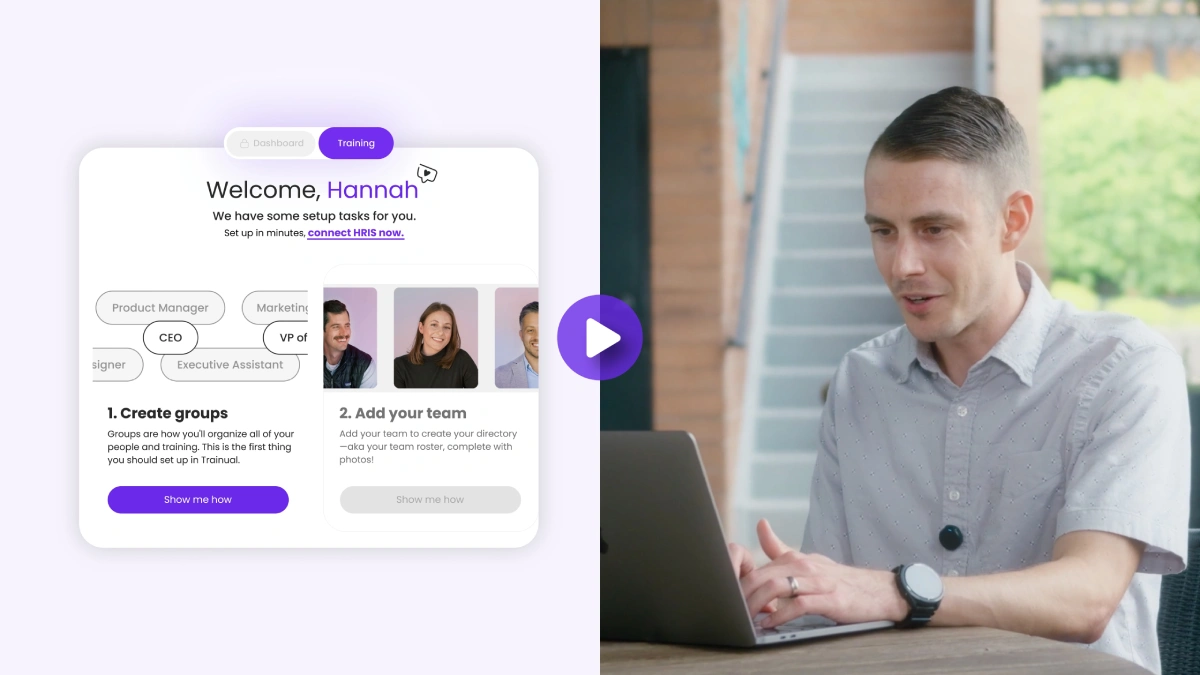
Configure your LMS to track completion, acknowledgment, knowledge check scores, and ramp-up progress for every role. Set up manager dashboards so each manager has real-time visibility into their team. Set up leadership reporting that aggregates the data across teams.
This is the visibility layer. Without it, the data exists but nobody can act on it. With it, leaders can see in seconds what used to take hours of manual reporting.
Step 4: Use role-based assignment to push the right content to the right people
Accountability tracking only works if the right content is assigned to the right people. Use role-based assignment so every team member sees the content that applies to their role. The tracking flows from the assignment.
When a new policy is rolled out, it pushes to the affected roles. When an employee acknowledges, the tracking captures it. When someone joins a new role, the role-based assignment automatically updates their content. The system does the work that managers used to do manually.
Step 5: Build the manager review cadence
Accountability tracking creates the data. Managers turn the data into action. Build a regular cadence where managers review their dashboards — weekly at first, then settling into whatever cadence fits the team's rhythm.
The dashboard becomes part of every 1-on-1. "I see you're behind on the new compliance training — let's talk about it" replaces "Hey, did you finish that thing I sent?" Managers shift from chasing completion to coaching application.
Step 6: Use the data to improve, not just police
The most important step is the cultural one. Accountability tracking can become punitive if leaders use it primarily to identify problems. The teams that get the most value use it primarily to improve — to identify content that isn't landing, training that needs adjustment, or roles that need clearer expectations.
When the team sees the tracking as a system that helps them succeed, accountability becomes a shared norm. When they see it as a system that catches them failing, they learn to game it. The framing matters.
Common mistakes to avoid
The framework works. The implementation is where teams stumble.
Mistake #1: Tracking attendance, not completion
The trap: You track who started the training. You don't track who finished it or whether they passed the knowledge check.
The fix: Track meaningful completion — finishing the path, passing the check, signing off on the version. Attendance is too weak a signal.
Mistake #2: Hiding the data from the team
The trap: Leaders see the dashboards. The team doesn't. People feel surveilled instead of supported.
The fix: Make the data visible to the team itself. Each team member sees their own progress. Each manager sees their team's. Transparency drives the right behaviors.
Mistake #3: Not following up on incomplete data
The trap: The dashboard shows 70% completion. Nobody addresses the 30%. The next quarter, completion is lower.
The fix: Use the dashboard. Manager-level follow-up. Track to higher than 90% completion as the standard, not 70%.
Mistake #4: Tracking too many metrics
The trap: You track everything. Nobody can find the signal in the noise.
The fix: Pick 3-5 accountability metrics that actually matter. Track those well. Add more only after the team is consistently hitting these.
Mistake #5: Using the system to punish, not improve
The trap: Leaders use the data primarily to call out underperformance. The team learns to game the metrics.
The fix: Use the data primarily to improve the system — identify content that isn't landing, training that needs adjustment, roles that need clearer expectations. Punishment is a last resort, not the default.
What rolling this out should look like
Software is half the job. Rollout is the other half.
Week 1: Define your accountability metrics
Decide what you're tracking. For each role, document the responsibilities, the required training, and the policies that need acknowledgment. The clearer the definitions, the more useful the tracking.
Week 2: Build or update the content
Make sure each role has documented responsibilities, a training path, and policies. Without content to track against, the tracking infrastructure doesn't help.
Week 3: Configure tracking and dashboards
Turn on completion tracking, acknowledgment tracking, and reporting. Set up manager dashboards. Make sure each manager can see their team in real time.
Week 4: Train managers on the dashboard
Show every manager how to read their dashboard. Set the expectation that the dashboard becomes part of weekly 1-on-1s. The system only works if managers use it.
Month 2
Track real usage. Identify which managers are leveraging the dashboard and which aren't. Coach the ones who aren't. The discipline of using the data is what creates the accountability.
Month 3
Use the data to refine the system. Where is content not landing? Which roles need clearer expectations? Which managers need coaching on accountability practices?
Quick wins you can implement this week
You don't need a full rollout to see value.
Quick win #1: Pull current completion data for one critical training
Pick one piece of training every employee is supposed to complete. Pull the actual completion data. The number will be eye-opening. That's your baseline.
Quick win #2: Set up acknowledgment tracking on one critical policy
For your most important policy — code of conduct, harassment, safety — turn on acknowledgment tracking and require sign-offs. The audit trail starts compounding immediately.
Quick win #3: Build a simple completion dashboard
For one team or department, build a simple dashboard showing completion rates for required content. Share it with the manager. Watch the manager's behavior change once they have visibility.
Quick win #4: Audit your last quarterly accountability review
Look at the last quarterly review. How much manual data gathering went into it? That's your time-recovery opportunity.
Quick win #5: Identify the 3 metrics that matter most
For your team, what are the 3 accountability metrics that most directly drive results? Track those three. Ignore the rest until those are nailed.
How to measure accountability tracking success
You can't fix what you can't measure.
1. Time to complete required training
Track how long it takes the team to complete required training after assignment. A falling number means accountability is working.
2. Acknowledgment rate
Track what percentage of affected employees have acknowledged each policy. Aim for 95%+ within two weeks of every rollout.
3. Manager dashboard usage
Track which managers are actually using the dashboards. Adoption is the leading indicator. If managers aren't using the data, the system isn't working.
4. Compliance audit results
For regulated industries, the strongest measure: how clean are your audits? Tracking and acknowledgment should make every audit straightforward.
5. Performance review consistency
When accountability tracking works, performance reviews align across managers. Track variance in performance review outcomes for similar roles. Less variance means clearer expectations and better tracking.
Stop guessing. Start tracking.
Most growing companies have an accountability problem they can't see clearly until it's hard to fix. Managers care. Leaders care. The team mostly cares. But the systems that should make accountability visible don't exist or don't work — so accountability becomes a manager-by-manager judgment call instead of a shared standard.
Trainual gives growing companies the operating system to fix this. Completion tracking that makes training landing visible in real time. Acknowledgment tracking with audit trails for every policy. Manager dashboards that turn invisible work into actionable data. Leadership reporting that aggregates across teams, departments, and locations. The visibility layer that makes accountability scale.
Imagine a company where every leader has real-time visibility into their team's progress, every manager runs 1-on-1s with data instead of guessing, and every audit is straightforward because the record exists. That's what's possible when accountability runs on a system instead of running on assumption.
Ready to see how Trainual works?
👉 Book a demo and experience how Trainual makes team accountability visible across a growing company.
Want a sneak peek?
👉 Explore real customer stories from teams who've made accountability a real practice.