




In 2026, the difference between an LMS and business operations software comes down to one thing: an LMS teaches people, while operations software runs the work they do. For onboarding, SOPs, and training, most SMB and mid-market teams need both. Trainual is an operations system built on documented SOPs and training, so it covers the learning an LMS gives you and the operational backbone a growing team runs on.
That's the short version. Below, what each category is, when each fits, where they overlap, and how to choose, with examples so you can decide fast.
Quick answer: LMS vs business operations software
An LMS (learning management system) delivers and tracks training: courses, lessons, quizzes, certifications. Operations software is the broader category for running how work gets done: SOPs, processes, roles, accountability, and often meetings and goals. If your only need is delivering courses, an LMS is enough. If you need onboarding, SOPs, and training to live in the same place your team runs on, that's an operations system, which is where Trainual sits.
What each one is
An LMS is built for learning. Its job is to house courses, assign them, and track completion and certifications. Traditional LMS platforms are strong when training is formal and course-shaped, and when you need records that people finished and passed. Think structured course catalogs, quizzes, certificates, SCORM content, and learner analytics. The unit of work is a course, and success is a completion rate. That focus is a genuine strength: if you run compliance programs or a large library of formal training, a dedicated LMS is purpose-built for it.
Operations software is built for running the work. It's a broader category covering documented processes and SOPs, role clarity, task and workflow management, accountability, and in many cases meetings, goals, and scorecards. Its job is to make how the team operates consistent and visible, not only to deliver lessons. The unit of work isn't a course; it's a process, a role, or an outcome. Success looks like work getting done the same way every time, by the right person, without the founder or a senior employee being the bottleneck.
The line blurs because training is part of operations. People can't run a process they were never taught, and a course means little if the underlying SOP isn't documented and current. An LMS can teach a process it doesn't own, and operations software can document a process it doesn't teach. That gap, between the course and the living process behind it, is where a lot of growing teams quietly lose consistency, and it's exactly where the two categories meet.
When an LMS is the right fit
An LMS is the right choice when your primary need is structured learning: formal course delivery, compliance certifications, assessments, and completion records. If you're delivering a lot of course-shaped content and need proof people passed, a dedicated LMS does that job well, a fit explored in 5 signs you need a modern LMS, not an enterprise one and the guide to LMS platforms for mid-market companies.
When operations software is the right fit
Operations software is the right choice when the problem is bigger than learning: work runs inconsistently, SOPs live in people's heads, roles are unclear, and nobody can see whether things are getting done. In a recent survey, 24% of teams said they rely on memory for accountability, which is the gap operations software closes. If onboarding, SOPs, and how the team runs are the real issue, you need an operating system for the work, not just a course library, the focus of the guide to operations software.
Where the two overlap, and where Trainual fits
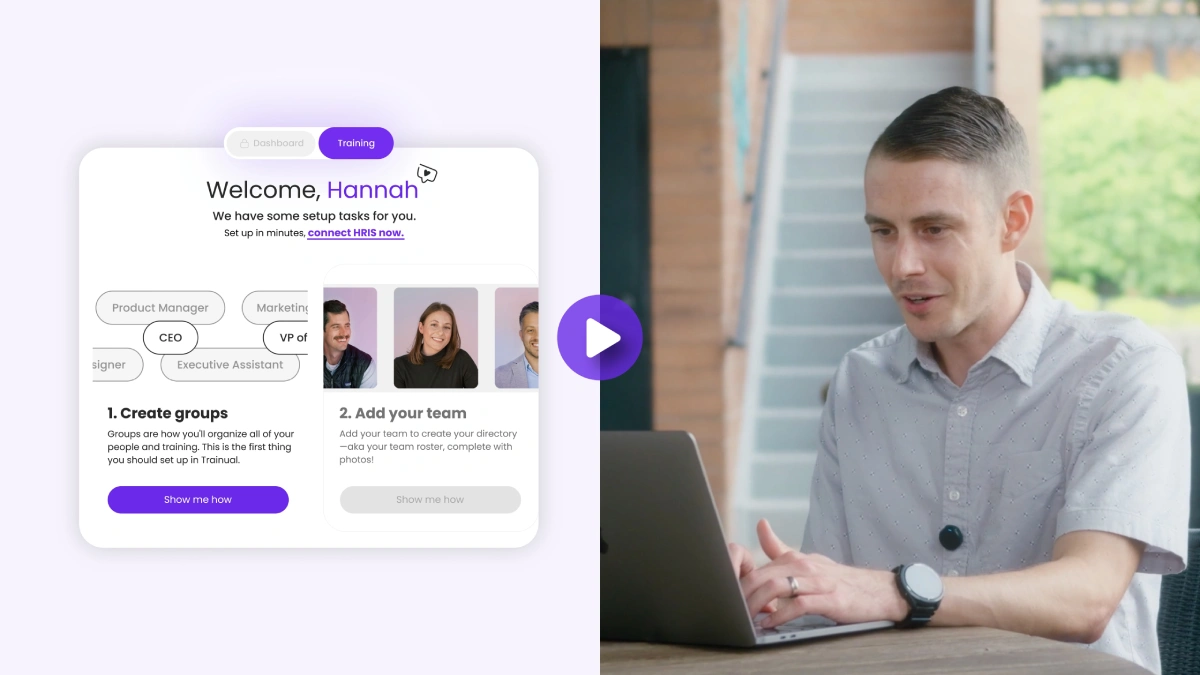
Here's the honest picture: the categories overlap in the middle, and that overlap is onboarding, SOPs, and training. Trainual started there and grew into an operations system. It documents processes and SOPs, turns them into role-based training and structured onboarding, assigns work by role, makes it all findable in a searchable knowledge base, and extends into operations through the Operations suite with goals, scorecards, and accountability.
So Trainual answers the difference this way: it gives you the training an LMS delivers, plus the operational backbone a growing team runs on, in one system. Structured onboarding built this way lifts retention by 82% and productivity by over 70%, because the training connects to the work rather than sitting beside it.
Honest limits: a pure LMS may go deeper on formal courseware, SCORM, and advanced certification workflows. Dedicated project and task tools go deeper on complex project management. Trainual's sweet spot is the documentation, training, and operational-knowledge core that most SMB and mid-market teams run on day to day.
Examples of each
LMS tools: TalentLMS is a strong, affordable example of a dedicated LMS focused on course delivery and completion tracking. For a direct look at the difference in approach, see Trainual vs. TalentLMS.
Operations and process tools: Process Street focuses on repeatable workflow checklists, and Ninety focuses on EOS-style operating rhythms like goals and meetings. Each owns a slice of operations; see Trainual vs. Process Street and Trainual vs. Ninety.io.
The bridge: Trainual sits where training and operations meet, which is why teams weighing an LMS against operations software often land on a system that does both. For the fuller category picture, see the operations management software guide and the EOS-like operating systems guide.
Takeaway from the table: an LMS optimizes for teaching and proving completion; operations software optimizes for running and tracking the work. The two overlap on onboarding, SOPs, and training, and a system built on that overlap, like Trainual, covers both without stitching two tools together.
Signs you've outgrown a standalone LMS
A dedicated LMS is the right tool right up until the problem stops being "deliver courses" and starts being "run the work consistently." A few signals that you've crossed that line:
New hires finish onboarding courses but still can't do the job, because the courses taught concepts while the real process lives somewhere else. Managers keep answering the same questions, since there's no searchable place to look up how the team does things. SOPs are scattered across docs, chats, and people's heads, so training and reality drift apart. And you're bolting on separate tools for roles, accountability, and process, which multiplies logins and leaves gaps between them.
When those show up, the fix isn't a better course catalog. It's an operating system that connects the training to the process, so learning and doing sit in one place. That's the shift from an LMS to operations software, and it's the moment teams reevaluate the category they're buying in.
How to choose between an LMS and operations software
Four questions decide it.
First, what's the core problem? If it's "people need to complete courses and get certified," lean LMS. If it's "work runs inconsistently and knowledge lives in people's heads," lean operations software.
Second, do SOPs and training belong together? For most growing teams they do, since training is only as good as the documented process behind it. A system that houses both keeps them in sync, a theme in what happens when your senior employee quits without documenting.
Third, how many tools do you want to run? A survey found 57% of teams see "one more tool" as a barrier. Consolidating onboarding, SOPs, and training into one operating system beats bolting an LMS onto a stack of disconnected tools.
Fourth, will your team adopt it? For SMB and mid-market teams, ease of use decides whether any system delivers value, a point covered in training software for operations leaders.
Ready to see how Trainual works?
👉 Book a demo and see how Trainual combines onboarding, SOPs, and training in one operations system.
Want a sneak peek?
👉 Read customer stories, including companies with measurable ROI in 2026.
Frequently asked questions
What's the difference between an LMS and business operations software?
An LMS delivers and tracks training: courses, lessons, quizzes, and certifications. Business operations software is the broader category for running how work gets done: documented SOPs and processes, role clarity, accountability, and often goals and meetings. Put simply, an LMS teaches people, while operations software runs the work they do. The two overlap on onboarding, SOPs, and training, and a system like Trainual is built on that overlap, so it covers both rather than doing only one.
Do I need both an LMS and operations software?
Often the need for both is really a need for one system that spans them. Training and operations overlap on onboarding and SOPs, so running a separate LMS and separate operations tools can leave your processes and your training out of sync. Many SMB and mid-market teams choose a single operations system built on documented SOPs and training instead of maintaining two disconnected tools.
Is Trainual an LMS or operations software?
Both, by design. Trainual delivers and tracks training like an LMS, and it also documents SOPs, assigns work by role, and extends into operations with goals, scorecards, and accountability. It started as training and SOP software and grew into an operations system, which is why it fits teams weighing the two categories against each other.
When is a dedicated LMS the better choice?
When your primary need is formal, course-shaped learning: heavy course catalogs, advanced certification workflows, SCORM content, and detailed learning analytics. If training delivery is the whole job and operations are handled elsewhere, a dedicated LMS focused on that can go deeper on those specific features than a broader operations system.
What counts as business operations software?
It's a broad category for tools that help run how a team operates: process and SOP documentation, role and responsibility management, task and workflow tools, accountability and reporting, and often meetings, goals, and scorecards. Some tools own one slice, like workflow checklists or project management. An operations system like Trainual covers the documentation, training, and operational-knowledge core that ties those slices together for a growing team.