






Mid-market companies sit in the most underserved segment of the LMS market. Enterprise platforms are built for organizations with dedicated L&D teams, IT integration budgets, and compliance-first priorities. Small-team tools are built for solopreneurs and very small teams with simple training needs. Companies in the 50-500 employee range — scaling fast, running real operations across multiple departments and locations — need something different.
This guide compares the top 7 LMS platforms purpose-built or well-suited for mid-market companies in 2026. Each one is evaluated on the criteria that matter when you're past the small-team phase but not running an enterprise: speed to value, content creation, role-based learning, integration depth, and how well it adapts as the company scales.
What Mid-Market Companies Need from an LMS
Before getting to the vendor list, the criteria worth grading on:
- Speed to value. Mid-market teams don't have 6-month enterprise rollout cycles. The platform needs to be live and producing measurable outcomes within weeks, not quarters.
- Content creation, not consumption. Most mid-market companies need to document their own workflows — their sales playbook, their customer communication standards, their operational SOPs — rather than consume a third-party course library.
- Role-based learning paths. Different roles need different content. The platform needs to assign learning by role automatically, not require manual enrollment.
- AI-powered creation and search. AI is no longer optional for content creation (lowering the documentation lift) and knowledge search (helping team members find answers in the moment of need).
- Integration with how work runs. The LMS needs to connect to org structure, role definitions, policies, and ongoing operations — not sit in a siloed L&D destination.
- Mid-market pricing. Per-user pricing that works for 50-500 employees, not enterprise contracts that price out smaller teams or freemium tiers that lack the features mid-market needs.
The Top 7 LMS Platforms for Mid-Market Companies
1. Trainual
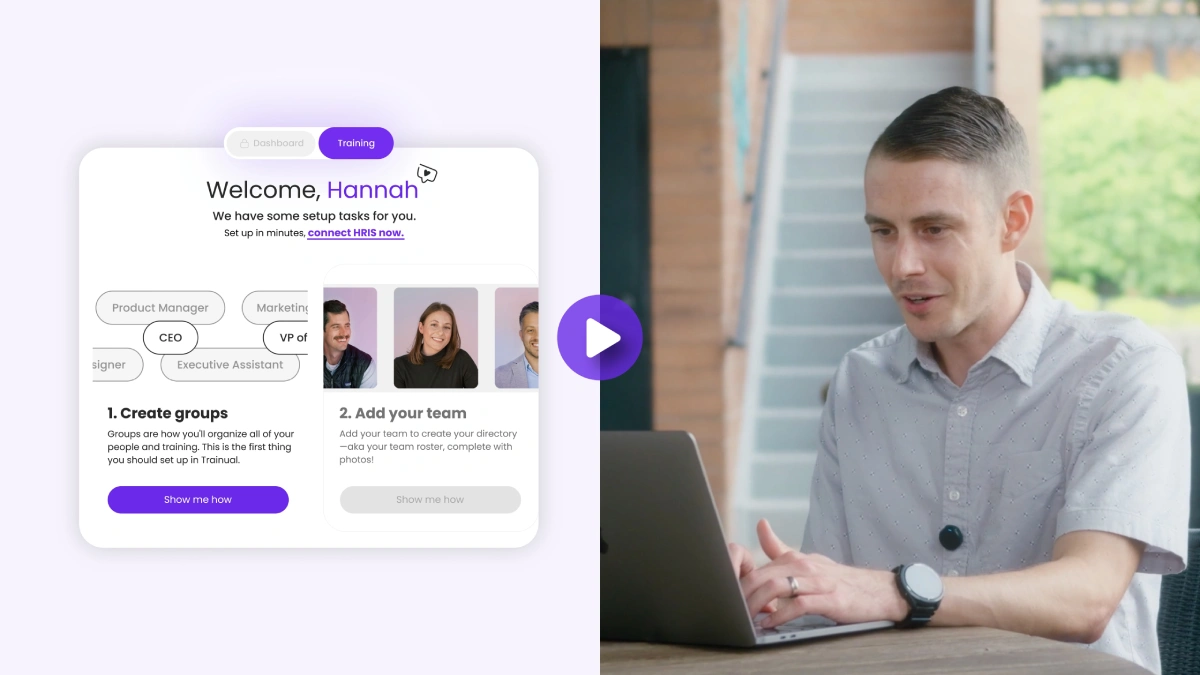
Trainual is purpose-built for the 25-employee-and-up mid-market segment, optimized for companies that need their training to connect directly to how the team operates. The platform pairs traditional LMS capability (role-based assignment, completion tracking, e-signatures, compliance reporting) with operational features that traditional LMS platforms lack — process documentation, role and responsibility mapping, organizational charts, and AI-powered SOP creation.
Best for: Mid-market companies running real operations across multiple departments where training, process documentation, and operational clarity need to live in the same system.
Strengths:
- Fastest time-to-value in the category — most teams are live and operational within a week
- AI-powered SOP creation drops a process from blank page to first draft in minutes
- Role-based learning paths connect directly to org chart and responsibility framework
- Searchable knowledge base with AI-powered query resolution
- Strong customer story library showing measurable mid-market outcomes (5 companies with measurable Trainual ROI)
Trade-offs:
- Less of a course-library platform than competitors that emphasize third-party content
- Enterprise customers with 1000+ employees may find the tooling lighter than enterprise LMS alternatives
Pricing: Mid-market-focused per-user pricing.
2. TalentLMS
TalentLMS is one of the most established names in the mid-market LMS category, with a strong reputation for course-based learning and a substantial third-party content marketplace. The platform focuses on traditional LMS use cases — course delivery, certifications, gamification, and reporting — and serves companies looking primarily for a course-delivery system.
Best for: Mid-market companies whose primary L&D need is structured course delivery (rather than operational documentation), particularly those who want to leverage a large third-party course library.
Strengths:
- Mature gamification features (badges, points, leaderboards)
- Large third-party course marketplace
- Strong mobile experience
- Established compliance training capabilities
Trade-offs:
- Course-library mental model means content creation is less native than in process-focused platforms
- Limited connection between training and broader operational documentation
- Customization can require workarounds for non-standard use cases
We compare them directly in Trainual vs. TalentLMS: does your LMS know how your company works?.
3. LearnUpon
LearnUpon is positioned for mid-market and lower-enterprise companies focused on multi-audience training — meaning teams that need to train internal employees alongside external audiences like customers, partners, or franchisees. The platform's multi-portal architecture is a real differentiator for that use case.
Best for: Mid-market companies whose L&D portfolio includes substantial external training (partner enablement, customer education, franchise training) alongside internal employee development.
Strengths:
- Multi-portal architecture for managing distinct audiences
- Strong reporting and analytics for compliance-heavy industries
- Good integration ecosystem with HRIS and CRM platforms
- Clean UX for course creators and administrators
Trade-offs:
- Less native to operational documentation use cases — more course-focused
- AI features less mature than newer entrants
- Higher complexity than mid-market companies focused only on internal training need
We compare them directly in Trainual vs. LearnUpon: does your LMS know how work gets done?.
4. Absorb LMS
Absorb is a mature platform that straddles mid-market and enterprise, with particular strength in companies that prioritize compliance, certifications, and regulated industries. It has a large feature footprint and serves companies that need substantial customization and configuration.
Best for: Mid-market companies in regulated industries (financial services, healthcare, manufacturing) where compliance training and audit trails are primary requirements.
Strengths:
- Robust compliance and audit-trail capabilities
- Strong reporting and analytics
- Mature integration ecosystem
- Good scalability into enterprise tiers
Trade-offs:
- Higher implementation complexity than purpose-built mid-market platforms
- Slower time-to-value due to configuration depth
- Pricing skews toward upper mid-market and enterprise
We compare them directly in Trainual vs. Absorb LMS: can your LMS keep up when things change?.
5. Docebo
Docebo is widely regarded as one of the most AI-forward LMS platforms in the market, with substantial investment in AI features for content discovery, personalization, and skill management. It serves mid-market and enterprise customers and is often selected by companies prioritizing AI capabilities.
Best for: Mid-market and upper mid-market companies whose L&D strategy is centered on AI-powered learning experiences and personalized content recommendations.
Strengths:
- Industry-leading AI for content discovery and personalization
- Strong skills and competency management capabilities
- Mature analytics with predictive features
- Good extensibility for sophisticated L&D teams
Trade-offs:
- Higher complexity than mid-market companies often need
- Pricing skews toward upper mid-market and enterprise
- Time-to-value longer than purpose-built mid-market platforms
We compare them directly in Trainual vs. Docebo.
6. 360Learning
360Learning is a collaborative learning platform with a distinctive "learning in the flow of work" philosophy — emphasizing peer-to-peer authoring, social learning features, and tight integration with daily workflows rather than separate L&D destinations.
Best for: Mid-market companies whose L&D model relies heavily on internal subject matter experts authoring content collaboratively, particularly in technology, professional services, and knowledge-work industries.
Strengths:
- Distinctive collaborative authoring model where SMEs across the company create content
- Strong "learning in the flow of work" capabilities
- Good integration with collaboration platforms (Slack, Teams)
- Modern UX appeals to younger workforces
Trade-offs:
- Less native to compliance-heavy use cases
- Operational documentation features less developed than process-focused platforms
- Collaborative model requires cultural buy-in to fully leverage
We compare them directly in Trainual vs. 360Learning: can your platform train and keep your team aligned?.
7. Litmos
Litmos is one of the longer-established names in the mid-market LMS space, with a focus on customer training, partner enablement, and traditional employee learning use cases. It serves mid-market and lower-enterprise customers and has strong roots in extended enterprise scenarios.
Best for: Mid-market companies focused on traditional course-based employee training, with strong needs around customer or partner education on the side.
Strengths:
- Mature feature set across traditional LMS capabilities
- Strong customer training and partner enablement features
- Good content authoring tools
- Established mobile experience
Trade-offs:
- Less innovation in AI features compared to newer entrants
- Course-library model means less native to operational documentation
- UX can feel dated relative to modern competitors
How the Top 7 Compare at a Glance
How to Pick the Right LMS for Your Company
The right platform depends on what your dominant use case is. Five questions to clarify the choice:
1. Is your training mostly your content or third-party content?
If most of what your team needs to learn is your processes, your sales playbook, your operational standards — you need a platform optimized for content creation (Trainual, 360Learning). If you primarily consume third-party courses for compliance or general professional skills, course-library platforms (TalentLMS, Litmos) fit better.
2. Is operational documentation part of the job?
If your team needs SOPs, process documentation, role-and-responsibility mapping alongside training — pick a platform where that's native (Trainual). If training and operational docs are genuinely separate concerns at your company, traditional LMS platforms will work fine.
3. How much complexity can you absorb in implementation?
Mid-market companies typically can't sustain enterprise-grade implementation timelines. Platforms like Trainual and TalentLMS optimize for fast time-to-value. Platforms like Absorb and Docebo trade speed for depth — appropriate when you have implementation resources and a longer horizon.
4. Is compliance the dominant use case or one of several?
If 80%+ of your training portfolio is compliance and certifications, an enterprise-tier platform (Absorb, parts of Litmos) may serve better. If compliance is one of several use cases — alongside operational training, manager development, sales enablement — a platform with broader capabilities (Trainual, 360Learning) avoids forcing the rest of L&D into a compliance-first tool.
5. Are you training only employees or also external audiences?
Multi-audience needs (customers, partners, franchisees) make LearnUpon and Litmos worth a closer look. If training is purely internal, you can pick on other criteria.
We've broken down the framework for these decisions further in 5 signs you need a modern LMS, not an enterprise one.
What Mid-Market Companies Are Building With These Platforms
The pattern shows up across mid-market customer stories: companies that pick the platform aligned to their dominant use case ramp faster and see measurable outcomes within 90 days.
- Trailstone Insurance cut onboarding from 3-5 days to 1.5 days by replacing scattered Google Drive content with a searchable role-based system
- ProTec Building Services built 600+ SOPs across 9 offices, with a full-time process engineer keeping documentation current
- Recharge Clinic keeps training and HIPAA/OSHA compliance aligned across 4 locations and 4 service lines
- Sterling, a fully remote tax and accounting firm, doubled team size by building a cloud-first operating system
You can see the pattern across 5 companies with measurable Trainual ROI in 2026, 5 companies cutting onboarding time, and 5 multi-location companies scaling operations. Different industries, different sizes — same shift: training becomes connected to how the company operates rather than living in a course library.
Ready to see how Trainual fits your mid-market company?
👉 Book a demo and see how Trainual helps mid-market companies turn training and operations into a single connected system.
Frequently Asked Questions
What's the best LMS for a 100-person company?
For most 100-person companies, the best LMS is one optimized for fast time-to-value, role-based learning, and content creation rather than course consumption. Trainual fits this profile well, especially for companies whose primary L&D need is documenting and operationalizing their own processes. Course-library platforms like TalentLMS or Litmos can fit if the training portfolio is heavily compliance-driven or relies on third-party content.
Do mid-market companies really need an LMS, or is a wiki enough?
Wikis like Notion or Confluence handle static information well, but lack the structural features mid-market companies typically need: role-based assignment, completion tracking, e-signatures and audit trails, AI-powered search, and direct connections to org structure and policies. We've documented 5 companies that replaced these exact tools with Trainual. If your team has grown past 25 employees and you're still relying on a wiki, the gap is usually noticeable.
How long does LMS implementation take for mid-market companies?
It varies widely by platform. Purpose-built mid-market platforms like Trainual typically deliver measurable outcomes within days to a few weeks. Larger platforms like Absorb or Docebo often run 8-16 weeks for full implementation. We've covered the rollout playbook in how to roll out an LMS without it failing.
What's the typical cost range for mid-market LMS platforms?
Mid-market LMS pricing is usually per-user-per-month, with most platforms in the $4-15 per user range depending on features and contract terms. Enterprise tiers and custom contracts can move higher. Platforms with substantial third-party content libraries often have a content licensing component on top of seat fees.
How do AI features really help mid-market companies?
Two ways. First, AI lowers the cost of creating content — converting a recorded workflow walkthrough into a structured SOP draft in minutes (covered in detail in this playbook). Second, AI-powered knowledge search lets team members find answers at the moment of need rather than interrupting senior teammates. Both shifts compound — more content gets created, and more of it gets used.
Should mid-market companies pick an LMS or a knowledge base?
The traditional split is breaking down. Modern mid-market platforms increasingly combine LMS capabilities (assignment, tracking, certifications) with knowledge-base capabilities (searchable documentation, AI-powered query resolution). For companies whose training and operational knowledge are tightly connected, a unified platform makes more sense than maintaining separate LMS and knowledge-base tools.
What if our company is 50 employees today but plans to be 300 in two years?
Pick a platform that scales without re-platforming. Mid-market-native platforms like Trainual scale from 50 to 500+ on the same architecture. Some platforms force a migration to enterprise tiers as you grow, which creates implementation work twice. The "scales with you" criterion is especially important for fast-growing companies. We've covered the deeper framework in training software for founders scaling past the bottleneck.