





Somewhere past 25 people, the way a team ran its operations stops working. Goals that lived in the founder's head, decisions made in hallways, priorities everyone just knew: none of it survives the jump to a few dozen people across shifts, sites, or time zones. The tell is quiet but consistent. In one survey of growing teams, 24% still relied on memory to track who's accountable for what, and 57% said "just one more tool" was itself a barrier to running operations well.
That second number is the trap. The instinct when operations get messy is to add software, and "operations management software" is one of the most crowded, least precise categories there is. Ask ten growing teams what they mean by it and you'll get ten answers, from project tracking to workflow automation to the whole operating rhythm of the company.
This guide compares the best operations management software for growing teams in 2026, and it starts by being honest about that: these tools do different jobs, and the right one depends on which job is breaking. We'll credit the work-management leaders for what they do well, and we'll be clear about the specific slice Trainual is built for, and where a dedicated tool goes deeper.
The three jobs hiding inside "operations management"
Most confusion in this category comes from treating it as one thing. It's really three.
The first is managing the work: tracking projects, tasks, and deadlines across teams. This is work and project management, the home turf of Monday.com, ClickUp, Asana, Wrike, and Smartsheet.
The second is automating the work: enforcing and running repeatable processes and workflows. This is workflow and process automation, where Process Street lives.
The third is running the operating system: the meetings, goals, scorecards, accountability, and documented processes that define how the company runs. This is where Ninety and Trainual sit, and it's the job that most often breaks first for a growing team, because it's the one that used to live in a few people's heads.
Knowing which job is breaking is most of the decision. A team drowning in projects needs something different from a team whose operating knowledge doesn't survive its own growth.
1. Trainual
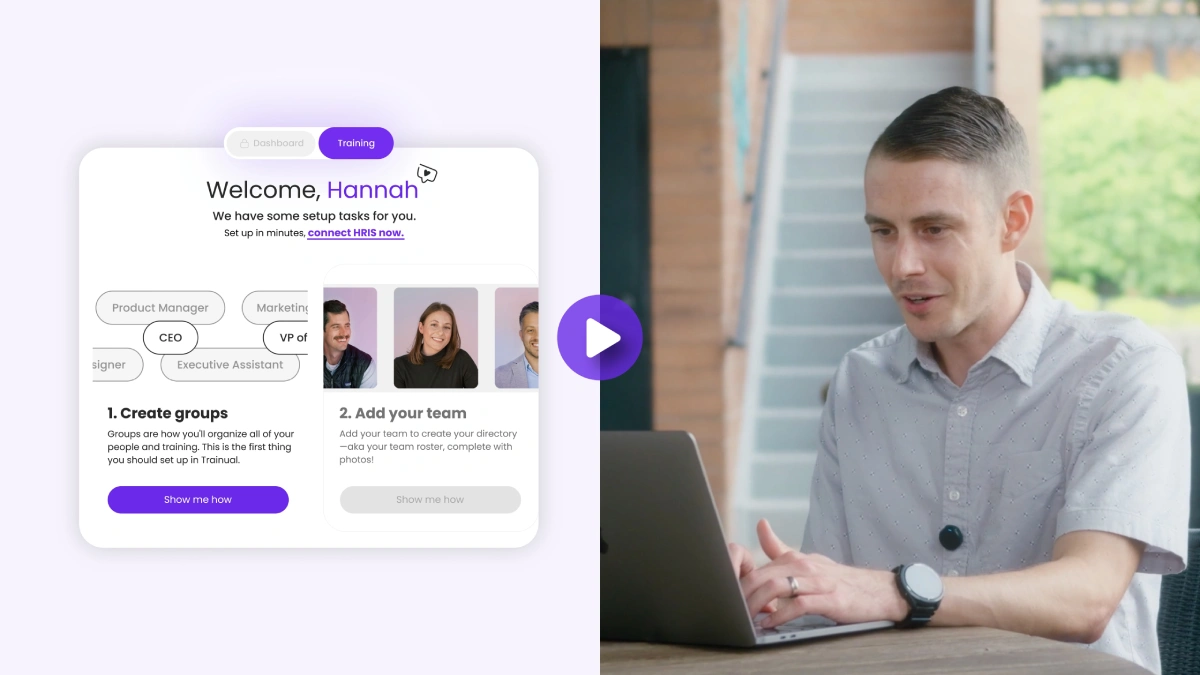
Trainual is an operating system for growing teams, and in this category its distinguishing move is connecting the operating cadence to the documented processes behind it. Its Operations suite runs meetings, goals and scorecards, KPIs, action tracking, and async updates, and unlike most tools here, those live in the same place as the documented SOPs and roles that define how the work gets done.
That's the fit for a growing team specifically. What breaks past 25 people isn't usually task tracking; it's that the operating knowledge (how meetings run, who owns what, how a process goes) stops fitting in the founder's head. Trainual moves that knowledge into a system, so operations scale with the team instead of bottlenecking on a few people. On the "what users say" question, it's rated 4.7 on G2 and is consistently praised for ease of adoption, with the review recap and customer reviews covering the detail.
Where Trainual is honest about its limits: it isn't a project or task-management tool, and it isn't an ERP. If your breaking point is coordinating complex projects, resource planning, or detailed task management, a work-management platform goes deeper. Trainual's slice is running the operating system on documented processes.
2. Monday.com
Monday.com is a flexible work operating system with strong visual boards, dashboards, and automations, and it's a leader in work management for good reason. For teams whose main need is coordinating projects and tasks across departments with a highly visual, customizable interface, it's excellent.
Its center of gravity is managing the work rather than the operating cadence and the documented processes behind it. It tracks what's being done superbly, and leaves the "how we run the company" layer, meetings, accountability rhythm, and SOPs, to other tools or manual habit.
3. ClickUp
ClickUp is an all-in-one work management platform that consolidates tasks, docs, goals, and dashboards into one tool, appealing to teams tired of juggling several apps. Its breadth and configurability are genuine strengths for teams that want to run projects, docs, and goals together.
That breadth is also its trade-off. ClickUp can do a great deal, which means setup and discipline matter, and its focus remains work and project management rather than an operating system grounded in your documented procedures.
4. Asana
Asana is a polished work and project management platform with strong goals and portfolio features, well-suited to coordinating cross-team initiatives and connecting daily work to higher-level objectives. For project-driven teams, its clarity and adoption are strong.
Like other work-management tools, its frame is managing projects and tasks rather than the operating cadence plus documented processes. It links work to goals well, and stops short of housing how the work itself is done.
5. Ninety
Ninety earns real credit as a purpose-built operating system for teams running on EOS, bringing Rocks, scorecards, to-dos, and Level 10 meetings into one place mapped to the methodology. If you run EOS or Traction, it fits your operating rhythm natively.
Its strength is also its boundary: it's opinionated around one framework, ideal if you use it and less so if you don't, and the operating cadence sits apart from the documented SOPs and training that drive it. For a direct look, see Trainual vs. Ninety.
6. Process Street
Process Street is a strong workflow and process-automation platform, good at turning recurring operations into structured, trackable, and increasingly automated workflows. For teams whose breaking point is enforcing repeatable processes, it goes deep on that specific job.
Its focus is workflow execution rather than the broader operating cadence of meetings, goals, and accountability, or the training layer that teaches people the process. It runs the workflow well and leaves the surrounding operating system to other tools.
7. Wrike
Wrike is a robust work management platform with detailed reporting, resource management, and project controls, aimed at teams that need more structure and oversight than a lightweight tool provides. For operations-heavy project work at scale, its depth is a real advantage.
That depth skews enterprise and project-centric. For a growing mid-size team, it can be more than needed, and like other work-management tools, it manages the work rather than the operating system and documented processes around it.
8. Smartsheet
Smartsheet brings a spreadsheet-familiar interface to work management, making it approachable for teams that already run operations in grids and want more structure, automation, and reporting on top. For spreadsheet-native teams, the learning curve is gentle.
Its spreadsheet roots are both the appeal and the limit: it's strong for structured, tabular work management and lighter on the operating cadence and process documentation that define how a growing company runs day to day.
9. Notion
Notion is a flexible all-in-one workspace where teams build docs, wikis, and lightweight project and operations tracking however they like. For teams that value customization and want docs and tracking in one adaptable place, it's popular and capable.
The trade-off is structure and governance. Notion's flexibility can sprawl without discipline, and its operations and process management are as strong as the system a team builds and maintains, rather than purpose-built for an operating cadence.
10. Connecteam
Connecteam is an all-in-one app built for deskless and frontline operations, combining scheduling, communication, tasks, and training in one mobile-first tool. For managing frontline operations, in field service, retail, or logistics, it meets deskless teams where they are.
Its focus is frontline operational coordination rather than the company-wide operating cadence of goals, scorecards, and documented processes for a scaling knowledge-work team. For deskless daily ops, it's a strong fit; for the operating system layer, it's a different job.
How to Choose Operations Management Software for a Growing Team
The right tool follows from which job is breaking, not the longest feature list. Work through four questions.
First, what's breaking? If it's projects and tasks slipping, a work-management tool like Monday.com or Asana fits. If it's repeatable processes going wrong, a workflow tool like Process Street fits. If it's operating knowledge living in people's heads as you grow, you need an operating system, not another task tracker.
Second, will it survive growth past the founder? The test for a growing team is whether the software captures how the company runs, its meetings, goals, accountability, and processes, so that knowledge scales with headcount instead of bottlenecking on a few people. This is the theme of How Work Is Run.
Third, does it connect the cadence to the work? Managing tasks is easy; the harder, higher-value link is between the operating rhythm and the documented processes and roles behind it, explored in the operations suite guide.
Fourth, what do users say? Adoption is where operations tools live or die, so weigh real reviews and how quickly teams like yours got value, not just the feature list, drawing on sources like the state of how growing teams run operations.
Key Features to Look For in Operations Management Software
A few features separate software that scales a growing team's operations from software that just adds a dashboard.
A real operating cadence. Meetings, goals, scorecards, action items, and updates should run in a rhythm, not scatter across tools, drawing on habits like a weekly leadership meeting that drives results.
Connection to documented processes. The highest-leverage feature is a link between the operating rhythm and the SOPs and roles behind it, so operations don't depend on a few people remembering how things run.
Clear accountability. Every goal and action item should have one owner, which matters when nearly half of employees aren't sure what's expected of them. See a lightweight accountability system for busy managers.
Adoption that sticks. For a growing team, the tool people use beats the most powerful one nobody adopts. Weigh ease of use and time-to-value heavily.
Benefits of Running Operations on a Connected System
When the operating cadence and the documented processes behind it live in one system, a few things change for a growing team:
- Operations survive growth, because how the company runs is captured in a system instead of a founder's memory.
- Accountability gets concrete, since goals and action items have owners tied to roles, not a shared blur.
- Fewer tools means less friction, addressing the "one more tool" barrier growing teams cite directly.
- New leaders ramp faster, because the operating rhythm and the processes behind it are documented, not absorbed by osmosis.
- The whole system compounds, as meetings, goals, updates, and SOPs reinforce each other instead of drifting apart.
For the payoff in terms leadership tracks, see how to measure the ROI of training and operations, and for the specific slices of this category, the guides to goal, KPI, and scorecard software, role clarity and org chart software, and AI for SOP software.
What Users Say About Operations Software for Growing Teams
Because adoption decides whether operations software works, "what do users say" is a fair question to lead with. The pattern across reviews of the tools here is consistent: work-management platforms like Monday.com, ClickUp, and Asana win praise for flexibility and visual project tracking, and draw the most criticism for complexity and setup effort as teams scale. Operating-system tools are judged more on whether they capture how the company runs and whether people adopt them.
Trainual's reviews skew toward ease of use, fast adoption, and becoming a team's single source of truth, reflected in a 4.7 rating on G2. The broader lesson for a growing team: read reviews for adoption and time-to-value in companies your size, not just feature counts, since the best-reviewed tool for a 200-person enterprise may be the wrong fit at 40 people. For teams that have made the shift, 5 multi-location companies scaling operations and how one team stayed aligned and accountable without breaking the bank show what it looks like in practice.
Cost Considerations
Pricing models vary widely, and the model matters more than a figure that changes by the quarter. You'll see per-user subscriptions (most work-management and operating-system tools), tiered pricing that gates key features behind higher plans, and per-editor or usage-based pricing for some workflow and dashboard tools. Deskless-focused tools sometimes price to account for large frontline headcounts.
For a growing team, look past the sticker to total cost: setup and configuration time, the number of tools you can consolidate, and, most of all, adoption, since software nobody uses is the most expensive option regardless of price. Because plans change often, compare each vendor's current pricing against the specific job you're solving.
Ready to see how Trainual works?
👉 Book a demo and see how Trainual runs your operating cadence on the documented processes that keep a growing team aligned.
Want a sneak peek?
👉 Read customer stories from growing teams who moved their operations out of people's heads and into one system.
Frequently asked questions
What's the best operations management software for growing teams?
It depends on which job is breaking. For managing projects and tasks, Monday.com, ClickUp, and Asana lead; for automating repeatable workflows, Process Street goes deep; for running the operating system, meetings, goals, scorecards, and accountability on top of documented processes, Trainual and Ninety are built for that. For a growing team whose operating knowledge is outgrowing the founder's head, an operating system that connects the cadence to your SOPs, like Trainual, is usually the higher-leverage choice than another task tracker.
What do users say about the best operations management software?
Reviews split by tool type. Work-management platforms like Monday.com, ClickUp, and Asana are praised for flexibility and visual project tracking, and criticized for complexity as teams scale. Operating-system tools are judged on adoption and whether they capture how the company runs; Trainual, for example, is rated 4.7 on G2 and consistently noted for ease of use and fast adoption. The most useful reviews to read are from companies close to your size and stage.
What is operations management software?
It's software that helps a team run its operations, but the term covers three different jobs: managing projects and tasks (work management), automating repeatable processes (workflow automation), and running the operating system of meetings, goals, scorecards, accountability, and documented processes. Many teams need a mix, and confusion usually comes from expecting one tool to do all three equally well.
How is operations management software different from project management software?
Project management software focuses on planning and tracking projects, tasks, and deadlines. Operations management, in the broader sense, also includes the operating cadence, meetings, goals, accountability, and the documented processes that define how work is done. A project tool tells you what's being worked on; an operating system also captures how the company runs, which is what tends to break as a team grows.
When does a growing team need operations management software?
Usually somewhere past 25 people, when the informal way operations ran, knowledge in the founder's head, decisions in hallways, accountability by memory, stops scaling. The signal is repeated dropped handoffs, unclear ownership, and meetings that don't drive follow-through. That's the point where capturing how the company runs in a system pays off quickly.
Can operations management software replace several separate tools?
Often, yes, and for growing teams that's a real benefit, since "one more tool" is a common barrier. An operating system that combines meetings, goals, scorecards, accountability, and documented processes can consolidate several point tools. The caveat is fit: a work-management tool won't replace deep project software, and a workflow tool won't replace the operating cadence, so match the consolidation to the jobs you need.