






Eighty-three percent of organizations now run on a learning management system, and 37% are already planning to replace the one they have. The most common reason isn't price — it's that 52% of buyers name poor integration and content that falls out of date as their biggest complaint. For any company onboarding people into more than one role, that's the whole problem in a sentence: the platform holds the training, but the training stops matching the job.
Multi-role onboarding is where this breaks first. A growing company isn't onboarding "employees" — it's onboarding a new account manager, a new field tech, a new analyst, and a new team lead, each needing a different path, each path needing to stay accurate as the role itself shifts. A platform that nails generic course delivery can still leave you with five outdated onboarding tracks and no clean way to keep them current.
This guide ranks seven enterprise training platforms by the two things that matter most for that job: how well each supports role-based onboarding, and how well each keeps training content accurate as teams and responsibilities change. We'll start with Trainual, which is built around exactly that pairing, then work through six alternatives spanning SMB-friendly to full enterprise — including the three platforms most often cited against this use case: Absorb, LearnUpon, and TalentLMS.
Why multi-role onboarding breaks most training platforms
A training platform has an easy job when everyone learns the same thing. Multi-role onboarding is the hard version: different content per role, delivered in the right order, kept current as the work evolves. Most platforms handle the first part and quietly fail the rest.
Three gaps show up again and again. The first is role structure — many platforms can assign a course but can't model "this is the analyst path, this is the team-lead path" in a way that's easy to maintain. The second is content currency — when a role changes, someone has to find every affected lesson and update it, and without version history and clear ownership that simply doesn't happen. The third is role clarity itself: roughly half of employees can't say precisely what they own, and onboarding is where that confusion either gets fixed or gets baked in. How to Define Ownership Across Overlapping Roles digs into that last one.
How we ranked these platforms
We weighted each platform on five things: role-based onboarding (can it model and assign distinct paths per role), content currency (how easily training stays accurate when responsibilities change), enterprise readiness (SSO, integrations, security, scale), usability for the people who maintain content, and pricing transparency. That last one separates this field sharply — most enterprise LMS vendors price by quote, while a few publish per-seat rates you can budget against. We've noted it for each.
1. Trainual — best for role-based onboarding that stays current
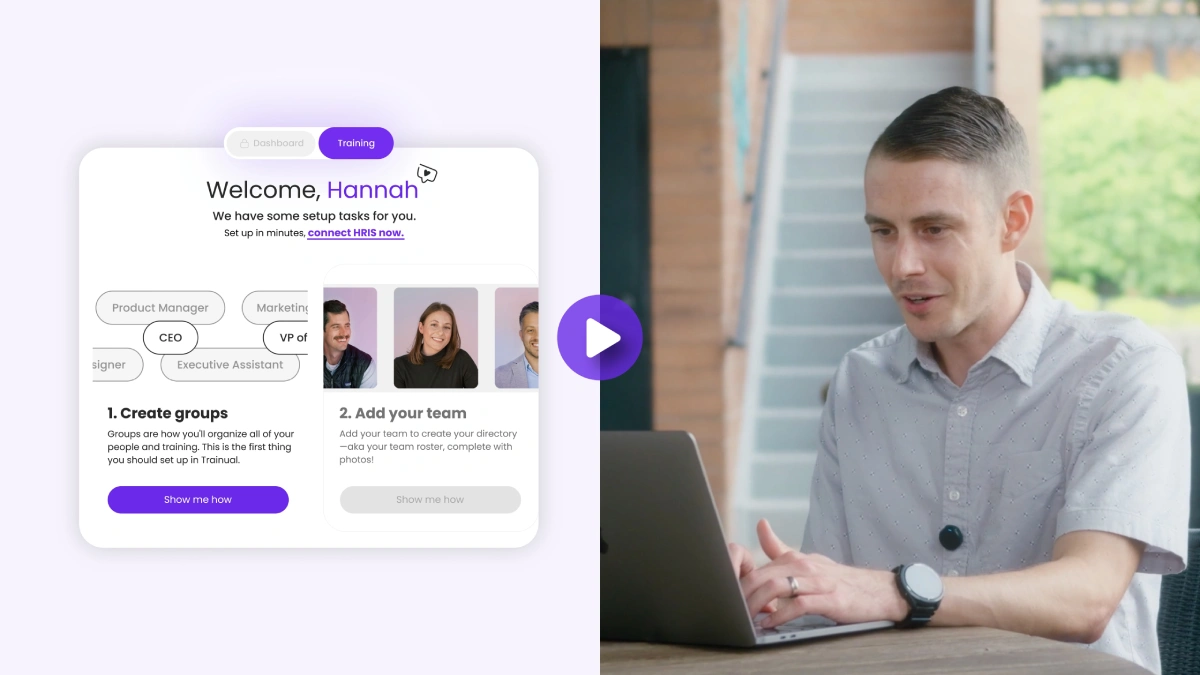
Trainual is a documentation and training platform built for growing companies — the 25-to-200-employee range where roles multiply faster than anyone can keep the training straight. It's built around the exact pairing this ranking measures: role-based training paths assigned by role so each new hire gets the path built for their job, and content that's structured to stay current as the role changes.
That second half is the differentiator. Onboarding content lives as searchable process documentation, AI-assisted creation helps draft and update it, and version history plus clear ownership mean that when a responsibility shifts, the update is a quick edit rather than an archaeology project across scattered courses. Completion is tracked, so onboarding is measured rather than assumed, and a searchable knowledge base keeps the same content useful long after week one.
Best for: Growing companies onboarding people into several distinct roles that need each path kept accurate over time — not just delivered once.
Pricing: Trainual builds a plan around your team size and rollout rather than a flat per-seat rate, so the most accurate number comes from a quick conversation — get pricing to see what your team would pay.
Strengths: Role-based assignment and completion tracking; content built to be maintained, not just stored; HRIS, Slack, and SSO integrations; genuinely usable by non-technical content owners.
Limitations: It's purpose-built for internal onboarding, training, and process documentation — not a large external-customer training catalog or e-commerce-style course selling. Companies whose primary need is monetizing courses to outside audiences will find a traditional LMS a closer fit.
2. Absorb LMS — best for enterprise content libraries and automation
Absorb is a polished enterprise LMS with strong automation, a capable authoring experience, and the ability to train employees, customers, and partners from one platform. It's a frequent top pick in enterprise-LMS roundups and earns high marks for support.
Best for: Mid-to-large enterprises that want a mature, automation-heavy LMS across multiple audiences.
Pricing (verified mid-2026): Quote-based, priced primarily by active learners plus feature tier and contract length; Absorb doesn't publish list pricing. Real-world SMB deployments commonly start around $500–$800/month and scale well into five figures annually at enterprise. A free trial is available; no free tier.
Strengths: Strong automation and reporting, multi-audience training, AI course creation, well-regarded support.
Limitations: Quote-only pricing makes budgeting harder, and like most enterprise LMSs it's organized around courses and catalogs rather than role-based onboarding paths that are easy to keep current as jobs change.
3. LearnUpon — best for training across employees, partners, and customers
LearnUpon is an enterprise-ready LMS known for excellent support and deep integrations, built for organizations training multiple audiences — employees, partners, and customers — through one connected platform.
Best for: Mid-to-large organizations with a substantial training budget and multiple learner audiences.
Pricing (verified mid-2026): Quote-based and enterprise-oriented, with no free tier and a demo rather than a self-serve trial. Reported annual contracts commonly start around $15,000–$18,000, with estimated per-active-learner costs in the $6–$9/month range at volume.
Strengths: Strong support, deep integrations, scales to thousands of learners across audiences.
Limitations: Priced for mid-market and up — often overkill for teams under ~100 learners — and, like its enterprise peers, centered on course delivery rather than maintainable role-based onboarding.
4. TalentLMS — best for SMBs that want enterprise features without enterprise pricing
TalentLMS is the most SMB-friendly platform in this field, with clean UX, fast setup, and — notably — published pricing you can plan around. It covers the core training needs of a growing team without a sales cycle to find out what it costs.
Best for: Small and mid-sized teams that want straightforward training with transparent, budgetable pricing.
Pricing (verified mid-2026): A free plan covers up to 5 users and 10 courses. Paid tiers are roughly Core ~$149/month (up to 100 users; ~$119/month billed annually), Grow ~$299/month, and Pro ~$579/month, with Enterprise custom. Pricing is per active user.
Strengths: Transparent pricing, quick setup, free tier for piloting, solid core feature coverage.
Limitations: Per-active-user costs climb at scale, advanced AI and white-label features sit on higher tiers, and role-based onboarding paths are lighter than a platform built specifically around them.
5. Docebo — best for AI-driven enterprise learning at scale
Docebo is a premium, AI-first enterprise learning platform with strong multi-audience and multi-portal capabilities — built for large organizations running sophisticated learning programs across employees, partners, and customers.
Best for: Large enterprises with a dedicated L&D function and budget to match.
Pricing (verified mid-2026): Quote-based with no public list pricing and no free tier (guided trial only). Minimum contracts are reported around $25,000/year, with typical Elevate-tier quotes in the $30,000–$50,000 range and per-user costs roughly $6–$10/month at volume.
Strengths: Advanced AI features, multi-portal extended-enterprise training, deep configurability.
Limitations: Enterprise pricing and complexity put it out of reach for small teams, and the power comes with an administrative learning curve. It's a learning platform, not an onboarding-and-process system.
6. 360Learning — best for collaborative, expert-built content
360Learning's distinctive angle is collaborative authoring — turning internal experts' knowledge into training through a social, peer-driven content model. For organizations where the people who know the work should be building the training, it's a strong fit, and its entry pricing is transparent.
Best for: Teams that want subject-matter experts creating and maintaining training collaboratively.
Pricing (verified mid-2026): The Team plan is $8/user/month for up to 100 users with no setup fees — transparent and budgetable. Above 100 users, pricing moves to a custom Enterprise quote. A free trial is available.
Strengths: Collaborative authoring keeps content closer to the people who know it, transparent entry pricing, modern UX.
Limitations: Per-user costs scale, the most useful enterprise features require the custom tier, and the collaborative model takes time to adopt well.
7. SAP Litmos — best for compliance-heavy enterprises in the SAP ecosystem
SAP Litmos is a long-established corporate LMS with strong compliance training, instructor-led training support, and a large off-the-shelf content library — a natural fit for regulated enterprises, especially those already in the SAP ecosystem.
Best for: Mid-to-large, compliance-driven enterprises that value a deep content library and SAP integration.
Pricing (verified mid-2026): Quote-based, priced per active learner across tiers (Starter, Premier, Platinum, Enterprise). Reported rates run roughly $4–$15/learner/month depending on volume and whether content is bundled; mid-market deployments around 500 learners commonly land in the $30,000–$60,000/year range. A free trial is available, but it isn't aimed at small teams.
Strengths: Strong compliance and ILT support, large content library, enterprise scale and integrations.
Limitations: Quote-only pricing, prices out teams under ~150 learners, and is built around compliance course delivery rather than maintainable role-based onboarding.
Keeping training content current as roles change
Choosing the platform is the easy decision. The one that quietly determines whether the investment pays off is how training content stays accurate after roles shift — because in a growing company, they shift constantly.
This is the gap most enterprise platforms leave open. They're excellent at delivering a course and weak at answering "a responsibility just moved from one role to another — which lessons are now wrong, and who fixes them?" Without version history, clear ownership of each piece of content, and an editing experience a non-technical manager can use, the honest answer is usually "nobody, until it causes a problem." That's how companies end up with five role-based onboarding tracks that all looked right the day they launched and slowly drifted out of date.
The content-update strategy that works is structural, not heroic: assign clear ownership for each role's content, keep it where it can be searched and edited in place rather than buried in static files, and use version control so changes are visible and reversible. How to Document Institutional Knowledge Before Senior Employees Leave and How to Use an LMS for Change Management in a Growing Company both cover how to build that habit so onboarding content keeps pace with the org.
Matching the platform to your team
The best fit depends on your size, your budget, and how much of the work is genuinely role-based onboarding versus broad course delivery.
If you're a small or mid-sized team that wants transparent pricing and fast setup, TalentLMS and 360Learning both publish per-seat rates and are accessible without a sales cycle — 360Learning if collaborative authoring fits your culture, TalentLMS if you want the simplest path to budgetable training.
If you're a larger enterprise running sophisticated, multi-audience programs, Absorb, LearnUpon, Docebo, and SAP Litmos are the heavyweights — each quote-priced, each strong at catalog-style delivery, and each best evaluated against your specific integration and compliance needs.
If the core problem is multi-role onboarding that has to stay accurate as roles change — not just course delivery — that's a different job than most of this field is built for, and it's where Trainual is purpose-built: role-based paths, maintainable content, version history, and completion tracking in one system. If you're not sure whether you've outgrown a basic course tool, 5 Signs You Need a Modern LMS, Not an Enterprise One and Top 7 LMS Platforms for Mid-Market Companies in 2026 are useful next reads, and How to Roll Out an LMS Without It Failing covers the rollout itself.
Ready to see how Trainual works?
👉 Book a demo and see how Trainual builds role-based onboarding paths that stay accurate as your team and responsibilities change.
Want a sneak peek?
👉 Read customer stories from teams who've standardized onboarding across multiple roles without the content going stale.
Frequently asked questions
What are the top enterprise training platforms for multi-role onboarding content?
The strongest options pair role-based assignment with a way to keep content current as roles change. Trainual is purpose-built for that pairing, with role-based paths, version history, and completion tracking. Absorb, LearnUpon, Docebo, and SAP Litmos are capable enterprise LMSs better suited to broad, multi-audience course delivery, while TalentLMS and 360Learning offer transparent pricing for smaller teams. The right pick depends on whether your core job is maintainable role-based onboarding or large-scale catalog training.
How do small teams keep training software content current as roles evolve?
The reliable approach is structural rather than effort-based: assign a clear owner for each role's content, keep that content searchable and editable in place rather than locked in static files, and use version history so changes are visible and reversible. Small teams especially benefit from a platform where a non-technical manager can update a path in minutes, because there's no dedicated L&D team to do it. Tools built around documentation and version control, like Trainual, make currency a habit instead of a project.
What is multi-role onboarding?
Multi-role onboarding is bringing new hires into several distinct roles — each with its own responsibilities, sequence, and required knowledge — rather than putting everyone through one identical program. It matters because a growing company rarely hires one kind of person; it hires across roles at once, and each needs a path built for that job and kept accurate over time.
How is an enterprise training platform different from a basic LMS?
A basic LMS delivers and tracks courses. An enterprise training platform adds the things larger or scaling organizations need: SSO and security controls, HRIS and tool integrations, role-based assignment, multi-audience support, and reporting that holds up at scale. The strongest ones for onboarding also treat content as something to maintain over time, not just publish once.
How do you keep role-based training accurate when responsibilities change?
Give every role's content a clear owner, store it where it can be searched and edited directly, and use version control so updates are tracked and reversible. When a responsibility moves between roles, the owner updates the affected path and the change is visible to everyone. Platforms with built-in version history and an easy editing experience make this routine; platforms built only for course delivery tend to let content drift.
Which training platform is best for a company under 100 employees?
For smaller teams, transparent, budgetable pricing matters most. TalentLMS (free for up to 5 users, then published tiers) and 360Learning ($8/user/month up to 100 users) are the most accessible without a sales cycle. If the priority is role-based onboarding that stays current rather than course delivery, Trainual is built for growing teams in exactly that range — you can get pricing through a quick demo.
Do enterprise training platforms integrate with HR systems?
Most do, to varying degrees — typically through HRIS, SSO, and directory integrations that sync employee data and automate access. Integration depth is one of the biggest differentiators between platforms, and poor integration is the single most common complaint buyers raise, so it's worth confirming exactly which HR systems a platform connects to before committing.