





Ever announce a new policy on Monday — you carefully drafted the email, walked through the rationale, asked everyone to acknowledge — and by Friday realize half your team is still operating on the old version, three managers somehow missed the announcement entirely, and the operations team in your second office has been quietly improvising their own interpretation? You announce again. You re-send the email. You add it to the all-hands deck. Two weeks later, somebody's still asking "wait, did this change?" and the new policy hasn't fully landed. The change wasn't bad. The system around the change was.
That's the change management problem most growing companies live in. The bigger the team gets, the harder it is to push a change through cleanly. Email gets ignored. Slack messages scroll off. Meeting decks get half-watched. Senior team members at HQ usually catch the update; remote employees and field teams catch the next iteration; everyone else gets it in fragments. By the time the change has fully landed, the next change is already incoming — and the cycle restarts.
The data is brutal. Industry reports consistently show that 60-70% of change initiatives fail. Only 34% of major organizational change initiatives meet their predefined objectives. Employee resistance, poor communication, and inadequate leadership are the top failure factors. And growing companies face a specific compounding problem: the same change that worked at 25 employees is the change that fails at 150 — because the communication infrastructure designed for a small team can't carry the weight of a bigger one.
This guide walks through how a learning management system (LMS) — used the right way — turns change management from a hope-it-lands rollout into a verifiable, trackable, accountable system. Not just a way to broadcast updates. A real operating layer where every change reaches everyone, gets acknowledged, and stays current.
Why change management breaks at scale
At 5 employees, change management is a Slack message. Everyone sees it. Everyone acknowledges. Everyone aligns. At 25, it's still mostly working — a clear announcement with a manager check-in usually does the job. At 50, it starts to break. Not everyone reads the email. Not everyone is at the all-hands. Different teams interpret things slightly differently. By 100+, every change generates fragmentation — pockets of the team operating on the old version, pockets operating on the new, and nobody can tell who's where without manually asking.
The pattern is consistent. The reason isn't bad management. It's that informal change communication doesn't scale. It depends on real-time human attention. The more people you have, the less attention each person gives any single message — and the more change drift compounds.
The cost of that drift shows up everywhere:
- Inconsistent customer experience across teams operating on different policies
- Compliance risk when people don't acknowledge policy changes
- Senior team members spending hours fielding "wait, what changed?" questions
- Updates that take 6 weeks to land instead of 6 days
- Frustration on both sides: leadership feels nothing is sticking, employees feel constantly behind
- Repeat announcements that condition the team to tune out
A good LMS — used as more than a content library — fixes this. Here's how.
What an LMS does for change management
An LMS turns change management from broadcast hope into trackable execution. Here's what changes:
The combination is what turns change from "did this land?" to "I can see exactly who's on the latest version and who isn't." That visibility is the difference between change that succeeds and change that fades.
The 6-step framework for using an LMS for change management
Here's the framework — start to finish.
Step 1: Identify what's actually changing and why
Before announcing anything, document what's changing and why. The detail matters. "We're updating the refund policy" is too vague. "We're updating the refund policy from a $500 manager threshold to a $1,000 manager threshold for all customer success leads, effective the 15th, because we've seen ROI on faster resolution at higher dollar amounts" is what people can actually act on.
The more specific the framing, the easier the change lands. Vague changes get vague compliance. Specific changes get specific behavior.
Step 2: Document the new version with version history
In your LMS, create or update the affected SOP, policy, or training. Use version history to capture the change cleanly. The old version is archived (still searchable for reference, not active). The new version is now the live source of truth.
This is the single most important step. The change isn't a Slack message that scrolls off. It's a versioned, dated artifact in the system. When somebody asks "wait, what's the current version?" six weeks later, the answer is "search the platform — the latest version is what's there."
Step 3: Assign by role
Use role-based assignment to push the change to exactly the people it affects. A refund policy change affects customer success leads — assign to that role. A safety policy change affects field crews — assign to that role. A code of conduct update affects everyone — assign to all.
The assignment is what turns the change from a broadcast into a directed delivery. People who are affected see it. People who aren't don't get noise.
Step 4: Require acknowledgment
For meaningful changes, require an acknowledgment. For high-stakes changes (compliance, safety, regulated content), require an e-signature. The platform tracks who has acknowledged, who's outstanding, and when each acknowledgment happened.
This is the mechanism that turns "I sent the email" into "I have a defensible record of who acknowledged the new version on what date." For regulated industries, that record is what stands up to an audit. For non-regulated companies, it's what gives leadership confidence the change has actually landed.
Step 5: Active notifications, not passive email
When a change publishes, the platform actively notifies everyone affected — through in-app alerts, email, Slack integrations, or whatever channel the team uses most. Reminders trigger automatically for anyone who hasn't acknowledged. The change pushes to people instead of waiting for them to find it.
This is where most change management programs fail in practice. Passive distribution (email someone hopes is read) gets ignored. Active distribution (push notifications + reminders + dashboards) lands.
Step 6: Track rollout and follow up
Use the LMS reporting to track rollout in real time. Who's acknowledged? Who's outstanding? Which teams are lagging? Which roles are 100% adopted?
The dashboard gives leadership the visibility to act. If the field team is at 30% acknowledgment a week after launch, that's a signal — maybe the change wasn't framed for them, maybe the timing wasn't right, maybe they need a different communication channel. The data tells you where to focus follow-up effort instead of broadcasting blindly.
Common mistakes to avoid
The framework works. The implementation is where teams stumble.
Mistake #1: Announcing the change in too many channels at once
The trap: Email + Slack + all-hands + 1-on-1s + LMS. The team gets confused about where the canonical source of truth lives.
The fix: Pick one canonical home for the change. The LMS is ideal because it's versioned, searchable, and trackable. Use other channels to point people to the LMS — not to compete with it.
Mistake #2: Skipping the rationale
The trap: "Effective Monday, the new policy is X." The team complies but doesn't internalize. The change feels arbitrary.
The fix: Always include the why. People execute changes they understand far better than changes they're told to follow. Spend the extra paragraph explaining the rationale.
Mistake #3: Not requiring acknowledgment
The trap: You publish the change, hope people read it, and move on.
The fix: Require acknowledgment. The friction is small. The accountability is significant. The behavioral signal — "leadership tracks whether I acknowledge changes" — drives engagement with future changes too.
Mistake #4: Pushing too many changes at once
The trap: You batch five updates into one rollout because it feels efficient. The team can't absorb them all and tunes out.
The fix: Pace changes. Batch related changes together (a single comp policy refresh) but don't bundle unrelated changes. Each change should be discrete enough that the team can engage with it.
Mistake #5: Not following up on stragglers
The trap: 80% of the team acknowledged. You consider it done. The 20% never engages.
The fix: Use the dashboard. Identify who hasn't acknowledged. Manager-level follow-up. Track to 100%. The 20% who don't engage with changes are the ones who quietly create the inconsistency that erodes execution.
What rolling this out should look like
Software is half the job. Rollout is the other half.
Week 1: Audit your recent changes
Look at the last 5 changes your company has tried to roll out. Ask: how cleanly did each one land? Where did they break? The pattern is your rollout fix priority.
Week 2: Set up the version history and acknowledgment infrastructure
In your LMS, make sure version history is enabled, role-based assignment is configured, and acknowledgment tracking is on. This is the foundational infrastructure every future change will run on.
Week 3: Run a pilot change
Pick a real change you're rolling out anyway. Run it through the new system end to end — version history, role assignment, acknowledgment tracking, dashboard follow-up. Document what went well and what needs work.
Week 4: Refine and document the playbook
Based on the pilot, document your team's standard change management playbook. Every future change runs through this playbook.
Month 2
Run all changes through the playbook. Track adoption rate per change. Identify where the playbook needs adjustment.
Month 3
Begin tracking change management metrics quarterly. Measure rollout time, acknowledgment rate, and execution consistency.
Quick wins you can implement this week
You don't need a full rollout to see value.
Quick win #1: Audit your most recent policy update
Pull up the last policy change your team rolled out. Can you tell who's acknowledged it and who hasn't? If not, that's your rollout gap.
Quick win #2: Pick one critical policy and require e-signatures
For your most compliance-sensitive policy, set up e-signatures and acknowledgment tracking. The first time you roll out a change with verified acknowledgment will surface how broken your old system was.
Quick win #3: Move one high-stakes doc into version history
Pick a critical SOP. Set it up in your LMS with full version history enabled. The next change you make to it becomes a tracked, dated, defensible artifact.
Quick win #4: Build your change management playbook
Document the standard playbook for every change going forward — version history, assignment, acknowledgment, follow-up. One page.
Quick win #5: Identify the stragglers from your last change
Pull up the last change you rolled out. Who hasn't engaged? Manager-level follow-up. Close the gap on this change before announcing the next one.
How to measure change management success
You can't fix what you can't measure.
1. Acknowledgment rate
Track what percentage of affected employees have acknowledged each change. Aim for 95%+ within two weeks of every rollout.
2. Time to acknowledgment
Track how fast changes reach full acknowledgment. A falling number means rollouts are landing faster.
3. Consistency of execution
Audit how consistently the team is operating on the new version. Spot checks across teams and locations tell you whether changes are landing or just being acknowledged.
4. Compliance audit results
For regulated industries, the strongest measure: how clean are your audits? E-signatures and version history should make every audit pass straightforwardly.
5. Change-related questions to leadership
Track how often leadership fields "wait, what changed?" questions. A falling number means changes are landing in the system, not in people's inboxes.
Stop hoping changes land. Start verifying it.
Most growing companies have a change management problem they can't see clearly — they push out updates, hope they land, and live with the consequences when they don't. The bigger the team gets, the worse the problem gets. Inconsistency creeps in. Compliance risk grows. Senior employees burn out fielding the same "did we change this?" questions over and over.
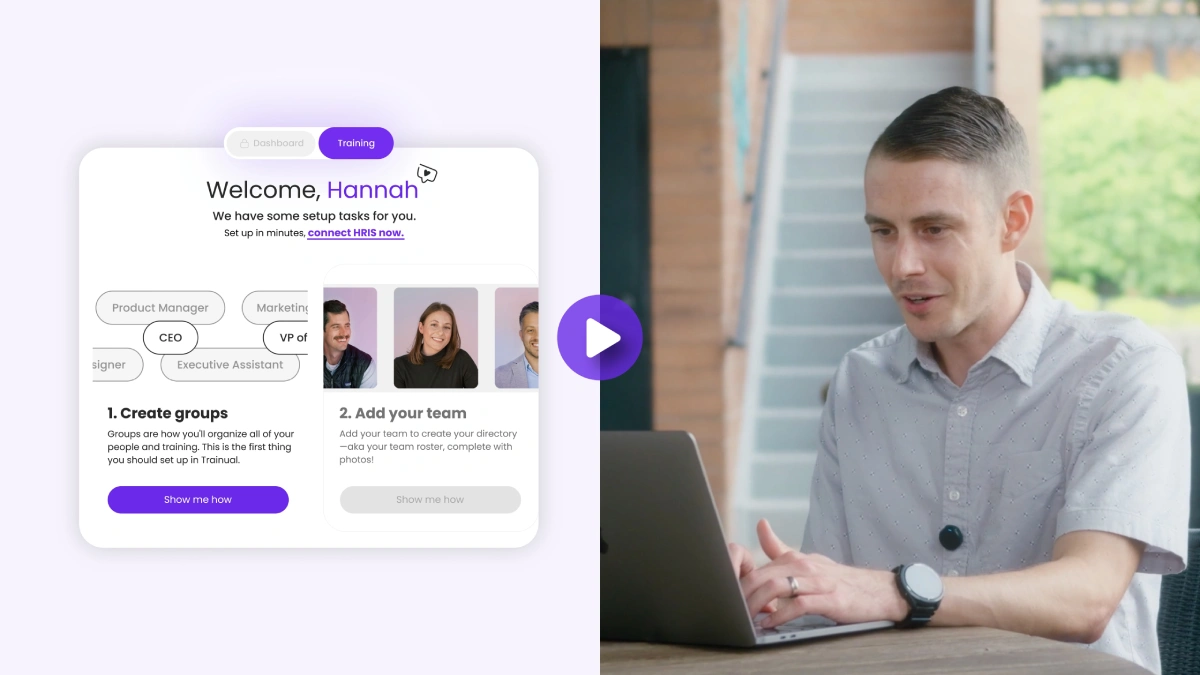
Trainual gives growing companies the operating system to make change management actually work. Version history that captures every update with a timestamp. Role-based assignment that pushes changes to exactly who needs them. E-signatures that create defensible records for compliance content. Active notifications that don't depend on people checking email. Reporting dashboards that tell you exactly who's on the latest version and who isn't.
Imagine a company where every policy change reaches every affected team within days, every acknowledgment is tracked, and every audit is straightforward because the record exists. That's what's possible when change management runs on a system instead of running on hope.
Ready to see how Trainual works?
👉 Book a demo and experience how Trainual makes change management verifiable across a growing company.
Want a sneak peek?
👉 Explore real customer stories from teams who've made change management actually work.