






Compliance training has a quiet failure mode that doesn't show up until an audit, an incident, or a turnover wave exposes it: the training existed, but it was out of date, inconsistently delivered, or disconnected from how people do the work. A policy changed in March; the course still teaches the January version. A procedure is owned by three roles, but everyone took the same generic module. The certificate says "complete," and the practice on the floor says otherwise.
For mid-market professional services teams, that gap is expensive in a specific way. These are firms where the work is regulated or client-sensitive, where procedures differ by role and seniority, and where policies change often enough that "set it and forget it" training is a liability rather than a safeguard. The platforms that solve this do three things well: they automate policy and content updates so training never silently goes stale, they map procedures to roles so the right people get the right rules, and they keep onboarding consistent so every new hire starts compliant.
This guide ranks ten compliance training platforms for 2026 against exactly those criteria. We'll start with Trainual, which approaches compliance as part of role-based onboarding and documented procedure, then work through nine alternatives spanning dedicated compliance libraries, enterprise LMSs, and workflow tools — including the platforms most cited for this audience: Absorb, TalentLMS, LearnUpon, Continu, and Process Street.
How we ranked these platforms
We weighted each platform on five things that matter for mid-market compliance: automated policy and content updates (does training stay current when a rule changes), role-based procedures (can rules and steps map to specific roles), onboarding consistency (does every new hire start compliant), audit-ready tracking (can you prove who completed what), and pricing transparency. That last one splits this field hard — most enterprise compliance LMSs price by quote, while a few publish per-seat rates you can budget against. We've flagged it for each.
1. Trainual — best for connecting compliance to role-based procedures
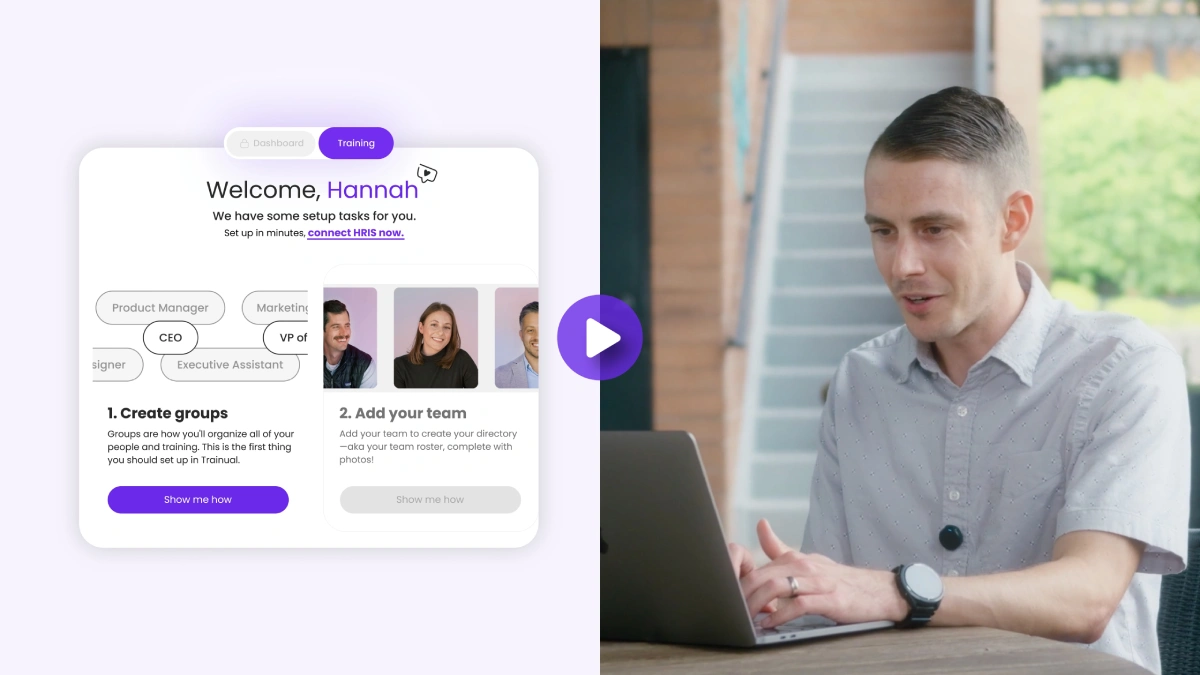
Trainual is a documentation and training platform built for growing companies, and its angle on compliance is distinct from a pure course library: it treats compliance as part of how the work is documented and done. Procedures and policies live as searchable documentation and role-based training paths, assigned by role so the right rules reach the right people — the exact "enforce role-based procedures" problem most platforms handle generically.
It's strong on the parts of compliance that go stale fastest. Policy acknowledgments with e-signatures capture sign-off, version history keeps procedures current when a rule changes and shows what changed, and completion tracking gives you an audit trail of who's done what. There's a library of HR and compliance courses for common requirements, and the same content powers onboarding so every new hire starts compliant rather than catching up later.
Best for: Mid-market teams that need compliance tied to role-based procedures and onboarding — and kept current — not just a catalog of generic courses.
Pricing: Trainual builds a plan around your team size and rollout rather than a flat per-seat rate, so the most accurate number comes from a quick conversation — get pricing to see what your team would pay.
Strengths: Role-based procedure assignment, policy acknowledgments and version history for staying current, completion tracking for audits, onboarding and compliance in one system, usable by non-technical owners.
Limitations: It isn't a deep, industry-specific certification library — organizations needing extensive pre-built regulated content (for example, heavy healthcare or financial-services certification catalogs) may pair it with or choose a specialist library.
2. Absorb LMS — best for automated compliance at enterprise scale
Absorb is a polished enterprise LMS with strong automation — automatic enrollments, reminders, recertification cycles — which makes recurring compliance programs largely hands-off at scale. It's a frequent top pick for enterprise compliance.
Best for: Larger teams running high-volume, recurring compliance programs that need heavy automation.
Pricing (verified mid-2026): Quote-based, priced primarily by active learners plus tier and contract; no public list pricing. Real-world deployments commonly start around $500–$800/month and scale into five figures annually. A free trial is available; no free tier.
Strengths: Excellent automation for recurring compliance and recertification, strong reporting, multi-audience support, well-regarded support.
Limitations: Quote-only pricing complicates budgeting, and it's organized around course delivery rather than role-based procedure documentation tied to onboarding.
3. TalentLMS — best for transparent-priced compliance training
TalentLMS is the most budget-transparent platform here, with published pricing, a built-in course library (TalentLibrary) that includes compliance topics, and fast setup. For a mid-market team that wants straightforward compliance training without a sales cycle, it's a strong entry point — and it was the top-cited competitor for enforcing role-based procedures.
Best for: Mid-market teams wanting solid compliance training with transparent, budgetable pricing.
Pricing (verified mid-2026): Free for up to 5 users and 10 courses. Paid tiers are roughly Core ~$149/month (up to 100 users; ~$119/month annual), Grow ~$299/month, and Pro ~$579/month, with Enterprise custom. Per active user.
Strengths: Transparent pricing, optional compliance content library, automation for assignments and reminders, quick to launch.
Limitations: Per-active-user costs climb at scale, the richest automation and AI features sit on higher tiers, and it's course-centric rather than built around documented role-based procedure.
4. LearnUpon — best for multi-audience compliance training
LearnUpon is an enterprise-ready LMS with strong support and integrations, built to train employees, partners, and customers — useful for firms that must deliver compliance across more than just internal staff.
Best for: Mid-to-large firms delivering compliance to multiple audiences with a real budget.
Pricing (verified mid-2026): Quote-based and enterprise-oriented, no free tier, demo rather than self-serve trial. Reported annual contracts commonly start around $15,000–$18,000.
Strengths: Strong support and integrations, multi-audience delivery, scales to large learner counts.
Limitations: Priced for mid-market and up, and centered on course delivery rather than role-based procedure documentation.
5. Continu — best for polished mid-to-large compliance hubs
Continu is a modern, well-designed learning platform for mid-to-large organizations that want a central, polished hub for compliance and ongoing training, with strong integrations into everyday tools.
Best for: Sizable, design-conscious teams wanting a sleek central learning and compliance hub.
Pricing (verified mid-2026): Quote-based, built for larger deployments (plans oriented around roughly 250 seats and up), with implementation typically around 10% of the first-year contract. No public list pricing; free trial available.
Strengths: Modern UX, strong integrations, good for a sizable team centralizing compliance.
Limitations: Seat orientation and implementation model put it out of reach for smaller teams; it's a learning hub rather than a role-based procedure system.
6. Process Street — best for auditable, recurring compliance workflows
Process Street turns recurring compliance tasks into trackable, step-by-step workflows with proof each step happened — strong for audit trails on processes like periodic reviews, attestations, and controls that must run on a schedule.
Best for: Teams that want auditable, checklist-driven compliance workflows with conditional logic.
Pricing (verified mid-2026): Moved to quote-based pricing in 2026; historically ran from a Startup tier around $100/month to a Pro tier around $1,500/month, per seat by role. No free tier; free trial available. Contact sales for current pricing.
Strengths: Excellent for auditable, recurring workflows; conditional logic; proof-of-completion on every run.
Limitations: It's a workflow tool, not a training platform — lighter on learning content and knowledge retention — and pricing turned opaque this year.
7. Docebo — best for AI-driven enterprise compliance programs
Docebo is a premium, AI-first enterprise learning platform with sophisticated automation and multi-portal delivery — built for large organizations running complex, multi-audience compliance and learning programs.
Best for: Large enterprises with a dedicated L&D function and complex compliance needs.
Pricing (verified mid-2026): Quote-based, no public list pricing, no free tier (guided trial only). Minimum contracts reported around $25,000/year, with typical Elevate-tier quotes in the $30,000–$50,000 range.
Strengths: Advanced AI and automation, multi-portal extended-enterprise delivery, deep configurability.
Limitations: Enterprise pricing and administrative complexity put it out of reach for most mid-market teams; it's a learning platform, not an onboarding-and-procedure system.
8. 360Learning — best for collaborative compliance content
360Learning's collaborative authoring model turns internal experts into content creators — useful when the people who own a compliance procedure should also be keeping its training current. Entry pricing is transparent.
Best for: Teams that want subject-matter experts building and maintaining compliance content together.
Pricing (verified mid-2026): Team plan $8/user/month for up to 100 users with no setup fees — transparent. Above 100 users, custom Enterprise pricing. Free trial available.
Strengths: Collaborative authoring keeps content close to the experts, transparent entry pricing, modern UX.
Limitations: Per-user costs scale, the strongest enterprise features need the custom tier, and the collaborative model takes time to adopt.
9. SAP Litmos — best for regulated industries with off-the-shelf compliance libraries
SAP Litmos is a long-established corporate LMS with deep compliance strengths — a large off-the-shelf compliance content library, instructor-led training support, and strong fit for regulated industries, especially within the SAP ecosystem.
Best for: Regulated, compliance-heavy enterprises that want a ready-made content library and SAP integration.
Pricing (verified mid-2026): Quote-based, per active learner across tiers; reported roughly $4–$15/learner/month by volume and bundle, with mid-market deployments around 500 learners commonly $30,000–$60,000/year. Free trial; not aimed at small teams.
Strengths: Deep compliance and certification content, ILT support, enterprise scale and integrations.
Limitations: Quote-only pricing, prices out teams under ~150 learners, and is built around compliance course delivery rather than role-based procedure tied to onboarding.
10. iSpring Learn — best for affordable, authoring-first compliance training
iSpring Learn pairs a clean LMS with the bundled iSpring Suite authoring toolkit, which turns PowerPoint into trackable courses fast — a practical, low-cost fit for teams converting existing compliance decks into structured training. Its pricing is among the most transparent in the field.
Best for: Budget-conscious teams that author their own compliance content and want predictable per-user pricing.
Pricing (verified mid-2026): Transparent, per active user — roughly $2.29–$3.58/user/month depending on volume, billed annually. Free trial; no free tier.
Strengths: Among the most affordable, strong authoring tools bundled in, clean and easy to administer, good for compliance and recurring training.
Limitations: Authoring runs on Windows only, no AI features and no off-the-shelf content marketplace, and reporting is basic — better for structured compliance training than complex learning ecosystems.
Keeping compliance training current as policies change
The single biggest difference between a compliance program that protects you and one that just looks complete is whether the training stays current when a policy or procedure changes. Most platforms can deliver a course; far fewer make updating it — and proving the update reached the right people — routine.
The pattern that works is the same one that keeps any role-based content accurate: a clear owner for each procedure, content stored where it can be searched and edited in place, version history so changes are tracked and reversible, and acknowledgment capture so you can prove who accepted the new version. When those are in place, a policy change becomes a quick edit and a re-acknowledgment rather than a scramble to rebuild a course and chase signatures. How to Use an LMS for Change Management in a Growing Company and How to Document Institutional Knowledge Before Senior Employees Leave cover how to build that habit.
Matching the platform to your team
The right choice depends on size, budget, and whether your core need is course delivery or role-based procedure tied to onboarding.
For budget-transparent training you can plan around, TalentLMS, 360Learning, and iSpring publish per-seat pricing without a sales cycle — iSpring if you author your own content, TalentLMS for a built-in library, 360Learning for collaborative authoring. For high-volume, automated compliance at enterprise scale, Absorb, Docebo, LearnUpon, and SAP Litmos are the heavyweights — each quote-priced and best evaluated against your specific regulatory and integration needs, with SAP Litmos strongest on ready-made regulated content. For auditable, recurring compliance workflows, Process Street is purpose-built.
If the core need is compliance that maps to role-based procedures, stays current as policies change, and starts every new hire compliant through onboarding — not just a catalog of courses — that's where Trainual is built to fit, with documented procedures, policy acknowledgments, version history, and completion tracking in one system. 5 Signs You Need a Modern LMS, Not an Enterprise One and Top 7 LMS Platforms for Mid-Market Companies in 2026 are useful next reads as you narrow the field.
Ready to see how Trainual works?
👉 Book a demo and see how Trainual ties compliance to role-based procedures and keeps it current as your policies change.
Want a sneak peek?
👉 Read customer stories from teams who've made compliance part of consistent, role-based onboarding.
Frequently asked questions
Which compliance training platforms work best for mid-market professional services firms?
The best fit ties compliance to role-based procedures and keeps it current — not just a generic course catalog. Trainual is built for that, mapping procedures to roles and keeping them current with version history and policy acknowledgments. Absorb and SAP Litmos are strong for automated, library-heavy compliance at larger scale, while TalentLMS, 360Learning, and iSpring offer transparent pricing for mid-market budgets. The right pick depends on whether your need is role-based procedure or high-volume course delivery.
What employee training platforms automate recurring compliance and policy updates?
Several automate recurring assignments and recertification — Absorb and Docebo are particularly strong on hands-off automation at scale. For keeping the content itself current when a policy changes, the platforms that make it routine pair version history with acknowledgment capture, so an update becomes an edit and a re-sign rather than a rebuild. Trainual is built around that pattern; Absorb and SAP Litmos lead on automated enrollment and recertification cycles.
Which training and onboarding software helps enforce role-based procedures?
Enforcing role-based procedures means the right rules reach the right roles and you can prove they were acknowledged. Trainual assigns procedures and training by role and captures policy acknowledgments with completion tracking, which is the core of enforcement. TalentLMS also supports role- and group-based assignment with automation. The key is whether the platform can map procedures to specific roles rather than pushing one generic module to everyone.
What is a compliance training platform?
A compliance training platform delivers, tracks, and documents the training a team needs to meet regulatory, policy, and procedural requirements — and proves it happened. The strongest ones go beyond delivering courses: they map requirements to roles, automate recurring updates and recertification, keep content current when rules change, and produce an audit trail of who completed and acknowledged what.
How do you keep compliance training current when policies change?
Give each procedure a clear owner, store content where it can be edited in place, use version history so changes are tracked and reversible, and capture acknowledgment of the new version so you can prove it reached the right people. With those in place, a policy change is a quick edit and a re-acknowledgment rather than a course rebuild — which is the difference between training that protects you and training that only looks complete.
How much do compliance training platforms cost in 2026?
Pricing ranges widely and several vendors are quote-only. Transparent options include iSpring (~$2.29–$3.58/user/month), 360Learning ($8/user/month up to 100 users), and TalentLMS (free up to 5 users, then ~$149/month and up). Quote-based platforms — Absorb, LearnUpon, Continu, Docebo, SAP Litmos, and Process Street — commonly start in the low five figures annually for enterprise deployments. Trainual builds pricing around team size and rollout, available through a quick demo. Always confirm current pricing with each vendor.