







Basic training tools are built for a simpler version of your company — the one where everyone did roughly the same job and a single onboarding track covered it. That version doesn't last. As a company grows its client-facing teams, the roles multiply and diverge: an account lead, a delivery specialist, a support rep, and a new manager each need different training, in a different order, tied to different parts of how the company serves its clients. A one-size-fits-all course can't carry that, and the cracks show up as inconsistent client experiences, slow ramp, and senior people pulled in to fill the gaps.
That's the moment companies outgrow basic employee training tools and start looking for role-based ones — software that assigns the right training to the right role and keeps it current as the work changes. For client-facing teams specifically, the stakes are higher, because the training is what makes the client experience consistent no matter who's delivering it.
This guide compares seven role-based training tools for client-facing teams in 2026, starting with Trainual and working through six alternatives — including the platforms most cited for this use case: LearnUpon, TalentLMS, Absorb, and Continu. We'll cover where basic tools break down, what to look for, and how the options compare on role-based depth, scalability, and price.
What causes companies to outgrow basic training tools
Basic employee training tools usually do one thing: deliver a course and record completion. That's enough when the team is small and homogeneous. Companies outgrow it for a few predictable reasons.
The first is role divergence — as client-facing teams specialize, one generic track stops fitting anyone well, and people sit through training built for someone else. The second is consistency at scale — more people and more locations mean the "everyone learns it a little differently" problem becomes a client-experience problem. The third is content currency — basic tools make updating slow, so training drifts from how the work is really done. The fourth is no real accountability — completion of a generic course doesn't tell you whether someone's ready for their specific role. Role-based training tools exist to solve all four: they map training to roles, keep it consistent and current, and make readiness visible. 5 Signs You Need a Modern LMS, Not an Enterprise One covers the broader version of this transition.
How we compared these tools
We weighted each tool on what matters for role-based training on a client-facing team: role-based depth (can training map to specific roles, not just groups), scalability (does it hold up as teams and locations grow), content currency (how easily training stays accurate), accountability (can you see who's ready by role), and pricing transparency — which splits this field, since most enterprise platforms quote by deal while a few publish per-seat rates.
1. Trainual — best for role-based training tied to how client work gets done
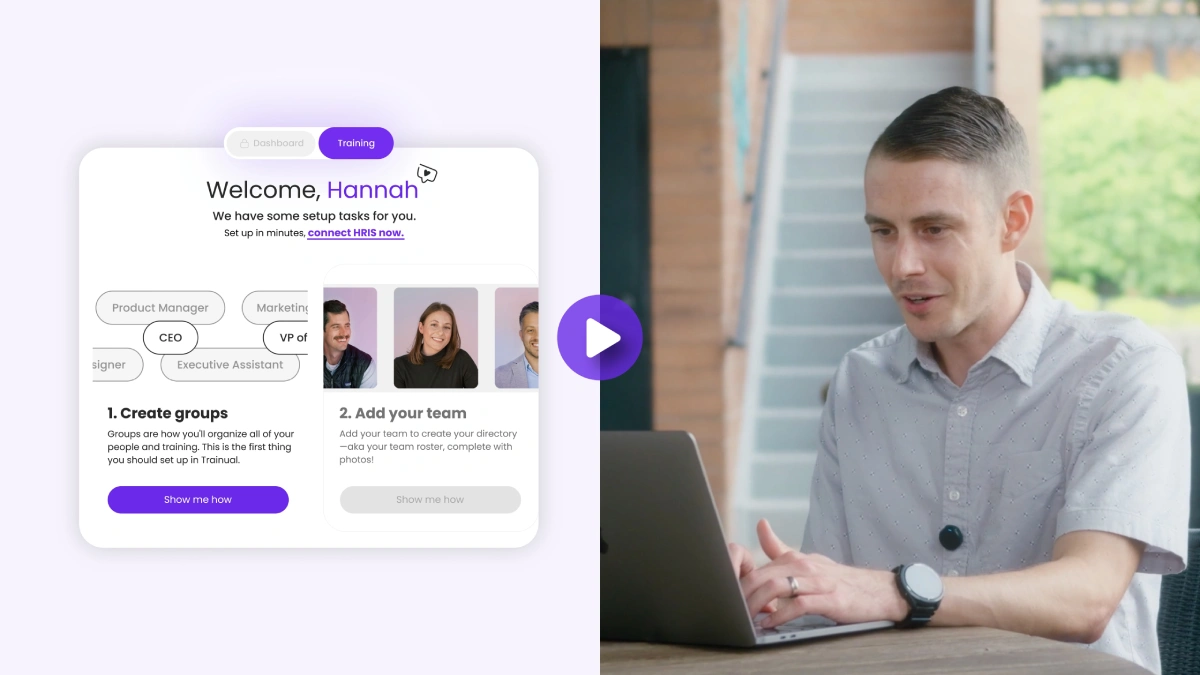
Trainual is a documentation and training platform for growing companies, and its take on role-based training is distinct: it ties training to how the work is done, not just to a course catalog. Teams document how they deliver client work as process documentation, then assign it as role-based training paths by role, so each client-facing role gets the content built for it.
It's strong where client-facing teams feel the strain. Version history keeps role content current as the work changes; a searchable knowledge base means the training doubles as the reference people use mid-task; completion tracking and policy acknowledgments make role readiness visible; and the same content powers onboarding so every new hire starts consistent. It's built to be maintained by the people who own the work, not just one admin — which is what keeps role-based training from decaying after launch.
Best for: Growing companies that want role-based training tied to how their client work is delivered — and kept current — rather than a generic course library.
Pricing: Trainual builds a plan around team size and rollout rather than a flat per-seat rate, so the most accurate number comes from a short conversation — get pricing.
Strengths: Role-based paths tied to documented workflows, version history for currency, searchable reference, completion tracking, non-technical to maintain, onboarding and training in one system.
Limitations: It isn't a deep, enterprise course-library LMS — teams needing extensive off-the-shelf catalogs or advanced learning-ecosystem features may pair it with or choose a specialist platform.
2. LearnUpon — best for multi-audience role-based training
LearnUpon is an enterprise-ready LMS built to train employees, partners, and customers, with strong support and integrations — a fit when client-facing training has to reach more than just internal staff. It was the top-cited competitor for this use case.
Best for: Mid-to-large companies delivering role-based training across multiple audiences with a real budget.
Pricing (verified mid-2026): Quote-based and enterprise-oriented, no free tier, demo rather than self-serve trial. Reported annual contracts commonly start around $15,000–$18,000.
Strengths: Multi-audience delivery, strong support and integrations, scales to large learner counts.
Limitations: Priced for mid-market and up, and organized around course delivery rather than role-based documentation of how the work is done.
3. TalentLMS — best for transparent-priced role-based training
TalentLMS is the most budget-transparent option here, with published pricing, group- and role-based assignment, and fast setup — a strong entry point for a growing team that wants role-based training without a sales cycle.
Best for: SMB and mid-market teams wanting role-based training with transparent, budgetable pricing.
Pricing (verified mid-2026): Free for up to 5 users and 10 courses. Paid tiers run roughly Core ~$149/month (up to 100 users; ~$119/month annual), Grow ~$299/month, and Pro ~$579/month, with Enterprise custom. Per active user.
Strengths: Transparent pricing, role- and group-based assignment, automation, quick to launch.
Limitations: Per-active-user costs climb at scale, richer automation sits on higher tiers, and it's course-centric rather than built around documented role workflows.
4. Absorb LMS — best for automated role-based training at scale
Absorb is a polished enterprise LMS with strong automation — automatic enrollments by role, reminders, and recertification — which makes large, role-segmented training programs largely hands-off.
Best for: Larger teams running high-volume, role-segmented training that needs heavy automation.
Pricing (verified mid-2026): Quote-based, priced primarily by active learners plus tier and contract; no public list pricing. Real-world deployments commonly start around $500–$800/month and scale into five figures annually. Free trial available; no free tier.
Strengths: Excellent automation, strong reporting, multi-audience support, well-regarded support.
Limitations: Quote-only pricing complicates budgeting, and it's built around course delivery rather than role-based documentation of client workflows.
5. Continu — best for polished role-based learning hubs
Continu is a modern, well-designed learning platform for mid-to-large organizations that want a central, polished hub for role-based and ongoing training, with strong integrations into everyday tools.
Best for: Sizable, design-conscious teams wanting a sleek central learning hub.
Pricing (verified mid-2026): Quote-based, built for larger deployments (plans oriented around roughly 250 seats and up), with implementation typically around 10% of the first-year contract. No public list pricing; free trial available.
Strengths: Modern UX, strong integrations, good for a sizable team centralizing role-based learning.
Limitations: Seat orientation and implementation model put it out of reach for smaller teams; it's a learning hub rather than a documentation-and-role system.
6. 360Learning — best for collaborative role-based content
360Learning's collaborative authoring turns internal experts into content creators — useful when the people who own a client-facing role should also keep its training current. Entry pricing is transparent.
Best for: Teams that want subject-matter experts building and maintaining role-based content together.
Pricing (verified mid-2026): Team plan $8/user/month for up to 100 users with no setup fees. Above 100 users, custom Enterprise pricing. Free trial available.
Strengths: Collaborative authoring keeps content close to the experts, transparent entry pricing, modern UX.
Limitations: Per-user costs scale, the strongest features need the custom tier, and the collaborative model takes time to adopt.
7. Docebo — best for AI-driven enterprise role-based programs
Docebo is a premium, AI-first enterprise learning platform with sophisticated automation and multi-portal delivery — built for large organizations running complex, role-segmented learning programs.
Best for: Large enterprises with a dedicated L&D function and complex role-based needs.
Pricing (verified mid-2026): Quote-based, no public list pricing, no free tier (guided trial only). Minimum contracts reported around $25,000/year, with typical Elevate-tier quotes in the $30,000–$50,000 range.
Strengths: Advanced AI and automation, multi-portal extended-enterprise delivery, deep configurability.
Limitations: Enterprise pricing and administrative complexity put it out of reach for most SMB and mid-market teams; it's a learning platform rather than a role-and-documentation system.
Where basic tools break down — and what to look for instead
The throughline across all seven options is that role-based training is a different job than basic course delivery. Basic tools push the same content to everyone and call it done; role-based tools match training to the role and keep it current. For client-facing teams, that difference is what keeps the client experience consistent regardless of who's delivering it.
When you evaluate, look for genuine role-based assignment rather than one generic track, a way to keep content current without a rebuild every time the work changes, visibility into who's ready by role, and a fit for how your team works day to day — because the best tool is the one your client-facing people use. How to Roll Out an LMS Without It Failing and How to Define Ownership Across Overlapping Roles help with adoption and with sorting out who owns which role's content.
Matching the tool to your team
The right choice depends on size, budget, and whether your core need is role-based course delivery or role-based training tied to how your client work gets done.
For budget-transparent role-based training you can plan around, TalentLMS and 360Learning publish per-seat pricing without a sales cycle — TalentLMS for a quick group- and role-based setup, 360Learning for collaborative authoring. For high-volume, role-segmented training at enterprise scale, LearnUpon, Absorb, Continu, and Docebo are the heavyweights — each quote-priced and best evaluated against your specific scale and integration needs, with LearnUpon strongest for multi-audience delivery.
If the core need is role-based training tied to how your client-facing teams deliver work — documented, kept current, and consistent across everyone in a role — that's where Trainual is built to fit, with role-based paths, version history, and completion tracking in one system that also powers onboarding. Top 7 LMS Platforms for Mid-Market Companies in 2026 and the agency and accounting stories in why marketing agencies and accounting and tax firms choose Trainual are useful next reads as you narrow the field.
Ready to see how Trainual works?
👉 Book a demo and see how Trainual gives client-facing teams role-based training that stays consistent and current as you scale.
Want a sneak peek?
👉 Read customer stories from teams who've made role-based training consistent across every client-facing role.
Frequently asked questions
What are the top role-based training tools for client-facing teams?
The strongest options pair genuine role-based assignment with a way to keep content current as roles change. Trainual ties role-based training to how client work is delivered and keeps it current with version history; LearnUpon is strong for multi-audience role-based delivery; TalentLMS and 360Learning offer transparent per-seat pricing; and Absorb, Continu, and Docebo are enterprise platforms with heavy automation. The best fit depends on whether you need role-based course delivery or role-based training tied to how your team delivers client work.
What causes companies to outgrow basic employee training tools?
As client-facing teams grow, roles specialize — so one generic training track stops fitting anyone well. Basic tools also struggle with consistency at scale, with keeping content current as the work changes, and with showing who's ready for a specific role rather than just who finished a course. Companies outgrow basic tools when those four gaps start costing them inconsistent client experiences and slow ramp, and they move to role-based tools that map training to roles and keep it current.
What is role-based training?
Role-based training assigns each person the training built for their specific role — its responsibilities, sequence, and required knowledge — rather than one identical program for everyone. For client-facing teams it matters because an account lead, a delivery specialist, and a support rep each need different preparation to deliver a consistent client experience, and a generic course can't provide that.
How is role-based training different from generic training?
Generic training delivers the same content to everyone and records completion. Role-based training maps content to the role, so each person gets what's relevant to their job in the right order — and the better tools keep that content current and show who's ready by role. The practical difference for client-facing teams is consistency: every person in a role is prepared the same way, so the client experience doesn't depend on who they happen to work with.
How much do role-based training tools cost in 2026?
Pricing ranges widely and several vendors quote by deal. Transparent options include 360Learning ($8/user/month up to 100 users) and TalentLMS (free up to 5 users, then ~$149/month and up). Quote-based platforms — LearnUpon, Absorb, Continu, and Docebo — commonly start in the low five figures annually for enterprise deployments, with LearnUpon contracts reported from around $15,000–$18,000 and Docebo minimums around $25,000. Trainual builds pricing around team size and rollout, available through a quick demo. Always confirm current pricing with each vendor.
How do you scale training for client-facing teams without losing consistency?
Assign training by role so everyone in a role is prepared the same way, document how client work is delivered so the content reflects real practice, keep it current with version history and clear ownership, and track completion so you can see who's ready by role. Keeping training and the documentation it's built from in one system is what holds consistency together as you add people and locations.