







Professional services firms sell their people's time, which makes onboarding a revenue problem wearing an HR costume. A new associate, consultant, or account lead who isn't billing yet is pure cost — and at a law firm, losing a third-year associate can run close to $1 million once you count lost billings, recruiting, and ramp. The faster and more consistently a firm gets new hires delivering client work the way the firm delivers it, the faster that cost turns into revenue.
That's a specific kind of onboarding problem, and it splits in two. Half of it is administrative — offers, payroll, benefits, compliance — the territory of an HR information system. The other half is operational: documenting how the firm runs a matter, a campaign, or an engagement so a new hire can do billable work correctly without shadowing a partner for a month. Most tools are built for one half. The firms that onboard well usually run both, connected.
This guide compares seven onboarding tools for professional services firms — agencies, accounting and tax firms, consultancies, and law firms — with honest notes on HR-system integration, billable workflow documentation, fit, and pricing. We'll start with Trainual, which owns the operational half — turning how the firm delivers work into trainable, repeatable onboarding — then walk through six alternatives, including the tools most cited for this audience: Process Street, LearnUpon, TalentLMS, Absorb, and Continu.
What professional services firms need from onboarding software
Firms have onboarding needs that a generic tool misses. The work is project- or matter-based, knowledge lives with senior people who are billing full-time, and consistency across clients and offices is the brand. Four things matter more here than almost anywhere else.
The first is documenting billable workflows — capturing how the firm scopes, runs, and closes client work so a new hire can deliver it correctly, not just learn company trivia. The second is role and seniority structure — an analyst, a manager, and a partner-track hire need different paths. The third is HR-system integration — onboarding software should sync with the HR information system that handles records and payroll, not duplicate it. The fourth is keeping it all current as engagements and regulations change. How to Turn Institutional Knowledge Into Documented Systems covers the first one in depth.
How we chose these tools
We weighted each tool on five things that matter for firms: billable workflow documentation (can it capture how client work gets done), role-based onboarding (distinct paths by role and seniority), HR-system integration (does it connect cleanly to your HRIS), usability for non-technical owners, and pricing transparency. A note up front: most tools here price by quote in 2026, which makes apples-to-apples budgeting harder — we've flagged it per tool.
1. Trainual — best for documenting how the firm delivers billable work
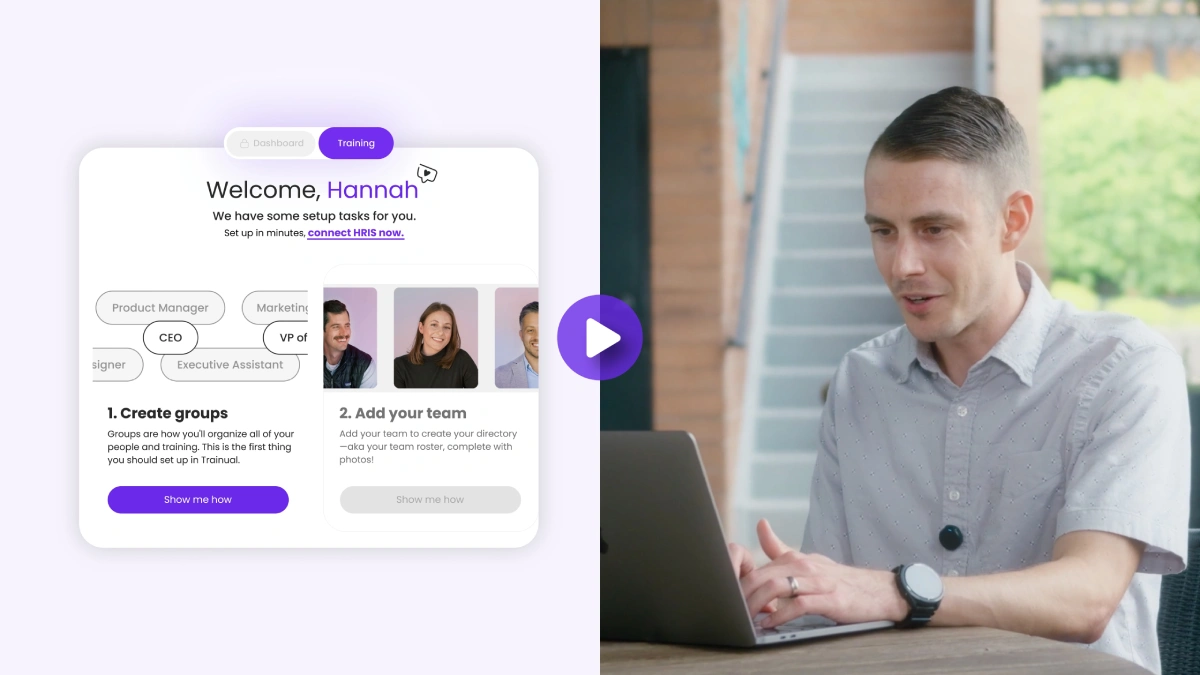
Trainual is a documentation and training platform built for growing companies — and for professional services firms specifically, it owns the operational half of onboarding. It turns how the firm delivers client work into searchable process documentation and role-based training paths, assigned by role so an analyst, a manager, and a partner-track hire each get the path built for their seniority.
That's what makes it fit billable work: the way a firm scopes an engagement, runs a matter, or ships a campaign becomes a documented, trainable system instead of something a new hire absorbs by shadowing a partner for weeks. AI-assisted creation speeds the documentation, version history keeps it current as engagements and regulations change, policy acknowledgments with e-signatures handle compliance sign-off, and completion tracking shows who's ready to bill. It also integrates with HRIS, Slack, and SSO, so it sits alongside your HR system rather than trying to replace it. Agencies and firms use it this way — see why marketing agencies and accounting and tax firms standardize on it, and how 829 Studios onboards and operates at nearly 300 people.
Best for: Professional services firms that need new hires delivering billable work the firm's way, fast — and need that documented and kept current.
Pricing: Trainual builds a plan around your team size and rollout rather than a flat per-seat rate, so the most accurate number comes from a quick conversation — get pricing to see what your firm would pay.
Strengths: Turns billable workflows into trainable systems; role-based paths and completion tracking; HRIS integration; compliance sign-off; genuinely usable by non-technical owners.
Limitations: It handles the operational half of onboarding, not payroll, benefits, or HR records — by design. Firms also need an HR information system for that side; Trainual is built to connect to one, not be one.
2. Process Street — best for repeatable, checklist-driven workflows
Process Street is a workflow and checklist platform that's strong at turning repeatable processes into trackable, step-by-step runs — useful for firms that want every engagement or onboarding task to happen in the right order with proof it got done.
Best for: Firms that want structured, auditable checklists for repeatable client and internal workflows.
Pricing (verified mid-2026): Process Street moved to quote-based pricing in 2026; historically its published plans ran from a Startup tier around $100/month to a Pro tier around $1,500/month, billed per seat by role. There's no free tier, but a free trial is available. Contact sales for current pricing.
Strengths: Excellent for checklist-driven, auditable workflows; strong automation and conditional logic; proof-of-completion on every run.
Limitations: It's a workflow tool, not a training platform — lighter on role-based learning paths and knowledge retention. Pricing turned opaque this year, and per-seat costs can climb for larger firms.
3. LearnUpon — best for structured training across clients and staff
LearnUpon is an enterprise-ready LMS known for strong support and deep integrations, built to train multiple audiences — staff, partners, and clients — through one connected platform. For firms that also train clients, that multi-audience capability is a real draw.
Best for: Mid-to-large firms training both staff and external audiences with a substantial budget.
Pricing (verified mid-2026): Quote-based and enterprise-oriented, with no free tier and a demo rather than a self-serve trial. Reported annual contracts commonly start around $15,000–$18,000, with estimated per-active-learner costs in the $6–$9/month range at volume.
Strengths: Strong support and integrations, multi-audience training, scales to thousands of learners.
Limitations: Priced for mid-market and up — often more than a small firm needs — and centered on course delivery rather than documenting how billable work gets done.
4. TalentLMS — best for firms wanting transparent, budgetable training
TalentLMS is the most SMB-friendly option here, with clean UX, fast setup, and published pricing — a good fit for a smaller firm that wants structured training without a sales cycle to learn the cost.
Best for: Small and mid-sized firms that want straightforward training with transparent pricing.
Pricing (verified mid-2026): A free plan covers up to 5 users and 10 courses. Paid tiers are roughly Core ~$149/month (up to 100 users; ~$119/month billed annually), Grow ~$299/month, and Pro ~$579/month, with Enterprise custom. Pricing is per active user.
Strengths: Transparent pricing, quick setup, free tier for piloting, solid core training features.
Limitations: Built for course delivery rather than billable-workflow documentation, per-active-user costs rise at scale, and advanced features sit on higher tiers.
5. Absorb LMS — best for larger firms with multi-audience training
Absorb is a polished enterprise LMS with strong automation and a capable authoring experience, able to train employees, clients, and partners from one platform. For a larger firm with a real L&D function, it's a mature choice.
Best for: Larger firms running structured, multi-audience training programs.
Pricing (verified mid-2026): Quote-based, priced primarily by active learners plus feature tier and contract; no public list pricing. Real-world deployments commonly start around $500–$800/month and scale into five figures annually at enterprise. A free trial is available; no free tier.
Strengths: Strong automation and reporting, multi-audience support, well-regarded support team.
Limitations: Quote-only pricing, and like other enterprise LMSs it's organized around courses rather than documenting billable client workflows or seniority-based onboarding paths.
6. Continu — best for mid-to-large firms wanting a polished learning hub
Continu is a modern, well-designed learning platform aimed at mid-to-large organizations that want a polished central hub for training employees, customers, and partners, with strong integrations into everyday tools.
Best for: Mid-to-large firms that want a sleek, centralized learning experience and have the scale to support it.
Pricing (verified mid-2026): Quote-based, built for larger teams — its plans (Growth, Professional, Enterprise) are oriented around deployments from roughly 250 seats up to tens of thousands, with implementation typically around 10% of the first-year contract. No public list pricing; a free trial is available.
Strengths: Modern UX, strong integrations, good fit for a sizable, design-conscious firm.
Limitations: The seat orientation and implementation model put it out of reach for smaller firms, and it's a learning hub rather than a billable-workflow documentation system.
7. Rippling — best for HR-system-led onboarding (paperwork and provisioning)
Rippling is a workforce platform that unifies HR, IT, and payroll — and its onboarding strength is the administrative half: offers, payroll, benefits, device and app provisioning, all from one system as a new hire is set up as an employee. It represents the HRIS side of the onboarding equation.
Best for: Firms that want the administrative side of onboarding — records, payroll, provisioning — automated in one platform.
Pricing (verified mid-2026): Modular and per-employee. The core platform starts at $8/employee/month plus a base monthly fee, but real-world cost typically lands around $20–$35+/employee/month once HR, payroll, and onboarding modules are added; full pricing is quote-based. Median annual contracts are reported around $40,000.
Strengths: Deep HR/IT/payroll automation, fast administrative onboarding and provisioning, broad integrations.
Limitations: It's an HR system, not a training or process-documentation tool — it sets a new hire up as an employee but doesn't teach them how the firm delivers billable work. That operational half lives in a platform like Trainual, which connects to it.
Onboarding software vs. your HR system
The most common mistake firms make here is expecting one tool to do both halves. An HR information system like Rippling is built to set someone up as an employee — records, payroll, benefits, provisioning. A training-and-process platform is built to make them productive — documented workflows, role-based paths, and the knowledge to do billable work correctly. They solve different problems, and stretching one to cover the other's job is where onboarding gets thin.
The firms that onboard well run both, connected. The HRIS owns the administrative side; the training platform owns the operational side; integration keeps employee data flowing between them so a new hire's setup and their learning path start together. That's why HR-system integration is a buying criterion, not a nice-to-have — and why a platform like Trainual is built to integrate with HRIS, Slack, and SSO rather than replace your system of record.
Matching the tool to your firm
The right fit depends on firm size, how much of your need is billable-workflow documentation versus course delivery, and what you already run for HR.
If you're a smaller firm that wants transparent pricing and structured training, TalentLMS publishes per-seat rates you can budget against. If your need is auditable, checklist-driven workflows, Process Street is purpose-built for that, though it's lighter on learning. If you're a larger firm running multi-audience training, LearnUpon, Absorb, and Continu are the heavyweights — each quote-priced, each best evaluated against your integration needs. If the administrative side is the gap, Rippling handles HR, payroll, and provisioning.
If the core problem is getting new hires to deliver billable work the firm's way — fast, consistently, and documented so it stays that way — that's the operational half most of this field doesn't focus on, and it's where Trainual is built to fit, sitting alongside your HRIS. How to Onboard a New Hire in Their First 30 Days, How to Write a SOP That People Actually Use, and 5 Signs You Need a Modern LMS, Not an Enterprise One are useful next reads as you narrow the field.
Ready to see how Trainual works?
👉 Book a demo and see how Trainual turns the way your firm delivers billable work into onboarding new hires can follow from day one.
Want a sneak peek?
👉 Read customer stories from firms who've standardized onboarding and documented how their work gets done.
Frequently asked questions
Which onboarding software helps professional services firms document billable workflows?
The best fit is a platform built to turn how the firm delivers client work into documented, trainable processes — not just deliver generic courses. Trainual is built for that: it captures how a firm scopes, runs, and closes engagements as searchable process documentation and role-based paths, so new hires can do billable work correctly without weeks of shadowing. Process Street is also strong for auditable, checklist-driven workflows, though it's lighter on training and knowledge retention.
What training and onboarding tools integrate well with enterprise HR systems?
Most established platforms integrate with HR systems through HRIS, SSO, and directory connections, but depth varies. Trainual integrates with HRIS, Slack, and SSO so onboarding content connects to your system of record rather than duplicating it. LearnUpon and Absorb also offer deep integrations suited to larger firms. The key is to confirm the specific HR system you run is supported before committing, since integration quality is one of the biggest differentiators between tools.
What is the best onboarding software for a professional services firm?
It depends on which half of onboarding is the gap. For the operational side — documenting billable work and getting new hires productive — Trainual is purpose-built and connects to your HRIS. For the administrative side — payroll, benefits, provisioning — an HR system like Rippling fits. For multi-audience course delivery, LearnUpon, Absorb, or Continu are options, and TalentLMS is the budget-transparent SMB choice. Most firms pair an operational platform with an HRIS rather than expecting one tool to do both.
Is onboarding software the same as an HRIS?
No. An HRIS handles the administrative side of onboarding — offers, e-signatures, payroll, benefits, compliance records. Onboarding software in the training-and-process sense, like Trainual, handles getting a new hire productive: documented workflows, role-based training, and consistent ramp. One sets someone up as an employee; the other teaches them the job. They're complementary, and firms typically use both rather than expecting one to do the other's work.
How do professional services firms keep onboarding consistent across roles and offices?
Consistency comes from documenting how the firm delivers work and assigning it as role-based paths, so every analyst, manager, and partner-track hire — in any office — gets the same content in the same order. Keeping it current matters as much as creating it: version history and clear ownership ensure the paths still match how the firm works as engagements and regulations change. A platform that tracks completion also tells you who's ready to bill.
How much does onboarding software cost for a professional services firm?
It varies widely and several vendors moved to quote-only pricing in 2026. Transparent options include TalentLMS (free for up to 5 users, then ~$149/month and up). Rippling's core platform starts at $8/employee/month plus a base fee, typically landing $20–$35+/employee/month with modules. Process Street, LearnUpon, Absorb, and Continu are quote-based, with enterprise LMS contracts often starting in the low five figures annually. Trainual builds pricing around firm size and rollout — you can get pricing through a quick demo.
Can onboarding software document billable client workflows?
Yes — if it's built for process documentation rather than only course delivery. The goal is to capture how the firm scopes, runs, and closes client work as a documented, trainable workflow, so new hires deliver it correctly and consistently. Trainual is designed for exactly this, turning billable workflows into role-based onboarding paths and keeping them current with version history. Pure LMS tools can host a course about the work but aren't built to document the work itself.