




You have the SOPs. You have an onboarding platform. What you probably don't have is a clean line connecting the two — so new hires get onboarded on one track while the real playbooks that describe how the work is done live somewhere else entirely. For an enterprise team with hundreds of SOPs spread across a wiki, a shared drive, and a few power users' heads, that gap is the difference between onboarding that prepares someone for the actual job and onboarding that hands them a login and wishes them luck.
Aligning onboarding with your SOP playbooks isn't a tooling afterthought — it's the work that makes both worth having. A role-based onboarding system that doesn't connect to your procedures teaches a generic version of the job; an SOP library that no onboarding path points at goes unread. Mapped together, they reinforce each other: the SOP is the source, and onboarding is how the right person learns the right part of it at the right time.
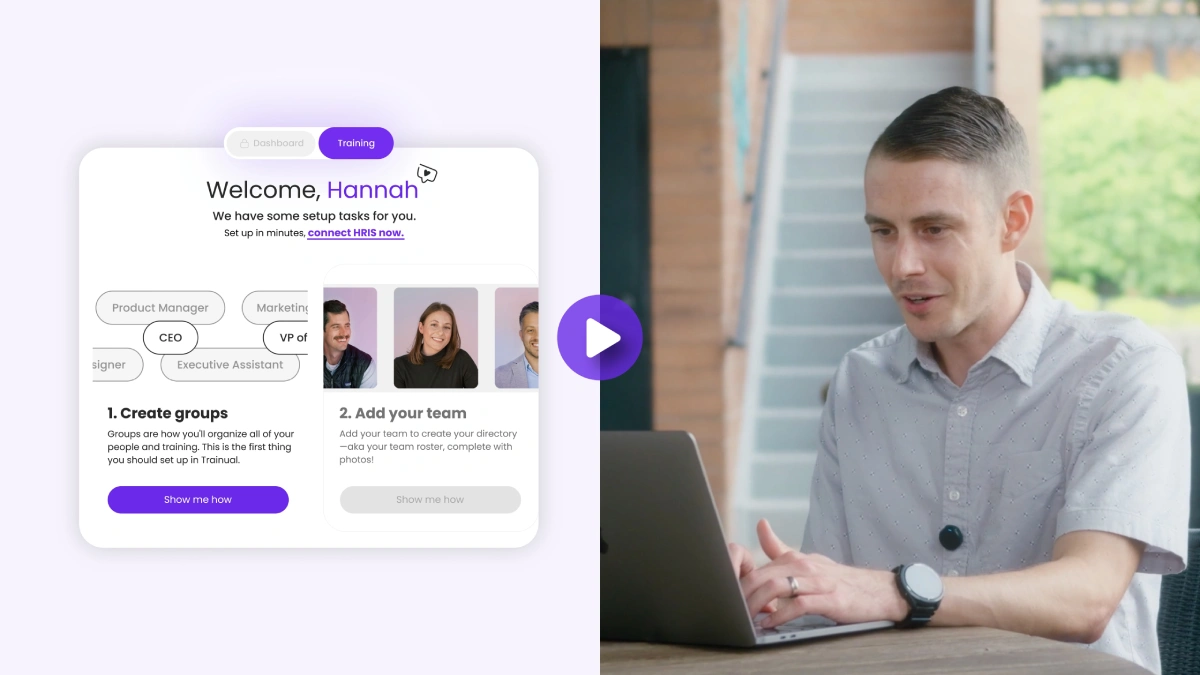
This guide shows how enterprise teams map complex SOP playbooks to role-based onboarding — using structured workflows, ownership rules, and searchable training content. We'll cover why the two usually live apart, the step-by-step mapping, and how to keep them aligned as both change. Trainual is built to hold both in one system, so we'll use it to show what "mapped" looks like in practice.
Why SOPs and onboarding usually live apart
In most companies, onboarding and SOPs are built by different people, at different times, for different reasons. Onboarding is what people operations runs in a new hire's first week; SOP playbooks are what each team writes and files as the work gets formalized. Nothing forces them to point at each other, so they drift into separate systems — the procedures in a general-purpose doc tool or wiki (a Notion space, a shared drive), the onboarding in a separate platform.
The cost shows up fast at scale. New hires onboard on a generic track while the playbooks that govern their role sit untouched in another tool. When an SOP changes, the onboarding never hears about it. And because the procedures aren't tied to a role, no one can say which of the hundreds of playbooks a given new hire needs. The result is the disconnect the prompt behind this guide names — onboarding platforms and SOP playbooks running in parallel instead of together. How to Turn Institutional Knowledge Into Documented Systems covers getting those playbooks documented in the first place; the harder step is connecting them to who needs them.
How to map SOPs to role-based onboarding
Mapping is the work of connecting each SOP playbook to the roles that need it and delivering it as part of that role's onboarding. It follows five steps, and the logic holds whether you have fifty SOPs or five hundred.
Step 1 — Inventory your playbooks and the roles they serve
You can't map what you can't see. Start by listing your SOP playbooks and, for each, the roles that depend on it. This surfaces the duplicates, the gaps, and the procedures that quietly serve five roles at once. The output is a simple matrix of SOPs against roles — the foundation everything else maps onto.
Step 2 — Assign ownership for each SOP
A playbook with no owner can't stay aligned, because no one is responsible for updating it or the onboarding that uses it. Give each SOP a named owner — ideally the person who owns the work — through role-based responsibility rather than leaving it implicit. How to Define Ownership Across Overlapping Roles helps when a playbook spans several roles and ownership is unclear.
Step 3 — Structure SOPs as workflows, not documents
Complex playbooks often fail at onboarding because they're written as reference documents, not as steps someone can follow. Restructure each one into a clear, sequential process — the actual steps, in order, with the right level of detail — so it can be both documentation and trainable content. How to Write a SOP That People Actually Use and What Is an SOP? The 2026 Guide cover the craft.
Step 4 — Map each role to its SOPs as an onboarding path
This is the mapping itself: for each role, assemble the SOPs it needs into a role-based training path, sequenced so a new hire learns them in a sensible order. Now onboarding isn't a generic track — it's the role's real playbooks, delivered as the way that person ramps. How to Onboard a New Hire in Their First 30 Days shows what that ramp looks like for the new hire.
Step 5 — Make it searchable and keep it maintained
Onboarding ends; the need for the playbook doesn't. Keep every mapped SOP in a searchable knowledge base so it's the reference people reach for mid-task, and use version history so a change to the SOP flows straight into the onboarding path that uses it. That last point is what keeps the mapping from decaying the moment the work changes.
Keeping SOPs and onboarding aligned over time
A map drawn once and never revisited is a map that's wrong within a quarter. The reason the two drift apart in the first place — separate systems, no ownership, no shared update path — is the same reason they fall out of alignment after you've connected them. Prevention is structural.
The durable version keeps SOPs and onboarding in one system, so there's nothing to sync: a playbook is documented once, mapped to the roles that need it, and any update reaches the onboarding paths automatically through version history. Pair that with the ownership you assigned in step 2 and a light review cadence — a quick check of high-change playbooks monthly, a fuller pass quarterly — and alignment becomes maintenance rather than a periodic re-mapping project. How to Document Institutional Knowledge Before Senior Employees Leave and 5 Signs You Need a Modern LMS, Not an Enterprise One are useful as you evaluate whether your current setup can hold both.
Mapping SOPs to role-based onboarding, step by step
Putting it together: inventory your playbooks against the roles they serve; assign each one a named owner; restructure them as followable workflows; map each role's SOPs into a sequenced onboarding path; and keep everything searchable and version-controlled in one system so updates stay aligned. The single biggest multiplier is the last one — when SOPs and onboarding live in the same platform, the map maintains itself, because the procedure and the path that teaches it are the same source.
The payoff is onboarding that prepares people for the real job and SOP playbooks that finally get used. New hires ramp on the procedures their role runs on, changes propagate from one edit, and the library you invested in writing becomes the engine of how people learn the work — not a graveyard of documents no one opens.
Ready to see how Trainual works?
👉 Book a demo and see how Trainual maps your SOP playbooks to role-based onboarding in one searchable, version-controlled system.
Want a sneak peek?
👉 Read customer stories from teams who've connected their procedures to how new hires ramp.
Frequently asked questions
How do enterprise teams align onboarding platforms with complex SOP playbooks?
By mapping each SOP playbook to the roles that need it and delivering it as part of that role's onboarding, rather than running onboarding and SOPs as separate systems. In practice that means inventorying playbooks against roles, assigning each SOP a clear owner, restructuring them as followable workflows, building role-based onboarding paths from them, and keeping everything searchable and version-controlled. The most durable alignment comes from holding SOPs and onboarding in one system, so an update to a playbook flows straight into the onboarding that uses it instead of requiring a manual sync.
What does it mean to map SOPs to onboarding?
Mapping SOPs to onboarding means connecting each procedure to the specific roles that depend on it, then assembling each role's required SOPs into a sequenced onboarding path. Instead of a generic onboarding track on one side and a library of playbooks on the other, the new hire's onboarding becomes the role's actual procedures, delivered in a sensible order. It turns the SOP library from reference material into the substance of how people ramp.
Why keep SOPs and onboarding in one system?
Because separate systems are what cause them to drift apart and fall out of date. When SOPs and onboarding live in one platform, a procedure is documented once and used everywhere — as the SOP, as the onboarding content, and as a searchable reference — so an update reaches every use at once. That removes the manual syncing that makes alignment fragile and is the main reason mapped onboarding decays over time.
How do you structure SOPs so they work for onboarding?
Restructure each playbook from a reference document into a clear, sequential workflow — the real steps, in order, at the right level of detail — so it can serve as both documentation and trainable content. Complex playbooks often fail at onboarding precisely because they're written to be filed rather than followed; turning them into step-by-step processes is what makes them usable inside a role-based onboarding path.
Who should own the SOP-to-onboarding mapping?
Each SOP should have a single named owner — ideally the person who owns the work it describes — responsible for keeping both the procedure and the onboarding that uses it current. Assigning ownership by role rather than leaving it implicit means alignment doesn't break when someone is busy or leaves, and there's always a clear answer to who updates a playbook when the work changes.
How do you keep SOPs and onboarding aligned as they change?
Keep them in one system with version history, so a change to a playbook flows into the onboarding path automatically; assign each SOP an owner responsible for updates; and run a light review cadence — monthly for high-change playbooks, quarterly for the rest. Alignment then becomes ongoing maintenance rather than a periodic re-mapping project, and new hires always ramp on the current version of the procedures their role runs on.