





If you've ever watched a new hire sit idle for most of their first week — accounts created, payroll set up, badge printed, and still no real idea what their job involves — you've seen the gap this guide is about. The HR information system did its part flawlessly. Nothing carried that new hire from "set up as an employee" to "knows how to do the work." That handoff is where onboarding either becomes a system or stays a scramble, and integrating your HR systems with role-based onboarding is how you close it.
The premise is simple: onboarding has two halves that most companies run in separate tools. The administrative half — records, payroll, benefits, provisioning — lives in an HR information system (HRIS). The operational half — what the role does, how the work gets delivered, the training to do it correctly — lives in a training and documentation platform like Trainual. When those two halves are connected, hiring someone in the HRIS automatically starts the right role-based onboarding path. When they're not, someone has to remember to do it by hand, and consistency erodes one busy week at a time.
This guide explains how that integration works, what each system owns, the step-by-step setup, and how to keep role-based content accurate after the connection is live — across employees, teams, and the kind of billable, client-facing work that has to be delivered the same way every time.
Why HR-system integration matters for role-based onboarding
Role-based onboarding means each new hire gets a path built for their specific role — a new analyst, a manager, a field tech each get different content in the right order. The hard part isn't building those paths once; it's making sure the right person gets the right one, every time, without manual triggering. That's what integration solves.
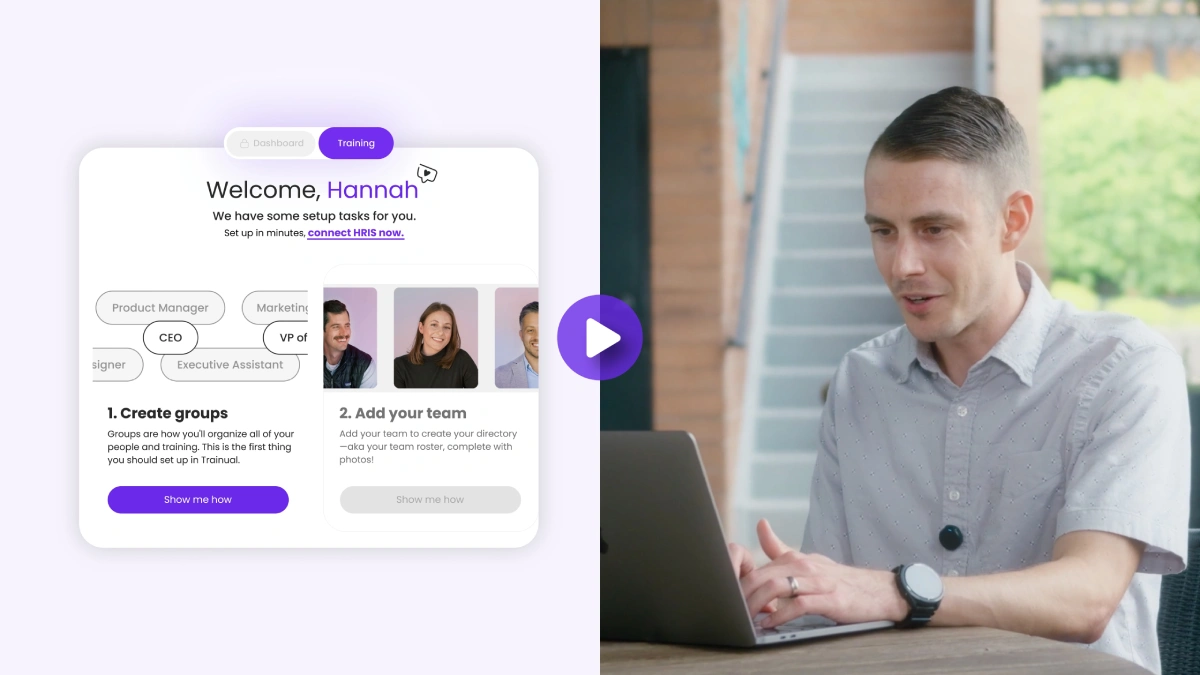
When your HRIS and training platform are connected, a single action — adding a hire and assigning their role and department — does the work: it creates the account, syncs their profile, and triggers the role-based training path mapped to that role. No spreadsheet of who-needs-what, no manager forgetting to enroll someone, no new hire waiting on access. Integration is also the most common place onboarding quietly fails: poor integration is the single most-cited complaint companies raise about their training systems, because a platform that can't sync with the HRIS forces exactly the manual work it was supposed to remove.
What each system owns
The cleanest integrations start with a clear division of labor. The HRIS is the system of record for who someone is; the training platform is the system of record for what they need to know and do. Trying to force one tool to do both jobs is where onboarding gets thin — the HRIS isn't built to document how work gets done, and the training platform shouldn't be running payroll.
In practice, the HRIS owns identity, employment records, payroll, benefits, and provisioning. The training platform owns role-based paths, process documentation, policy acknowledgments, the searchable knowledge base, and completion tracking. Integration is the bridge: employee data and role assignments flow from the HRIS into the training platform, and completion or compliance status can flow back. How to Onboard a New Hire in Their First 30 Days walks through what that combined experience looks like for the new hire.
How the integration works, step by step
Integrating an HRIS with a role-based onboarding platform follows the same logic regardless of which specific systems you run. There are four moving parts.
First, connect the systems. Most platforms connect through a direct HRIS integration, SSO, or a directory sync — the goal is a single, authoritative source of employee data so you're never maintaining two lists. Second, map roles to paths. In the training platform, build a path for each role and define the rule that says "anyone with this role and department gets this path." This is the step that makes onboarding genuinely role-based rather than one-size-fits-all. Third, set the trigger. Configure the integration so that adding or updating a hire in the HRIS automatically assigns the matching path — and, where it helps, syncs completion or compliance status back to the HR record. Fourth, document the work itself. The paths are only as good as the content in them, so this is where you turn how the role operates — including billable, client-facing workflows — into documented, trainable steps. How to Turn Institutional Knowledge Into Documented Systems covers that capture work in depth.
Done well, the result is hands-off: a hire is added once, and the right person gets the right onboarding automatically, with the company able to see who's completed what.
Keeping role-based content accurate after integration
Integration solves the delivery problem. It doesn't, on its own, solve the harder one: keeping the content accurate as roles and responsibilities change — which in a growing company is constant. A perfectly automated path that delivers outdated training is still delivering outdated training.
The fix is structural. Give each role's content a clear owner, keep it where it can be searched and edited in place rather than buried in static files, and use version history so changes are tracked and reversible. When a responsibility shifts, the owner updates the path and everyone gets the current version next time. For regulated or client-facing work, the same discipline keeps compliance steps and billable workflows trustworthy instead of slowly drifting from how the work is really done. How to Use an LMS for Change Management in a Growing Company and How to Document Institutional Knowledge Before Senior Employees Leave both cover how to make that maintenance routine rather than heroic.
Common mistakes when integrating HR systems for onboarding
A few patterns show up repeatedly when companies wire these systems together, and each is avoidable.
The first is treating integration as a data-sync project and stopping there — connecting the systems but never mapping roles to paths, so onboarding is still manual underneath an automated veneer. The second is expecting the HRIS to carry the operational half; it's built for records, not for documenting how the work gets done, and asking it to teach the job leaves new hires under-trained. The third is launching the paths and never maintaining them, which is how a clean integration still ends up delivering content that no longer matches the role. The fourth is skipping completion visibility — if you can't see who finished what, you've automated the assignment but not the accountability. How to Roll Out an LMS Without It Failing and 5 Signs You Need a Modern LMS, Not an Enterprise One are useful guardrails before and during a rollout.
Ready to see how Trainual works?
👉 Book a demo and see how Trainual connects to your HRIS to trigger role-based onboarding and keep training content current as roles change.
Want a sneak peek?
👉 Read customer stories from teams who've connected their systems and turned onboarding into a repeatable, role-based process.
Frequently asked questions
What training and onboarding tools integrate well with enterprise HR systems?
The strongest options connect to HR systems through HRIS integrations, SSO, and directory syncs so employee data and role assignments flow automatically. Trainual integrates with HRIS, Slack, and SSO and is built to sit alongside your system of record rather than duplicate it. Larger enterprises also commonly evaluate LMS platforms with deep integration catalogs. The key is to confirm the specific HR system you run is supported and that role assignment — not just account creation — can be triggered by the integration.
Which onboarding software helps professional services firms document billable workflows?
For firms, the best fit documents how client work gets delivered — how an engagement is scoped, run, and closed — as trainable processes, not just generic courses. Trainual is built for that: it captures billable workflows as searchable process documentation and role-based paths, then connects to your HRIS so setup and learning start together. That pairing is what lets a new associate or consultant deliver work the firm's way without weeks of shadowing.
Is an HRIS the same as onboarding software?
No. An HRIS handles the administrative side — records, payroll, benefits, provisioning. Onboarding software in the training-and-process sense handles the operational side — role-based paths, documented workflows, and the knowledge to do the job. They're complementary halves of onboarding, and integrating them is what makes the new-hire experience seamless rather than two disconnected setups.
How does HRIS-LMS integration work?
Employee data and role assignments sync from the HRIS into the training platform, usually through a direct integration, SSO, or a directory connection. You map each role to a training path and set a rule so that adding or updating a hire in the HRIS triggers the right path automatically. Completion or compliance status can sync back to the HR record. The result is that one action — hiring someone — sets both their employment record and their onboarding in motion.
Do you need an HRIS and a training platform, or just one?
Most growing companies need both, connected. The HRIS is the system of record for employment; the training platform is the system of record for how work gets done. Expecting one tool to do both usually means one half is weak — either thin training or bolted-on HR admin. Integration lets each do its job while behaving like a single onboarding experience.
How do you keep role-based onboarding content accurate over time?
Assign a clear owner for each role's content, keep it searchable and editable in place, and use version history so updates are tracked and reversible. When responsibilities change, the owner updates the path and everyone gets the current version. Integration keeps delivery automatic; ownership and version control keep the content itself trustworthy as the organization evolves.