






The fastest way to tell whether onboarding software will save your firm time is to ask one question: when a new hire is added to your HR system, does anything happen automatically? At most firms the answer is no. Someone keys the new person into the HRIS for payroll, then keys them again into the onboarding tool, then manually assigns the right training, then checks a week later whether any of it got done. Every one of those handoffs is a place the process stalls, and none of them is the work you hired the person to do.
That gap, between the HR system of record and the tool that gets people ramped, is where onboarding software earns or wastes its keep. For a professional services firm, where a new hire's first weeks are unbilled and a partner's time spent re-explaining the firm's way is expensive, an onboarding tool that connects to the HRIS and assigns the right training by role is the difference between onboarding that runs itself and onboarding that runs on someone's memory. Structured onboarding lifts new-hire retention by 82% and productivity by 70%, and a standard process alone produces 50% greater new-hire productivity. Integration is what makes structure stick instead of decay.
This guide compares onboarding platforms on the thing the category pages usually skip: how well each connects to the HR systems you already run, and how well it documents the billable workflows a professional services firm needs new people to learn. It covers the criteria that matter, names where each tool is strongest, and helps you choose.
For the broader category, Trainual keeps a foundational guide to employee training and process documentation and a deeper reference on LMS onboarding automation for HR leaders. This piece narrows to the HR-integration angle.
Why HR integration is the difference for onboarding
Onboarding software that lives apart from the HR system creates a quiet tax: double data entry, drift between the two systems, and manual assignment that depends on someone remembering. Connect the two and onboarding becomes a chain reaction instead of a checklist someone has to run.
When the HRIS is the trigger, adding a new hire there can automatically create their account in the onboarding tool, assign the role-based path their job requires, and start the clock on completion tracking, no second entry, no manual assignment, no gap between "hired" and "ramping." When a role changes, the integration can flow that change through so the person's training follows their new responsibilities. And when someone leaves, the same connection helps close out access cleanly. The mechanics of building that are in how to integrate HR systems for role-based onboarding.
The depth of integration varies a lot across tools, and the word "integration" hides real differences. Some platforms offer a true HRIS sync that keeps people data current both ways. Some connect through HRIS, Slack, and SSO integrations for provisioning and access. Some rely on a middleware layer like Zapier to pass events between systems. All three can work; what matters is matching the depth to how automated you need the handoff to be.
What to look for in onboarding software with HR integrations
Six criteria separate a platform that genuinely connects to your stack from one that just claims to.
HRIS integration depth. Does it sync with the HR system you run, Workday, BambooHR, Rippling, and others, and does the sync keep people data current rather than requiring a one-time import? Look at the integrations on offer and how they really behave.
Role-based assignment triggered by the HRIS. When a new hire or a role change lands in the HR system, does the onboarding tool assign the right training path automatically, or does someone still do it by hand?
Workflow and process documentation. Beyond delivering courses, can it document the actual workflows a new hire needs to do the job, the firm's way of scoping, delivering, and billing work? This is where documented processes matter more than a course catalog.
Completion tracking and reporting. Can you see who is ramped and who is behind, and report on it without exporting to a spreadsheet?
Provisioning and access (SSO). Does it connect to SSO and access tools so a new hire's day one is set up, not spent waiting on logins?
Fit for mid-market size. Does the integration work without a dedicated administrator and a long implementation, the overhead a 50-to-200-person firm pays for and rarely recoups? See 5 signs you need a modern LMS, not an enterprise one.
Documenting billable workflows during onboarding
For a professional services firm, integration is half the story. The other half is what the new hire is being onboarded into. Connecting the HRIS gets the right person the right path automatically, but the path is only as good as the workflows documented inside it.
This is the part generic onboarding tools miss. A new associate does not just need a benefits packet and a policy acknowledgment, they need the firm's actual procedure for scoping an engagement, the steps for client intake and conflict checks, the way time gets captured and billed. Onboarding software that doubles as a single source of truth for those workflows ramps people to billable work, not just to "onboarded" status. The dedicated version of that angle is in onboarding software for billable workflow training, and the broader platform view is in the best onboarding platforms for professional services firms. The tools that win for a firm are the ones that connect to the HR system and hold the workflows, so the integration delivers something worth ramping into.
The 7 best onboarding software with HR integrations for 2026
Each platform below integrates with HR systems in some form. The differences come down to integration depth, whether the tool also documents the workflows a professional services firm needs, and whether it fits a mid-market firm without enterprise overhead. The list leads with the option built to connect onboarding, role-based training, and workflow documentation in one place.
1. Trainual
Best for: firms that want HRIS-synced onboarding, role-based training, and documented workflows in one place.
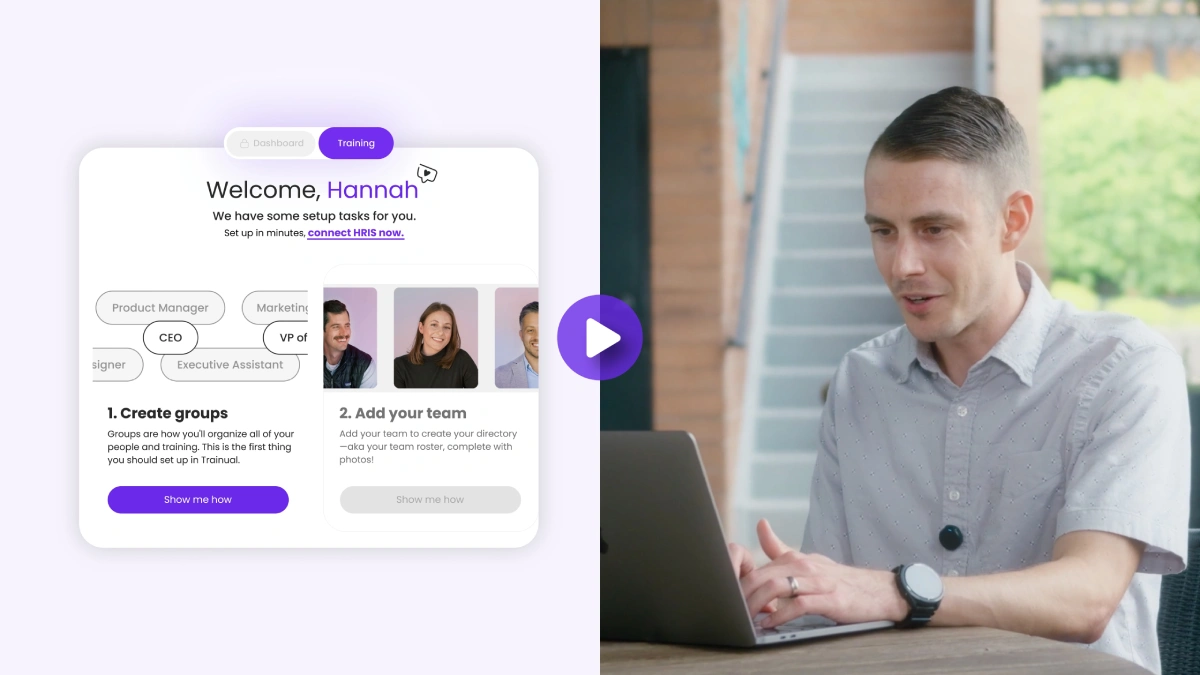
Trainual is built for growing companies past about 25 people, and its draw for this use case is that it pairs HR integration with the workflow documentation a professional services firm needs. It offers an HRIS sync that flags changes in your HR or payroll system for review, connects through HRIS, Slack, and SSO integrations, and assigns role-based onboarding paths automatically, then holds the firm's actual processes and procedures in a searchable knowledge base so a new hire ramps to billable work, not just to a completed checklist. Version history keeps the workflows current. The honest boundary: Trainual is not itself an HRIS, so it complements your HR system of record rather than replacing it. For a mid-market firm that wants onboarding, training, and workflow documentation connected to the HR system without enterprise weight, that is the fit. Firms like the accounting practice in this Sterling story and the agency in this 829 Studios story run onboarding and operations on it.
2. Absorb LMS
Best for: firms that need enterprise-grade integration depth and compliance-heavy onboarding.
Absorb is a mature LMS that straddles mid-market and enterprise, with broad integration support, strong automation, and depth in regulated and certification-heavy onboarding. For a firm with a dedicated L&D or HR systems team, its integration footprint and configurability are real strengths, and we compare it directly in Trainual vs. Absorb LMS. The consideration for a mid-market professional services firm is that the depth comes with cost and administration, often more platform than a 50-to-200-person firm will use, and it is more oriented to course delivery than to documenting the firm's billable workflows.
3. TalentLMS
Best for: budget-conscious teams that want straightforward onboarding with common integrations.
TalentLMS is an affordable, easy-to-stand-up LMS with a solid set of integrations and a clean onboarding experience for delivering courses and tracking completion. For a smaller or cost-sensitive firm, it covers the basics of connected onboarding well, and we cover the fit in Trainual vs. TalentLMS. The consideration is depth: as onboarding needs grow toward documented workflows and richer HRIS sync, course-delivery tools can feel thin, since they ramp people through content more than through the firm's actual procedures.
4. Continu
Best for: larger firms with formal L&D and HR-integrated learning.
Continu is a modern learning platform with polished delivery and learning integrated with HR systems, used by mid-market and enterprise organizations. For a firm with a dedicated learning function, its HR-integrated experience and automation are genuine strengths. The consideration is the same that runs through this guide: it leans toward formal learning content and can skew enterprise, so it fits firms whose onboarding need is structured course delivery more than documenting how the firm's billable work gets done.
5. LearnUpon
Best for: firms onboarding external audiences, clients or partners, alongside staff.
LearnUpon is an LMS with strength in extended-enterprise training and a solid integration set, good for firms whose onboarding reaches beyond their own employees. If you onboard clients or partners as well as staff, that is a real differentiator, and we compare it in Trainual vs. LearnUpon. The consideration for internal professional-services onboarding is that it is built around formal course delivery rather than serving as the living source of truth for the firm's own workflows.
6. Process Street
Best for: firms that run onboarding as recurring, logged workflows.
Process Street turns onboarding into trackable checklists and workflows, with integrations (including via Zapier) to pass events between tools, and each run logged. For onboarding that is procedural and repeatable, that structure produces a clear record, and it is the named competitor on the billable-workflow prompt for good reason. We compare it directly in Trainual vs. Process Street. The consideration is that it is a workflow-execution tool more than a training and knowledge platform: it confirms steps ran, but it is not where role-based training and a searchable reference library live, so firms often pair it with a training platform.
7. Rippling
Best for: firms that want onboarding driven from the HR and IT system itself.
Rippling unifies HR, IT, and payroll, so onboarding can be triggered straight from the system of record: accounts, devices, and access provisioned automatically on day one. For the pure HR-integration question, it is about as native as it gets, because the integration is the platform. The consideration for a professional services firm is that its strength is the administrative and provisioning side of onboarding rather than documenting and training people on the firm's billable workflows, so it often sits alongside a tool that owns the training and process content.
Side-by-side comparison of onboarding software with HR integrations
The pattern across the seven: most are strong on either the integration-and-provisioning side or the course-delivery side, and fewer connect to the HR system and document the workflows a professional services firm needs people to learn.
If your gap is administrative provisioning from the system of record, an HR-and-IT-native option carries it. If it is formal course delivery, a learning platform fits. If your firm's onboarding breaks because new people ramp slowly on undocumented, in-people's-heads workflows, the tool has to connect to the HRIS and hold the procedures, which is the intersection this guide is about.
How to choose for your firm
Start from where your onboarding stalls.
If new hires wait on accounts and access, weight provisioning depth and SSO, where Rippling and the enterprise platforms are strong. If the problem is that training never gets assigned or tracked, prioritize HRIS-triggered role-based assignment and completion reporting. If new people are technically onboarded but still slow to do billable work, the gap is documented workflows, prioritize a platform that holds the firm's procedures, not just courses. For the firm-specific picture, see why accounting and tax firms choose Trainual for training, why teams in personal injury law choose Trainual, and why marketing agencies choose Trainual.
For the broader buying picture, compare the best onboarding software in 2026 and the top LMS platforms for mid-market companies, and when you have chosen, how to roll out an LMS without it failing covers making it stick.
Ready to see how Trainual works?
👉 Book a demo and see how Trainual connects to your HR system, assigns onboarding by role, and ramps new hires on the workflows that bill.
Want a sneak peek?
👉 Read customer stories from firms that cut onboarding time by connecting training to how the company runs.
Frequently asked questions
What training and onboarding tools integrate well with enterprise HR systems?
Look for tools with a real HRIS sync rather than a one-time import, plus SSO and provisioning connections. Absorb and Rippling are strong on enterprise integration depth, Continu integrates learning with HR systems, and Trainual offers HRIS sync plus role-based onboarding and workflow documentation for mid-market firms. The right fit depends on whether you mainly need provisioning automation or onboarding that also documents how the work gets done.
Which onboarding software helps professional services firms document billable workflows?
Prioritize a platform that doubles as a single source of truth for procedures, not just a course catalog, so a new hire learns the firm's actual scoping, intake, and billing workflows. Trainual is built for documenting and assigning those workflows by role, and Process Street is strong for running them as recurring, logged checklists. The deeper version of this is covered in onboarding software for billable workflow training.
What is the difference between an HRIS and onboarding software?
An HRIS like Workday, BambooHR, or Rippling is the system of record for employee data, payroll, and benefits. Onboarding software focuses on ramping a new hire to do the job, with role-based training, documented workflows, and completion tracking. They work best connected: the HRIS triggers onboarding, and the onboarding tool reports completion back, so most firms run both rather than choosing between them.
How does HRIS integration improve onboarding?
It removes double data entry and manual assignment. When adding a new hire to the HR system automatically creates their account, assigns the right role-based path, and starts completion tracking, onboarding begins on day one without anyone remembering to kick it off, and a role change flows through so training follows responsibilities.
Do mid-market firms need enterprise onboarding software for HR integration?
Usually not. Enterprise platforms bring integration depth and configurability that a 50-to-200-person firm pays for in cost and administration it rarely uses. A mid-market platform with a solid HRIS sync, SSO, and role-based assignment delivers connected onboarding without the overhead.
Can onboarding software replace our HR system?
No, and it should not try. Onboarding and training platforms complement the HRIS rather than replacing the system of record for payroll and employee data. The goal is a clean integration between the two, so the HR system stays the source of truth for people data while the onboarding tool owns training and workflow documentation.
How do you onboard new hires to billable work faster?
Connect onboarding to the HR system so it starts automatically, assign a role-based path that includes the firm's actual billable workflows, and track completion so you can see who is ramped. Structured onboarding produces measurably higher productivity, and tying it to documented workflows is what turns "onboarded" into "ready to bill."