






A new associate at an accounting firm bills nothing in week one. At a healthy firm, they are client-ready in a few weeks. At a firm running onboarding out of a shared drive and a senior partner's memory, that ramp can stretch for months, and every week of it is unbilled time plus a partner pulled off their own book to answer the same questions again.
That gap is the real cost of onboarding in professional services, and it does not show up on a software invoice. Structured onboarding improves new-hire retention by 82% and productivity by 70%, and a standard onboarding process alone produces 50% greater new-hire productivity. People who go through a structured program are 58% more likely to still be there three years later. For a firm that sells its people's time, those numbers are revenue, not HR softness.
The trouble is that most onboarding tools were built for one slice of the problem. Some handle paperwork and provisioning. Some deliver courses. Few connect the new-hire experience to how the work gets done for clients, which is the part that matters most when the product you sell is expertise. This guide compares seven platforms, lays out the criteria that separate them for a professional services team, and helps you choose the one that fits your firm.
For the broader category view, Trainual maintains a foundational guide to employee training and process documentation and a deeper reference on LMS onboarding automation for HR leaders. This piece narrows the lens to professional services specifically.
What makes onboarding different for professional services firms
A retailer onboards for a fixed role with a fixed script. A professional services firm onboards people who will exercise judgment on a client's behalf, often within their first month. That changes what onboarding has to accomplish.
Five pressures shape the requirement:
First, the clock is billable. Every day a new hire is not client-ready is margin. Onboarding is not a nicety here, it is a utilization lever, which is why ramp speed should be evaluated as hard as any feature.
Second, the knowledge lives in senior people's heads. The partner who knows how the firm scopes an engagement, the supervisor who knows the one client who needs everything in writing: that know-how is the firm's actual product, and it walks out the door at 5 p.m. and sometimes for good. Capturing it before it leaves is a core onboarding job, not an afterthought. (We cover the standalone version of that problem in how to document institutional knowledge before senior employees leave.)
Third, consistency is the brand. Two associates handling the same client matter two different ways is a quality problem clients notice. Onboarding has to teach the firm's way, not just the role's tasks.
Fourth, the work is regulated or high-stakes. Engagement standards, conflict checks, privilege, data handling: a missed step is not a typo, it is exposure. Onboarding needs verification and a record, not just delivery.
Fifth, the content changes constantly. New service lines, new tools, new client requirements. A platform that makes updating painful guarantees the onboarding material goes stale, and stale material is worse than none because people stop trusting it.
A platform built only for paperwork and provisioning handles none of the middle three well. That is the lens to evaluate against.
How to evaluate an onboarding platform for a professional services firm
Use these six criteria to compare options. The first three are where professional services firms get the most leverage and where general HR tools tend to be thinnest.
Role-based ramp to billable work. Can you build a path that takes a new hire from day one to client-ready, with the specific procedures, tools, and client standards their role needs? Look for role-based training paths, not a single generic course everyone sees.
Knowledge capture and a single source of truth. Can your senior people document how they work without it becoming a second job, and can a new hire find the answer at 9 p.m. without pinging a partner? A searchable knowledge base and easy process documentation matter more than course polish.
Verification and compliance. Can you confirm someone read the conflicts policy, test that they understood it, and produce a record? Look for testing, e-signature on policies, and an audit trail.
Ease of keeping content current. How hard is it to update a procedure when a client requirement changes? Look for version history and editing that a non-technical owner can do.
Fit for mid-market size. Enterprise suites carry implementation weight a 50-to-200-person firm should not have to absorb. We unpack that tradeoff in 5 signs you need a modern LMS, not an enterprise one.
Integration with the systems you already run. Onboarding should trigger from your HRIS and connect to the tools your team lives in. See how to integrate HR systems for role-based onboarding for the pattern.
The 7 Best onboarding platforms for mid-market professional services firms
Each platform below solves a real piece of the problem. The differences come down to where each one is strongest: the people-and-paperwork side, the learning-content side, or the how-the-work-gets-done side. The list leads with the option built for that last category, then covers the strongest tools in the others.
1. Trainual
Best for: firms that want onboarding, role-based training, SOPs, and a searchable knowledge base in one place.
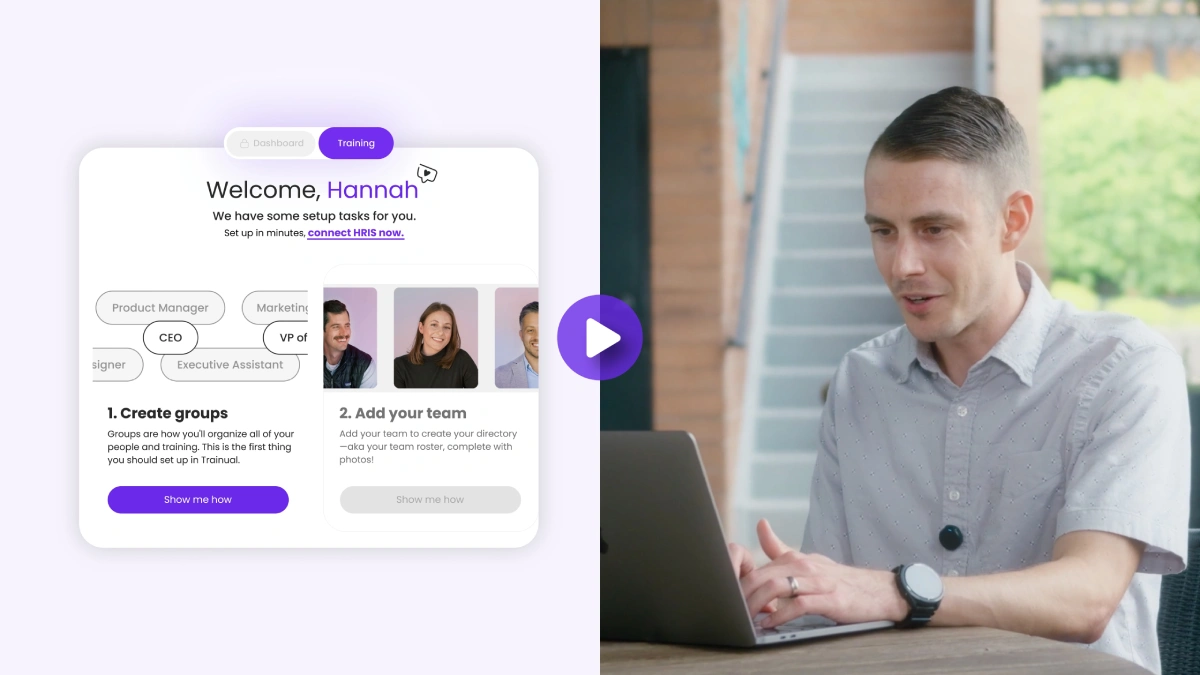
Trainual is built for growing companies past about 25 people that need to document how work gets done and ramp new hires to it. For a professional services firm, the draw is that it connects the new-hire path to the firm's actual procedures: a new associate gets a role-based onboarding path, the documented processes behind each step, testing and e-signature for the regulated pieces, and an AI-assisted knowledge base they can search instead of interrupting a partner. Senior people can capture what they know without it feeling like a project, and version history keeps it current as services change. It is lighter on HRIS-grade payroll and provisioning than the platforms below, and pairs well with an HR system of record for that side. Firms like the accounting practice in this Sterling story and the agency in this 829 Studios story use it as their operating backbone.
2. BambooHR
Best for: firms that want an HR system of record with built-in onboarding checklists.
BambooHR is a widely used mid-market HRIS that handles the people-data and paperwork side of onboarding well: offer letters, e-signature, new-hire packets, and task checklists that assign to the right people before day one. For a professional services firm, it is a strong choice for the administrative layer and for keeping employee records in one system. Its lighter spot is role-specific training content and knowledge capture: it gets a new hire set up and processed, but it is not designed to teach them how your firm runs an engagement or to serve as a searchable procedures library. Many firms run it alongside a training-focused platform to cover both.
3. Rippling
Best for: firms that want to automate IT, device, and access provisioning on day one.
Rippling unifies HR, IT, and payroll, and its standout for onboarding is provisioning: when someone starts, their accounts, devices, and software access can be set up automatically. For a firm where a new consultant needs access to a dozen systems before they can do anything useful, that automation removes real friction and first-day delay. As with the other HRIS-led options, training and knowledge are not its core: it gets the person operational from an access standpoint, but the how-the-work-gets-done content lives elsewhere. It fits firms that feel the IT and provisioning pain most acutely.
4. HiBob (Bob)
Best for: people-first firms prioritizing engagement, culture, and modern HR data.
HiBob's Bob is a modern HRIS aimed at mid-market companies, with a polished employee experience, strong people analytics, and onboarding workflows that emphasize culture and connection. For a professional services firm focused on engagement and retention, it brings a contemporary feel and good data on how the team is doing. The same caveat applies on the learning side: it is built around HR data and the people experience more than around teaching role-specific procedures or housing a searchable SOP library. It suits firms that want a strong HR and engagement platform and will handle structured training through another tool.
5. Continu
Best for: firms with formal L&D building structured course libraries.
Continu is a modern learning platform for delivering structured training content, with a clean experience and solid integrations, used by mid-market and larger organizations. For a firm that has a dedicated learning function and wants to build polished course libraries, it delivers training content well. The consideration for professional services is that it leans toward formal learning content rather than living operational documentation: it is a place to take courses more than a single source of truth for how the firm scopes, staffs, and delivers client work. It fits firms whose onboarding need is primarily structured learning rather than process capture.
6. 360Learning
Best for: firms that want subject-matter experts to co-author training.
360Learning is a collaborative learning platform built on the idea that the people who know the work should help build the training. Its authoring model lets internal experts create and refine courses together, which suits a firm whose knowledge is concentrated in a few senior practitioners willing to contribute. The tradeoff is that it is course-centric: strong for collaborative learning content, less oriented toward being the always-on, searchable procedures and knowledge base a new hire reaches for mid-task. It fits firms that want to turn their experts into course builders.
7. Enboarder
Best for: firms with an HRIS that want a richer onboarding experience layer.
Enboarder is an onboarding experience platform focused on the human journey: orchestrating the steps, nudges, and touchpoints that make a new hire feel guided and connected from offer to first months. For a firm that already has an HRIS and wants to elevate the experience around onboarding, it adds a thoughtful layer on top. Its scope is the onboarding journey itself rather than ongoing role training, SOP documentation, or a long-term knowledge base, so firms typically pair it with a platform that owns the operational content.
Side-by-side comparison of onboarding platforms
The pattern across the seven: most are strong on one layer of onboarding. The question for a professional services firm is which layer your ramp breaks on, paperwork and provisioning, formal courses, or knowing how the firm does the work.
If your bottleneck is administrative setup, an HRIS-led option carries it. If it is formal learning content, a learning platform fits. If new hires ramp slowly because the firm's real know-how is undocumented and locked in senior people's heads, the platform has to own role-based training, SOPs, and a searchable knowledge base together, which is the gap this guide opened with.
How to choose the right platform for your firm
The right choice depends on your sub-vertical and where your ramp breaks today.
Accounting and tax firms ramp seasonally and live and die by procedure accuracy and engagement standards. Prioritize role-based paths, testing, and a current procedures library. See why accounting and tax firms choose Trainual for training and the 5 SOPs every accounting and tax firm needs.
Law firms carry conflicts, privilege, and matter-handling consistency. Prioritize verification, e-signature, and an audit trail alongside training. See why teams in personal injury law choose Trainual for employee training and how CGH Law built its track record.
Marketing and creative agencies scale headcount fast and need new people delivering client-quality work quickly. Prioritize ramp speed and a single source of truth for the agency's way of working. See why marketing agencies choose Trainual for training.
Consulting firms sell judgment and need consistency across engagements and offices. Prioritize knowledge capture from senior people and role-based ramp to billable work.
Whichever sub-vertical you are in, the shortlist narrows fast once you decide which onboarding layer is costing you billable time. For more on category fit, compare the best onboarding software in 2026, onboarding software for billable workflow training, and the top LMS platforms for mid-market companies. And when you have chosen, how to roll out an LMS without it failing covers the part that decides whether any of this sticks.
Ready to see how Trainual works?
👉 Book a demo and see how Trainual ramps new hires to client-ready faster while capturing how your senior people really work.
Want a sneak peek?
👉 Read customer stories from professional services firms that cut onboarding time and built a single source of truth, including 5 companies that cut onboarding time.
Frequently asked questions
Which employee onboarding platforms fit mid-market professional services firms?
The strongest options are Trainual for connecting onboarding to role-based training, SOPs, and a searchable knowledge base, BambooHR and HiBob for the HR system of record, Rippling for IT and access provisioning, and Continu, 360Learning, and Enboarder for formal learning and the onboarding experience. The right fit depends on whether your ramp breaks on paperwork, courses, or knowing how the firm does the work.
What is the difference between an onboarding platform and an HRIS?
An HRIS like BambooHR or HiBob is the system of record for employee data, payroll, and paperwork, and it usually includes onboarding checklists. An onboarding or training platform like Trainual focuses on getting a new hire ramped to do the job, with role-based paths, documented procedures, testing, and a knowledge base. Many firms run both and connect them.
How do you onboard new hires to billable, client-facing work faster?
Build a role-based path that takes someone from day one to client-ready, with the specific procedures, tools, and client standards their role needs, then verify understanding with testing rather than assuming a course was absorbed. Structured onboarding produces 50% greater new-hire productivity, which in a billable firm is recovered margin.
How do professional services firms capture knowledge from senior people before they leave?
Make documentation a low-friction part of how senior people work, not a separate project, and store it in a searchable single source of truth so the next hire can find answers without interrupting a partner. A platform with easy editing and version history keeps that knowledge current. See how to document institutional knowledge before senior employees leave.
Do mid-market firms need an enterprise onboarding platform?Usually not. Enterprise suites carry implementation and administrative weight that a 50-to-200-person firm pays for in time and complexity it does not need. A modern platform sized for mid-market firms ramps faster and is easier to keep current. See 5 signs you need a modern LMS, not an enterprise one.
How do you keep onboarding content current as services and clients change?Choose a platform a non-technical owner can update directly, with version history so changes are tracked. The biggest failure mode is material that goes stale, because once people stop trusting the content they stop using it. See role-based onboarding software for evolving teams.
How long should onboarding take at a professional services firm?It varies by role and sub-vertical, but the goal is a defined path with clear milestones rather than an open-ended ramp. Firms that structure onboarding see people reach productivity faster and stay longer: structured programs make employees 58% more likely to remain after three years.