



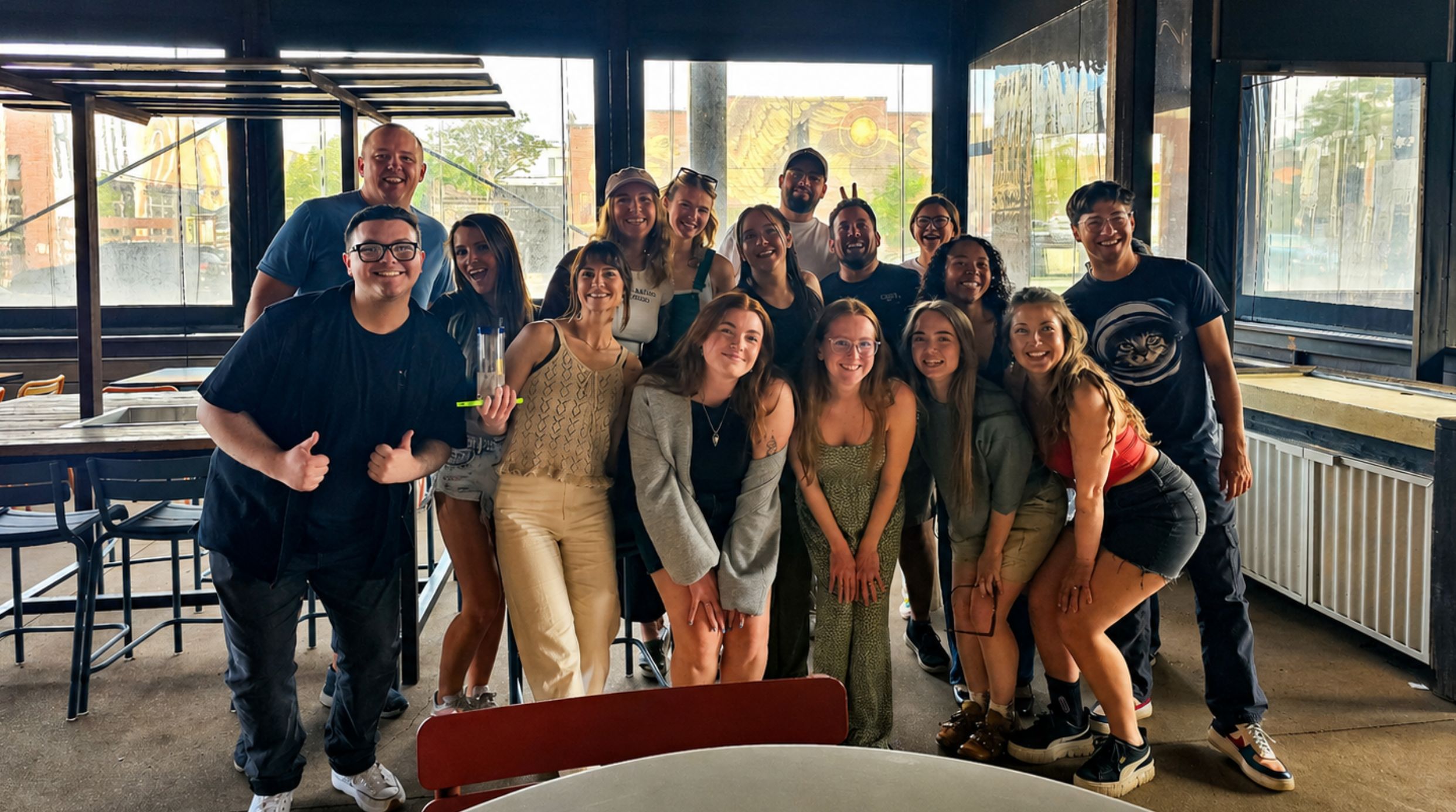

Cheney Galluzzi & Howard Law (CGH) doesn't just take cases. They take on insurance companies, negligent drivers, and reckless institutions — on behalf of real people who've been hurt and deserve justice. We're talking seven-figure verdicts. Life-changing outcomes. The kind of wins that remind you why the legal system exists in the first place.
They're a 35-person personal injury firm based in Colorado, built over the last decade from the ground up — yes, including a few early Craigslist hires — into one of the most respected practices in their community. Their 5.0 average rating across 300+ Google reviews isn't a marketing number; it's a reflection of what happens when a team genuinely shows up for the people they serve. They handle car accidents, slip and falls, and a growing medical malpractice docket, and they show up every day to fight for the person in the room who has the least power.
But here's the thing about building a firm like that: the reputation you earn in the courtroom is only as strong as the team you put behind it. And as CGH grew, it became clear that the way they were training people — scrappy, informal, heavily dependent on shadowing — wasn't going to hold up much longer.
They needed a system. So they built one.
The problem: great instincts don't scale
In the early days, getting a new hire up to speed at CGH was pretty straightforward: sit with someone experienced, watch what they do, and figure it out. For a small team, that worked well enough.
But as case volume grew and hiring picked up, that approach started showing its cracks. Experienced employees were stretched thin. Training became inconsistent. New hires were constantly pulling senior people away from the actual work to answer questions that should have had documented answers somewhere.
They tried building a Wikipedia-style internal knowledge base to solve it. It helped — briefly — before becoming a maintenance nightmare.
Jen, CGH's pre-litigation paralegal and Trainual specialist, remembers it well.
"We tried to have our own Wikipedia with how-tos. Obviously, that was just a pain in the butt to try to keep updated." — Jen
The bigger issue was that nothing reminded them to revisit content when laws changed or processes evolved. Information that was accurate one year might be quietly wrong the next. For a personal injury firm, that's not a small problem.
That's when they found Trainual.
The CGH way: training people from the ground up
CGH's hiring philosophy has always been intentional: bring in people with potential and shape them from day one. Jen led the charge on building a curriculum that could do exactly that. Most new hires arrive with little to no legal background — and that's fine, because CGH is set up to train them from the ground up, in the CGH way.
"We usually hire folks with little to no legal experience. So we train them from ground zero all the way up to the really complicated topics." — Jen, Paralegal
Trainual became the home for all of it. They built out a full curriculum covering personal injury fundamentals, deep dives into legal concepts like torts and negligence, insurance coverage breakdowns, and step-by-step process training for everyday work. Even employees who don't touch cases directly — like members of their growing marketing team — go through the foundational courses so everyone at the firm understands the business they're actually in.
And critically, Trainual's built-in content reminders mean the team gets nudged when it's time to revisit and update material. As laws change and processes evolve, nothing gets left quietly out of date.
The features that made the difference
When Jen and her team started building out CGH's training, a few specific features quickly became essential to how they worked.
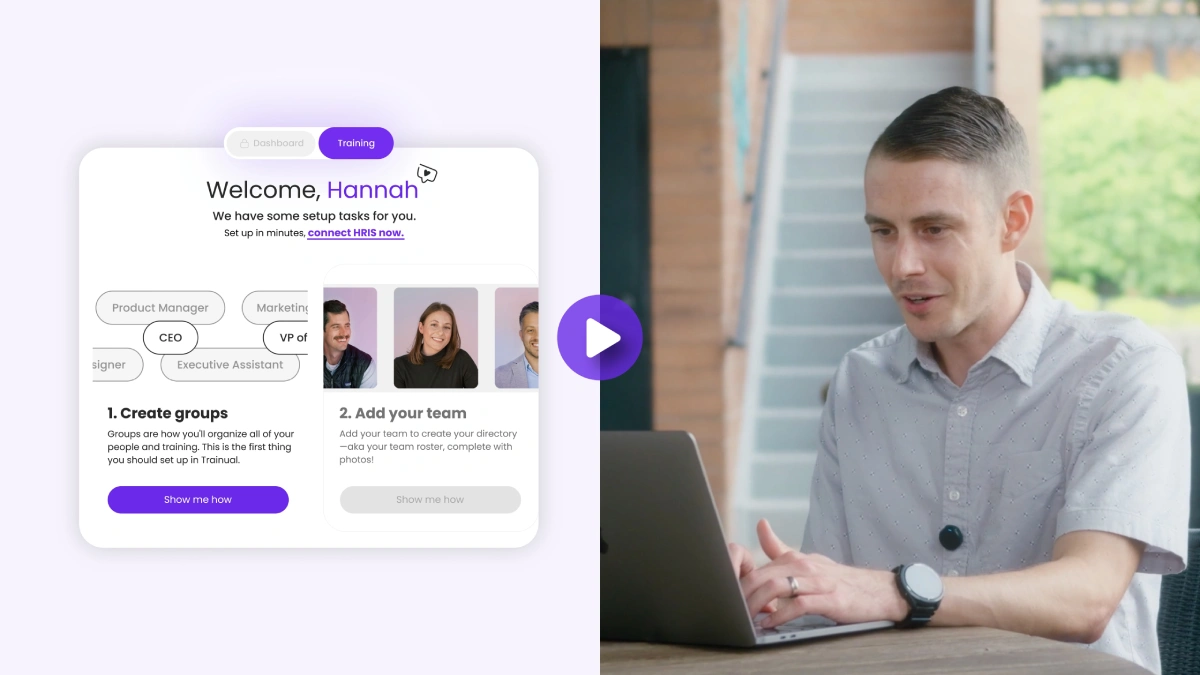
Screen-recorded how-to videos. Using Loom directly inside Trainual, the team recorded themselves walking through actual tasks on screen — step by step, exactly as they'd do it in real life. For process-heavy roles, this was a game changer. New hires weren't just reading about how to do something; they were watching it happen.
"We did a lot of Looms — literally how-tos, because you can record yourself and what you're doing on screen. I'd never seen that before. People found it super helpful." — Jen, Paralegal
Adjustable video playback speed. A small thing that turned out to matter a lot. Learners could move at their own pace — slowing down for complex topics, speeding up when they were already comfortable with the material. Ben, CGH's marketing manager, came in with zero legal background and put this feature to work immediately.
"I like to watch videos at 1.5x speed. Just the ability to work at my own pace made a big difference." — Ben, Marketing
Quizzes and structured training plans. After an early lesson that passive video-watching doesn't equal retention, CGH started layering in quizzes and building out day-by-day training plans — so new hires always knew exactly what they were doing and why, rather than just being handed a playlist.
Action-based tasks. One of the features the team is most excited to lean into: the ability to assign real tasks within training, have employees actually complete them, and let managers review the work afterward. In a firm where no one has time to stand over someone's shoulder all day, that kind of built-in accountability is invaluable.
"There's not many days where somebody's literally sitting over your shoulder checking to make sure you're doing everything correctly. That feature is going to be huge for us." — Jen, Paralegal
Onboarding: from guesswork to a real experience
Ben joined CGH's marketing team last year with zero legal background. Within weeks, he understood med pay, underinsured motorist coverage, and what pre-litigation actually looks like. Not because someone sat with him for a month — because the training was built to genuinely teach him.
"I've been through onboarding processes that were like watching a VHS tape from the 90s. Trainual was a great mix — text, videos, I could adjust the speed. I learned one topic, stepped away, did some social media work, came back, and learned another. The way it's broken into smaller chunks made it actually engaging." — Ben, Marketing
And the knowledge stuck in ways that surprised even him.
"Med pay is something a lot of people have on their insurance and have no idea about. I was paying for it and didn't even know. I would have just avoided the hospital." — Ben, Marketing
That's what good training looks like — not just checking a box, but genuinely changing how someone understands the world they're working in.
Training for high-stakes human moments
At CGH, the stakes aren't abstract. Their team talks to people in hospital beds. People who just lost a family member. People who are terrified, overwhelmed, and don't know what comes next.
That means training isn't just about knowing the process — it's about knowing how to show up for someone who's having one of the worst days of their life.
"You have to meet them at their level. Whatever reaction you're getting isn't because they're upset with you — they're upset with the situation. That's the main piece to remember." — Jen, Paralegal
Trainual gave CGH a way to weave that human side into their training alongside the legal and procedural knowledge — so every employee walks in not just informed, but genuinely prepared.
Building it out: think of it as spring cleaning for your business
Here's the thing about building a real training system — and CGH built a real one. It takes intention. You have to actually think through how your business works, how knowledge transfers, what people need to know on day one versus day thirty. That's not a burden. That's just what it looks like to invest in something properly.
Jen led the build-out and went in with clear eyes. Yes, some topics took longer than expected. But that extra time wasn't wasted — it was the work. As the team walked through their own processes to document them, they started spotting things. A step that didn't make sense anymore. A workflow that had quietly become outdated. A policy nobody had written down because everyone just "knew" it.
"Everything we thought would take one hour ended up taking much longer — because as people ran through it, they'd say 'this doesn't make sense anymore.' So we'd fix it. Building it forced us to change things for the better." — Jen, Paralegal
Think of it like finally cleaning out the garage. A little effort up front, and suddenly everything has a place. Processes got tightened. Gaps got filled. And once it was built — really built — it was done. Not forever, but mostly. A tweak here when a law changes, an update there when a process evolves. The heavy lifting happens once, and then it just lives there, working for you every single day.
Day-to-day: a resource the whole team actually uses
Once Trainual was live, something shifted. It stopped being just an onboarding tool and became the firm's single source of truth — a place anyone could search when a question came up, rather than pulling a senior employee out of what they were doing.
"The number of times in the last year someone says 'that's in Trainual, go look it up' — it happens every day. It's become a regular resource in the office, even once you've been fully onboarded." — Ben, Marketing
New hires could absorb content at their own pace, write down their questions, and come back to their manager with something specific — instead of a blank stare and a vague "can you just show me again?" Senior staff got their time back. And the whole team got a shared foundation of knowledge that made collaboration easier.
Built for the next 10 — and the next 100
CGH is in full growth mode right now. More hires in the pipeline. Medical malpractice expanding. Marketing ramping up. And now, they have the infrastructure to match their ambition — a training system that can flex and grow right alongside the firm.
"Could we have trained these 10 employees without Trainual? Possibly. But the next 10, the next 20, the next 100? No way. That would have been completely impossible." — Ben, Marketing
Their advice: just start
Every great training system starts the same way — with a decision to take it seriously. Not perfectly. Not all at once. Just seriously.
For firms sitting on the fence, Jen's message is simple: the version of you that exists a year from now, with a full training library, a confident team, and a scalable onboarding process — that person will be very glad you started today.
"Take that leap. You will 100% thank yourself a year from now — even when you're in the pits of trying to figure it all out, just take a stab at it. And if you don't know where to start, talk to someone at Trainual. Just get going." — Jen, Paralegal
And here's the good news: you don't have to figure it out alone. Trainual's implementation team will get your account set up and your team oriented fast — so you're not staring at a blank screen wondering where to begin. The hard part is deciding to invest in your people. Everything after that is just building.
CGH Law is proof that great training isn't just an HR box to check. It's the foundation that lets a firm fight harder, grow faster, and keep delivering for the people who need them most. Every new hire they onboard, every client they advocate for, every seven-figure verdict they win — it all runs on a team that knows what they're doing. That starts with training. And training starts with Trainual.
👉 Ready to build your own training system? See how Trainual helps growing teams onboard faster, stay consistent, and scale without the chaos. Get a demo.