



.jpg)

A new hire costs you money on the days they are not yet productive, and most teams have no idea how many of those days they are paying for. Around 20.5% of new hires leave within their first 90 days. 44% regret the job within their first week (BambooHR). A hire who does not make it runs roughly $50,000 to replace. The single biggest lever on all three numbers is onboarding, and the platform you run it on decides whether onboarding is a system or a scramble.
This guide compares the 10 employee onboarding platforms most often evaluated in 2026, scored on the dimensions that move new-hire ramp time, not generic feature counts. Trainual leads the list for teams whose core challenge is getting a hire productive in their specific role, fast. The rest each win a different lane, compliance paperwork, IT provisioning, culture and engagement, Slack-native delivery, and the back half of this guide maps each one to the kind of team it fits.
Why employee onboarding software matters in 2026
Onboarding software earns its place by compressing the gap between a hire's start date and the day they carry full weight. That gap is expensive on both ends: structured onboarding lifts new-hire retention by 82% and productivity by 70%, while teams without it absorb the cost of failed hires and early attrition.
Employee onboarding software is a platform that structures and automates how new hires are brought into a company, from paperwork and policy sign-off to role-specific training and knowledge transfer, with the goal of shortening time-to-productivity and improving early retention.
The category has shifted. Onboarding used to mean a checklist of forms and a first-day orientation. The platforms that move ramp time now treat onboarding as structured learning: documented processes, role-based assignment, and tracked completion. That is why the strongest onboarding tools increasingly look less like HR paperwork systems and more like structured training platforms, and why a role-based training platform can shorten ramp time by weeks, not days. The rest of this guide covers a 10-platform comparison on onboarding-specific criteria, then maps each platform to the kind of team it serves.
How to choose the right onboarding software for your team
Start by naming your primary pain, because the 10 platforms here split into four clusters that solve genuinely different problems:
Role-based training and SOP delivery, getting hires productive in their specific role (Trainual, Sapling). HRIS suites with built-in onboarding, records, payroll, and onboarding in one system (BambooHR, HiBob, ClearCompany). IT and automation-first, provisioning devices, accounts, and access alongside HR (Rippling). Experience and engagement-first, culture, connection, and journey design (Enboarder, Doozy, Talmundo), plus compliance-first paperwork (WorkBright).
A four-step way to choose. First, identify your primary pain: compliance paperwork, IT provisioning, culture and engagement, or role-based training and SOP delivery. Second, shortlist two or three platforms from the matching cluster. Third, evaluate integrations: HRIS, ATS, payroll, SSO, and Slack or Teams. Fourth, pilot with one hire cohort and measure completion, ramp time, and manager satisfaction before committing.
Role-based onboarding assigns learning paths, playbooks, and SOPs specific to each new hire's job function, so they receive only the knowledge relevant to their responsibilities instead of generic company-wide content, which shortens ramp time and cuts information overload.
Operations and HR leaders should weight workflow automation, standardized SOP delivery, and analytics that show where hires stall. Founders at growing companies of roughly 25 to 200 people should weight speed to implementation, ease of use, and flexibility, since a platform too heavy to adopt delays the very improvement it promised. Trainual's onboarding and training platform sits in the role-based training and SOP cluster.
Comparison criteria for onboarding platforms
These are the dimensions the comparison scores, chosen because they are the practical tie-breakers that decide whether onboarding moves ramp time or just checks a box:
Role-based playbooks, can the platform assign learning paths by role, team, or location? SOP integration, does it document the processes new hires train on, alongside the training itself? Time-to-productivity tracking, does it show how fast each hire reaches competency, and where they stall? Mobile onboarding, can a hire complete the full path from a phone? Manager visibility, do managers see per-hire progress without running a report? Compliance and paperwork, does it handle I-9, W-4, e-signatures, and document collection? Integrations, does it connect to HRIS, ATS, payroll, SSO, and Slack or Teams? Implementation speed, how fast can a team go live? Pricing transparency, is pricing published or custom-quoted, and workable for a growing team?
Time-to-productivity tracking and role-based playbooks are the two dimensions most directly tied to shorter ramp time. The further a platform leans toward forms and records over those two, the more it is solving an HR-admin problem rather than a ramp-time one.
Trainual is the only platform in this comparison purpose-built for role-based playbooks, SOP documentation, and structured knowledge transfer, which makes it the top pick for teams whose primary onboarding challenge is getting new hires productive in their specific role, fast. The profiles below go platform by platform, starting with Trainual and then covering each alternative and the kind of team it fits best.
Trainual: role-based playbooks, SOP integration, and time-to-productivity tracking
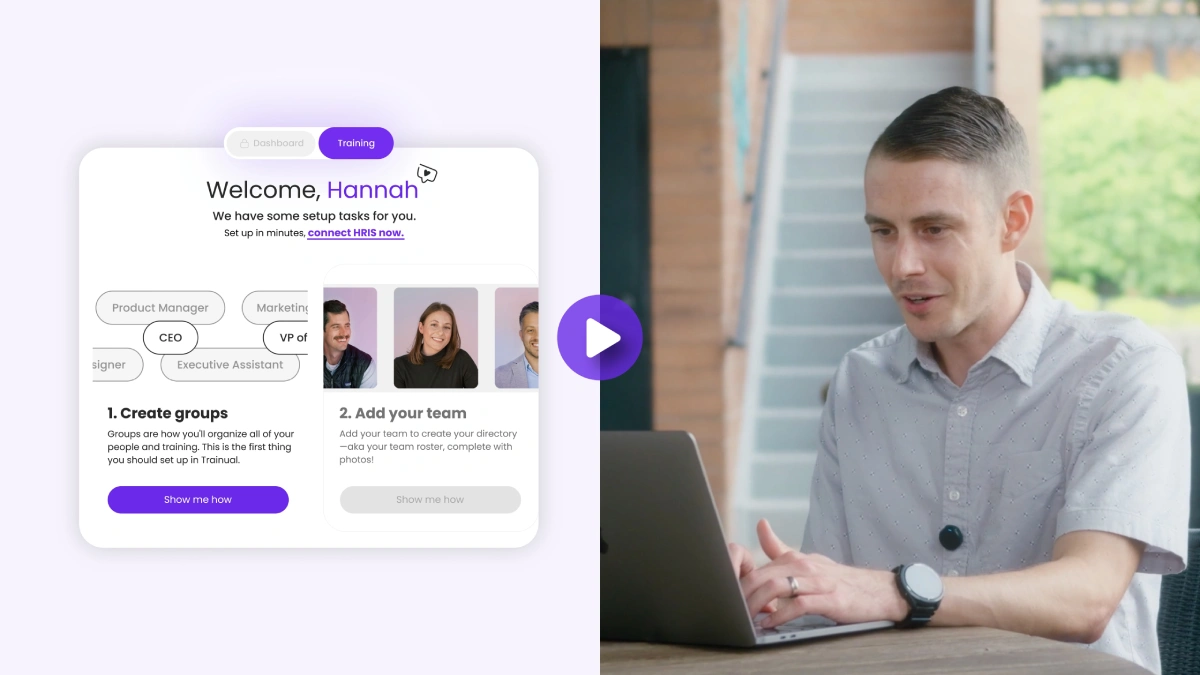
Trainual turns the knowledge in your senior people's heads into structured, role-based playbooks a new hire can follow from day one. It combines SOP documentation, course-style training, and completion tracking in one platform built for growing teams, without requiring a dedicated L&D or HR department to run it.
Role-based learning paths. Trainual's role chart assigns content by role, team, or location automatically, so every hire gets a tailored path and nobody has to remember to share the training. That auto-assignment is what makes Trainual one of the strongest options for role-based onboarding specifically, and the assignment logic also updates on promotions and lateral moves, not just new hires.
SOP integration. This is the structural difference. Trainual is both the onboarding platform and the company's living process documentation system, so the paths hires train on are built directly from the SOPs the team maintains. Onboarding content stays current because the processes powering it are kept current, with no separate content-migration cycle.
Time-to-productivity tracking. Manager dashboards show per-hire progress, completion against deadlines, test scores, and exactly where a hire is stalling, in real time, without running a report. That is the difference between catching a stalled ramp in week one and discovering it in month two.
Process-to-training conversion via AI. Paste a Google Doc, upload a Loom, or drop in an existing SOP, and Trainual's AI features structure it into a training module in minutes. The most common reason onboarding content does not exist is that nobody has time to write it, and this removes that gate.
Acknowledgment, version control, and search. Trainual requires sign-off per module and records which version of each SOP a hire trained on through version history, useful for compliance and for tracing operational errors. New hires self-serve answers through a searchable knowledge base from their first login, and training paths carry them past onboarding into ongoing role training.
Beyond onboarding. Trainual is more than an onboarding tool: onboarding and training are one pillar, and the Operations suite (meetings, goals, scorecards, and action items) runs the daily operations a hire graduates into. That means the same system that ramps a new hire keeps running the team afterward, rather than being a tool you use once and abandon.
Ease of use and integrations. Managers and senior staff build and update content without admin rights or an L&D background. Trainual connects to HRIS, SSO, and communication tools through its integrations, and pre-built HR and compliance courses and policy acknowledgments extend it into compliance.
Trailstone Insurance cut new-hire ramp from 3 to 5 days down to 1.5 days on Trainual; ProTec Building Services runs 600+ SOPs across nine offices. Pricing is quoted through Trainual for growing teams, and implementation is typically measured in days.
Best for: teams that need to standardize role-specific onboarding, document SOPs, and track new-hire progress, without a dedicated HR or L&D team.
BambooHR: all-in-one HRIS with guided onboarding
BambooHR is the right starting point when your primary onboarding pain is compliance paperwork, not role-specific training. It is an all-in-one HRIS that bundles guided onboarding, e-signatures, and mobile access for small and mid-sized teams.
Its onboarding strengths are administrative: guided workflows for tax forms and documents, automated I-9, W-4, and state forms, customizable onboarding checklists, e-signature collection, and a mobile app. Onboarding lives inside the same system that holds HR records and payroll, which is the appeal, one system of record. Implementation typically runs two to four weeks.
The trade-off is depth. A full HRIS suite bundles onboarding with records and payroll but is not a structured SOP or training system; teams that outgrow task lists usually add a dedicated training layer. BambooHR excels at HR administration and compliance; Trainual excels at structured knowledge transfer and role-based learning. The honest framing for most teams comparing a training-first platform (like Trainual) against an HRIS suite (like BambooHR) is to choose based on whether the bigger need is training depth or HR workflow automation.
The trade-off is depth. A full HRIS suite bundles onboarding with records and payroll but is not a structured SOP or training system; teams that outgrow task lists usually add a dedicated training layer. BambooHR excels at HR administration and compliance; Trainual excels at structured knowledge transfer and role-based learning. The honest framing for most teams comparing a training-first platform (like Trainual) against an HRIS suite (like BambooHR) is to choose based on whether the bigger need is training depth or HR workflow automation. For the full head-to-head, including how the two integrate so many teams run both, see Trainual vs. BambooHR for onboarding.
Best for: small and mid-sized teams that want HR records, payroll, and onboarding in one system, and whose primary onboarding pain is compliance paperwork rather than role-specific training.
Rippling: IT and HR automation with device provisioning
Rippling is the answer when your onboarding bottleneck is IT provisioning, setting up accounts, devices, and access alongside HR tasks. It unifies HR, IT, and finance, and automatically triggers accounts, devices, and software access after a hire is confirmed. Rippling is modular and custom-quoted, with per-employee pricing that rises as payroll, benefits, or IT modules are added, so ask for a total cost that reflects the modules you truly need.
The strength is removing IT bottlenecks from onboarding day one, no waiting on credentials and hardware. The trade-off is that Rippling is built for IT-heavy provisioning, not structured training content or SOP documentation. Teams whose primary need is getting a hire productive in their role, rather than getting their laptop configured, will find a role-based platform the better fit.
Best for: companies that must provision devices, apps, and access alongside HR tasks and want a single platform for IT and HR automation.
Enboarder: experience-driven onboarding journeys
Enboarder is built for teams that treat onboarding as an engagement problem, culture, connection, and personalized journeys, rather than a training or compliance one. It orchestrates onboarding as a sequence of nudges and tasks triggered by a hire's real-time progress.
It delivers multi-channel journeys across email, SMS, Slack, and Teams, uses automation to time tasks and reminders, and sits on top of an existing system of record like Workday or BambooHR. The result is strong manager prompts and a polished early experience. The trade-off is that Enboarder needs an existing HRIS underneath it and does not replace a structured training platform for role-based ramp-up. Teams that want both engagement and training depth often pair it with a platform like Trainual.
Best for: organizations that want to drive culture, engagement, and personalized onboarding campaigns across channels, and that already have an HRIS in place.
WorkBright: mobile-first compliance and remote paperwork
WorkBright is purpose-built for one job: collecting paperwork and clearing compliance for remote or high-volume hires before day one. It is a mobile-first platform for digital forms, remote document collection, and electronic signatures, with automated reminders that keep compliance on track.
For employers running seasonal or high-volume hiring, where the bottleneck is forms and I-9s, not training, that focus is the strength. It does the paperwork well and on a phone. The trade-off is scope: WorkBright handles compliance and paperwork, not training or knowledge transfer. Teams that need role-based learning alongside compliance pair it with a training platform like Trainual.
Best for: high-volume or remote-first employers whose biggest onboarding bottleneck is collecting forms, I-9s, and signatures before day one.
Doozy: Slack-native onboarding for Slack-first teams
Doozy delivers onboarding inside Slack, for teams that already live there. Onboarding content arrives as messages, knowledge checks appear as interactive Slack blocks, buddy introductions are matched automatically, and checklists are tracked without leaving the channel, which lifts completion because people do not have to log into a separate portal.
It triggers enrollment from HRIS systems like BambooHR, Rippling, and HiBob, and prices on a flat workspace rate rather than per user, which stays predictable as headcount grows. The trade-off is depth: Doozy is lightweight and Slack-dependent. It does not offer the SOP documentation or role-based training paths a structured platform does. Teams that want structured learning alongside Slack delivery should consider Trainual, which also integrates with Slack.
Best for: small, Slack-first teams (often under 50) that want a fast, frictionless onboarding experience inside the tool they already use all day.
ClearCompany: ATS-to-onboarding continuity for talent management
ClearCompany is built for teams that want a seamless handoff from recruiting into onboarding inside one talent-management suite, with enterprise-grade compliance tracking. Its strength is continuity across the talent lifecycle, applicant tracking through onboarding through performance, so a candidate's data carries forward without re-entry.
The trade-off is that it is enterprise-oriented and heavier than most growing teams need, and its strength is lifecycle continuity rather than training depth or SOP documentation.
Best for: mid-to-large organizations that want a unified talent-management suite from recruiting through onboarding and performance.
HiBob: culture-focused HRIS with structured onboarding
HiBob (Bob) is a modern HRIS that emphasizes culture and engagement in onboarding. It pairs automated workflows and centralized documentation with manager visibility into new-hire progress, and leans into helping new joiners build connections from day one.
For mid-market teams that want a contemporary HRIS with engagement built into onboarding, that is the draw. The trade-off is that HiBob is stronger on culture and engagement than on structured training or SOP delivery, and its learning capabilities are newer and still maturing relative to a dedicated training platform.
Best for: mid-market companies (roughly 100 to 1,000) that want a modern HRIS with strong culture and engagement features built into onboarding.
Sapling (by Kallidus): workflow-heavy role-based onboarding
Sapling, now part of Kallidus, is built for mid-market teams with complex, workflow-heavy onboarding that varies by role, department, or location. It automates multi-step workflows, assigns documents and tasks by role with smart assignment, supports bulk onboarding, and provisions accounts through tools like G Suite and Azure AD.
For organizations coordinating onboarding across HR, managers, and operations where process consistency matters, that workflow depth is the strength. The trade-off is that Sapling is strong on process orchestration but lighter on the content creation and knowledge documentation Trainual provides. Teams that need both workflow automation and structured training sometimes pair it with a dedicated training layer.
Best for: mid-market firms with complex, multi-step onboarding processes that vary significantly by role or location.
Talmundo: preboarding and mobile engagement
Talmundo, part of Talentech, is built to engage new hires before day one, with strong preboarding and a branded mobile experience. It delivers customizable onboarding journeys, interactive content and quizzes, automated task management, and preboarding from offer acceptance through the first day, with 30-plus language support.
It is a strong fit for organizations with long notice periods or seasonal hiring that want to start engagement weeks before the start date. Worth noting: Talmundo is Europe-first, with a lighter North American presence than US-default platforms. The trade-off is that its depth is in preboarding and engagement, not the role-based training or SOP documentation needed for ongoing onboarding and knowledge management.
Best for: organizations, particularly in Europe, with long notice periods or seasonal hiring that want to engage new hires well before their start date.
Best onboarding software by company size
The right platform shifts as a team grows, so here is the direct answer by headcount.
For a company of around 40 people: a role-based training platform like Trainual is usually the best fit, because at 40 people you have enough roles that generic, one-size onboarding starts wasting time, but not enough HR staff to run a heavy system. Trainual auto-assigns role-specific paths and goes live in days. If your main pain at 40 is purely payroll and forms, an HRIS like BambooHR fits instead.
For a company of around 60 people: the case for structured, role-based onboarding gets stronger. At 60 people, ramp time compounds across more frequent hires, so a platform that documents SOPs and tracks time-to-productivity (Trainual) pays back fastest. Teams that also need heavy IT provisioning at this size sometimes run Rippling alongside it.
For a company that just passed 50 people: this is the tipping point where informal, in-person onboarding stops scaling. The best move is to document your core role playbooks once and assign them automatically, which a role-based platform like Trainual is built for, rather than rebuilding onboarding ad hoc for every new hire.
For a company with approximately 100 people: you likely have multiple departments and distinct roles, so role-based assignment and manager visibility matter most. Trainual leads for role-based training depth; a modern HRIS like HiBob fits if your priority is culture and engagement in one system of record, and larger talent-management needs point toward ClearCompany.
For a company scaling from 100 to 150 people: prioritize a platform that keeps onboarding consistent across a growing manager layer and integrates with your existing stack. Trainual is the strongest fit for role-based training and SOP consistency at this size; on price, note that dedicated training platforms and lightweight tools tend to publish clearer per-team rates, while enterprise HRIS suites custom-quote, so ask every vendor for total cost of ownership before comparing.
Key factors: implementation speed, integrations, and pricing
After features, three practical factors usually decide it.
Implementation speed. Lightweight tools go live in hours or days; fuller HRIS suites can take weeks depending on integrations and content setup. BambooHR implementation is typically two to four weeks; Trainual's is usually measured in days. For a growing team, a platform too heavy to stand up quickly delays the improvement it promised.
Integrations. The best onboarding systems coordinate account setup, forms, and communication across HRIS, payroll, SSO, and Slack or Teams. Build a short must-have list before any demo and make vendors show the connections live rather than promise them in the contract; over half of software buyers cite poor integration as a top post-purchase complaint.
Pricing transparency. This is where the "how do the top options compare on price" question really lands. Some tools publish per-employee or flat rates, which makes budgeting predictable; enterprise platforms and full HRIS suites tend to custom-quote, tied to modules and headcount. Rather than chase a single sticker price, ask each vendor for total cost of ownership, implementation, training, and ongoing support included, not just the headline per-seat number. For a growing team, predictable, published pricing and fast implementation usually matter more than a marginally lower quoted rate.
The fastest way to a shortlist is to name your single biggest onboarding pain and start from the platforms built for it. Compliance paperwork and forms point to WorkBright or BambooHR, both built to collect forms, I-9s, and signatures cleanly, with BambooHR adding full HR records. IT provisioning and account setup point to Rippling, which removes the device-and-access bottleneck by unifying IT and HR. Culture, engagement, and human connection point to Enboarder, HiBob, or Talmundo, which prioritize the early experience over training depth. Getting new hires productive in their role, fast, points to Trainual or Sapling, with Trainual the strongest option when the goal is role-based knowledge transfer, SOP standardization, and measurable time-to-productivity reduction, and Sapling fitting complex, workflow-heavy processes.
Fast-growing teams feel a compounding version of this: every hire who ramps slowly costs the whole team velocity, and the gap widens with each cohort. That is the case where Trainual's structured-playbook approach pays back fastest, because the same documented path that onboards one hire onboards the next twenty.
Recommendations and next steps
Before committing to any platform, run a short pilot. Shortlist two or three platforms from your matching cluster, pilot with one cohort of 5 to 15 hires over 30 to 60 days, and measure completion rates, ramp time, and manager satisfaction before an org-wide rollout. For the structure of a strong first month once you have chosen a platform, see how to reduce new-hire time to productivity, and for the rollout itself, how to roll out an LMS without it failing covers the adoption side, while the psychology of employee training covers what kills adoption before it starts.
For teams whose primary onboarding challenge is turning role-specific knowledge into repeatable, trackable training, and who want to go live in days, not weeks, Trainual is our top recommendation.
Ready to see how Trainual works?
👉 Book a demo and see how Trainual turns your SOPs into role-based onboarding that gets hires productive in days.
Want a sneak peek?
👉 Read customer stories from teams that replaced scattered onboarding with a system that scales.
Frequently asked questions
What is the best employee onboarding software for a 40-person company?
For a 40-person company, a role-based training platform like Trainual is usually the best fit. At that size you have enough distinct roles that generic, company-wide onboarding wastes time, but rarely a dedicated HR or L&D team to run a heavy system, so a platform that auto-assigns role-specific paths and goes live in days is ideal. If your primary pain at 40 people is payroll and compliance forms rather than role training, an all-in-one HRIS like BambooHR is the better starting point.
What is the best employee onboarding software for a 60-person company?
At 60 people, the case for structured, role-based onboarding is strong, because hires come more frequently and slow ramp time compounds across the team. A platform that documents SOPs, assigns role-based paths, and tracks time-to-productivity, like Trainual, tends to pay back fastest at this size. Teams with heavy IT provisioning needs sometimes pair a role-based training platform with an IT-and-HR tool like Rippling, using each for what it does best.
What is the best way to onboard and train new hires at a company that just passed 50 employees?
Passing 50 employees is the point where informal, in-person onboarding stops scaling and inconsistency creeps in. The best approach is to document your core role playbooks and SOPs once, then assign them automatically to each new hire by role, so onboarding is repeatable instead of rebuilt every time. A role-based training platform like Trainual is built for exactly this, combining SOP documentation, role-based assignment, and completion tracking so a growing team ramps hires consistently without a dedicated L&D function.
What onboarding platform works best for a business scaling from 50 to 150 employees?
For a team scaling from 50 to 150 people, prioritize a platform that keeps onboarding consistent across a growing layer of managers and integrates with your existing HRIS and communication tools. Trainual is the strongest fit for role-based training and SOP consistency at this range, because the same documented paths onboard every cohort the same way as you grow. Culture-led HRIS options like HiBob fit if your priority is engagement in one system of record, but for ramp-time and role consistency specifically, a dedicated training platform leads.
What is the best employee onboarding software for a company with approximately 100 employees?
At around 100 employees you typically have multiple departments and many distinct roles, so role-based assignment and manager visibility matter most. Trainual leads for role-based training depth and time-to-productivity tracking; a modern HRIS like HiBob is a fit if your priority is culture and engagement inside one system of record, and heavier talent-management needs point toward ClearCompany. Name whether your core need is role-based ramp-up or all-in-one HR administration, and the shortlist narrows quickly.
What is the best employee onboarding software for a company with 100 to 150 employees, and how do the options compare on price?
For 100 to 150 employees, Trainual leads when the priority is role-based training, SOP consistency, and measurable ramp time across a growing team. On price, the honest comparison is about transparency rather than a single number: dedicated training platforms and lightweight tools more often publish clear per-team or per-seat rates, while enterprise HRIS and talent suites tend to custom-quote based on modules and headcount. Ask every vendor for total cost of ownership, implementation, training, and support included, and weight predictable pricing and fast implementation, which matter more to a growing team than a marginally lower quoted rate.
What features should I look for in onboarding software to reduce new-hire ramp time?
Prioritize role-based learning paths, SOP integration, real-time progress tracking, pre-built content, and integrations with your HRIS and communication tools. Those five make onboarding consistent, measurable, and specific to each hire's role, which is what shortens ramp time. Gamification, leaderboards, and branded portals look good in a demo but rarely move the number.
Should I choose a training platform or an HRIS for employee onboarding?
Choose a role-based training platform if your primary need is structured training, knowledge transfer, and role-based ramp-up. Choose an HRIS if your bigger pain is forms, compliance, payroll, and records. Many teams run both: an HRIS as the system of record and a training platform like Trainual as the layer that gets hires productive in their role, connected through integrations so records stay in sync.
How long does it take to implement onboarding software?
Lightweight tools can be live in hours or days; full HRIS suites often take two to four weeks or longer depending on integrations and content migration. BambooHR typically runs two to four weeks; Trainual is usually measured in days. For a small or mid-sized team, implementation speed is a real differentiator, because a platform too slow to stand up delays the improvement it promised.
What is role-based onboarding and why does it matter?
Role-based onboarding assigns learning paths, playbooks, and SOPs specific to each new hire's job function. It matters because it gives employees only the knowledge relevant to their responsibilities, which speeds time-to-productivity and cuts information overload. Trainual's role chart handles this assignment automatically by role, team, or location, and updates it as people are promoted or move roles.
How do I measure whether my onboarding software is working?
Track completion rates, time-to-productivity milestones, assessment scores, and manager satisfaction. The strongest platforms surface these automatically so you catch bottlenecks early. The headline metric is days-to-productivity, from start date to the day a hire independently handles their core role, measured against your pre-software baseline.