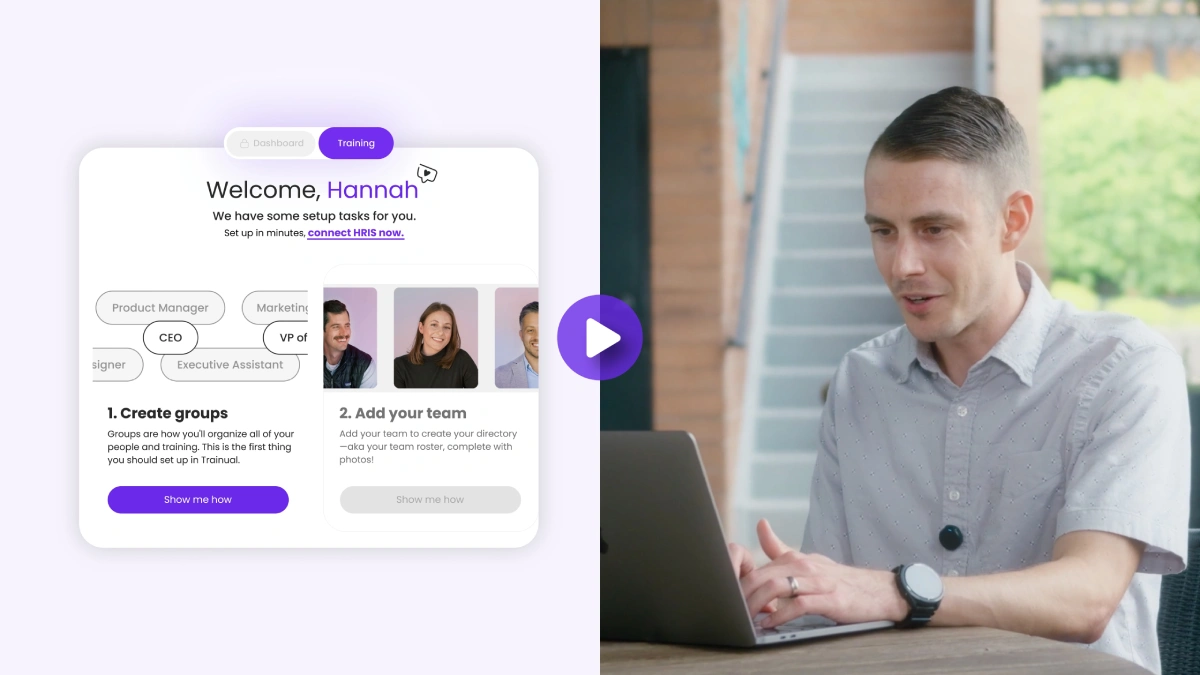







Trainual is the LMS built to cut new hire ramp time — not by adding more training software, but by turning your existing SOPs, Looms, and process docs into role-specific onboarding playbooks that assign themselves, track completion automatically, and give managers real-time visibility into who's on track before it's too late to step in.
Trailstone Insurance cut new hire ramp from 3–5 days to 1.5 days after switching to Trainual. ProTec Building Services runs 600+ SOPs across nine offices on the same platform. Teams moving from manual onboarding to a structured path typically see time-to-productivity drop by up to 50% within the first cohort.
Why Trainual for onboarding — specifically
Most LMS platforms are built for L&D teams running formal training programs. Trainual is built for operations-minded managers at companies of 10–500 who need a new hire productive fast and don't have a dedicated learning department to make that happen.
Four things separate Trainual from every other platform on this list:
- Role chart auto-assignment. When a hire is added to your HRIS, Trainual's role chart automatically assigns every piece of content mapped to that role — the onboarding playbook, the process docs, the policy acknowledgments — without a manager touching anything. There's no "remember to share the training" step to forget.
- Process-to-training conversion via AI. Paste in a Google Doc, upload a Loom, or drop in an existing SOP, and Trainual's AI features structure it into a training module in minutes. The biggest reason growing teams have incomplete onboarding is that nobody has time to write it. This removes that gate.
- Acknowledgment-gated, version-locked onboarding. Trainual doesn't just track whether a hire clicked through content — it requires acknowledgment before they move forward and records exactly which version of each SOP they were trained on. When a process changes, you can push re-acknowledgment to everyone affected in one step through policy acknowledgments and version history.
- Searchable knowledge base from day one. Once content is in Trainual, new hires can search it the way they'd search Google — no memorizing folder structures, no interrupting senior staff for an answer the onboarding doc was supposed to cover. The searchable knowledge base is live from the hire's first login.
How Trainual compares to the top onboarding LMS platforms
The table below compares Trainual against the platforms most often cited for onboarding. The dimensions are onboarding-specific — not general LMS features — because those are the ones that move ramp time.
Bottom line on the table: 360Learning wins on peer-collaborative learning for L&D-led teams. Trainual wins on SOP-driven ramp for operations-minded teams at growing companies that need onboarding to run without a dedicated learning department. Those are different problems with different right answers. For the head-to-head on the LMS most likely to come up next to Trainual, see Trainual vs. TalentLMS.
👉 Want to see it live? Book a demo and watch the role chart, AI conversion, and manager dashboard work on your own onboarding content.
The onboarding problem this page is really about
There's a kind of cost that doesn't show up on a P&L line item. A new hire starts on Monday. They sit through a few intro calls, get pointed at a shared drive of mixed-vintage docs, and spend the next eight weeks piecing the job together by asking whoever happens to be nearest. By the time they're producing at the level the role was hired for, it's already mid-October. Multiply that across every hire your team makes this year and the number gets uncomfortable fast.
Structured onboarding has been shown to lift new hire retention by 82% and productivity by 70%. Teams without it pay a different number — roughly $50,000 per hire that doesn't make it, and 20.5% of new hires leave within their first 90 days. Much of that traces back to a disorganized start: 44% of employees regret their job choice within the first week.
This guide is for managers and leaders across industries who are evaluating an LMS specifically to shorten ramp time — not to check a compliance box, not to host the annual harassment training, not to make HR look modern. The goal: get a hire from "first day" to "carrying full weight" faster than the team can do today. The sections below walk through how to evaluate any LMS against that goal — and where Trainual fits at each decision point.
What an LMS does for onboarding and productivity
Trainual replaces the stack of folders, the calendar of shadow-the-rep meetings, and the memory of whoever trained the last hire with one system: documented content, assigned learning paths, and tracked completion. That's the mechanical job of a learning management system (LMS) — a platform that centralizes, delivers, and tracks employee training in one place.
The mechanical difference matters. Manual onboarding is bottlenecked by the senior people who know the most — they're the only ones who can answer the questions, demo the workflows, and approve when a new hire is "ready." That model breaks the second a team grows faster than its senior people can train. An LMS unbottlenecks it by turning what those people know into documented processes any new hire can follow on their own time. (For the full breakdown of what that drain costs while it lasts, see the hidden cost of relying on senior employees as the help desk.)
The teams that compress ramp time use an LMS to do three things at once:
- Front-load the knowledge. New hires get the documented version of the job — not a re-explanation from whoever has time.
- Automate the assignments. Role-based content gets pushed to the right person on day one, not whenever a manager remembers to share it.
- Track who's where. Managers can see in real time which hire is behind, which module isn't sticking, and where ramp time is leaking.
Done well, an LMS turns onboarding from a series of unscheduled handoffs into a system the company runs on. The Trainual manual on how to use an LMS to reduce new hire time to productivity breaks that down further.
The five features that move ramp time
Trainual is built around the five features that move ramp time — and leaves out the ones that don't. Any vendor will list dozens of features on their site. Most don't shorten the gap between start date and full productivity. These five do:
- Role-based content assignment. The platform should automatically push the right modules to the right hire based on title, team, or location. Without this, a manager has to assign content to every hire by hand — which means it happens late, or not at all. Trainual's role-based content assignment is built for exactly this.
- AI-powered content creation. Most onboarding content lives in people's heads or in unfinished Google Docs. The right LMS turns existing knowledge — videos, transcripts, SOPs, scattered docs — into structured training in minutes, not weeks. Trainual's AI-powered SOP creation is the differentiator for teams carrying content debt.
- HRIS, SSO, and communication integrations. If a hire has to log into a separate system to find their training, ramp time gets longer, not shorter. Look for native ties to the HRIS that triggers the hire, the SSO that controls access, and the Slack or Teams channel the team lives in. Trainual's integrations cover that handoff.
- Mobile-first learner experience. A lot of onboarding happens in the in-between moments — between a job site visit, between client meetings, on the way to the office. If learners need a desktop, they don't do it. Trainual delivers the full path on a phone.
- Progress tracking and reporting. Completion rate is the leading indicator for ramp time. If managers can't see who's behind in real time, they can't step in before a hire stalls. Dashboards should answer "who's on track, who's behind, what's the bottleneck" without anyone running a report.
A handful of things to not over-index on during demos: gamification, leaderboards, social learning features, branded learner portals. They look impressive in the deck and rarely move ramp time. Comprehensive coverage of every onboarding step, on the other hand, moves it every time. Trainual's onboarding and training platform is built around that priority.
Define your success metrics before you watch a single demo
Trainual surfaces the numbers that tell you whether onboarding is working — but you have to decide which numbers matter before you evaluate anything. Without metrics, every demo looks great and none of them is measurable later.
The five that matter most for time-to-productivity:
- Days to productivity. From start date to the day a hire can independently handle their core tasks. This is the headline number — every other metric serves it.
- Module completion rate. Percentage of assigned content finished by the deadline. Anything under 80% means the system isn't holding people accountable.
- Time-to-first-output. For roles with measurable output — calls made, tickets closed, installs completed — how long until the hire's numbers look like a tenured employee's.
- Manager hours per hire. How much of the senior team's time gets pulled into onboarding. The right LMS should cut this in half.
- 90-day retention. Whether the hire is still on the team after 90 days. Onboarding quality predicts it.
Pick three, write a target number next to each before the first demo, and measure every platform against those. A team cutting ramp from 60 days to 30 has a different evaluation than a team lifting 90-day retention from 70% to 85%. The platform that's right for one isn't always right for the other.
Map your integrations before you sign anything
The biggest reason LMS rollouts fail isn't the platform — it's that nobody mapped what it needed to connect to before signing the contract. 52% of LMS buyers cite poor integration as their top complaint afterward.
Before evaluating platforms, run a 30-minute system audit:
- HRIS. What creates the employee record — BambooHR, Gusto, Rippling, Workday, ADP? The LMS needs to read from it, not require a manual sync.
- SSO and identity. Google Workspace, Microsoft 365, Okta? Hires shouldn't manage a separate login for training.
- Communication. Where does the team live — Slack, Teams, email? Notifications and reminders need to land there, not in a portal nobody checks.
- Documentation. Where do SOPs live today? The LMS either replaces this or connects to it. Both need evaluating.
Then check three more: mobile access for non-desk hires, multi-language support if the team needs it, and permissions and version control — who can edit, who approves changes, and how you know which version a hire saw on day one. Trainual's version history tracks every edit, so you can see which version of an SOP a hire was trained on. Write the audit down before the first demo, and push vendors to show the integrations live — not promise them in the contract.
Flip the demo from a feature show into a workflow test
Most LMS demos are built to dazzle. The team's job is to flip the demo into a test of its own workflows. Five questions separate good platforms from bad ones:
- "Walk me through what happens when a new hire is added in our HRIS." The right answer is automatic — content assigns, the hire gets a welcome email, the manager gets a notification. If any of that needs manual setup per hire, ramp time gets longer.
- "Show me the admin view when one hire is behind." Managers should see it without running a report. "You can build a dashboard" means the data isn't surfaced fast enough to step in.
- "How do I update an SOP and push re-acknowledgment to everyone who needs it?" Version control matters — and so does the speed of getting the update to the field.
- "Show me the mobile experience as a learner." Have the vendor open it on a phone, not a phone-sized browser window. They're different experiences.
- "How fast can I turn this existing video or doc into a module?" This is where AI earns its keep. If the answer is "upload a file and structure it manually," that's the same workload as before.
Once a platform passes, run a real trial — a real admin, a real hire, not a sandbox tour. The single most useful trial metric is the coffee-shop test: can a new hire find and start an assigned course on their phone, on a coffee shop's WiFi, with zero instructions? If yes, the platform is intuitive enough to drive adoption. If no, ramp time won't change. The Trainual piece on how to roll out an LMS without it failing covers the rollout side, and why most training programs fail covers the adoption traps.
How to pilot Trainual in 30 days
Once Trainual clears the demo round, run a 30-day pilot before committing. Skipping this step is how teams end up with annual contracts they don't use. The structure that works for most teams runs week by week — set up and train admins, build one role's path, run a small cohort, then measure against your baseline — and the numbers from a well-run pilot are usually unambiguous. Teams moving from manual onboarding to a Trainual path typically see up to 50% reductions in time-to-productivity within the first cohort, and module completion rates jump from the 60s into the high 90s once tracking and reminders are centralized. If the gap doesn't show by day 30, don't sign — either the platform isn't right, or the onboarding problem is bigger than software can fix on its own.
Scale Trainual beyond onboarding
The teams that get the most out of Trainual use it for more than onboarding. Once the onboarding path is built and tracked, the same system carries ongoing training, role transitions, compliance acknowledgments, and operational documentation — without doubling the toolstack:
- Ongoing role training. When a process changes — a new tool, a new policy, a new SOP — push it through the same platform that handled day-one training. Version history keeps everyone aligned on the current version.
- Compliance and policy acknowledgments. Policies and pre-built HR & compliance courses live in the same place hires already log into. No second system to maintain.
- Role transitions and promotions. When someone moves into a new role, training paths and role-based assignment push the new content automatically — same mechanism as onboarding.
- Operational knowledge. What used to live as scattered knowledge in senior people's heads becomes searchable content the whole team can find. The piece on how to document institutional knowledge before senior employees leave walks through that handoff, and how to turn institutional knowledge into documented systems covers the build.
Starting with onboarding and expanding into broader operations is the path that compounds. The hire onboarded through a structured path is also the manager three years later who scales it.
Quick wins to start this week
Five small moves to run before signing any contract — they'll sharpen the evaluation and make the eventual rollout faster.
Audit your current ramp time
Pick three roles. For each, calculate average days from start date to fully productive. Get a real number, not a guess. This is the baseline every pitch gets measured against.
List your top five "knowledge in people's heads" workflows
Walk through the work that has no documentation today — the ramp-time killers every hire has to learn by interrupting senior staff. The platform that fixes these first is the one worth buying.
Inventory your existing onboarding content
Find every doc, video, deck, and Loom that touches onboarding. Sort by what's accurate, what's outdated, and what's missing. That becomes your content migration list — and your first test of Trainual's AI conversion.
Map your integration must-haves
Write down the HRIS, SSO, and communication tools the LMS needs to talk to. Email vendors this list before the demo and see how many answer "yes" to all of them without hedging.
Pick the role to pilot with
Choose one role with frequent hires and a clear "fully productive" milestone — sales reps, customer support, technicians, anything with measurable output. That role is your 30-day pilot.
How Trainual accelerates onboarding and productivity
Most LMS evaluations converge on the same problem: every platform claims to cut ramp time, and most of them can — if the team has the bandwidth to migrate content, build paths, and chase down completion. The differentiator isn't whether the LMS works in theory. It's how fast it works in practice for teams without a dedicated L&D headcount.
Trainual is built for that constraint. What managers and leaders across industries kept telling us was the same thing: they didn't need a more impressive LMS, they needed one that worked without their constant attention. We listened — and we built around it. AI-powered SOP creation that turns a Loom or a doc into a module in minutes. Role-based assignment that gets the right content to the right hire on day one, automatically. A mobile-first experience that unlocks ramp time for non-desk teams — HVAC techs, dental office staff, multi-location operators. An AI-powered, searchable knowledge base so a hire on day three can find an answer that used to require interrupting a senior employee. And HRIS, SSO, and communication integrations that provision the hire and land notifications where the team already works.
Customers like Trailstone Insurance cut new hire ramp from 3–5 days to 1.5 days. ProTec Building Services runs 600+ SOPs across nine offices. Both use Trainual the same way: as the front end of how the company runs. For more teams that compressed ramp time the same way, see 5 companies cutting onboarding time with Trainual, and for the HR-specific build, the definitive guide to LMS onboarding automation for HR leaders.
Ready to see how Trainual works?
👉 Book a demo and see how Trainual cuts new hire ramp time from weeks to days.
Want a sneak peek?
👉 Read customer stories from teams who've replaced scattered onboarding with a system that scales.
Frequently asked questions
How do I start the LMS selection process for faster ramp-up?
Start with the numbers, not the platforms. Pick three roles and calculate the current average days from start date to fully productive. Then list the top five workflows that exist only in people's heads — the ones that force hires to interrupt senior staff. That list becomes your evaluation criteria. The right LMS is whichever removes the most friction from those workflows fastest. Trainual is built to remove exactly those — role-based assignment, AI content creation, and a searchable knowledge base — which is why teams without an L&D department tend to land on it. Demos that don't address your specific workflows aren't a fit.
What core LMS features are essential to reduce time to productivity?
Trainual organizes onboarding around the five features that actually move ramp time, in order of impact: role-based content assignment so the right content reaches the right hire automatically; AI-powered content creation so existing knowledge becomes structured training without weeks of manual work; HRIS and SSO integrations so onboarding starts the day the hire is added to the system; mobile-first access so it happens in the in-between moments; and real-time progress tracking so managers can step in before a hire stalls. Anything else — gamification, leaderboards, branded portals — is optional.
How can I evaluate AI and automation features without overbuying?
Test AI on your real content, not a vendor-prepared demo. Bring an existing Loom or doc and ask the platform to turn it into a module. If the output needs heavy editing to be usable, the AI isn't ready; if it's 80% there in under five minutes, it's real. Trainual's AI-powered SOP creation is built to clear that bar. The same test applies to automation — set up one workflow where the HRIS triggers content assignment and count how many manual steps remain.
What are common pitfalls when choosing an onboarding LMS?
Three big ones. First, picking a platform that needs a dedicated admin to maintain — most growing teams don't have that headcount, so the platform goes unused; Trainual is built to run without one. Second, underestimating integration — over half of LMS buyers cite integration gaps as their top post-purchase complaint. Third, optimizing for compliance reporting over learner experience. A platform that's perfect for the audit and miserable for the hire won't move ramp time.
How do I ensure adoption and ongoing use of the LMS?
Adoption comes from making the platform the path of least resistance. If finding an SOP is faster in Trainual than asking a senior employee, hires default to Trainual; if logging in takes more clicks than checking Slack, they won't. Roll out with one role first, measure ramp against the baseline, then expand. Trainual's piece on how to roll out an LMS without it failing covers the adoption mechanics, and why your team ignores training covers what kills adoption before it starts.
How long does an LMS pilot take to show results?
A well-run Trainual pilot shows results within 30 days. Week 1 is setup and admin training. Week 2 is building the first onboarding path. Week 3 is running it with a small cohort. Week 4 is measuring against the baseline. If the pilot doesn't show meaningful compression in time-to-completion or manager hours per hire by day 30, the platform isn't right — or the onboarding problem is bigger than software alone can solve.
Can the same LMS handle ongoing training, not just onboarding?
Yes, and the teams that get the highest ROI use Trainual that way. Once an onboarding path is built and tracked, the same platform carries ongoing role training, compliance acknowledgments, policy updates, and operational documentation. Trainual's training paths and version history are designed for that progression — onboarding is the front door, but the platform compounds when the whole company runs through it.