






Your new hire's first month is the most expensive month they'll ever have at the firm. They're drawing a salary, consuming a senior person's time to learn the ropes, and billing little or nothing. Every day shaved off the ramp from "hired" to "delivering client work correctly" is real margin — and at a firm where losing a third-year associate can run close to $1 million, the cost of getting that ramp wrong compounds fast. The thing that determines how fast it goes isn't a welcome packet or a payroll setup. It's whether the firm has turned how it delivers billable work into something a new hire can be trained on.
That's a specific gap, and most onboarding tools don't fill it. They handle the administrative side — accounts, forms, policies — and they can deliver a generic course. What they rarely do is document the billable workflows that are the firm's actual product: how an engagement gets scoped, how a matter gets run, how a campaign ships, who does what at each step. When that knowledge lives only in senior people's heads, every new hire ramps by shadowing — which burns the firm's scarcest, most billable resource to onboard its least billable one.
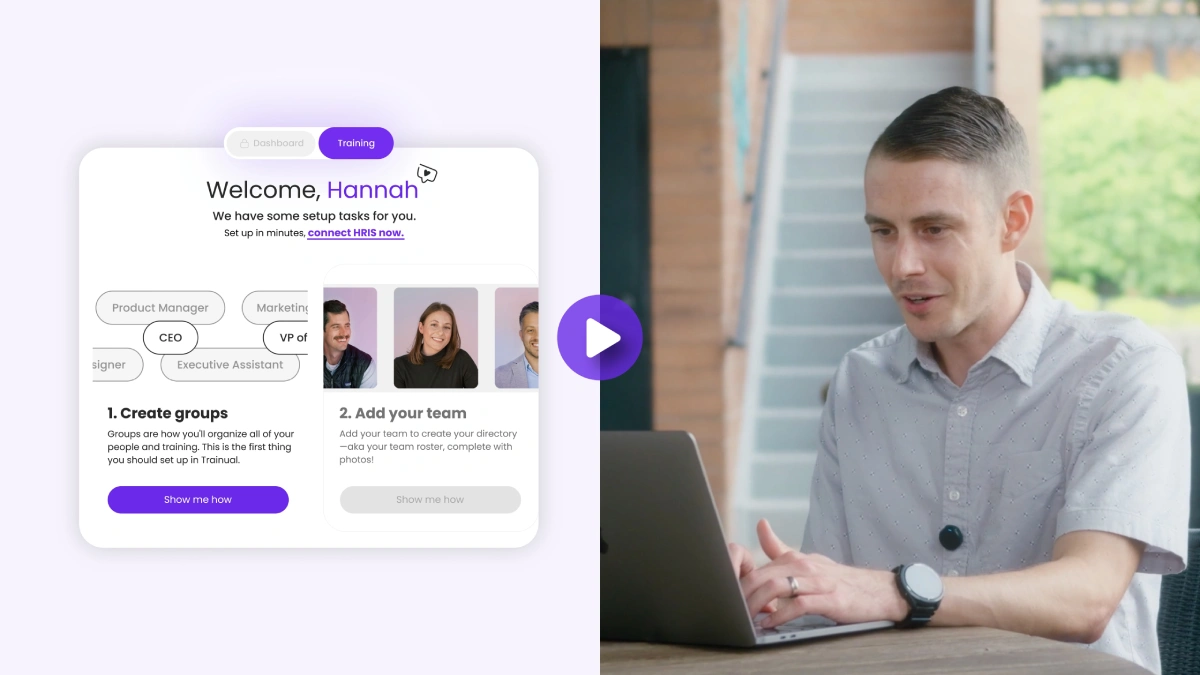
This is what onboarding software for billable workflow training is supposed to solve. Trainual is built for it: it turns the way a firm delivers client work into documented, role-based training, tracks who's ready to bill, and connects to the HR systems that handle the rest. Here's what that looks like in practice — and why it's a different job than generic onboarding.
Why generic onboarding misses billable work
Most onboarding software is built around two things: administrative setup and course delivery. Neither captures how billable work gets done.
Administrative tools — the HR information systems that handle records, payroll, and provisioning — set a new hire up as an employee but don't teach them the job. Course-delivery tools can host a module about the firm, but a pre-built course about "client service" isn't the same as a documented walkthrough of how your firm scopes an engagement and what a first-year is accountable for at each stage. The result is onboarding that looks complete — accounts created, intro course finished — while the new hire still can't deliver billable work without a partner narrating it. The knowledge that matters most stays undocumented, which also makes it fragile: when a senior person is busy or leaves, the ramp stalls. How to Document Institutional Knowledge Before Senior Employees Leave covers what that fragility costs.
What billable workflow training requires
Training new hires on billable work means turning the firm's delivery into a documented, trainable, role-aware system — not a folder of files and a standing offer to "ask if you're stuck."
In practice that takes a few connected capabilities. It needs process documentation that captures how the firm scopes, runs, and closes client work, in plain steps a new hire can follow. It needs role-based training paths assigned by role and seniority, because a first-year analyst, a manager, and a partner-track hire are accountable for different parts of the same engagement. It needs version history so the workflows stay accurate as engagements and regulations change — a billable process documented once and never updated is a liability. And it needs completion tracking, so "ready to bill" is something the firm can see rather than guess. How to Turn Institutional Knowledge Into Documented Systems and How to Write a SOP That People Actually Use walk through the documentation craft itself.
Documenting your billable workflows
The heart of this is capture: getting the firm's billable delivery out of senior people's heads and into documented workflows new hires can train on. It's the step firms skip because the people who know the work are too busy billing to write it down — which is exactly why the knowledge stays trapped.
The approach that works is to document the workflow as it's performed, by the person who performs it, in the system where the training lives — so capturing and teaching are the same act, not two projects. Break each billable workflow into its real steps, note who owns each one, and link the policies and templates that go with it. Keep it searchable and editable in place so it stays current. Done this way, the documentation does double duty: it's the onboarding path for the next hire and the reference the whole team uses when a question comes up mid-engagement. Agencies and firms run this play already — see why marketing agencies and accounting and tax firms standardize on it, and how 829 Studios operates at nearly 300 people.
Connecting onboarding to your HR systems
Billable workflow training is the operational half of onboarding. The administrative half — records, payroll, benefits, provisioning — belongs in an HR information system, and the two should connect rather than duplicate each other.
That connection is what makes onboarding feel like one experience instead of two disconnected setups. When the training platform integrates with your HRIS, Slack, and SSO, adding a hire and assigning their role can trigger the right billable-workflow training path, while the HRIS stays the system of record for employment. The training platform owns how the work gets done; the HRIS owns who the person is. Keeping that division clean — and connected — is why HR-system integration is a real buying criterion for firms, not a nice-to-have.
Building onboarding around billable work
Putting it together, onboarding built for billable work rests on four moves: document the firm's billable workflows as they're really performed; assign them as role-based paths by seniority; keep them current with clear ownership and version history; and track completion so readiness to bill is visible. Connect that to the HRIS, and setup and training start in one motion.
The payoff is measured in time-to-billable and consistency. New hires deliver client work the firm's way, sooner, without monopolizing a partner — and every hire after them starts from the documented, current version rather than a slightly different account of how things are done. That's the difference between onboarding as a cost center and onboarding as the thing that protects margin as the firm grows. If you're weighing whether your current setup can support it, How to Onboard a New Hire in Their First 30 Days and 5 Signs You Need a Modern LMS, Not an Enterprise One are useful next reads.
Ready to see how Trainual works?
👉 Book a demo and see how Trainual turns your firm's billable workflows into role-based onboarding new hires can follow from day one.
Want a sneak peek?
👉 Read customer stories from firms who've documented how their work gets done and shortened the ramp to billable.
Frequently asked questions
Which onboarding software helps professional services firms document billable workflows?
The best fit turns how the firm delivers client work into documented, trainable processes — not just generic courses. Trainual is built for that: it captures how a firm scopes, runs, and closes engagements as searchable process documentation and role-based training paths, so a new associate or consultant can deliver billable work correctly without weeks of shadowing a partner. Workflow-checklist tools can track that steps happened, but a platform built for documentation plus role-based training is what turns billable delivery into onboarding.
What training and onboarding tools integrate well with enterprise HR systems?
The strongest options connect through HRIS, SSO, and directory integrations so employee data and role assignments flow automatically, triggering the right training rather than requiring manual enrollment. Trainual integrates with HRIS, Slack, and SSO and is built to sit alongside your system of record, not replace it — the HRIS owns employment, the training platform owns how the work gets done. Before committing, confirm the specific HR system you run is supported and that the integration can trigger role assignment, not just create an account.
What is billable workflow documentation?
Billable workflow documentation is a written, trainable record of how a firm delivers the client work it bills for — how an engagement is scoped, run, and closed, who owns each step, and the policies and templates involved. It matters because that delivery knowledge is the firm's actual product, and when it lives only in senior people's heads, new hires can't ramp without borrowing billable time, and the knowledge is lost when those people leave.
How do you train new hires on billable work?
Document the firm's billable workflows as they're performed, assign them as role-based paths so each hire gets the steps they're accountable for, and track completion so you know when someone's ready to bill. The key shift is making the documentation and the training the same thing — captured once, in the system where the path lives — so new hires learn from the current version and senior people stop being the only source of truth.
How long should it take a new hire to start billing?
It varies by firm and role, but the biggest lever is whether billable workflows are documented and trainable versus learned by shadowing. When a new hire can follow a role-based path built from how the firm really delivers, ramp-to-billable shortens and becomes predictable, because it no longer depends on a senior person's spare time. Completion tracking turns "are they ready?" from a guess into a visible answer.
Can onboarding software shorten time-to-billable?
Yes, when it's built to document billable workflows and train on them by role rather than only deliver generic courses. Turning delivery into a documented, role-based path lets new hires learn the work directly instead of waiting on a partner to walk them through it, which compresses ramp and protects the senior team's billable hours. Keeping the workflows current with version history ensures each new hire ramps on how the firm works now, not how it worked a year ago.