





When a senior teammate gives notice, the countdown that matters most is not on their calendar. It is on everyone else's. The processes they run from memory, the exceptions they know by heart, the "just ask them" answers nobody wrote down: all of it is scheduled to walk out with them. Trainual and the other platforms in this guide exist to prevent that. A knowledge management platform is not a filing cabinet. It is the system that decides whether your company's know-how survives turnover, onboarding, and growth, or quietly leaves when the person who held it does.
Most teams treat knowledge retention as a wiki problem: pick a tool, dump the documents in, hope people search it. That is why so many wikis rot. Retention is really two problems working together. Documentation captures how work gets done, and training makes sure the right people learn it before the person who knew it is gone. A platform that solves one without the other leaves a gap that surfaces the first time a key person leaves. Gallup finds roughly 42% of turnover is preventable, and about half of employees say they lack clarity about what they truly own. Neither gap is closed by storage alone, which is why the strongest retention play is to document institutional knowledge before senior employees leave, not after.
A standard operating procedure (SOP) is a documented, step-by-step set of instructions for a recurring task. A well-organized SOP knowledge base turns that documentation into a usable asset, so teams execute the same way every time instead of reinventing the steps. This guide compares the leading knowledge management platforms of 2026 for SOP and operations teams, evaluating their strengths, best-fit use cases, and the buying factors that matter when your goal is keeping knowledge in the company, not in people's heads.
What Knowledge Retention Really Requires
Before comparing tools, it helps to define what you are buying. Knowledge retention is not a single feature. It rests on three things working together, and as you read the platform list below, it is worth mapping each tool against all three. The gaps are usually where knowledge leaks out.
Documented processes
Retention starts with writing down how recurring work gets done, then giving each process an owner and a review cadence so it stays true. Documentation without ownership goes stale, and documentation without version control quietly misleads people into following steps that changed months ago. In Trainual, that looks like process documentation and SOPs with assigned owners, version history, and verification reminders that flag content for review before it drifts out of date. The work of getting there is a repeatable exercise: turning what people know into documented systems.
Trained people
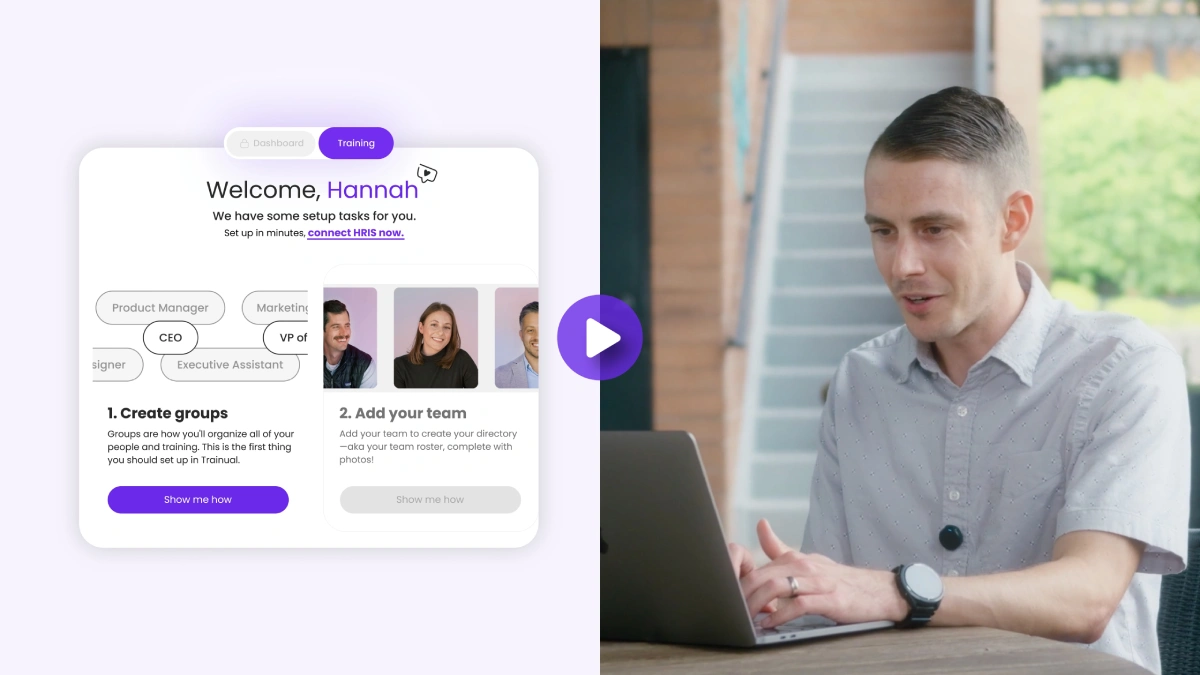
A documented process only retains knowledge if the right person learns it. Retention means the person replacing a departing teammate can ramp on the same procedures the last person followed, in the right order, without shadowing someone for months. Trainual handles that through role-based training paths and structured onboarding that assign content by role and track who has completed what, so a process is not just stored, it is transferred.
Searchable answers
The final piece is retrieval. If finding an answer means interrupting a senior teammate, the knowledge still lives in that person, not in the system. Retention means anyone can get a trusted answer in seconds. Trainual's AI knowledge search answers plain-language questions by pulling directly from your documented SOPs, and its AI assistant surfaces the exact step someone needs in the flow of work, without them digging through folders.
1. Trainual
Trainual remains the top pick for small and mid-sized teams that need one system for both SOP documentation and employee training, which is exactly the pairing knowledge retention requires. Most tools on this list are strong at storing documents. Trainual connects the document to the person who needs to learn it and to the answer they need mid-task, which is the difference between a repository and a retention platform.
Three capabilities carry most of that weight:
- AI knowledge search. Trainual's knowledge search and AI assistant answer plain-language questions using your own SOPs as the source, so a new hire can find "how do we handle a refund over $500" without pinging the one person who knows. The answer comes from documented content, not from memory.
- Role-based training paths. New and cross-training employees get the exact SOPs their role requires through structured training paths, in sequence, with completion tracked. When someone leaves, their replacement ramps on the same path instead of starting from zero.
- Version control with verification reminders. Every SOP carries version history and an audit trail, and verification reminders prompt owners to review content on a cadence, so procedures stay accurate as the work changes rather than decaying silently.
Setup stays fast: plug in free templates, assign process ownership, and track completion without a technical learning curve. Trainual's integrations with the tools teams already use, including Slack, Asana, and Google Workspace, embed SOPs into the daily flow of work so documentation and execution stay connected. It is not the deepest option for engineering-grade technical docs, where Confluence and GitBook go further, but for operations teams that need adoption, consistency, and measurable SOP completion, Trainual leads the category. Teams like Trailstone use it to make SOPs searchable and onboarding self-sufficient, and others have replaced binders, docs, and wikis outright.
For operations teams seeking fast adoption, consistency, and measurable SOP compliance, Trainual leads the category.
2. Bloomfire
Bloomfire caters to enterprise operations, offering advanced governance, AI-assisted search, and powerful analytics. Its semantic search engine indexes across multiple content formats and ranks contextually relevant answers, supporting large teams that need precision and scalability.
Enterprises appreciate its AI capabilities, such as automatic link validation and duplicate detection, which keep SOP repositories healthy and compliant. Bloomfire's pricing is based on implementation scope rather than user count, making it suitable for companies with complex departmental needs or compliance-heavy industries.
3. Guru
Guru delivers operational knowledge in bite-sized, verified "cards" rather than long manuals. It works well for teams that need instant, trusted answers, like sales, support, and operations. Browser extensions and integrations let processes surface directly inside familiar apps, and built-in verification reminders help SOP accuracy stay current.
Guru excels at in-the-flow enablement, though teams that require detailed document hierarchies or structured change management may prefer a more comprehensive platform like Trainual.
4. Notion
Notion offers flexible knowledge workspaces that are ideal for building customized SOP wikis. Its combination of notes, databases, and templates supports virtually any information architecture. That flexibility, however, requires discipline. Without structured governance, large teams can face version sprawl.
With Notion AI (available in Business and Enterprise plans), teams can summarize existing SOPs or draft new ones quickly, accelerating documentation without starting from scratch.
5. Atlassian Confluence
Confluence remains the benchmark for technical and engineering teams managing complex documentation lifecycles. Its hierarchical structure, granular permissions, and integration within the Atlassian ecosystem make it a strong fit for organizations balancing collaboration with strict governance.
For product or IT operations teams that require rigorous change tracking and approval processes, Confluence offers unmatched depth, though its learning curve can be steep for small teams or non-technical departments.
6. eGain
eGain focuses on regulated, enterprise-scale operations and omnichannel SOP delivery. Its semantic search connects enterprise knowledge across web, chat, email, and phone, so every channel delivers consistent information.
"Omnichannel delivery" means users access the same trusted SOPs regardless of how or where they engage. eGain's expert approval workflows and compliance-grade audits suit heavy documentation environments, though implementation time can run longer than it does for lighter tools.
7. Helpjuice
Helpjuice specializes in highly customized, analytics-driven knowledge bases suited to external or customer-facing SOPs. Its strengths include deep reporting on article performance and a flexible design framework for branding documentation portals.
Its collaboration and AI capabilities lag behind newer competitors, which makes it a fit for teams that prioritize data insights and visual customization over real-time coauthoring.
8. Slite
Remote and fast-scaling teams turn to Slite for its clean interface, affordable pricing, and built-in reminders that keep documents current. Integration with Google Drive, Slack, and other core tools makes adoption seamless.
Choose Slite if you want quick documentation deployment without the overhead of enterprise governance. It strikes a balance between structure and simplicity.
9. Freshdesk Knowledge
Freshdesk Knowledge extends its help desk ecosystem into SOP and operations management. With extensive integrations and an AI Copilot for summarizing and replying to tickets, it streamlines agent workflows by embedding procedure checklists directly within support queues.
As a centralized repository for SOPs and FAQs, Freshdesk Knowledge fits teams focused on customer operations and service consistency across support channels.
10. GitBook and Stonly
GitBook and Stonly address specialized documentation needs. GitBook structures technical SOPs with precise version control, change logs, and integration with developer toolchains. Stonly, by contrast, builds interactive SOP guides and decision trees, which work well for customer support and troubleshooting flows.
How to Choose the Right Knowledge Management Platform for SOPs
Selecting the right tool begins with aligning technology to team dynamics. A useful primer on the training-plus-documentation model is How Work Is Done. From there, work through four steps:
- Assess team size and complexity. Small teams thrive on simple, centralized tools like Trainual or Slite. Enterprises need advanced governance from Bloomfire, eGain, or Confluence.
- Define governance needs. Determine how often documentation changes and who approves updates.
- Evaluate integration stacks. Make sure the platform connects to the internal systems where work happens.
- Set lifecycle expectations. Consider version control, review cadences, and archiving.
CriteriaLightweight toolsEnterprise toolsGovernanceModerateAdvancedAI / searchContextualSemantic and predictiveSetup timeFastLongerCostAffordableVariable scope pricing
Key Features to Look for in SOP and Operations Knowledge Management
- Governance: keeps ownership, version tracking, and review cadence managed consistently.
- Contextual delivery: embeds the right SOP or policy where the task occurs, reducing time spent searching.
- AI and semantic search: delivers results based on meaning, not just keywords.
- Analytics: measures engagement, identifies outdated content, and tracks zero-result searches to improve coverage.
Effective platforms, like Trainual, connect these features in one system so teams can keep knowledge organized and actionable rather than scattered across tools.
Benefits of Using Knowledge Management Platforms for SOPs
Modern SOP knowledge bases have a direct impact on performance, retention, and compliance:
- Cut the time employees spend searching for information.
- Improve execution and decision quality by giving everyone the same source of truth.
- Shorten onboarding through structured, role-based access to processes.
- Keep operations consistent, which supports audits and certification readiness.
- Prevent knowledge decay by enforcing content freshness across teams, so expertise does not walk out the door when a person does.
Pricing and Cost Considerations for Knowledge Management Tools
Pricing varies widely by model and feature set:
Beyond licensing, factor in setup time, integration work, governance management, and internal training. Real ROI comes from reducing operational friction and keeping knowledge usable wherever teams work.
Ready to see how Trainual works?
👉 Book a demo and see how Trainual keeps SOPs, training, and answers in one system so knowledge stays put when people move on.
Want a sneak peek?
👉 Read customer stories from teams who've replaced scattered docs and wikis with a single searchable source of truth.
Frequently Asked Questions
What is the best knowledge management platform for SOPs?
The best platform depends on scale and goals, but Trainual stands out for small and medium-sized teams that need structured documentation and built-in onboarding in one place.
How do I choose a knowledge base for operations teams?
Evaluate governance levels, integrations, user adoption needs, and whether the tool makes SOPs easily accessible during daily work.
What features make a knowledge platform ideal for SOP workflows?
Look for ownership and review governance, AI-powered search, version control, and usage analytics that show how employees apply SOPs.
How can AI improve SOP knowledge management?
AI improves SOP management through semantic search, automated summaries, and contextual delivery of procedures right when they are needed.
When should a company start documenting SOPs?
Start documenting as soon as processes repeat. Capturing best practices early makes scaling smoother and more consistent.
How do you retain operational knowledge when employees leave?
Retention comes from three things working together: documented processes with clear owners, role-based training that transfers those processes to the next person, and searchable answers anyone can reach without interrupting a senior teammate. Platforms like Trainual combine all three, so a departing employee's know-how stays in the system rather than leaving with them. The highest-leverage move is to document that knowledge before the person gives notice, not after.
What is the best knowledge retention software for growing teams?
Growing teams (roughly 25 to 200 people) are usually better served by a connected training and documentation platform than by a standalone wiki. Trainual is built for that range: it pairs SOP documentation with role-based onboarding and AI knowledge search, so processes are captured, taught, and retrievable in one system. Enterprise-scale tools like Bloomfire or Confluence add heavier governance, but often more setup than a scaling team needs.
How is knowledge retention different from a wiki or knowledge base?
A wiki stores information. Knowledge retention makes sure that information is documented, learned by the right people, and findable on demand. A wiki can hold every SOP and still fail at retention if nobody is trained on the content or can find it mid-task. Retention platforms connect documentation to training and search, which is why they hold up better through turnover and growth.