




The operations manual used to be eight inches thick.
Colored tabs for every department. A copy at every property. Forms behind each divider. And a quiet, constant prayer that nobody's pages were out of date — because the only way to fix a wrong one was to reprint it, re-tab it, and hope it made it into the right binder at the right campground.
That binder is where this story starts. Where it ends is a searchable system the whole company lives in — one the team gave its own name.
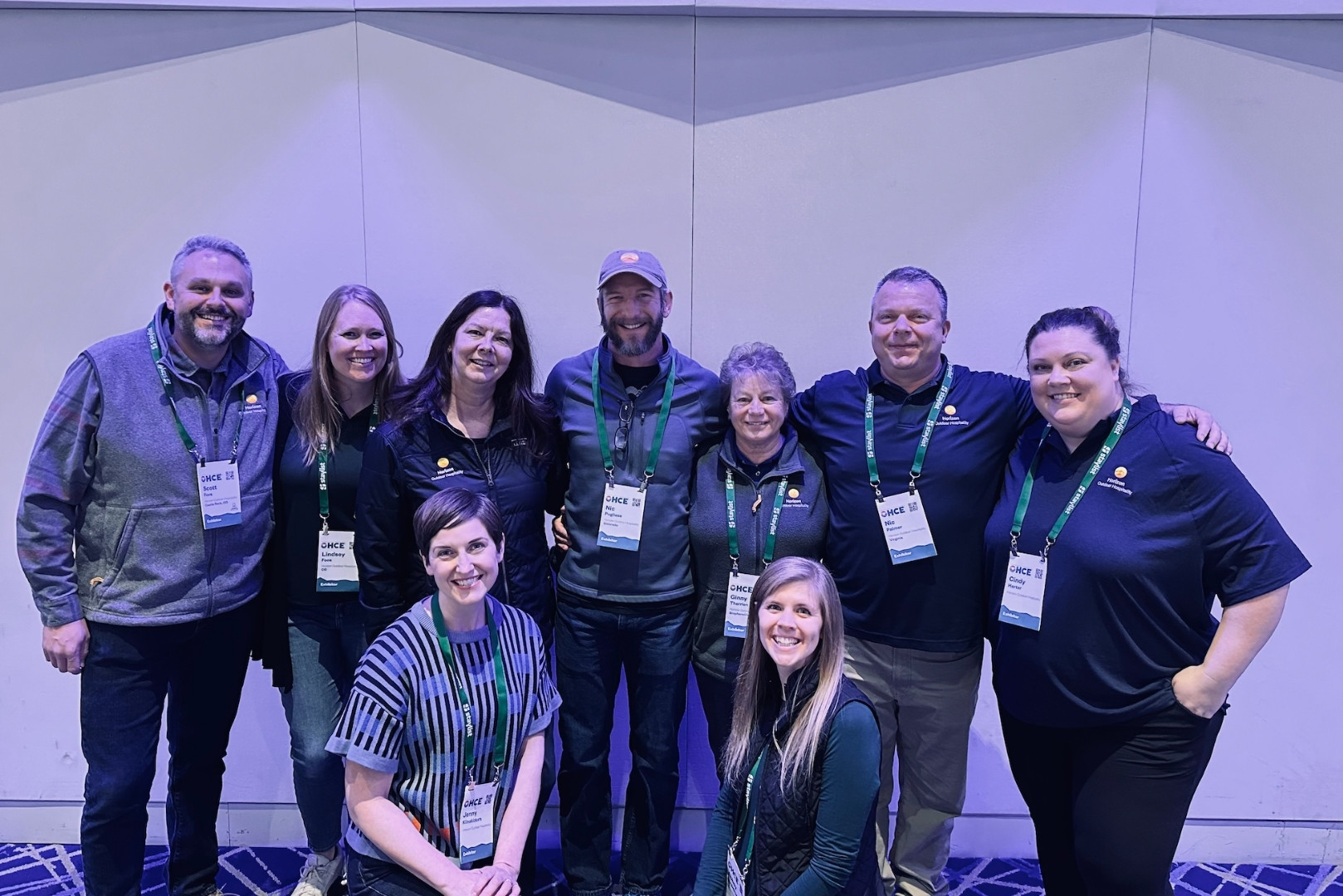
Horizon Outdoor Hospitality is a third-party property management company built for the outdoors. Glamping resorts, campgrounds, the kind of places people drive hours to disconnect at — Horizon runs the day-to-day operations behind them. Marketing, accounting, the works. Their clients range from a mom-and-pop owner with a single site to chain owners juggling anywhere from three to eleven properties, some of them topping 400 sites. Today the company supports more than 300 employees across multiple states. In 2021, their headcount was below 200.
This is how they scaled that fast without the wheels coming off.
The results
- One searchable resource the whole company runs on — the team named it the Horizon Field Guide
- Standard policies and SOPs across every property — everybody doing the same thing, the same way
- Real-time updates that reach everyone instantly — change one document, and the whole team gets it
- GMs empowered to support their own teams — fewer redundant questions routed back to HQ
- Safety built in and standardized — foundation courses, an OSHA-style manual, SDS and PPE standards, every property identical
- State-specific compliance handled by role and location — harassment training allocated by state-specific and job role.
When growing meant repeating yourself
Back in 2021, Horizon hit a growth spurt — adding multiple properties into the HOH portfolio — and the old way of getting people up to speed stopped scaling.
"Previously, we'd try to disseminate information individually," says Shari, who oversees operations and brings 31 years in outdoor hospitality. "We'd talk one-on-one with our GMs at each location, provide policies and procedures — and it just got to be overwhelming. The time commitment, the consistency that's required, especially as you take on more properties."
The deeper need was consistency — and accountability. "You need everybody on the same standard policies, so you can make sure everybody's doing the same thing," Shari says. There was a sharper edge to it, too. "We really saw a need, specifically in the liability realm — safety training, and a platform where we could track that people had gone through their SOPs and were advised of all policies."
That's the exact wall every multi-location operator hits: one-on-one knowledge transfer works until it doesn't, and the day you add the property that breaks it, you don't find out until something's already inconsistent. The fix is to standardize operations across locations in one place — so the standard doesn't depend on who happened to train whom.
An eight-inch binder, reborn
Shari Disher, Senior VP of Operations with 31 years in outdoor hospitality, and Ginny Therrien, Training and Operations Director with 41 years in the industry, were both general managers at one time and knew the binder intimately.
"Our operations guideline manual was printed," Ginny says. "About eight inches thick, with colored tabs for all the departments, and all your forms behind each tab."
So when they built Horizon's system in Trainual, that binder was the blueprint — minus the part where paper goes stale the moment it's printed.
"The beauty of everything electronically is that if we have to change something, I can change it instantly," Ginny says. "I can remove a document, put a new one in, hit save changes — and it goes to everybody immediately, to their email, which they can click and it takes them right to what changed."
No scavenger hunt. No "go re-tab your binder." Just: tab 7 just changed — here's the new version. That's the difference between a static reference and a version-controlled one that updates itself, and it's the same upgrade we've documented across companies that replaced binders, docs, and wikis with Trainual. A binder is frozen the day it prints. A living guide moves at the speed of the company — the trade-off we break down in Trainual vs. Absorb LMS: can your LMS keep up when things change?
"Your best friend is the search bar"
Documenting everything only matters if people can find it. At Horizon, that's the line every new GM hears.
"Your best friend is that search bar," Ginny says. "You don't have to remember where it lives, or what department it's under. You type a keyword, click the document, and it takes you right to that page." She puts it more plainly: "It's like its own little Google search for everything we've loaded into the Horizon Field Guide."
That searchable knowledge base is what turns a deep library into a usable one. And Horizon gets more out of it than most because of how deliberately they label things — property name, state initials, and the property's PMS or POS system, all baked into the naming. That discipline pays off twice: it tells the team what each property needs at a glance, and it makes AI-powered search pull cleanly, because well-named content is findable content.
Building the bear
Ginny has a name for spinning up a new property: building the bear.
"You have to build the bear," she says. "A new property — name it, what state, what PMS and POS system. Then allocate the operations director, then your GM reports to that operations director, then their team reports to the GM. Everybody nestles under somebody."
That's exactly how the field guide itself rolled out in 2021: onboard the GMs first, nest their team members underneath, run a group training and navigation session — then launch the Horizon Field Guide that December.
It's a role-based structure mapped onto a real org chart — and once it's built, assigning training is a click, not a chore. Each new hire drops into their property's group and their role group beneath it, and the right content lands automatically.
"I don't have to go get everybody individually," Ginny says. "I click the group and everybody gets that training immediately."
The payoff is reliability. "It's networked so tight that our error level is so minimized," she says. "And you only have to have it accurate once to get it on there.” It's the same repeatable system thinking that let ProTec build one operating model across nine offices — and that multi-location companies keep scaling on.
One platform for everything — including safety
Horizon could have run safety training on a separate tool. They chose not to.
"We were looking at other methods we'd used in the past for safety training," Ginny says. "Making the decision that it's all on one platform was hands down"
Premium compliance courses live right alongside the company's own processes, and Horizon routes them by group: harassment training that's state-specific for their California, Washington, and Colorado properties, and role-specific depending on whether someone's in a leadership or employee track. The naming conventions do the reminding — the state tag on each property tells the team which version applies.
The safety depth is where the field-guide idea really earns its name. There are three safety divisions: foundation courses with a test behind each one, an OSHA-style safety manual the team built from scratch, and SDS guidance down to a PPE-by-task sheet a property can print, laminate, and post right where the tools are stored. "Everybody's binder cover looks exactly the same," Ginny says. "The index is the same, the contents are the same." Standardization isn't a slogan at Horizon — it's the branded result.
Getting it out of people's heads
The hard part of any system like this isn't the software. It's the real knowledge that lives in the people who've been doing the work for decades.
"We have 72 combined years of experience between Shari and me, and the goal was to put it into a Training Module that can be updated as the company grows and compliance standards change,” Ginny says.
Translating that into something a brand-new stable wrangler or front-desk hire can use — that's the work. (And yes, an oceanfront property with a full stable taking trail rides on the beach is a real thing Horizon had to write roles and safety standards for. Glamping is not boring.) The team loops in their HR director, Tina Retana, to keep everything tight on the liability side, and turns lived experience into documented, teachable SOPs.
Which is exactly why getting institutional knowledge out of senior people's heads before they leave is the whole game. Ask Shari what would happen if the system vanished tomorrow, and the answer is immediate:
"That's a horrible thought." A pause. "It would be a lot less organized. We can't go back to the way it was — calling up each individual GM to say 'today we're training on this,' and then they immediately forget what you just told them."
Ginny agrees, and goes further: "I live and breathe in The Horizon Field Guide every day I work. To me, it's a priceless commodity."
Empowering GMs to find their own answers
The quiet win in all of this is what stopped happening: the steady stream of questions landing on the training team's desk.
Horizon front-loads its general managers. New GMs get navigational training and hands-on, screen-share-heavy onboarding, training, plus every department assigned to them so they know exactly what their team is learning. "That way everybody's all on the same page," Ginny says — and a GM who knows the Horizon Field Guide cold can answer their own team's questions instead of forwarding them up the chain.
When a GM inquires about a document or topic, Ginny has a reflex. "I'll say, 'Well, did you look on the search bar first?'" she laughs. "Because if I keep answering it for them, they'll never look for it themselves. Our goal is independence — we empower them with [Trainual]." That's the antidote to the hidden cost of treating senior people as the help desk — a trap that hits hardest when your team is spread across properties and time zones, exactly the reality field-based teams and distributed operators sharing knowledge across locations face every day. One more detail the team loves, especially in a setting where you get pulled away mid-task: training picks up right where you left it. "You come back, and it's right where you left it," Ginny says. "It doesn't lose its traction."
Why Horizon recommends Trainual
The Horizon Field Guide didn't just change how the team works internally — it became part of how they win new clients.
"When we're soliciting new clients, it's something we use as a benefit," Shari says. "Our forms, our procedures, all of our policies are in there. It's nice to be able to share that — not many other companies have it."
As for the version of themselves still running on an eight-inch binder, weighing whether to make the switch? Shari doesn't hesitate.
"It's the consistency and the ease of rollout — so many time-saving elements," Shari says. "Honestly, I don't know how we did it before. I could not see operating our company without this platform."
From a stack of paper to 300-plus across the country, running on one guide, everybody can search.
Even the name was a team effort. Someone pitched "Train y'all." Leadership landed on the Horizon Field Guide. The point is that it's theirs — and that's usually the moment a tool stops being software and starts being how a company works.
Ready to see how Trainual works?
👉 Book a demo and see how Trainual keeps every location working from the same searchable source of truth — and updates everyone the moment something changes.
Want a sneak peek?
👉 Read customer stories from teams who've turned binders and scattered docs into one system the whole company runs on.