





Most teams add a meeting when alignment slips. The teams that stay aligned do the opposite — they add a 15-minute habit that lets them remove meetings. That habit is the Friday update: a short, written, async check-in each person sends at the end of the week, capturing what moved, what's stuck, and what's next.
It sounds almost too small to matter. It works precisely because it's small. A Friday update takes one person fifteen minutes and gives the whole team a current, written picture of where things stand — no calendar block, no status round, no "quick sync to get everyone on the same page." Here's what goes in one, why async beats another meeting, how it connects to the rest of how you run the week, and how to make it a habit that holds. We'll use Trainual as the working example.
What a Friday update is
A Friday update is a brief written summary each team member submits at the close of the week. Three to five prompts, answered in a few sentences each, sent somewhere the team and their manager can read it. It's not a report anyone presents and it's not a meeting anyone attends — it's a ritual that turns the loose ends of the week into a record before they evaporate over the weekend.
The magic is in the timing and the format. Friday, because the week is fresh in everyone's mind and Monday starts with clarity instead of catch-up. Written, because writing forces a person to decide what mattered — and it leaves a searchable trail instead of a conversation nobody remembers.
Why async beats another sync
The instinct when a team feels out of sync is to schedule time together. But the standing status meeting is a poor tool for alignment: it's expensive, it happens on everyone's calendar at once, and it produces no record. Executives already rate 67% of their meetings as failures — adding another one rarely fixes alignment.
The deeper problem is where the information ends up. When Trainual surveyed managers and leaders across industries, 31% were keeping their notes and updates in scattered docs, and 57% said "one more tool" was the single biggest barrier to running operations better. A Friday update solves both: it's a written record in one place, and when it lives in the same system as your goals and meetings, it's not one more tool — it's the same one.
Async also respects how people work. A written update gets read when the reader has attention to give it, not when the calendar says so. It's reviewable, searchable, and forwardable. And it does the one thing a status meeting can't: it gives the manager what they need to walk into Monday already knowing where everyone stands.
What goes in a Friday update
A good Friday update is short and consistent — the same handful of prompts every week, so writing it becomes muscle memory and reading it becomes fast. Five prompts cover almost everything a team needs:
What moved this week?
The two or three things that progressed. Not a task log — the outcomes worth knowing about.
What's blocked or at risk?
The honest part. What's stuck, what's slipping, what needs a decision. This is the prompt that surfaces issues before they become fires.
Where am I against my goals?
A quick read against the person's goals or scorecard numbers, so progress is tied to what they're accountable for — not just activity.
What's the focus next week?
The one to three things that matter most in the coming week. This is what makes Monday start with direction.
What do I need from someone?
The explicit ask. Naming it in writing means it gets actioned instead of forgotten.
How Friday updates link to the rest of your operations
A Friday update isn't a standalone ritual — it's the connective tissue between the parts of how you run the week. The "what's blocked" answers become the issues list for the next leadership meeting, so the meeting opens already knowing what needs deciding. The "against my goals" answers tie each update back to the scorecard and goals, so progress is visible without a separate review. The "what I need" asks turn into action items with owners. Done right, the Friday update is the async layer that makes the live meeting shorter and sharper — it feeds the meeting prep so nobody walks into Monday cold.
That's the shift: instead of a Monday meeting where everyone reports what async could have covered, the Friday update carries the status, and Monday is free for the decisions that genuinely need a room.
How we run Friday updates at Trainual
[HANDOFF NOTE — Ben: this section is written illustratively against the Updates feature. Drop in the real internal detail (cadence, exact prompts, which departments, how it rolls into syncs and scorecards) and I'll rewrite it as first-party fact. Placeholder copy below so the section has shape.]
Internally, the pattern we keep coming back to is the one we built Operations suite around: every team sends a short async update at the end of the week, the prompts stay the same week to week, and the updates feed straight into Monday's meetings and the scorecards each team owns. Leaders read updates before the week starts, so the first meeting of the week is about decisions, not recaps — and because the updates are written and saved, anyone can look back at what was happening three weeks ago without asking. (Ben to confirm specifics.)
How to run Friday updates in Trainual
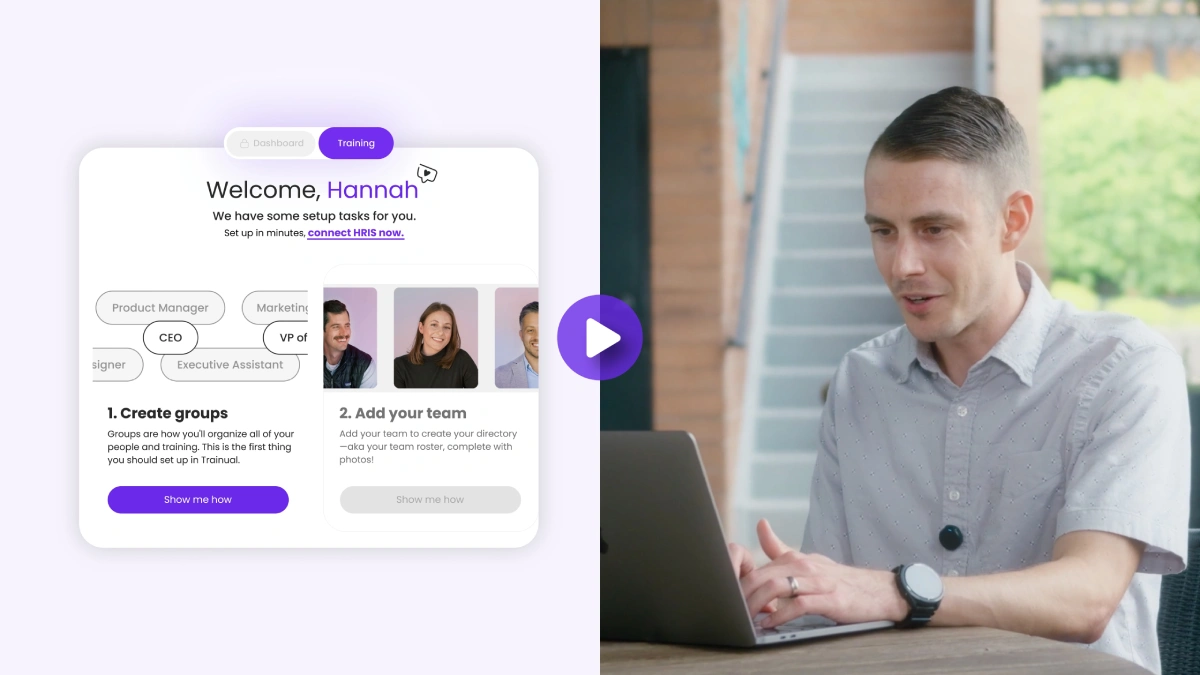
The habit only sticks if it's frictionless and lives where the rest of the work does. In Operations suite, recurring updates run on a cadence you set — every Friday, say — with the same prompts each time, so nobody reinvents the format. Submitted updates land in a central place the manager reads on their own time, and because updates sit alongside goals, scorecards, and meetings, the "against my goals" answers pull from live data and the "what's blocked" answers flow into the next meeting's agenda. Team Pulse AI can summarize the week's updates and flag what's trending at-risk, so a manager gets the signal without reading every line. The full setup is in the Operations suite guide.
The teams that get the most from this treat the Friday update as non-negotiable and short. Fifteen minutes, five prompts, every week. Structured weekly check-ins like this are part of why teams that run them complete 43% more of their goals — the habit compounds.
Quick wins to start this week
Quick win #1: Send your first Friday update yourself
Lead by doing it. Write yours this Friday using the five prompts before asking the team to.
Quick win #2: Lock the five prompts
Use the same prompts every week. Consistency is what makes writing and reading them fast.
Quick win #3: Cancel one recurring status meeting
Replace a standing Monday status meeting with the Friday update. Reclaim the calendar block.
Quick win #4: Read updates before your Monday meeting
Walk into the week already knowing where everyone stands. Use the meeting for what the updates surfaced.
Quick win #5: Turn every "what I need" into an action item
Don't let asks sit in an update. Convert them to owned action items with dates.
Ready to see how Trainual works?
👉 Book a demo and see how Operations suite turns a 15-minute Friday update into the habit that keeps your team aligned all week.
Want a sneak peek?
👉 Read customer stories from teams who've replaced their scattered tools with one system.
Frequently asked questions
What is a Friday update?
A Friday update is a short, written, async check-in each team member submits at the end of the week. It answers a few consistent prompts — what moved, what's blocked, progress against goals, next week's focus, and what they need — so the whole team has a current picture without a status meeting.
Why send updates on Friday instead of Monday?
Because the week is fresh in everyone's mind on Friday, and it means Monday starts with clarity instead of catch-up. A Friday update captures the week before it fades over the weekend, and gives managers what they need to plan the next week before it begins.
Can a Friday update replace a status meeting?
For most teams, yes. The status round in a meeting exists to share what everyone did — which a written async update does better, on everyone's own time, with a searchable record. Replacing the status meeting with a Friday update frees the live meeting for decisions that genuinely need a room.
What should a Friday update include?
Five prompts cover it: what moved this week, what's blocked or at risk, progress against goals or scorecard, the focus for next week, and what you need from someone. Keep each answer to a few sentences — the update should take about fifteen minutes to write.
How long should a Friday update take?
About fifteen minutes. If it takes much longer, the prompts are too broad or the update is turning into a task log. The goal is the outcomes that matter and the things that need attention — not a record of everything that happened.
How do Friday updates connect to goals and meetings?
The "progress against goals" answers tie each update to the team's scorecard and goals. The "what's blocked" answers become the issues list for the next meeting. And the "what I need" asks turn into action items. The update is the async layer that feeds the live meeting, so the meeting can be shorter and focused on decisions.