




Only 37% of meetings open with an agenda. 35% of meeting invites land less than a day before the meeting starts. And executives rate 67% of their meetings as failures. None of that is a meeting problem — it's a preparation problem.
The teams that run tight, decision-driving meetings aren't sharper in the room than everyone else. They do the work before the room. By the time the meeting starts, the updates are read, the agenda is set, the numbers are on the screen, and the open question is the only thing left to talk about. The meeting is for deciding — not for catching up.
This is the meeting prep checklist those teams run in the 24 hours before any meeting, and how to set it up inside Trainual so it happens every week without anyone chasing it down.
The real cost of walking into a meeting cold
Most meetings fail before they start. When the agenda shows up minutes beforehand — or never — people walk in without context. The first ten minutes go to recapping what everyone should already know. Status updates get read aloud one person at a time. Someone asks about a number nobody has in front of them, and the answer becomes "let me pull that and circle back." By the time the group reaches the decision that genuinely needed everyone in a room, half the time is gone and half the attention with it.
That cold start has a measurable cost. With only 37% of meetings using an agenda and 35% of invites going out with less than 24 hours' notice, most teams are unprepared by default. And preparation is exactly what shortens the meeting: research from the University of Nebraska-Lincoln found that meetings with a pre-distributed agenda run 13% shorter. Spread that across a week of standups, syncs, and one-on-ones, and the time adds up fast.
When Trainual asked managers and leaders across industries how they run their teams, the same pattern showed up in the tooling. 31% were keeping meeting notes in docs, and 24% relied on memory for accountability. Prep, when it happens at all, lives somewhere other than the meeting — a Slack thread here, a doc there, a spreadsheet nobody opened. The information exists. It's just not in front of the team when the meeting begins.
The shift: prep is async, the meeting is for decisions
Here's the move that separates high-performing teams from everyone else: they pull everything that can happen asynchronously out of the meeting and do it beforehand. Status updates, context-setting, number-gathering, most routine questions — none of it needs a live room. What needs a live room is the thing async can't resolve: a decision, a trade-off, a disagreement, a plan.
So the 24-hour window before the meeting does the heavy lifting. Updates are submitted async, so nobody reads status aloud. The agenda is shared and open, so anyone can add a topic the day before instead of derailing the discussion during. The relevant goals and scorecards are attached, so the numbers are already on the screen. Open action items from last time are carried forward, so nothing restarts from zero. When the meeting starts, the only thing left is the conversation that required everyone there in the first place.
This is also why meetings matter most for the working manager — the person running the standup, tracking the goals, and answering to leadership for results. They feel the cost of bad prep more than anyone, which is why training and enabling managers to run meetings this way pays back across the whole team.
The 24-hour meeting prep checklist
Run this in the day before any recurring meeting. It works for a leadership sync, a team standup, or a one-on-one — the cadence changes, the checklist doesn't.
Share the agenda — and let people add to it
The agenda should be visible to everyone the day before, not revealed in the room. When the agenda is shared and open, topics get queued in advance instead of sprung live, and people arrive having already thought about what they want to raise. In Operations suite, the agenda persists across every instance of a recurring meeting, so the structure stays put and only the discussion topics change week to week.
Collect updates async — so status isn't read aloud
The single biggest time sink in most meetings is the status round, where each person narrates what everyone could have read in two minutes. Replace it with an async update submitted before the meeting. Recurring updates on a set cadence let each person answer the same few questions on their own time, and the manager reads them ahead of the meeting. The live time is then free for the discussion the updates surfaced — not the updates themselves.
Put the numbers on the agenda
If your meeting touches metrics, the numbers should be on the agenda before anyone sits down. Link a scorecard or a goal directly into the agenda so the team is looking at live data during the discussion, not arguing over which version of the spreadsheet is current. No more "I'll pull that and follow up" — the data is already on screen.
Carry forward open action items
Last meeting's open items are the fastest thing to lose and the most expensive to re-explain. Carry them into the new agenda automatically so the group picks up where it left off. Each one keeps its owner and due date, so the meeting starts with accountability instead of amnesia.
Name an owner for every topic
Every agenda item should have one person responsible for leading it. A topic with a clear owner stays pointed; a topic owned by "the group" drifts. This is the same principle that makes ownership across overlapping roles work day to day — when someone is clearly accountable, things move.
Right-size the attendee list
The last 24 hours is also when to ask who genuinely needs to be there. Smaller groups decide faster. If someone only needs the outcome, send them the recap instead of the invite — and let the async update carry the rest.
How to make the checklist automatic in Trainual
A checklist only works if it happens every week without someone playing enforcer. That's the difference between running meetings across five disconnected tools — a calendar invite, a doc, a Slack thread, a spreadsheet, and someone's memory — and running them inside one system.
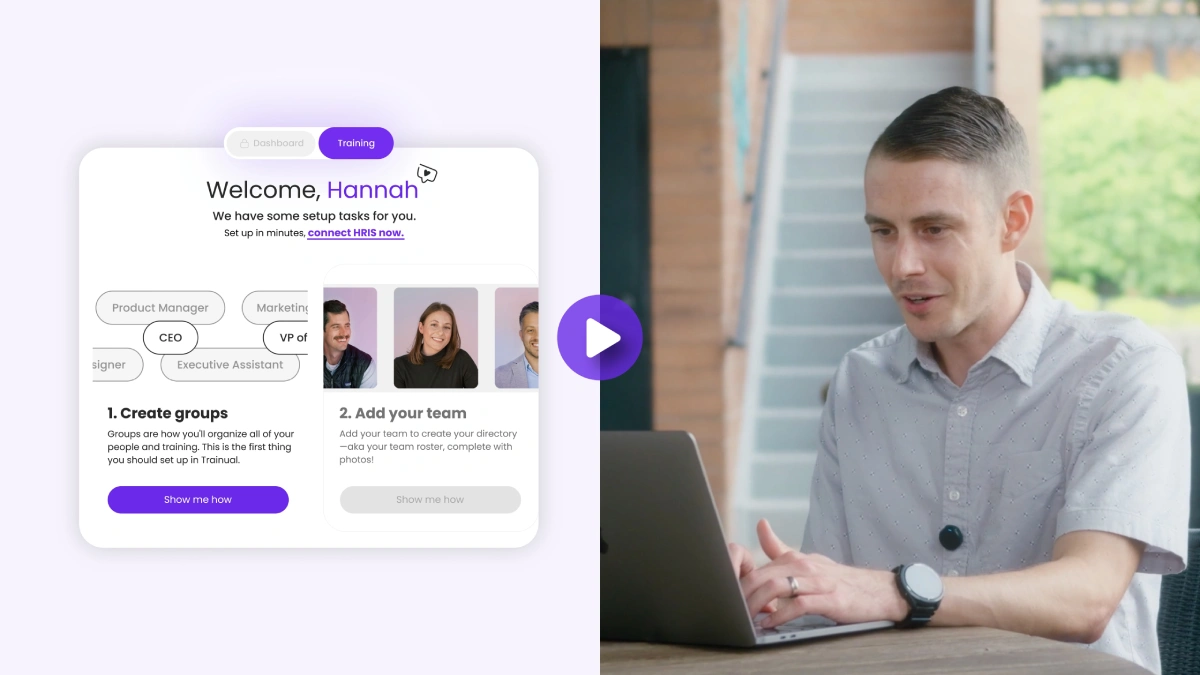
Operations suite is built around exactly this prep loop. Agendas are shared and persistent. Async updates land in a central inbox the manager reads before the meeting. Scorecards and goals link straight into the agenda. Action items defer, move, and roll forward with a single click. And because it's connected to the rest of Trainual, the AI Assistant and Team Pulse can flag a meeting that's coming up with an unresolved blocker — surfacing the prep gap before the meeting, not after. Meetings also sync two ways with Google Calendar and Outlook, so the prep lives where the meeting already is.
The full mechanics — agenda setup, recurrence, action item handling, calendar rules, and the AI summary — are walked through in the complete Operations suite guide. And if you want a sense of how much time your current meeting habits are costing, the operations time-wasters breakdown is a useful gut check.
The reason prep sticks when it's built into the system is the same reason any workplace habit sticks: the friction is removed and the cue is automatic. (There's a whole psychology to why teams adopt — or ignore — new habits worth understanding if you've tried to change meeting behavior before and watched it slide back.) When the agenda, the updates, and the numbers are all one click away, prepping for a meeting stops being a chore someone has to remember and becomes the default way the team works.
Quick wins to start this week
You don't need a full rollout to feel the difference. A few focused moves this week build the habit.
Quick win #1: Send next week's agenda today
Pick your most chaotic recurring meeting and share its agenda a full day in advance. Invite the team to add topics. Notice how much less time the meeting spends figuring out what it's about.
Quick win #2: Replace one status round with an async update
Take the status portion of one meeting and move it to a written update due the day before. Read the updates ahead of time. Use the meeting only for what they raised.
Quick win #3: Link one scorecard into your next meeting
Attach your team's key metrics to the agenda so they're on the screen when the discussion starts. No more pulling numbers mid-meeting.
Quick win #4: Carry your open action items into the next agenda
Before you close out your next meeting, roll the unfinished items forward with their owners and dates. Start the following meeting already accountable.
Quick win #5: Cut two people from a recurring invite
Look at one standing meeting and remove two attendees who only need the outcome. Send them the recap. Smaller room, faster decisions.
Ready to see how Trainual works?
👉 Book a demo and see how Operations suite turns scattered prep into meetings that drive decisions.
Want a sneak peek?
👉 Read customer stories from teams who've replaced their scattered tools with one system.
Frequently asked questions
How far in advance should you send a meeting agenda?
At least 24 hours. Sending the agenda a full day ahead gives people time to read it, prepare their contributions, and add topics of their own — and meetings with a pre-distributed agenda run measurably shorter. Sending it minutes before the meeting (or not at all, as happens in most meetings) means everyone arrives cold and the first chunk of the meeting goes to catching up.
What should a meeting prep checklist include?
Six things: a shared agenda people can add to, async status updates submitted beforehand, the relevant numbers linked in, open action items carried forward with owners, a named owner for each topic, and an attendee list trimmed to who's needed. Done in the 24 hours before the meeting, these move status, context, and number-gathering out of the live room so the meeting itself is for decisions.
How do you cut down the time a meeting takes?
Move everything that can happen asynchronously out of the meeting. The status round, context-setting, and routine questions don't need a live room — they can be read and answered before it. What's left is the discussion that genuinely needs everyone present, which is usually a fraction of the original agenda. A pre-distributed agenda alone makes meetings around 13% shorter; pairing it with async updates compounds the effect.
Should status updates happen in the meeting or before it?
Before it. Reading status aloud is the most common and most avoidable time sink in meetings. A recurring async update lets each person answer the same questions on their own time, and the manager reads them ahead of the meeting. The live conversation then focuses on what the updates surfaced — blockers, decisions, trade-offs — instead of the updates themselves.
What's the difference between meeting prep and a meeting agenda?
The agenda is one part of prep. Prep is the whole 24-hour window: collecting async updates, linking in the numbers, carrying forward open items, assigning topic owners, and right-sizing the room — in addition to setting and sharing the agenda. The agenda tells the team what you'll discuss; the rest of the prep makes sure they walk in ready to discuss it.
How do you get a team to prepare for meetings consistently?
Make it automatic instead of relying on memory. When the agenda, updates, scorecards, and action items all live in one connected system, prep stops being a separate task someone has to remember and becomes the default. Removing the friction is what turns a one-time push into a standing habit.