








About this episode
"Performance problems are more likely to be instructions problems than people problems."
You hired someone, gave them almost nothing to work with, and now you're disappointed. Chris Ronzio, Jonathan Ronzio, and Sasha Robinson spend this one on the whole arc of performance management — expectation setting, evaluation, and recognition — starting from the moment a job post goes live rather than the moment a review cycle opens. Sasha walks through exactly what goes in a 30-60-90 plan, including the "slam dunks" she plants in week one specifically so a new hire can build confidence. Jonathan argues goals should be outcomes, not tasks, and Chris pushes back on where that breaks down. They get into the failure mode nobody names: your expectations of someone rise steadily and silently, and then one day the person who was fine last month is suddenly underperforming against a bar they were never told had moved.
Also in here: the $5,000 offer Trainual makes every new hire 30 days in, borrowed from a Zappos office tour years ago. Why "no news is good news" only works if you say it out loud. Why Jonathan spends his time on high performers instead of struggling ones. And why nobody should get promoted until they're already doing the job.
Key Takeaways:
- Expectation setting starts at the job post, and it includes the ugly parts. Sasha's rule is that anyone considering Trainual should see the good, the bad, and what's broken before they accept — not a branded version of the role. That honesty is a retention play: you can't under-deliver on a job you described accurately. It continues past the offer, because the 30-60-90 plan she researched carefully will be materially different within a few weeks, and resetting expectations as the business changes is what keeps people from spending time on things that no longer matter.
- Goals should be outcomes, but projects still earn their place. Jonathan's position is that every hire exists to affect a specific outcome, and anchoring on the metric rather than the task list is what lets the work flex when priorities shift. Chris's counter is that sales and marketing get clean short-term metrics while finance or people ops are working against things like forecast variance or eNPS that take six to twelve months to read — so completed projects are the honest early signal there. Sasha's synthesis is a job description section called What You'll Own and Improve: name the metric, then stay out of how they get there.
- Your expectations rise silently, and that's the failure mode. Performance gets rated below, meeting, or exceeding expectations — but the bar is moving the whole time. Someone bobbling in week one is fine because expectations are low. Six months later the same output is a problem. Most managers never communicate that the standard has climbed. The same thing happens on promotion: a raise, a title, or new direct reports quietly resets what "exceeding" means, and someone who was a star last month is suddenly average against a new standard nobody articulated.
- The $5K to quit offer is a second yes. Thirty days in, every Trainual hire gets a surprise offer: $5,000 to walk away, no hard feelings, now that you've seen what the job actually is. Chris picked the idea up touring Zappos with the late Tony Hsieh. The value isn't the people who take it — it's that everyone else actively re-opts in after seeing the inside. Sasha attached a quiz to the decision, so there are now roughly a hundred written answers to "why do you want to stay," which doubles as some of the most honest culture data the company has.
- Promote after someone is already doing the job, not before. Chris's bar: before an internal promotion, the person should demonstrate 100% of what you'd screen for if you were hiring that role externally. Sasha's addition is that this protects the employee, not just the business — Trainual has promoted people into roles too big for them and then managed them out, when staying put would have meant continued success and growth. And when someone has clearly earned a promotion the business can't fund? Jonathan's answer is an honest conversation and, sometimes, a happy exit — not stringing them along.
Chapter Markers:
[0:14] Cold open: performance management, not band performance
[2:38] The three parts of performance management
[3:49] Performance problems are usually instructions problems
[5:05] Why the job post should include what's broken
[7:46] What actually goes in a 30-60-90 plan
[10:15] Outcome goals vs. task goals
[14:36] Permission to ask for help before you deliver something bad
[17:50] The bar keeps rising and nobody tells the employee
[18:56] How much grace does a new hire get?
[28:47] The $5K to quit offer, borrowed from Zappos
[32:04] Feedback cadence, and why no news is good news
[37:46] The delegation planner, and the case against career ladders
[41:20] Recognition, promotions, and the tension when there's no budget
Resources:
Want more resources from this episode? We've got an episode recap, replay, and every template, process, and resource we covered right here: Organize Chaos
Trainual
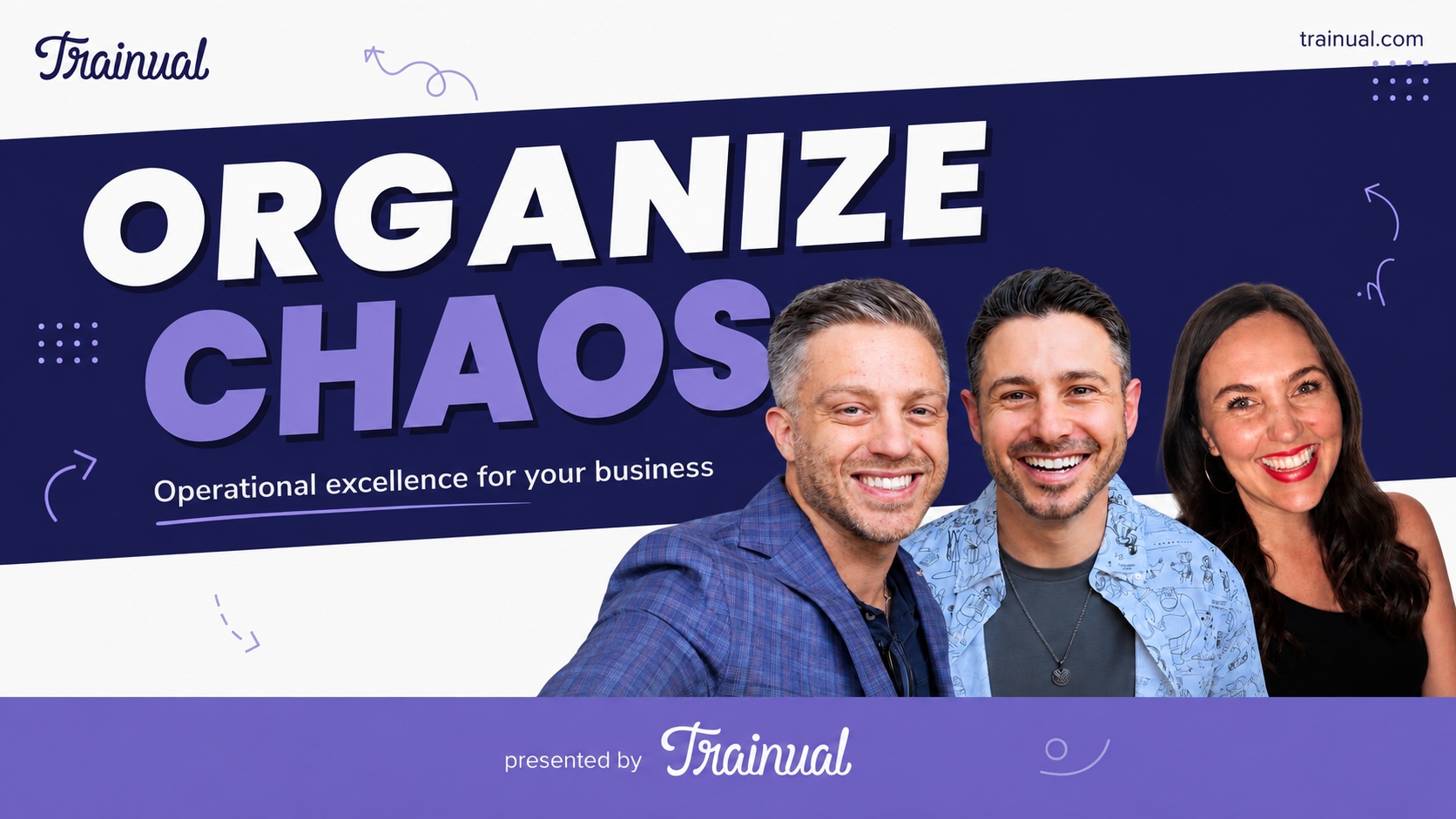
Organize Chaos is where founders and leaders learn how to build businesses that scale. Hosted by Chris Ronzio, Jonathan Ronzio, and Sasha Robinson, each episode explores the systems, leadership, operations, performance, and AI strategies behind high-performing organizations. Through candid conversations, practical frameworks, and real-world experience, they help you replace chaos with clarity — so your business can grow with confidence.
This is one of a few podcasts from Trainual, a software platform that helps businesses build playbooks to train and grow their team. You can check out the rest of our shows here: Podcasts

.svg)