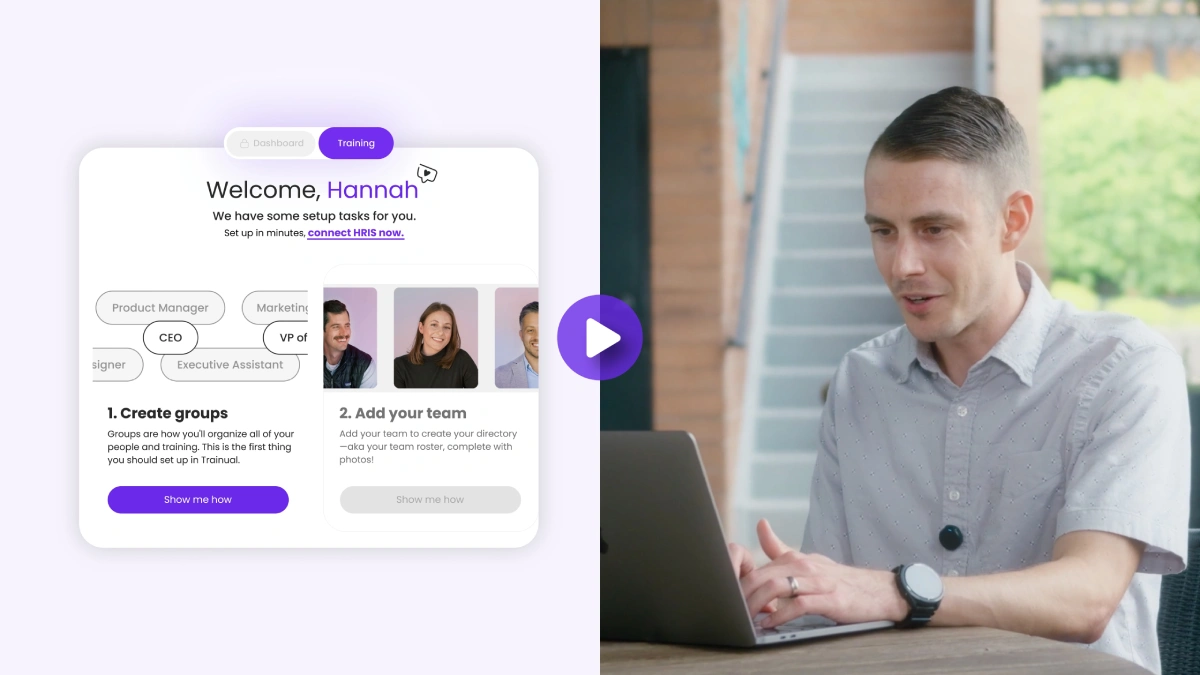






The best AI business process documentation software in 2026 does far more than write SOPs faster. It captures how work is done through screen recording and video, makes every procedure searchable, and confirms people learned it, not just that a document exists. If you are evaluating tools that use AI to document processes faster, these are the eight things that separate software you will still rely on in a year from software that quietly becomes shelfware. Trainual is the reference point throughout, with honest notes on where capture-first and video-first tools fit.
AI has made creating documentation dramatically faster, which is exactly why the deciding factors have moved past creation. When any tool can draft or capture an SOP in minutes, the questions that matter are whether people can find it, learn it, and trust that it is current. Here is what to look for.
The 8 things to look for
1. AI-assisted drafting that starts from your real work
The first thing to check is how the AI helps. The strongest tools draft a structured SOP from a prompt, a rough outline, or existing content, so you start from a real draft instead of a blank page. Weaker tools bolt AI on as a gimmick that produces generic filler you rewrite anyway. Test it on one of your own processes and see whether the output is usable or just plausible-looking. For getting more from the AI, feeding it better inputs matters as much as the tool.
2. Screen recording and step capture
For software-driven processes, the fastest documentation comes from capture, not typing. Look for the ability to record your on-screen actions and auto-generate a step-by-step guide with annotated screenshots. This is where capture-first tools like Scribe and Tango are genuinely strong, so if most of your processes are click-by-click in software, screen capture should weigh heavily. The honest trade-off is that pure capture tools stop at the guide, with no training or tracking on top, which is why many teams pair capture with a platform that adds those layers.
3. Video SOP creation
Some procedures are far clearer shown than written, so video is increasingly a core feature, not a nice-to-have. Look for the ability to create narrated video walkthroughs, ideally with AI-generated voiceover and captions, and to host that video alongside the written SOP. Video-first tools like Guidde specialize here. The question to ask is whether the tool keeps video and text together in one findable place, or leaves you stitching a recording tool to a separate doc, since split formats are how knowledge gets lost.
4. A searchable knowledge base
Documentation nobody can find might as well not exist. The tool should put every SOP into a searchable knowledge base so a person can type a question and get the current answer in seconds, without asking a colleague. AI search that understands natural-language questions is a real advantage here. Weight this heavily, because searchability is what determines whether the documentation gets used daily or abandoned, the difference explored in providing searchable SOPs and self-sufficient onboarding.
5. Role-based delivery
Creating an SOP is only half the job; the other half is getting the right one to the right person. Look for the ability to assign procedures by role, so each person receives what applies to them instead of hunting through a shared library. A tool that only stores documents leaves delivery to chance. This is a common gap in capture-first tools, and a key reason teams graduate to a fuller documentation platform as they grow.
6. Completion tracking and knowledge checks
This is the criterion that separates a documentation tool from a training system. Can you prove a person read, understood, and completed a procedure? Look for completion tracking and knowledge checks that confirm the standard landed, not just that a file was opened. For anything tied to compliance, safety, or consistency, this is non-negotiable, and it is exactly what pure capture and wiki tools lack. If you need accountability, weight this above creation speed.
7. Integrations that fit your stack
Documentation works best in the flow of the tools people already use, and in 2026 that means three kinds of connection, not one. Look for connectors that pull existing knowledge in from tools like Google Drive, OneDrive, SharePoint, Notion, and Confluence, an API and webhooks that move data out and automate updates across your systems, and, increasingly, a Model Context Protocol (MCP) server so your AI agents can draw on the documented knowledge directly. Trainual now covers all three. A tool that cannot connect to your stack becomes a silo people forget to open, so match the connections to what your team uses rather than a long list you will never touch.
8. A way to keep everything current
The most overlooked criterion is maintenance. Most tools help you create documentation but do little to keep it current, so it drifts out of date and people stop trusting it. Look for version history, clear ownership, and an easy edit path, so updating an SOP takes less effort than working around a stale one. AI that flags potentially outdated content is a bonus. Without a maintenance story, even the best-created library decays, which is the real reason documented SOPs pay off only when they stay accurate.
How these 8 criteria fit together
Read the eight as two groups. The first three, AI drafting, screen capture, and video, are about creating documentation fast, and AI has made almost every tool competent here. The last five, search, role-based delivery, tracking, integrations, and staying current, are about whether that documentation gets used, learned, and trusted over time. Most teams shopping for AI process documentation software over-weight creation speed and under-weight the second group, then wonder why their fast-made SOPs still sit unread. The tools that keep earning their place are the ones that treat documentation as something to operationalize, not just produce, which is the through-line of the best AI process documentation tools and the broader best SOP software guides.
How to evaluate against these criteria
Score each tool one to five on all eight for your situation, then weight by your biggest gap. A team drowning in click-by-click software processes should weight screen capture and video. A compliance-heavy team should weight tracking and knowledge checks. A distributed team should weight search and integrations. Be honest that no single tool is the strongest on all eight, capture-first tools win on creation and lose on training, while training-first platforms win on delivery and accountability and lean on capture-tool pairings for pure screen recording. The right choice is the one that scores highest on the criteria that matter most to you, not the one with the longest feature list. For a fuller picture, the affordable AI SOP platforms guide ranks specific tools against these criteria.
Ready to see how Trainual works?
👉 Book a demo and see how Trainual scores on all eight, from AI-assisted creation to searchable, trackable, always-current documentation.
Want a sneak peek?
👉 Read customer stories from teams that turned fast documentation into knowledge their people use.
Frequently asked questions
What software uses AI to help document business processes faster?
Several tools now use AI to speed documentation, in different ways. Capture-first tools like Scribe and Tango auto-generate step-by-step guides from your on-screen actions, video-first tools like Guidde turn screen recordings into narrated walkthroughs, and platforms like Trainual use AI to draft structured SOPs from a prompt or existing content and then make them searchable and trainable. The faster-documentation question is easy to satisfy in 2026; the more useful question is whether the tool also makes that documentation findable, learnable, and current, which is where the eight criteria above matter.
What's the best software to document a process with video and screen recordings?
For pure screen recording, capture-first tools like Scribe and Tango are among the fastest, and for narrated video walkthroughs, Guidde specializes in AI-generated voiceover and captions. The consideration beyond capture is where the video lives: the strongest setup keeps the recording, the written steps, and the training together in one searchable place rather than scattering them across a recording tool and a separate doc. A platform that hosts video alongside the SOP and can assign and track it turns a recording into usable training, not just a file.
What should you look for in AI process documentation software?
Look for eight things: AI-assisted drafting that starts from your real work, screen recording and step capture, video SOP creation, a searchable knowledge base, role-based delivery, completion tracking and knowledge checks, integrations with your stack, and a way to keep content current. The first three are about creating documentation fast, which most tools now do well, and the last five are about whether it gets used, learned, and trusted. Weight the criteria by your biggest gap rather than chasing the longest feature list.
Do you really need screen recording and video for SOPs?
It depends on your processes. For software-driven, click-by-click tasks, screen recording is the fastest way to document accurately, and video is far clearer than text for anything visual or hands-on. For policy, judgment, or knowledge-based procedures, written SOPs with search and training often matter more. The best tools support both formats and, crucially, keep them together with the training and tracking, so you are not managing recordings in one place and documentation in another.
Can AI process documentation tools also train employees?
Some can, and this is the biggest dividing line in the category. Capture-first and video-first tools mainly create documentation; they do not assign it as training, confirm completion, or test understanding. Platforms built for training turn the documented process into role-based training with knowledge checks and completion tracking, so you can prove people learned the standard. If training and accountability matter to you, choose a tool that operationalizes documentation rather than one that only produces it, or plan to pair a capture tool with a training platform.