





About this episode
"No back pocket 'I told you so.'"
Every growing company hits the same wall. In the early days everyone knows everything by default. Then you add managers, and executives, and suddenly there are spheres of information — and the people who were there from the start start feeling shut out, even when the reality is they don't need to be in every decision.
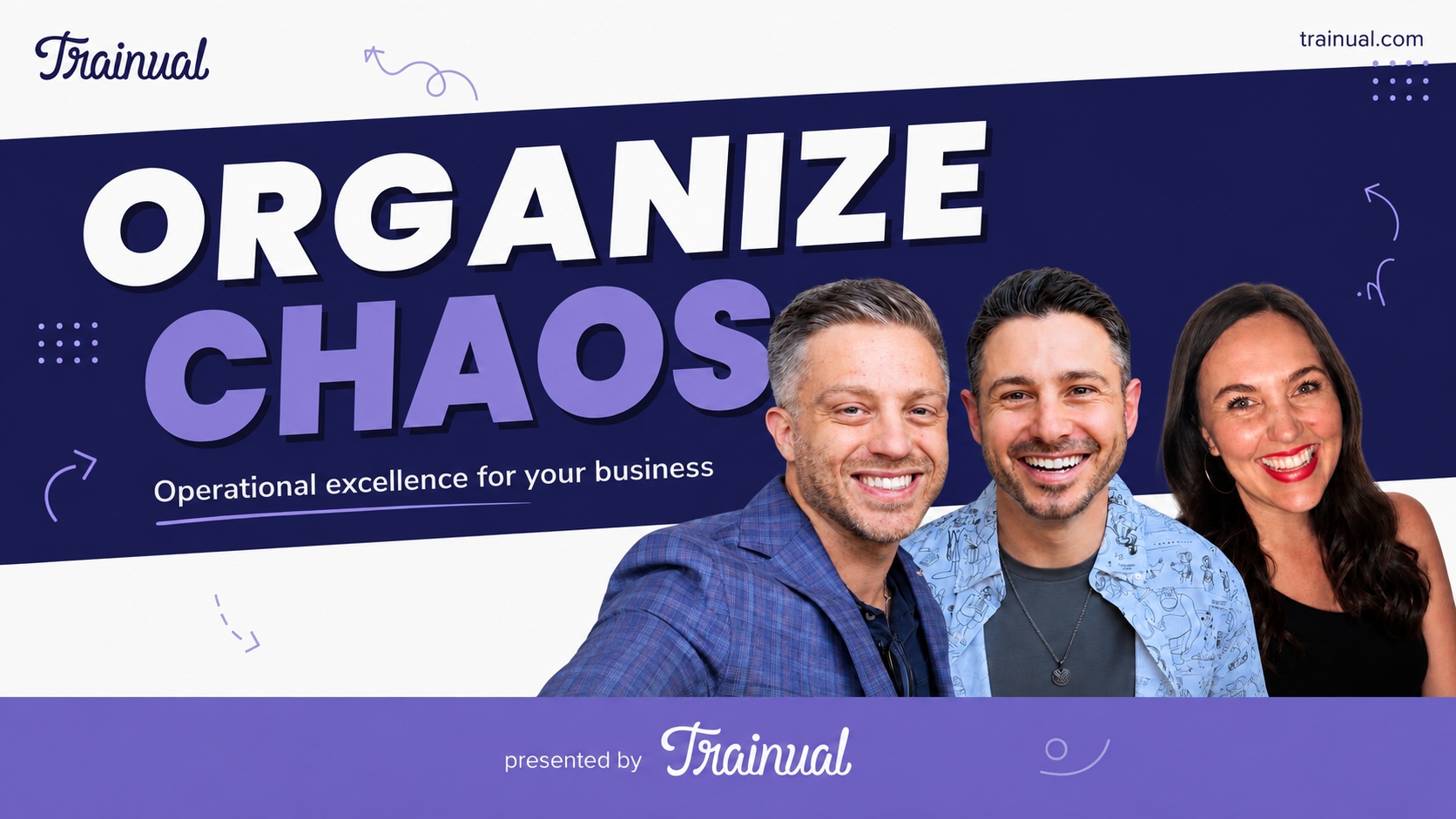
Chris Ronzio, Jonathan Ronzio, and Sasha Robinson open up Trainual's entire internal communication system, including the version that didn't work. For years, leadership would spend two or three days at a planning offsite working through frameworks and debates, then come back and hand the company a list of conclusions with none of the reasoning attached. The fix wasn't more information — it was structure. There's a specific narrative arc they now use to bring a hundred-plus people through a decision they weren't in the room for.
The most copyable thing here is the quarterly all-hands rebuild. It used to be every department head preparing a slide section, stitched together into a three-hour live presentation that left people glazed over with almost no retention. Now the material goes out five business days early as written and video content, with a comprehension check attached, and questions are due 48 hours before. The live hour is celebration plus an open town hall with the whole company.
Also in here: how to deliver a bad quarter without spreading fear, why pre-empting the hardest question yourself dissipates tension faster than inviting it, the tiered channel structure that decides who hears what first, and a surprising answer to whether they've ever been too transparent — the risk isn't over-sharing, it's over-asking for feedback you're not in a position to act on.
Key Takeaways:
- The gap isn't information, it's context — and people fill it themselves. When someone doesn't have enough context, they don't wait. They build a narrative, and if trust is thin that narrative skews negative. Trainual's own failure mode was spending days at a planning offsite and then returning with conclusions only. The correction was a deliberate story structure: here's the current reality, here's why it's a problem, here's where the trend goes if we do nothing, here are the options we considered, here's the one we chose and why, and here's how we'll execute it. Chris also started filming a short walkthrough at the end of each planning session, in front of the actual sticky notes, so the team could see the thinking rather than just the output.
- Name the paths you didn't take. Sasha's addition to the story structure is preemptively surfacing the alternatives you rejected and why — a use of Trainual's pink elephant principle. Someone in the room almost certainly thinks you should have gone the other way. Addressing that directly, even briefly, means people can see their perspective was weighed rather than missed, which is most of what they actually wanted.
- The async rebuild is the single most copyable thing in this episode. The old quarterly all-hands was every department head building a slide section, stitched into three hours of live presentation and near-zero retention. The new version: written and video material distributed five business days ahead inside Trainual with a test attached to confirm people actually engaged, questions submitted at least 48 hours out so answers can be prepared, and a live hour spent on celebration and open town hall Q&A with the full company. It also freed department leaders to participate instead of presenting.
- Delivering a bad quarter has a shape. Flag the tone shift at the top so nobody is blindsided. Start from shared purpose before the hard content. Re-anchor on the why at every step rather than just once. Then leave real time for questions with nothing off limits. The pattern interrupt that earns attention is sharing something you normally wouldn't — like what an investor said on a call that stopped you in your tracks. And rather than waiting for the worst question, ask it yourself out loud: naming it first dissipates the tension instead of letting it build. There's also a useful tell buried here — if you don't want to put a particular leader in front of the company to account for their results, that's information about the leader.
- The real transparency risk is over-asking, not over-sharing. Asked whether they'd ever shared too much, the answer was essentially no — but they have repeatedly asked for feedback during seasons when they weren't positioned to act on it, which creates more friction than silence would. Alongside that: a tiered channel structure (executive, leadership at director and up, people managers) that routes information by who needs it and lets it waterfall down, and a bias toward communicating in real time rather than saving news for the next scheduled meeting.
Chapter Markers:
[2:07] What most companies get wrong about internal communication
[2:51] The growing pains of information spheres
[5:01] Without context, people write their own narrative
[5:55] The mistake: delivering conclusions without the reasoning
[7:41] How to structure the story you tell the company
[9:48] Name the paths you didn't take
[11:01] The full communication cadence, tier by tier
[12:30] How the quarterly all-hands actually runs
[14:57] The async rebuild that replaced a three-hour deck
[16:01] Annual kickoff: from movie theater to sketch comedy
[19:55] Why the Zoom chat is the real engagement engine
[24:14] Disagree and commit, and no back pocket I told you so
[25:17] How to deliver a bad quarter
[27:04] Pre-empt the hardest question by asking it yourself
[30:24] Have we ever been too transparent?
[35:36] Inside the every-two-weeks all-hands format
[38:35] Running an AMA, and when "I don't know" is the right answer
[42:42] What gets communicated in real time, and to whom[
46:07] If you could keep only one thing
[49:01] This week in Trainual
Resources:
Have a topic you'd like covered? Connect with the hosts on LinkedIn — Chris, Jonathan, and Sasha — or email chris@trainual.com.
Want more resources from this episode? We've got an episode recap, replay, and every template, process, and resource we covered right here: Organize Chaos
Trainual
Organize Chaos is where founders and leaders learn how to build businesses that scale. Hosted by Chris Ronzio, Jonathan Ronzio, and Sasha Robinson, each episode explores the systems, leadership, operations, performance, and AI strategies behind high-performing organizations. Through candid conversations, practical frameworks, and real-world experience, they help you replace chaos with clarity — so your business can grow with confidence.
This is one of a few podcasts from Trainual, a software platform that helps businesses build playbooks to train and grow their team. You can check out the rest of our shows here: Podcasts

.svg)