





The Definitive Guide to Choosing an LMS for AI-Powered SOP Creation and Automation
Process documentation can make or break how fast a team scales. Manual SOP writing — recording the founder's screen, transcribing the meeting, formatting the doc, chasing approvals, watching it go stale — slows everyone down. That's why growing companies are turning to AI-powered SOP creation inside a Learning Management System (LMS): a platform that turns existing knowledge into structured, owned, role-assigned, version-controlled documentation in minutes. In this guide, we'll show you how to choose the right LMS for AI-powered SOP creation and automation — from defining your success metrics to running a pilot that proves real time savings.
Understanding the role of AI in SOP creation and process automation
AI-powered SOP creation in an LMS does more than draft text. It ingests existing inputs — Looms, Google Docs, meeting transcripts, voice notes, screen captures — and produces structured, publishable SOPs with headers, steps, and role tags. The right system pairs that generation with role-based assignment, version control, and AI search so the SOP doesn't just exist but actively reaches the right people.
Compared with traditional manual documentation, an AI-powered approach delivers:
- Speed — turn an existing recording into a draft SOP in minutes, not hours.
- Coverage — close the documentation backlog instead of letting it grow.
- Governance — every version tracked, every acknowledgment timestamped.
- Findability — natural language search means hires don't interrupt senior employees for answers.
The result: faster onboarding, fewer "how do we do this again" questions, and an operating layer that scales with the team.
Defining your success metrics for AI SOP work
Before comparing platforms, define what success looks like. Clear metrics keep the evaluation focused on operational lift, not feature counts.
Common AI SOP success metrics include:
Identify current gaps — unfinished SOP backlogs, senior employees who hold knowledge in their heads, hires interrupting managers for process questions — and set concrete goals like "Cut time-to-publish by 75%" or "Document the 20 most-asked workflows in 30 days." These benchmarks become the baseline for evaluating any platform.
Essential features of an LMS for AI SOP creation and automation
Not every learning platform is built for AI-powered SOP work. To genuinely compress documentation time, focus on features that handle real input formats, automate assignment, and integrate with the tools your team already uses.
Core features to look for:
- Input flexibility — AI that converts Looms, docs, voice notes, and screen captures into structured SOPs.
- Role-based assignment — content reaches the right hire on day one, automatically.
- Version control with acknowledgment tracking — every update tracked, every required reader prompted to re-acknowledge.
- AI search across all content — team members get answers in plain language with the source linked.
- Mobile-first delivery — non-desk teams complete SOPs and acknowledgments from a phone.
The goal isn't the smartest AI in isolation. It's the AI that closes the loop from generation to assignment to acknowledgment to retrieval.
Mapping technical requirements and integration needs
Selecting an AI SOP platform isn't only about features — it's about fit with your stack. Begin with a quick audit to map your HR, IT, and communication tools.
Common connections include:
- HRIS and payroll for automatic provisioning and role data.
- SSO for seamless logins across the team.
- Slack or Microsoft Teams for in-workflow notifications and reminders.
- Existing documentation tools (Google Drive, Notion) to support the migration into the new system.
Also review localization, mobile compatibility, and security standards (SOC 2, GDPR). A clear technical checklist now prevents rework later.
Evaluating LMS platforms: what to look for in demos and trials
A real evaluation tests vendor promises against actual workflows. Always include the people who will use the system — admins, managers, and end users — in your demos.
Targeted demo questions to ask:
- "Take a 10-minute Loom of one of our processes and turn it into a publishable SOP — show me the editing burden."
- "Walk through how an SOP gets assigned to three roles automatically."
- "Show me what happens when an SOP gets updated — version history, re-acknowledgment, audit trail."
Apply the "coffee shop test": if a new hire can find and use an AI-generated SOP on their phone with no instructions, the platform passes usability. Capture findings in a comparison matrix to keep the decision grounded in evidence.
Piloting your LMS: measuring time-to-publish and adoption
Before rolling out company-wide, pilot the shortlisted platform with a small cohort. Pick three real SOPs from real existing inputs — one Loom, one doc, one voice note — and run them through the AI.
During the pilot:
- Track time-to-publish for each SOP against your manual baseline.
- Compare adoption rates with previous documentation rollouts.
- Measure manager hours saved on writing, formatting, and chasing acknowledgments.
Teams running this pilot typically see SOP creation time compress by 75% or more — provided the platform handles assignment and governance, not just generation.
Scaling your LMS usage beyond SOP creation
The right LMS doesn't stop at the first SOP. Once the documentation backlog starts to close, the same system can carry training paths, policy acknowledgments, role transitions, and a searchable knowledge base that powers the team's daily work.
Many teams begin by generating their top 20 SOPs, then layer in compliance, role-based onboarding, and AI search across the full content library. Over time, the platform becomes both a documentation engine and an operating manual that scales with the team.
How Trainual accelerates AI-powered SOP creation
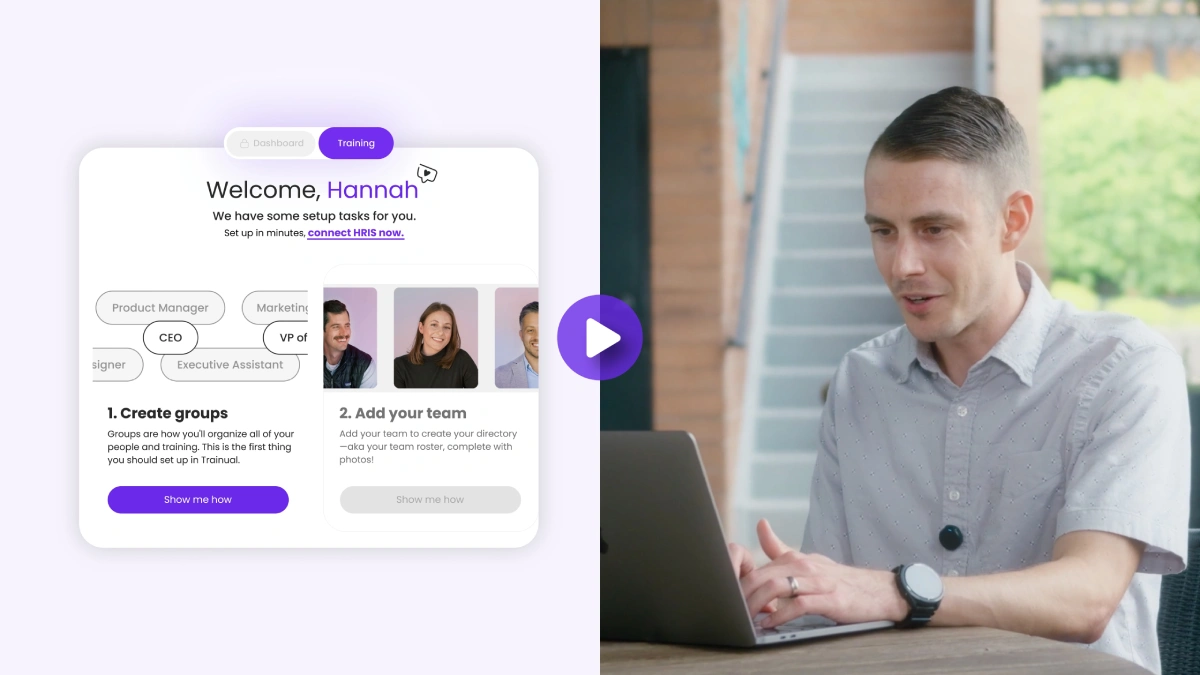
Trainual combines AI-powered SOP creation with role-based assignment, version control, and AI search in one platform built for growing teams. Its AI features turn existing Looms, docs, voice notes, and screen captures into structured SOPs in minutes — no instructional design experience required.
A mobile-first interface keeps documentation accessible anywhere, and the role chart ensures the right hire gets the right content on day one. Version history tracks every update and acknowledgment, and integrations with Slack, Gusto, and BambooHR keep onboarding workflows automated end-to-end.
For teams looking to compress documentation time while strengthening governance, Trainual offers a scalable, easy-to-use system that turns AI-generated SOPs into an operating layer the whole team can rely on.
Frequently asked questions
How do I start evaluating AI SOP platforms?
Audit your current SOP backlog, identify the most-needed workflows, and define outcomes like reduced time-to-publish or improved coverage across roles.
What core features matter most for AI SOP creation?
Prioritize input flexibility (video, doc, voice), role-based assignment, version control with acknowledgment tracking, AI search, and mobile-first delivery.
How can I evaluate AI features without overbuying?
Test the AI on real content — your actual Looms and docs, not vendor demos. If the output needs 30+ minutes of editing per SOP, the AI isn't ready.
What are common pitfalls to avoid?
Buying for generation alone without governance. AI that creates 50 SOPs in an afternoon without version control or assignment workflows produces content debt, not clarity.
How do I ensure successful adoption?
Pilot with a small cohort, measure time-to-publish against a baseline, and expand only after the numbers prove the system saves manager hours.