





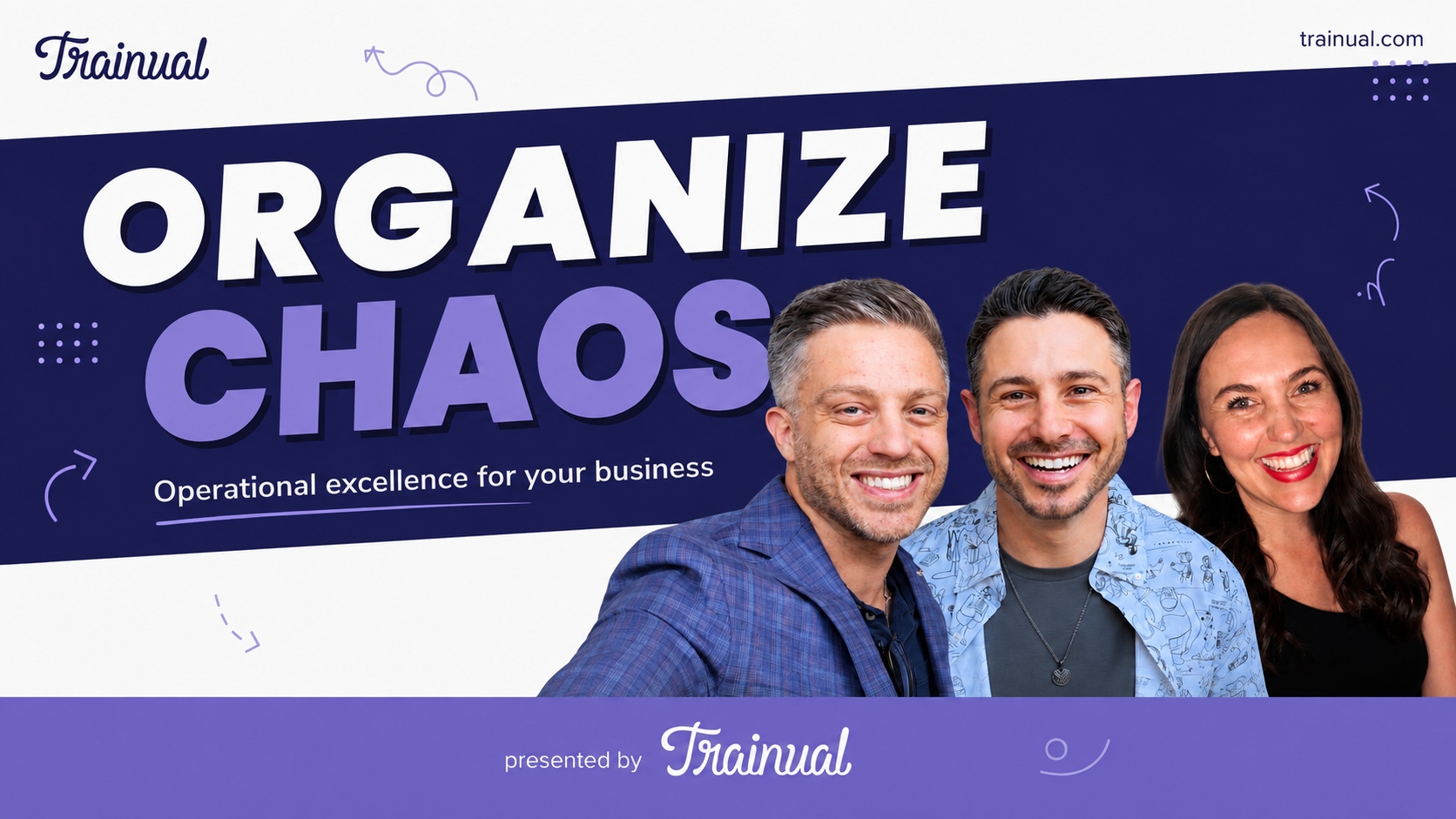

About this episode
“You have to manage by percentages and not just dollars, because low percentages can be high dollars in a poorly run business.”
It’s spirit week at Trainual, and the hosts are dressed for Adam Sandler day. Underneath the costumes is a question they’ve been circling for years: what’s the Michelin star of businesses? Saying you finished an Ironman tells people you’re in incredible shape. What’s the equivalent for a company, and how would anyone know it when they saw it? With Trainual’s operations and performance suites and its new Operational Excellence Program, the answer is getting more concrete.
The episode runs as a series of questions. What separates a business that makes money from one that runs well? What would a credit score for operations measure? Can the business run without the owner? Could five random employees explain where the company is going? Is “scrappy” just a nicer word for immature? From there, the hosts get into why goals and meeting rhythms die on paper, how to tell a people problem from a system problem, whether accountability has become code for blame, and how to keep improving without wearing your team out. They call it a brainstorm, with a recommended framework coming in Part 2.
Key Takeaways
- Manage by percentages, not just dollars. Plenty of businesses make a lot of money while running badly under the hood. They strike oil with a high-margin product or a right-place, right-time market, but people don’t like working there and the door keeps revolving. Burnout doesn’t show up on a P&L. Chris’s test is to benchmark against others in your industry on gross margin, net margin, and revenue per full-time employee. A company with big profit dollars and a falling revenue per employee is looking into a crystal ball at razor-thin margins five years out.
- An operating score should measure inputs and outputs. The hosts debate what a business credit score for operations would actually be. Jonathan sees it as a diagnostic, like an executive physical: a snapshot of what’s good, what’s bad, and what to act on. Sasha points out that a well-run business can struggle to turn a profit while a poorly run one rakes in cash. So she’d blend operational leading indicators, like goals, clear expectations, retention, and performance, with company performance metrics. Chris adds an external factor: a crowded, race-to-the-bottom market can squeeze margins even when everything inside runs well.
- Test whether the business runs without the owner. Sasha calls it the clearest sign of a well-run business: if the owner is the operating system, the company can’t scale past them. Chris checks himself against his own daily and weekly responsibilities. None of them hinge on him to serve customers, keep the product running, or close deals. His role now is investors, thought leadership, customers, and strategy on quarterly and annual cycles. Jonathan’s outside-in test is to look at the owner’s calendar: vacations, date nights, kids’ games. Sasha adds that the owner often isn’t the strongest operator in every area, so staying tactically involved can actively hurt the business.
- Don’t just repeat your mission and values. Quiz people on them. Every year at annual kickoff, Sasha walks the office with a tiny mic asking people to recite the mission, vision, values, and decision principles. One year, most people knew the vision but not the mission or the principles. So the team spent a full year working them into weekly team meetings, one-on-ones, and all hands, and tied values to how people get praised. Chris adds pop quizzes: in weekly all hands, the first person to answer in the chat wins a $5 gift card. If you expect people to know it, get them to say it back.
- Scrappy only counts if there’s stability underneath. To Sasha, scrappy means gritty problem solvers who will take on any problem, and it can coexist with being operationally efficient. She’s also seen companies use it to excuse chaos. Chris’s version: if the S in scrappy stands for stability, you’ve earned the word. Without it, you’re just crappy. Jonathan’s definition is the upside: scrappy is playing like a $100 million brand on a $1 million budget.
- Start with one operating rhythm and make it stick. Why do so many companies have goals, KPIs, and meeting rhythms on paper that nobody runs? Sasha says it’s painful to run and starts to break once goals cascade without an easy way to track them. Jonathan says a lot of founders aren’t passionate about operations. They read a book or hire a coach, get inspired by the “should haves,” and don’t build the muscle to keep it going. The fix is to pick one thing, like every manager meeting with their direct reports on a set cadence, and don’t add anything new until everyone does it consistently.
- Check the system first, and watch for people patching holes. Sasha recommends investigating before deciding. Something that looks like a people problem might be a resourcing gap, and a system problem can mask a talent issue. Jonathan looks at whether it recurs or was just a blip. Chris starts with the system: was there a clear instruction, did it work before, and what changed? The most dangerous problem in a business, he says, is exceptional people covering for bad systems, because they’re spending their time patching holes instead of doing much more valuable work.
- Ownership beats accountability, and accountability needs a tripwire. In an unhealthy culture, Sasha says, accountability turns into blame. In a healthy one, it just means the person responsible for an outcome manages it, reports on it, and adjusts when it’s off track. Jonathan’s line is to define in advance what changes if something goes wrong. Otherwise, “accountability” is just pointing fingers. Chris prefers ownership, which builds accountability in. Sasha warns that leaders often keep the ownership and decision-making but hand out accountability, blaming the people executing their vision. Chris’s example: a team member who proactively brought a metric to the leadership team because it had crossed a threshold set in an if-then statement agreed on up front.
- Fight change fatigue with context, profiles, and anchors. Constant change can fracture trust and make a team wonder whether the company knows what it’s doing. Sasha’s first move is context: explain how the change affects people’s day-to-day, and show when it came from their own feedback. Jonathan uses Kolbe profiles to know who thrives on change. Those people can be a “labs team” trying new things, while others need weeks or months of lead time. Chris anchors people to what isn’t changing. When Trainual shifts its go-to-market motions, for example, the conversation with sales starts with how their pay stays stable.
- The one change to make tomorrow: put your expectations in writing. Sasha’s answer is to be crystal clear about strategy, who your customer is, and how the team should show up and operate, then write it down so people can refer to it. Jonathan previews where Part 2 is headed with Chris’s sports-team loop: build the right team, create the playbook, play the game, keep score, watch the game film, and get better.
Chapter Markers
[0:00] Cold open: Adam Sandler day at Trainual’s spirit week
[3:15] Defining a gold standard business
[5:49] Making money vs. running well
[8:34] Manage by percentages, not dollars
[9:42] A credit score for how a business operates
[12:26] Predictive or diagnostic?
[13:29] Measuring inputs and outputs
[14:36] Internal vs. external factors
[15:08] Can the business run without the owner?
[16:08] How long could you step away?
[17:21] Look at the owner’s calendar
[18:13] When the owner isn’t the best operator
[18:57] Could five random employees explain the strategy?
[20:44] Pop quizzes, not just repetition
[21:51] Is “scrappy” code for immature?
[23:00] Without stability, you’re just crappy
[24:33] Why goals and KPIs die on paper
[26:00] Start with one rhythm and make it stick
[26:51] People problem or system problem?
[28:03] When great people patch bad systems
[29:05] Has accountability become code for blame?
[31:01] Ownership over accountability
[32:06] What accountability looks like done right
[33:23] Improving without change fatigue
[35:16] Knowing who thrives on change
[36:52] Anchor people to what isn’t changing
[37:38] One change a leader can make tomorrow
[38:24] The sports team loop
[39:33] This week in Trainual
[41:45] Coming in Part 2
Resources
Have a topic you’d like covered? Connect with the hosts on LinkedIn — Chris, Jonathan, and Sasha — or email chris@trainual.com.
Want more resources from this episode? We’ve got an episode recap, replay, and every template, process, and resource we covered right here: Organize Chaos
Trainual
Organize Chaos is where founders and leaders learn how to build businesses that scale. Hosted by Chris Ronzio, Jonathan Ronzio, and Sasha Robinson, each episode explores the systems, leadership, operations, performance, and AI strategies behind high-performing organizations. Through candid conversations, practical frameworks, and real-world experience, they help you replace chaos with clarity — so your business can grow with confidence.
This is one of a few podcasts from Trainual, a software platform that helps businesses build playbooks to train and grow their team. You can check out the rest of our shows here: Podcasts