




About this episode
“When everybody is afraid, that is the time to go on the offensive.”
Sasha’s back, and the hosts run through the small business news heading into 2027 planning season. Not much of it is cheerful. Owner optimism is slipping, health insurance renewals are coming in steep, and owners who are trying to hire say they can’t find qualified people. The hosts are upfront that they don’t have tidy answers for all of it. This one is three operators thinking out loud about the same pressures their listeners are facing.
They cover whether to pull back or press forward when the market feels stuck, who should absorb rising premiums, whether to hire for experience or for how fast someone learns, where AI agents fit and where they don’t, and whether this is the moment to raise prices. With time left over, the conversation turns to PTO and burnout. The three of them describe three completely different versions of work-life balance, and Sasha shares an admittedly unhealthy hot take about people who unplug on vacation.
Key Takeaways:
- When everyone pulls back, look for the offense, but stay long-term greedy. The hosts open with the latest small business optimism numbers. The index fell to 97.9 in September, only 6% of owners expect conditions to improve, and the share rating their own business health as good dropped nine points to 48%. Chris’s take, borrowed from a line in the show Lioness: be greedy when others are risk-averse, and risk-averse when others are greedy. Sasha ties it to one of Trainual’s decision principles, long-term greedy. Don’t make short-sighted cuts that save cash this quarter but hurt the business, or your family’s finances, over time.
- Rising benefits costs are a math problem without a clean answer. The numbers cited: small-group plans face a median premium increase of about 14% for 2027, with most insurers raising rates 10 to 20%, the second straight double-digit year. Employer health benefit costs are rising 8.2%, the fastest pace since 2003. Enhanced marketplace subsidies expired at the end of 2025. Sasha says HR peers are seeing renewals up 25 to 50%. That leaves a choice between absorbing a huge budget increase and shifting hundreds of dollars a month onto employees, which is a real cut to their total compensation. Chris frames it as one line item in a broader reality: invest what you can afford, and if that makes you less competitive as an employer, ask what needs to change in revenue or profit so you can invest more.
- Hire for how fast people learn, and plan to train them. The hosts cite figures showing labor quality is the single biggest problem for 26% of owners, and that 87% of those trying to hire found few or no qualified applicants. Chris would write job posts around mindset rather than qualifications, and test for how quickly candidates figure things out, because the work is changing too fast for experience alone to carry over. Jonathan pushes back that most employers still want plug-and-play hires with proven track records. Sasha adds that most managers aren’t good at evaluating something as subjective as learning ability. Chris points to a friend in commercial construction who started his own trades university with free scholarships to build his own talent pool. Jonathan argues the root problem is that education can’t keep pace with technology. On a tour of Harvard, a student told them AI was barely in the curriculum.
- Use agents for the infrastructure, and keep humans at the customer line. Jonathan vetted AI voice tools for sales outreach and decided against using them, because talking to a robot feels inauthentic. His line is that conversations with prospects and customers should stay human. Almost everything behind them is fair game, including content, data, and back-end workflows. Sasha runs her people ops team the same way: plenty of automation on internal tasks, but anyone talking to a candidate or employee shows up as a person. In a market saturated with AI, both see human-led interaction as a differentiator.
- Raising prices isn’t the only lever. Consider getting smaller and mightier. The hosts note that 28% of owners are still raising compensation even as customer demand wobbles. Sasha would talk to customers about the value they get before touching prices, since losing customers is a common side effect. Jonathan frames it as a bet: protect your margin, or stay lean and win on volume and loyalty while everyone’s wallets are tight. Chris shares advice from Trainual’s investors. Half as many customers paying twice as much is the same revenue with far less infrastructure, and profitability gives you dry powder to pounce when an opportunity shows up. Jonathan’s caveat is to avoid concentrating revenue in a few big clients, since losing one can take out a huge share of the business.
- Agree on the macro, and flex on the micro. Jonathan blocks out the things that fuel him at the start of every quarter, like band practice, a weekly basketball league, and date night, and keeps his working hours flexible around them. Sasha stays lightly connected on PTO because it’s easier for her emotionally than coming back to a pile. Chris works nearly nonstop and resets with short breaks. The lesson is to ask each direct report what their version of balance looks like and plan around it, then judge commitment over the week or month, not the hour. Jonathan doesn’t mind people fully unplugging on PTO. What bothers him is key voices going missing when something is on fire.
Chapter Markers:
[0:00] Cold open: Sasha’s back, and a flying Tesla
[2:45] Running through the latest business news
[3:16] Small business optimism hits a three-month low
[5:13] Going on the offense when everyone’s afraid
[6:14] Staying long-term greedy
[6:51] Health insurance costs ahead of open enrollment
[8:16] What HR peers are seeing at renewal
[9:26] Benefits as a business math problem
[12:19] Labor quality is the top problem
[14:43] Hiring for experience or for learning speed?
[16:40] Building your own talent pool
[18:19] The gap between education and real work
[20:45] AI agents instead of headcount
[22:04] Two AI avatars that won’t say goodbye
[23:28] Human-led as a differentiator
[24:12] Agents beyond digital businesses
[25:49] Is it time to raise prices?
[28:57] Half the customers at twice the price
[30:17] The risk of concentrating revenue
[30:51] Bonus: PTO and burnout
[32:11] Why unplugging is hard
[33:31] Calendar the things that fuel you
[35:22] Every person’s version of balance is different
[36:55] Sasha’s hot take on PTO
[38:58] Unplugged on vacation vs. missing in a fire
[40:49] Life without notifications
[41:38] This week in Trainual
[43:57] In defense of procrastination
Resources:
Have a topic you’d like covered? Connect with the hosts on LinkedIn — Chris, Jonathan, and Sasha — or email chris@trainual.com.
Want more resources from this episode? We’ve got an episode recap, replay, and every template, process, and resource we covered right here: Organize Chaos
Trainual
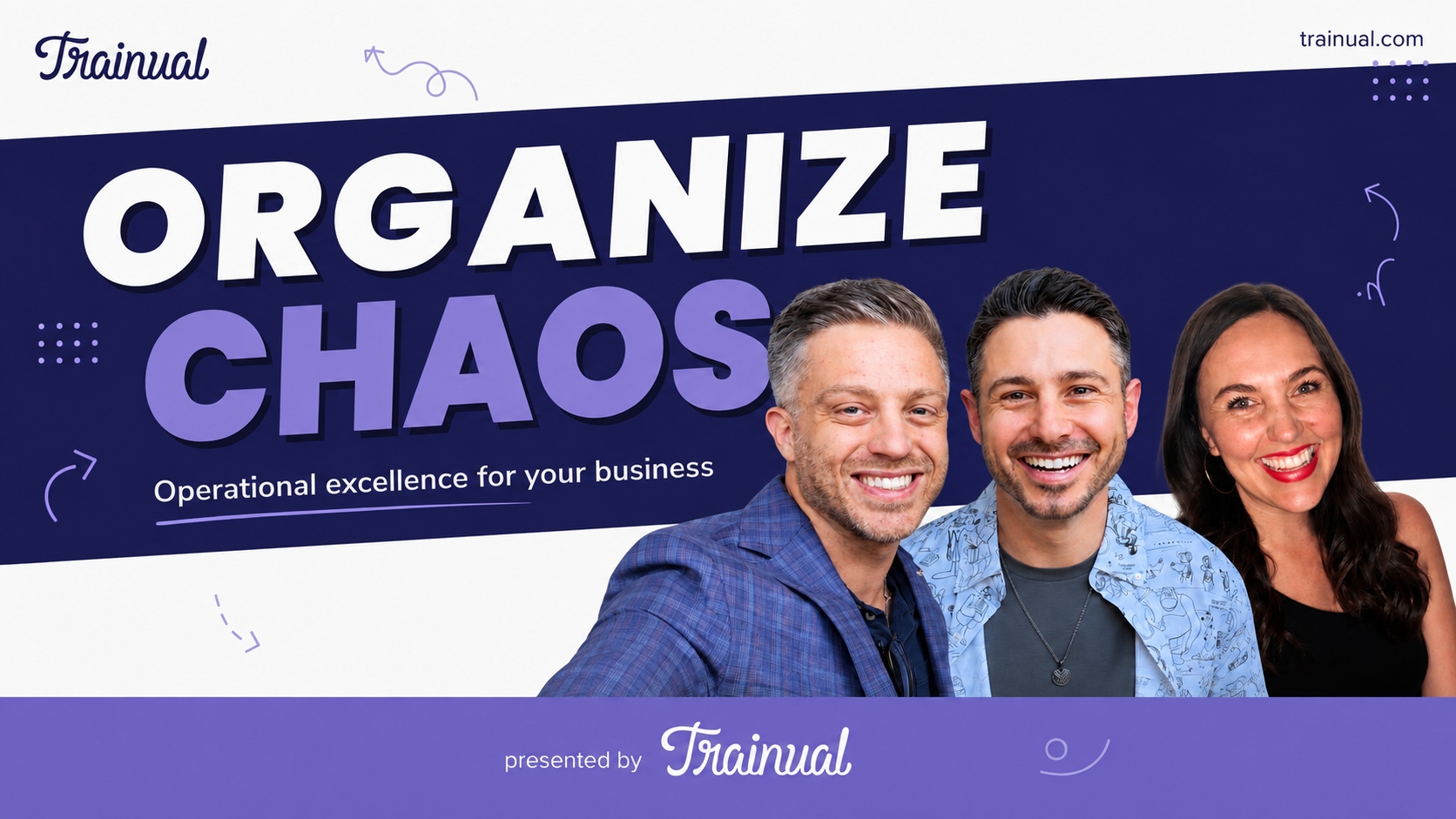
Organize Chaos is where founders and leaders learn how to build businesses that scale. Hosted by Chris Ronzio, Jonathan Ronzio, and Sasha Robinson, each episode explores the systems, leadership, operations, performance, and AI strategies behind high-performing organizations. Through candid conversations, practical frameworks, and real-world experience, they help you replace chaos with clarity — so your business can grow with confidence.
This is one of a few podcasts from Trainual, a software platform that helps businesses build playbooks to train and grow their team. You can check out the rest of our shows here: Podcasts