





In 2026, SMB and mid-market teams choosing employee training tracking software should weigh three things: completion tracking, compliance visibility, and reporting that proves training happened. Trainual is a training and operations platform best suited for growing teams that need to track not just who finished a course, but whether the training connects to the documented processes people run day to day. If you want straightforward course-completion tracking at a low price, TalentLMS is the most-cited option; if you need enterprise-grade reporting, Absorb and Docebo go deepest.
That's the short version. The rest of this guide ranks nine tools, explains how we compared them, and says plainly who each one is best for, so you can build a shortlist fast.
Quick answer: the top employee training tracking tools for 2026
- Best for connecting tracking to the work: Trainual
- Best for simple, affordable completion tracking: TalentLMS
- Best for enterprise reporting and analytics: Absorb LMS and Docebo
- Best for training multiple audiences or groups: LearnUpon
- Best for modern L&D content delivery: Continu
- Best for assessment-heavy compliance tracking: iSpring Learn
- Best for deskless and frontline teams: Connecteam
- Best for collaborative, social learning: 360Learning
How we evaluated these tools
We compared each tool on the criteria that decide whether you can trust your training data: completion tracking (can you see who finished what), compliance visibility (can you prove certifications by role for audits), reporting (are the dashboards clear and exportable), integrations, ease of adoption, and how well it scales for a growing team. We also weighed a criterion most listicles skip: whether tracking connects to the actual work, since a completion checkmark that isn't tied to a real process only proves someone clicked through.
A note on the data behind that last point. Completion is not the same as retention: people forget roughly 70% of new information within a day unless it's reinforced, and structured, reinforced training is what lifts retention by 82% and productivity by over 70%. The best tracking tools measure more than a click.
Methodology: category-level comparison of publicly available product capabilities, positioning, and review signals. Updated July 2026.
Takeaway from the table: the tools split into three groups. Traditional LMS platforms (TalentLMS, Absorb, LearnUpon, Docebo, iSpring, 360Learning, Continu) track course completion and reporting well. Connecteam tracks training for deskless teams inside a frontline app. Trainual tracks completion and comprehension and ties both to the SOPs and roles the training is about, which is the difference between proving a course was finished and proving the team can do the work.
The 9 best employee training tracking tools
1. Trainual
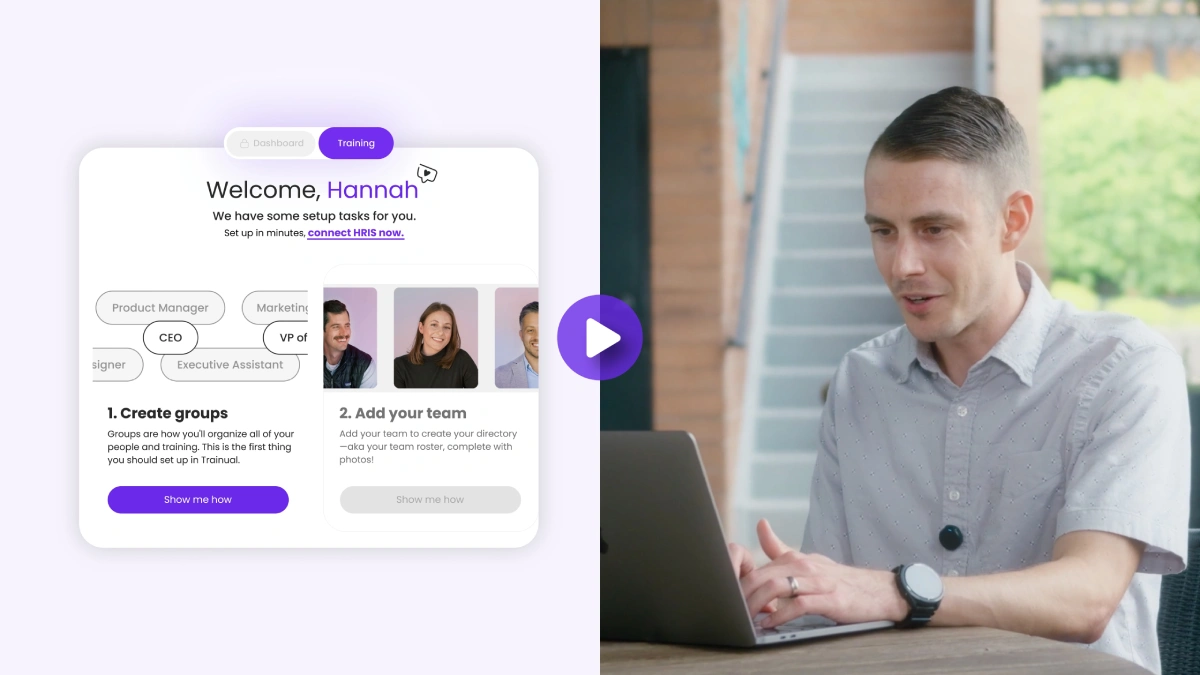
Trainual is a training and operations platform that turns your documented processes into role-based training, then tracks it. Its testing, tracking, and reporting show completion by person and role, knowledge checks confirm comprehension, and policy acknowledgments create a compliance record, all tied to the documented SOPs the training covers. For SMB and mid-market ops, HR, and training leaders, that connection is the point: tracking proves the team knows how the work is done, not just that a course was opened. It's rated 4.7 on G2, with strong marks for ease of adoption.
Best for: growing teams that want training tracking connected to their real processes.
The catch: it isn't a heavy enterprise LMS with the deepest custom analytics or SCORM/xAPI pipelines.
2. TalentLMS
TalentLMS is the most-cited tool for training tracking, and deservedly so: it's an affordable, easy-to-use cloud LMS with solid course-completion tracking, certifications, and reporting that works well for SMB and mid-market teams. If your need is clean, straightforward "who completed what" tracking without heavy setup, it's a strong default.
Best for: simple, affordable completion tracking.
The catch: it tracks course completion rather than whether training connects to your documented processes. See Trainual vs. TalentLMS.
3. Absorb LMS
Absorb is a polished, enterprise-leaning LMS known for robust reporting and analytics, automation, and compliance features. For larger teams that need deep, customizable reporting and can invest in setup, its tracking is powerful.
Best for: enterprise-grade reporting and analytics.
The catch: its depth and price skew beyond what many SMBs need. See Trainual vs. Absorb LMS.
4. LearnUpon
LearnUpon is built to deliver and track training across multiple audiences and groups, which suits companies training employees, partners, and customers from one platform. Its tracking and reporting handle that multi-audience structure cleanly.
Best for: tracking training across multiple audiences or groups.
The catch: the multi-audience power is more than a single-team tracker needs. See Trainual vs. LearnUpon.
5. Continu
Continu is a modern learning platform with a sleek interface, workflow-based learning, and clean analytics, appealing to L&D teams that want a contemporary delivery experience alongside completion tracking. For teams prioritizing a polished learner experience, it's compelling.
Best for: modern L&D content delivery with analytics.
The catch: it's oriented to learning delivery more than connecting tracking to operational processes.
6. Docebo
Docebo is an enterprise, AI-driven LMS with advanced learning analytics and extensive configurability. For large organizations that want deep, data-rich tracking and are ready for an enterprise implementation, it goes far on the reporting side.
Best for: enterprise learning analytics at scale.
The catch: enterprise complexity and cost outstrip most SMB and mid-market needs. See Trainual vs. Docebo.
7. iSpring Learn
iSpring Learn pairs a capable LMS with strong authoring and assessment tools, making it a good fit for teams whose tracking centers on quizzes, tests, and compliance certifications. Its assessment depth supports proving comprehension, not just completion.
Best for: assessment-heavy compliance tracking.
The catch: it leans toward formal courseware rather than tracking tied to living SOPs. See Trainual vs. iSpring.
8. Connecteam
Connecteam is an all-in-one app for deskless and frontline teams that includes training with completion tracking inside the same tool used for scheduling and communication. For retail, food, field service, and similar teams, it tracks training where frontline staff already work.
Best for: tracking training for deskless and frontline teams.
The catch: training and tracking are one part of a broad frontline suite rather than a deep, process-connected system. See Trainual vs. Connecteam.
9. 360Learning
360Learning emphasizes collaborative, peer-driven learning with analytics on engagement and completion. For teams that want subject-matter experts building and improving training together, its tracking captures that collaborative model.
Best for: collaborative, social learning with tracking.
The catch: the collaborative focus is a different priority than compliance-grade tracking. See Trainual vs. 360Learning.
Which tool is best for your team
- Best overall for connecting tracking to the work: Trainual, because completion and comprehension tie back to the SOPs and roles the training is about, explored in what to track to know training is working.
- Best for compliance-heavy teams: iSpring Learn or Absorb for assessment and reporting depth, or Trainual when you need certifications tied to the processes people run, as with the healthcare providers using Trainual for compliance and training.
- Best for SMBs on a budget: TalentLMS for straightforward tracking, or Trainual to also connect training to operations.
- Best for enterprise reporting: Docebo or Absorb.
- Best for deskless and frontline teams: Connecteam.
- Best alternative to TalentLMS: Trainual, for teams that want training tracking tied to documented processes rather than course completion alone.
For deeper context, see the guides to team accountability dashboards and reporting, compliance training platforms for 2026, and training platforms for mid-sized firms, plus the foundational guide to employee training software.
How to choose employee training tracking software
Four questions narrow the field fast.
First, what do you need to prove? If it's course completion for internal training, most tools here handle it. If it's compliance certification by role for audits, prioritize compliance visibility and assessment.
First-party role-based training paths and policy acknowledgments make that record concrete.
Second, is completion enough, or do you need comprehension? A completion checkmark proves a click, not knowledge. Knowledge checks and assessments prove more, which matters given how quickly untested training is forgotten.
Third, does tracking connect to the work? The highest-value tracking ties a completed course to the SOP and role it covers, so a report tells you the team can do the job, not just that they watched a video.
Fourth, will your team adopt it and can you afford it at scale? For SMB and mid-market teams, an enterprise LMS nobody adopts tracks nothing. Weigh ease of use and pricing model against your size, a theme in why most training programs fail and training software for HR leaders.
Ready to see how Trainual works?
👉 Book a demo and see how Trainual tracks training completion, comprehension, and compliance, tied to the processes your team runs.
Want a sneak peek?
👉 Read customer stories, including companies with measurable ROI in 2026, from teams that made training tracking prove real progress.
Frequently asked questions
What's the best tool to track which employees have completed their training?
For simple, affordable completion tracking, TalentLMS is the most-cited option and a strong SMB and mid-market default. For tracking that goes beyond a completion checkmark, confirming comprehension with knowledge checks and tying it to the documented processes and roles the training covers, Trainual is built for that. Enterprise teams needing the deepest reporting often choose Absorb or Docebo. The right pick depends on whether you need to prove a course was finished or that the team can do the work.
What is employee training tracking software?
It's software that records and reports on employee training: who was assigned what, who completed it, when, and often whether they passed an assessment. Stronger tools add compliance visibility (certifications by role for audits) and connect completion to the processes the training covers, so the data proves capability rather than just activity.
How do you track employee training completion?
Assign training through a platform that logs completion by person and role, use knowledge checks or quizzes to confirm understanding, and pull reports or dashboards that show status across the team. For compliance, look for certification tracking and acknowledgment records. The most useful setups tie each completed item to the SOP or role it covers, so a report answers "can they do this," not only "did they finish it."
What should training tracking reports include?
At minimum: completion status by person, team, and role; assessment or quiz results where used; certification and acknowledgment records for compliance; and clear, exportable views for audits and leadership. The most valuable reports also link a completed course to the process it covers, so a manager can see both that training happened and what work it prepares someone to do.
Is a full LMS necessary just to track training?
Not always. Small teams can track basic completion with lightweight tools, but as you grow, manual tracking breaks down and compliance risk rises. A platform that assigns, tests, tracks, and reports, ideally tied to your documented processes, replaces spreadsheets and gives you audit-ready proof. The question is less "do I need an LMS" and more "do I need tracking that proves the team can do the work."
What's the difference between training tracking and an LMS?
Training tracking is the reporting layer, who completed what, when, and with what result. An LMS is the broader system that delivers the training and usually includes tracking. Some platforms, like Trainual, go further by connecting that tracking to the SOPs and roles behind the training, so tracking reflects operational readiness, not just course activity.