





For a mid-sized professional services firm — an agency, an accounting or law practice, a consultancy — training is where operational consistency is won or lost. The work is the people and what they know, so when onboarding is slow, when knowledge lives in a few senior heads, or when two teams run the same process two different ways, it shows up directly in client work. The right employee training platform fixes that. The wrong one adds a tool nobody adopts.
The catch is that most "best employee training platforms" lists are built for either tiny teams or the enterprise, and a mid-sized firm fits neither. You've outgrown ad hoc training, but you don't need — or want to pay for — an enterprise learning management system (LMS) built around a massive course catalog and a dedicated administrator. What you need is the platform that matches a firm your size: fast to adopt, strong on onboarding and knowledge, and able to keep every person doing the work the same way.
This is a comparison of the best employee training platforms for mid-sized professional services firms in 2026 — Trainual, Absorb LMS, TalentLMS, and LearnUpon — judged on what matters at your size: onboarding, knowledge management, operational consistency, and the ability to scale without enterprise overhead. We'll also cover what makes a firm outgrow its current tools, so you can tell which side of that line you're on.
What is an employee training platform?
An employee training platform is software a company uses to deliver, track, and manage how its people learn their roles — from onboarding new hires through ongoing development. It centralizes training materials, documented processes, and knowledge in one place so every team member can find what they need and complete what's assigned, and so leaders can see who's trained on what. The strongest platforms also house the company's processes and policies, not just courses.
The category spans a wide range. At one end sit lightweight tools for delivering a handful of courses; at the other, enterprise systems built for large catalogs, certifications, and complex compliance. Mid-sized professional services firms generally need something in between — a platform that handles role-based onboarding and a searchable knowledge base without the weight of an enterprise rollout. Knowing where a platform sits on that spectrum is the first filter in choosing one.
What mid-sized professional services firms need from a training platform
Four things, weighted differently than they would be for a tiny team or a large enterprise: fast onboarding, strong knowledge management, operational consistency across the firm, and the ability to scale without adding overhead. A platform can be excellent at delivering courses and still fail a professional services firm if it can't get a new hire productive quickly or keep documented processes findable.
The reason these four matter most is the nature of the work. Professional services firms sell their people's expertise, so the speed at which a new hire becomes billable is a direct cost line — and structured onboarding moves it: companies with a strong onboarding process see 82% higher new-hire retention and 70% higher productivity. Knowledge management matters because expertise that lives only in senior people's heads is a risk that walks out the door — and because employees lose nearly 1.8 hours a day hunting for information they should be able to find. Operational consistency is what keeps client work uniform as the firm grows. Compliance and certifications matter in regulated corners like law and accounting, but for most mid-sized firms they're a secondary need, not the headline — which is why an enterprise LMS built around them is often the wrong fit.
Signs your firm has outgrown basic training tools
Companies outgrow basic training tools when the firm gets big enough that informal training stops scaling — usually somewhere past 25 people. The trigger isn't headcount alone; it's the moment shared docs, a folder of videos, and "ask whoever knows" stop keeping work consistent. When onboarding depends on grabbing time with a busy senior person, when the same questions get re-answered weekly, and when two teams do the same task differently, the tools have been outgrown.
The specific signs are worth naming, because most firms hit several at once before they act:
- Onboarding runs on someone's calendar, not a system. New hires ramp at the speed a senior person has free time, and the experience differs every time.
- Knowledge lives in people's heads. The answer to "how do we do this?" depends on who you ask, and walks out the door when they leave.
- The same questions get asked over and over. Your most expensive people spend their days as a help desk because there's no single place to self-serve an answer.
- Processes drift across teams and locations. Two offices, or two pods, run the same workflow differently — and client work shows the inconsistency.
- You can't see who's trained on what. Onboarding and compliance status live in someone's memory or a spreadsheet, not a system you can report on.
- Adding the next ten people feels risky, not routine. Growth strains the firm instead of being absorbed by it.
Hit three or more and the question isn't whether to move to a real training platform — it's which one fits a firm your size. Two clarifying reads on that line: 5 signs you need a modern LMS, not an enterprise one and the playbook on turning institutional knowledge into documented systems.
The best employee training platforms for mid-sized firms in 2026
Four platforms cover the realistic range for a mid-sized professional services firm, each strongest for a different priority. The right pick depends on whether your core need is operational consistency, enterprise-grade customization, budget-friendly course delivery, or training audiences beyond your own staff.
1. Trainual — best for operational consistency and onboarding
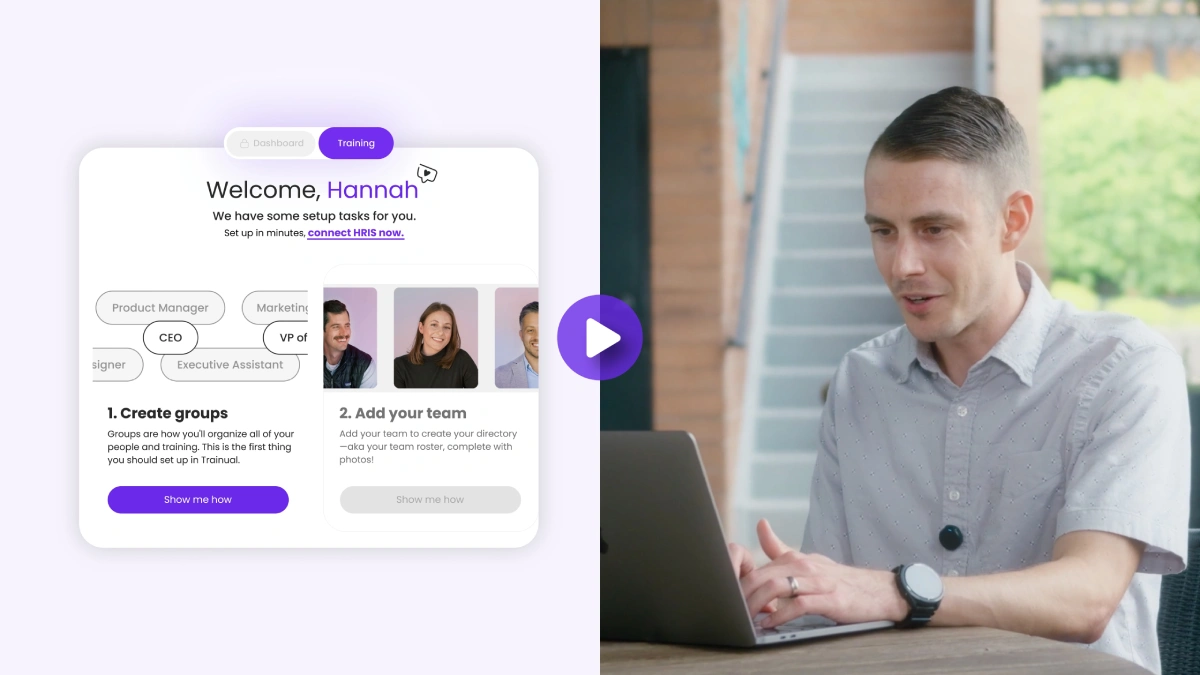
Trainual is the strongest fit for a mid-sized professional services firm whose core need is consistency — getting every person to do the work the same way, onboarding new hires fast, and keeping knowledge findable instead of trapped in people's heads. Rather than centering on a course catalog, it's built to document how the firm runs: processes, policies, role-based training, and a searchable knowledge base, all in one place.
That focus is what sets it apart for this audience. New hires get a role-based onboarding path that doesn't depend on a senior person's calendar; documented processes keep work uniform across teams and locations; and an AI-powered knowledge base with an AI Assistant lets people self-serve answers instead of interrupting your most expensive staff. Because anyone can build and update content, it's fast to adopt — the platform tends to be live in days, not the quarter-long rollout an enterprise system can demand. Professional services firms from marketing agencies to accounting and tax practices use it for exactly this.
Best for: mid-sized firms that need operational consistency, fast onboarding, and knowledge management without enterprise overhead.
2. Absorb LMS — best for enterprise-scale customization
Absorb LMS suits firms that need enterprise-grade customization and reporting, and that train audiences beyond employees — customers and partners included. It's a scalable, highly configurable platform that supports large user volumes and detailed performance analytics, which is why it shows up on enterprise shortlists.
For a mid-sized professional services firm, that strength is also the consideration. Absorb's depth — extensive customization, robust reporting, extended-enterprise support — comes with more implementation effort and a higher price point than a leaner firm typically needs. If you're heading toward enterprise scale or have a genuine extended-enterprise training requirement, it's a strong choice; if your real need is internal onboarding and consistency, it can be more platform than the problem calls for. (Head-to-head: Trainual vs Absorb LMS.)
Best for: larger or fast-scaling firms needing deep customization, advanced reporting, or training for customers and partners.
3. TalentLMS — best for budget-friendly course delivery
TalentLMS is a well-regarded option for smaller and cost-conscious teams that want straightforward, course-based training up and running quickly. It's known for an easy setup, an approachable price point, a drag-and-drop course builder, mobile access, and gamification features like points, badges, and leaderboards that help keep learners engaged.
Where it fits less naturally is the operations side of a professional services firm. TalentLMS is oriented toward delivering and tracking courses rather than documenting how the firm runs day to day — role clarity, process consistency, and a living knowledge base are less of its focus. For a firm whose pain is "our onboarding and processes are inconsistent" rather than "we need to deliver courses," that's a meaningful difference. (Head-to-head: Trainual vs TalentLMS.)
Best for: smaller or budget-focused teams whose main need is delivering and tracking courses.
4. LearnUpon — best for training multiple audiences
LearnUpon stands out for firms that need to train more than just their own staff — clients, partners, or members alongside employees. It's known for rapid deployment, a clean interface, and strong integrations, with the ability to manage multiple distinct audiences from one platform.
For professional services firms that productize training or run structured client education, that multi-audience capability is genuinely useful. The consideration is the same as with the other course-centric platforms: LearnUpon is a more traditional course LMS, so it's less focused on documenting the internal operating knowledge — the processes, role expectations, and SOPs — that keep a firm's own work consistent. Firms whose first problem is internal consistency will weigh that; firms training external audiences will value the fit. (Head-to-head: Trainual vs LearnUpon.)
Best for: firms training external audiences — clients, partners, or members — alongside their own teams.
How to choose the right training platform for your firm
Start from your primary problem, not the feature list. If the pain is inconsistent onboarding and knowledge trapped in people's heads, you need an operations-and-onboarding platform like Trainual. If it's delivering and tracking formal courses on a budget, TalentLMS fits. If it's training clients and partners, LearnUpon. If it's enterprise-scale customization and reporting, Absorb. Naming the problem first turns a crowded category into a short list.
Then weigh three practical factors that decide whether a platform sticks at a mid-sized firm. Adoption comes first: a platform only returns value if people use it, so favor tools that are fast to set up and easy for non-specialists to maintain — a system that needs a dedicated administrator is a system a mid-sized firm will under-use. Scalability comes next, but the useful question is whether it scales without adding overhead — growing should feel routine, not like a re-implementation. Finally, fit to your size: enterprise depth you won't use is cost and complexity, not safety. The honest test is whether the platform rewards what your firm genuinely is rather than what a much larger one would need. For firms weighing the broader market, the top LMS platforms for mid-market companies in 2026 widens the field, and how to roll out an LMS without it failing covers making the choice stick.
Ready to see how Trainual works?
👉 Book a demo and see how Trainual keeps a mid-sized firm's onboarding, knowledge, and processes consistent in one place.
Want a sneak peek?
👉 Read customer stories from professional services firms running onboarding and operations on Trainual.
Frequently asked questions
Which employee training platforms work best for mid-sized professional services firms?
For most mid-sized professional services firms, the best fit is the platform that matches your primary need: Trainual for operational consistency, onboarding, and knowledge management; Absorb LMS for enterprise-scale customization and extended-enterprise training; TalentLMS for budget-friendly course delivery; and LearnUpon for training external audiences like clients and partners. Firms whose core problem is inconsistent onboarding and knowledge trapped in people's heads — the most common pain at this size — are usually best served by an operations-and-onboarding platform rather than a course-catalog LMS.
What causes companies to outgrow basic employee training tools?
Companies outgrow basic training tools when informal methods stop scaling — usually past about 25 people. The signs: onboarding depends on a senior person's calendar rather than a system, knowledge lives in a few people's heads, the same questions get re-answered weekly, processes drift across teams or locations, and no one can see who's trained on what. When several of these appear at once, shared docs and "ask whoever knows" have stopped keeping work consistent, and the firm needs a real training platform.
What should mid-sized firms look for in a training platform?
Four things, weighted for your size: fast onboarding, strong knowledge management, operational consistency across teams, and the ability to scale without adding overhead. Adoption matters most — a platform only returns value if non-specialists can set it up and maintain it, so a tool that needs a dedicated administrator is a poor fit. Enterprise depth you won't use is cost and complexity, not safety.
What is an employee training platform?
An employee training platform is software a company uses to deliver, track, and manage how its people learn their roles — from onboarding through ongoing development. It centralizes training materials, documented processes, and knowledge in one place so team members can find what they need and complete what's assigned, and so leaders can see who's trained on what. The strongest platforms house the company's processes and policies, not only courses.
How is a training platform different from an enterprise LMS?
An enterprise LMS is built around large course catalogs, formal certifications, and complex compliance, and typically requires a dedicated administrator and a longer rollout. A training platform sized for a mid-sized firm focuses on role-based onboarding, documented processes, and a searchable knowledge base, and is fast to adopt without specialist staff. For most mid-sized professional services firms, enterprise depth is cost and complexity they won't fully use — the right-sized platform is the better fit.