





In 2026, SMB and mid-market teams choosing an AI tool to create employee training and onboarding content should compare three things: how fast the AI drafts content, how well that content becomes usable documentation, and whether people can find it later. Trainual is a training and knowledge platform whose AI helps you create onboarding content and turns it into structured, trackable training with a searchable knowledge base. If you want AI-generated courses in an affordable LMS, TalentLMS is the most-cited option; if you need AI video, Synthesia leads.
That's the short version. Below, seven tools ranked with clear use cases, how we compared them, and who each is best for, so you can shortlist quickly.
Quick answer: the top AI tools for onboarding content in 2026
- Best for content that becomes trackable training: Trainual
- Best for AI-generated courses on a budget: TalentLMS
- Best for AI-assisted flexible documentation: Notion
- Best for enterprise AI content and delivery: Absorb LMS
- Best for AI training video: Synthesia
- Best for auto-documenting how-to steps: Scribe
- Best for fast AI course authoring: Coassemble
How we evaluated these tools
We compared each tool on the criteria that matter for onboarding content: content creation speed (how much the AI drafts for you), documentation quality (whether the output is usable and organized), knowledge access (can new hires find and search it), how the content becomes training people complete, and fit for SMB and mid-market teams. AI that drafts a document in seconds still has to leave you with content your team can use and find.
The time case for AI here is real: among people who use generative AI daily, about a third save four hours or more each week, and structured, well-built onboarding is what lifts new-hire retention by 82%. The goal is speed that produces content worth keeping.
Methodology: category-level comparison of publicly available AI content features, positioning, and review signals. Updated July 2026.
Takeaway from the table: these tools do different AI jobs. Some draft documents (Notion), some generate courses (TalentLMS, Absorb, Coassemble), some create media (Synthesia for video, Scribe for step-by-step capture), and Trainual uses AI to create onboarding content and then makes it assignable, trackable training tied to roles, with a searchable knowledge base. Pick by the job you need done, not by which tool says "AI" loudest.
The 7 best AI tools for employee onboarding content
1. Trainual
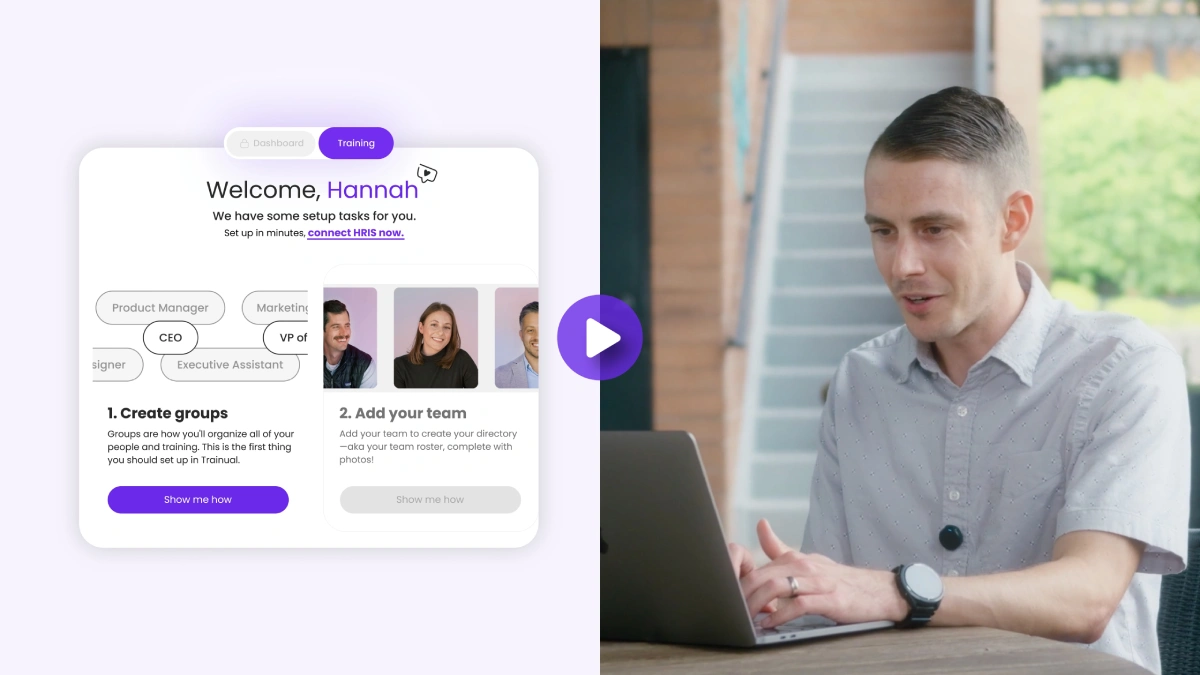
Trainual uses AI to speed up creating onboarding content, then does the part most AI tools leave out: it turns that content into structured, assignable training tied to roles, with a searchable knowledge base so new hires can find answers on their own. You draft with AI assistance right inside the documentation, and the result is trackable training, not an orphaned document. One verified reviewer put it plainly: the AI is excellent to work with while you build content. For SMB and mid-market ops and people leaders, that connection between creation and a usable system is the differentiator.
Best for: onboarding content that becomes trackable training.
The catch: for specialized AI video it isn't Synthesia, and for freeform doc drafting it isn't as open-ended as Notion.
2. TalentLMS
TalentLMS is the most-cited option for this use case, and it earns it: affordable, easy to use, with built-in AI that generates course content and structure quickly. For teams that want AI-assisted courses inside a straightforward LMS, it's a strong default.
Best for: AI-generated courses on a budget.
The catch: its AI centers on course generation more than connecting content to your documented processes. See Trainual vs. TalentLMS.
3. Notion
Notion pairs a flexible workspace with Notion AI, which drafts, summarizes, and reshapes documents fast. For teams that want AI help writing onboarding docs and wikis in a highly adaptable space, it's popular and capable.
Best for: AI-assisted flexible documentation.
The catch: it drafts documents but doesn't turn them into assigned, tracked training, so whether new hires complete and retain the content is left to discipline.
4. Absorb LMS
Absorb is an enterprise-leaning LMS with AI content tools and strong delivery and reporting. For larger teams that want AI to help build content inside a robust learning platform, it goes deep.
Best for: enterprise AI content and delivery.
The catch: its depth and price skew beyond what many SMBs need. See Trainual vs. Absorb LMS.
5. Synthesia
Synthesia turns text scripts into polished training videos with AI avatars and voiceover in many languages, removing the cost and time of filming. For teams that want onboarding video content at scale, it's the specialist.
Best for: AI training video.
The catch: it creates video assets, not the wider system that assigns, tracks, and organizes onboarding, so it pairs with a platform that does.
6. Scribe
Scribe watches you perform a process and auto-generates a step-by-step guide with annotated screenshots in seconds, which is ideal for documenting the how-to content onboarding depends on. For fast, visual capture of tasks, it's genuinely impressive.
Best for: auto-documenting how-to steps.
The catch: it captures a guide but doesn't manage role-based assignment, completion, or long-term upkeep. See Trainual vs. Scribe.
7. Coassemble
Coassemble offers AI-assisted course authoring with templates and interactive lessons, making it quick to spin up engaging onboarding content. For teams that prioritize fast, polished course creation, it's approachable.
Best for: fast AI course authoring.
The catch: it centers on course creation rather than a full system with role-based structure and tracking. See Trainual vs. Coassemble.
Which tool is best for your team
- Best overall for onboarding content that sticks: Trainual, because AI-created content becomes trackable training tied to roles, with a searchable knowledge base, explored in how to onboard a new hire in their first 30 days.
- Best for AI courses on a budget: TalentLMS.
- Best for flexible AI doc drafting: Notion.
- Best for enterprise AI content: Absorb.
- Best for AI video: Synthesia.
- Best for capturing how-to content: Scribe.
- Best alternative to a standalone LMS: Trainual, for teams that want content creation and the system it lives in together.
For deeper context, see the guides to AI-powered SOP creation and automation, the AI assistant for training and knowledge search, and employee onboarding and new-hire training software, plus the foundational guide to employee training software.
How to choose an AI onboarding content tool
Four questions narrow the field fast.
First, what content are you creating? Documents point to Notion, courses to TalentLMS, Absorb, or Coassemble, video to Synthesia, and step-by-step guides to Scribe. If it's all of the above plus training, a platform like Trainual covers more of it.
Second, does the content become training, or stay a document? AI that drafts fast still leaves a file. Tools that turn content into assigned, tracked training, and confirm people completed it, deliver more, as covered in how to use AI to answer your team's questions.
Third, can new hires find it later? Onboarding content is only useful if it's searchable when someone needs it. A searchable knowledge base beats content scattered across files.
Fourth, will it fit your team and budget? For SMB and mid-market teams, an enterprise tool nobody adopts creates nothing. Weigh ease of use and price against your size, a theme in training software for HR leaders and the guide to LMS onboarding automation.
Ready to see how Trainual works?
👉 Book a demo and see how Trainual uses AI to create onboarding content and turn it into trackable training your team can find.
Want a sneak peek?
👉 Read customer stories, including companies cutting onboarding time with Trainual.
Frequently asked questions
What's the best AI tool for creating employee training and onboarding content?
It depends on the content. TalentLMS is the most-cited option for AI-generated courses in an affordable LMS. Synthesia leads for AI video, and Scribe for auto-capturing step-by-step guides. Trainual is the strongest fit when you want AI to help create onboarding content that then becomes assignable, trackable training tied to roles, with a searchable knowledge base, so the content is used and found, not just drafted. Notion and Absorb are strong for AI-assisted docs and enterprise delivery respectively.
Can AI create employee onboarding content?
Yes. AI can draft SOPs and lessons, generate full courses, produce narrated video, and auto-capture how-to guides from a recorded workflow. The bigger question is what happens after: whether the AI-created content becomes organized, assignable, trackable training that new hires can search and complete, or stays a document someone has to chase down. The best tools handle both creation and the system the content lives in.
Does AI-generated training content still need review?
Yes. AI accelerates a first draft, but a person should verify accuracy, add company-specific detail, and confirm the content matches how the work is really done. AI is a speed multiplier for creation, not a replacement for the subject-matter knowledge that makes onboarding content correct. Treat AI output as a strong starting point to refine, not a finished product to publish blind.
What should I look for in an AI onboarding tool?
Look for fast, useful content creation; documentation that stays organized; a searchable knowledge base so new hires can self-serve; a way to turn content into assigned, tracked training; and a fit for your team size and budget. The highest-value tools connect AI content creation to a system that delivers and tracks it, so you can see that onboarding happened, not just that content exists.
Is a separate AI tool needed, or is it built into training platforms?
Both models exist. Specialist tools like Synthesia (video) or Scribe (capture) do one AI job extremely well. Platforms like Trainual, TalentLMS, and Absorb build AI into content creation inside the system that also delivers and tracks training. Many teams use a specialist for a specific asset and a platform for the core onboarding system, so the AI-created content ends up somewhere it can be assigned, tracked, and found.