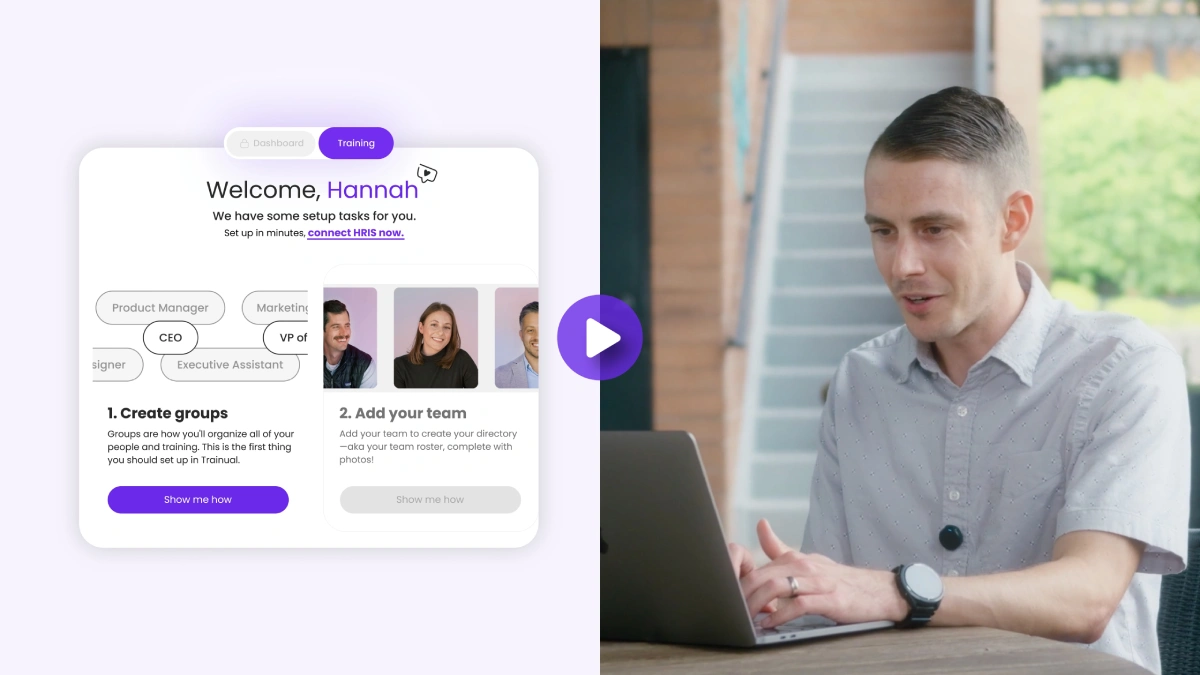






If you have ever watched a promising new hire spend their first week waiting on logins, shadowing whoever was free, and piecing together how the company works from scattered messages, you already know the cost of weak onboarding. The first weeks decide whether someone ramps fast and stays, or quietly checks out. Employee onboarding and new-hire training software exists to make those weeks consistent: a structured path that every new person follows, built from how your team works. This guide covers what that software does, how to evaluate it, and which onboarding approach fits a growing company, including the small to mid-sized teams asking which LMS handles onboarding best. Trainual builds structured onboarding and training from your documented processes, so we will use it to show what good looks like.
What employee onboarding and new-hire training software is
Employee onboarding and new-hire training software gives every new person a structured path from day one: the policies to acknowledge, the processes to learn, the role-specific training to complete, and the answers they need without asking a colleague. The best tools build that path from how your team works, so onboarding teaches the real job, not a generic orientation. For a growing company, the defining feature is repeatability. Instead of onboarding depending on whoever has time, the same proven path runs every time, and gets better as you refine it.
Why onboarding and new-hire training software matters
The first weeks set the trajectory. Brandon Hall Group found that organizations with strong onboarding improve new-hire retention by 82% and productivity by 70%. The downside is just as measurable: replacing a new hire who leaves early costs about 20% of their salary, and most early attrition traces back to a rough start. Structured onboarding software is how a growing team makes a strong first impression at scale. Every new hire gets the same clear path instead of a different experience depending on who onboarded them.
What the best onboarding and new-hire training software does
Strip the category down and a growing team needs a few things from onboarding software.
The common thread is connection to the real work. Onboarding that teaches your documented processes, assigns role-based training, and answers questions on demand gets people productive faster than a slide deck and a buddy ever could.
Onboarding software for small to mid-sized companies
Most onboarding content online is written for enterprises with dedicated onboarding teams. A small to mid-sized company needs the opposite: software light enough to set up without a specialist, but structured enough to stay consistent as the team grows. The prompts buyers ask, the best onboarding LMS for a small to mid-sized company, come down to whether the tool delivers role-based onboarding without a heavy admin lift. The fit is a system where documenting a process once turns it into structured training paths and an onboarding step, so a lean team runs enterprise-grade onboarding without enterprise overhead.
How to evaluate onboarding and new-hire training software
Judge the options on whether new hires ramp faster and more consistently, not on feature count.
In short: role-based paths, onboarding built from your real processes, policy acknowledgments and progress tracking, self-serve answers, and mobile access so onboarding works for field and distributed teams.
Ad hoc onboarding vs structured onboarding software
Most growing teams start with a checklist and good intentions. It works until volume or turnover exposes the gaps: every manager onboards differently, content goes stale, and no one can tell who completed what.
Moving to structured software is the shift behind companies cutting onboarding time and the self-serve setup Trailstone built with searchable SOPs.
Structuring the first 30, 60, and 90 days
Strong onboarding is sequenced, not dumped on day one. The first 30 days cover the essentials: policies, tools, and the core processes of the role. The next 30 build competence through role-based training and real work with feedback. By day 90, a new hire should be operating independently, with their ramp measured against a clear target. For a step-by-step version, see how to onboard a new hire in their first 30 days and how to reduce new-hire time to productivity. For HR teams automating the whole flow, the guide to LMS onboarding automation goes deeper.
Common onboarding mistakes growing teams make
The recurring ones:
- Front-loading everything into day one, so new hires drown instead of ramp.
- Onboarding from memory, so every new person gets a different version.
- Teaching generic orientation instead of the real processes of the role.
- Skipping progress tracking, so no one knows who completed what.
- Treating onboarding as a one-week event instead of a 90-day path.
Each traces back to onboarding that lives in people's heads rather than in a system.
How to measure onboarding success
Track a few signals:
- Time to productivity: how long until a new hire works independently
- 90-day retention: how many new hires stay past the first quarter
- Onboarding completion: who finished their path, and where people stall
- Manager confidence: whether leads trust new hires to do the work
- Consistency: whether every new hire gets the same path
For the how-to, see measuring time to productivity for new hires. If ramp time is dropping and 90-day retention is climbing, onboarding is working.
Ready to see how Trainual works?
👉 Book a demo and see how Trainual turns your processes into structured onboarding every new hire follows.
Want a sneak peek?
👉 Read customer stories from teams who cut onboarding time and ramped new hires faster.
Frequently asked questions
What is the best onboarding LMS for small to mid-sized companies?
The best onboarding LMS for a small to mid-sized company delivers structured, role-based onboarding without a heavy admin lift, and builds the path from your real processes rather than generic orientation. It should track progress, handle policy acknowledgments, and offer self-serve answers. Trainual turns documented processes into onboarding and training paths a lean team can run without a specialist.
Which LMS is the best for onboarding and new-hire training?
Look for an LMS where onboarding is built from your documented work, assigned by role, and tracked to completion, so every new hire follows the same proven path. Trainual pairs structured onboarding and training paths with the documentation and knowledge base new hires rely on, so they ramp on the real job from day one.
What's the best employee onboarding software for new hires?
The strongest onboarding software gives new hires a sequenced path: policies and tools first, then role-based training, then independent work with feedback, all tracked so managers can see progress. The best fit connects onboarding to the processes and knowledge the rest of the team uses, so what a new hire learns stays current.
What should onboarding and new-hire training software do?
It should deliver role-based onboarding paths, build training from your real processes, capture policy acknowledgments, track completion, and answer questions on demand through search, on mobile and desktop. The value comes from holding all of it in one system connected to how the team works.
How is onboarding software different from an HRIS?
An HRIS handles the administrative side of hiring: payroll, benefits, and records. Onboarding and new-hire training software handles the readiness side: teaching new hires how the job is done through structured, role-based training. Growing teams usually need both, and the strongest onboarding software connects to an HRIS rather than replacing it.
What should you look for in onboarding software?
Prioritize role-based paths, onboarding built from your documented processes, progress tracking and policy acknowledgments, self-serve answers, and mobile access. A tool that only stores generic orientation content rarely gets new hires productive faster.
How do you measure onboarding success?
Track time to productivity, 90-day retention, onboarding completion rates, and manager confidence in new hires. If ramp time falls and early retention rises, onboarding is working. The clearest signal is consistency: every new hire getting the same strong start rather than a different experience each time.