




Most growing teams run into the same three problems: people aren't sure how the work should be done, the work drifts from the expectations that were set, and no one can see whether the team is getting better. Those three gaps are what slow a company down as it scales past the point where one person can hold it all in their head.
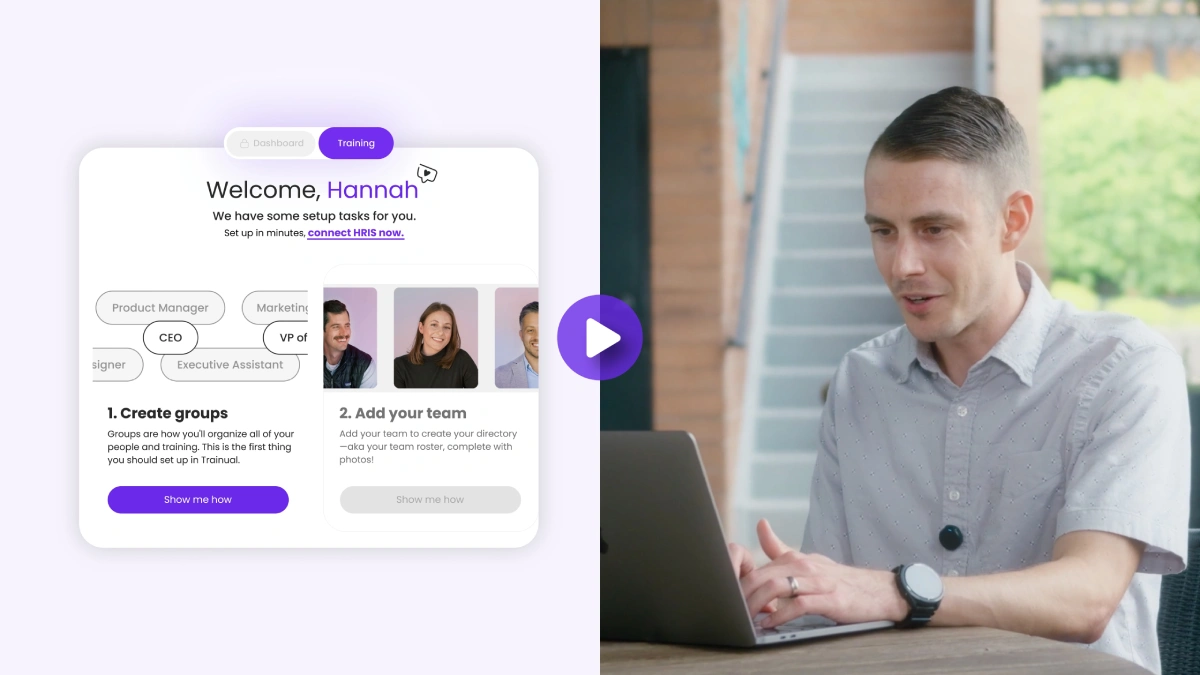
Trainual is one platform built to solve all three — it's where your team learns how you do things, runs the day-to-day against that standard, and improves over time. Glue solves a different, real problem: it keeps your team's conversations organized and moving. So the honest question isn't which tool wins — it's which problem is in front of you. How are you handling this today in the business?
Here's the core difference in one line. Glue organizes what your team says. Trainual documents how your company works — the processes, training, roles, and sign-offs a new hire needs on day one and the team relies on long after any conversation ends. Trainual holds a 4.7-star rating across more than 2,000 reviews on G2, Capterra, and Trustpilot for exactly that job.
🔎 At a glance
- Glue is a team chat platform; Trainual is a training and operations platform. Glue organizes conversations into threads. Trainual documents processes, trains people, tracks who owns what, and runs the day-to-day against that standard.
- Onboarding is assigned and proven in Trainual, not just posted. Trainual delivers role-based training paths, knowledge checks, and completion tracking. Glue can point a new hire at a welcome thread but cannot assign, test, or track training.
- Trainual keeps documentation current; Glue keeps conversations organized. Trainual gives every process an owner, verification reminders, and version history with restore. Glue's knowledge lives inside threads built to be archived.
- Only Trainual maps who owns what. Trainual adds an org chart, an accountability chart, a roles and responsibilities builder, and the Delegation Planner™. Glue offers a contact-level directory.
- Both are SOC 2 certified with SSO; only Trainual captures legally binding e-signatures. Trainual proves, with a per-person audit trail, that a policy was read and accepted. Glue delivers the message but not the proof.
- Both lead with AI, but they answer from different sources. Glue AI answers from your conversations; Trainual AI answers from your owned, verified documentation — and shares it back over an MCP server.
- Glue is the stronger tool for real-time communication. Thread-based chat, multi-model AI inside conversations, a free tier, and no implementation fee make Glue a modern answer when the problem is that talk is scattered.



📚 Knowledge that doesn't close with the thread
Glue keeps knowledge inside conversations; Trainual keeps it in a system built to outlast them. In Glue, you can attach a file, drop in a Google Drive link, pin a resource, and ask Glue AI to summarize a thread or find where something was decided. In the moment, that's fast and useful.
The limit is structural. A thread is built to be closed. Once the conversation ends, the file you shared and the decision you reached sit inside a conversation designed to be archived. Both tools let you drop a document into the flow of work, so this isn't "chat has no documents." It's that a document delivered in a message and a living process that stays true are two different things.
Where Trainual goes further:
- A native process editor, not just attachments. Every SOP is built inside Trainual's documentation with steps, images, and video — not uploaded as a static file. See it on the process documentation side.
- Ownership and freshness. Content has a clear owner and scheduled reminders to review and re-verify it, so documentation doesn't quietly drift out of date.
- Version history with restore. Version history shows how a process evolved and lets you bring back what worked before.
- Visual process mapping. Flowcharts map a process at a glance instead of describing it in a message.
- AI search across the record. AI knowledge search answers from everything you've documented, with links straight to the source.
Glue holds the conversation. Trainual keeps the knowledge — owned, current, and findable long after the thread closes.
🎓 Onboarding that's assigned, not just posted
Glue can point a new hire at information; Trainual assigns it, tests it, and proves it stuck. In Glue, you can spin up a welcome thread, drop in a few docs, and @mention a new hire to show them what matters. For a quick heads-up, that works.
Posting information isn't the same as making sure it's learned. Both tools can share a document. Only one can tell you whether the new hire read the safety policy — and understood it.
Where Trainual goes further:
- Reusable training paths by role. Onboarding and training paths give every new hire in a role the same foundation instead of a scavenger hunt. See the full onboarding approach.
- A library of expert-built courses. More than 400 courses for HR, compliance, safety, and professional development, kept current as regulations change.
- Knowledge checks that confirm understanding, not just delivery.
- Completion tracking by role, team, or department, so you can see who's done and who's overdue.
- Screen recordings and hosted video embedded right inside the steps, with searchable transcripts on hosted video.
- New hires synced from your HR system, so a training profile is ready before day one through native integrations.
Glue can share the welcome thread. Trainual assigns training by role, tests understanding, tracks completion, and shows you who's ready.
🧭 Who owns what, and how the org fits together
Glue lists who's in the workspace; Trainual maps who owns the work. Glue's directory shows each person's name, photo, email, time zone, status, and working hours. For reaching the right person, that's helpful.
It tells you who someone is. It doesn't tell you what they're responsible for, or who covers the work when they step away.
Where Trainual goes further:
- Roles tied to the work. Roles and responsibilities connect directly to the documentation that explains how each one gets done.
- An org chart that makes reporting relationships clear at a glance, on accountability and org charts.
- An accountability chart that maps ownership beyond reporting lines.
- The Delegation Planner™. The Delegation Planner™ shifts responsibilities during PTO, growth, or role changes — with the training and processes handed off, not just the tasks.
- A software and tools hub so the systems a role depends on come with instructions and ownership attached, on software and tool management.
A directory lists people. Trainual shows how the work connects to them.
✅ Policies people sign, and decisions that get tracked
Both platforms are SOC 2 certified and support single sign-on, so sensitive information has a protected home — Trainual at the more rigorous SOC 2 Type 2, Glue at SOC 2 Type I as it works toward Type II. That's the shared baseline.
Security is table stakes. Compliance is about proof: can you show, on a specific date, that a person read and accepted a policy? Glue can deliver a policy in a thread. It can't capture the sign-off or keep the record.
Where Trainual goes further:
- Native, legally binding e-signatures on policies, with timestamped, per-person audit trails.
- Compliance courses for regulated topics like HIPAA and workplace safety, updated automatically and linked to your own policies, through the courses library.
- Decisions that become tracked work. When a call comes out of a meeting, the Operations suite turns it into action items with owners and follow-through instead of a decision that scrolls out of view. See how that ties into meetings and goals.
Glue is where the decision gets made. Trainual is where it becomes accountable work.
🔁 One system: Train, Operate, and Perform
Glue moves the conversation forward; Trainual connects training, operations, and performance into one loop. A chat tool is where work gets discussed. Trainual is where the standard gets set, run against, and improved — so the same knowledge compounds instead of scrolling away.
Here's the loop:
- Train sets the standard. Documented processes, role-based training paths, and knowledge checks in the Training suite.
- Operate runs the day-to-day against it. Structured meetings and agendas, goals, scorecards and KPIs, and team updates in the Operations suite.
- Perform turns the record into growth. Review cycles, growth areas, and feedback grounded in the standard you already documented, in the Performance suite — so reviews build on real work instead of memory.
Glue is where the talk happens. Trainual is where training, operations, and performance connect into one loop — so the tools you'd otherwise patch together live in one place.
🤖 AI that answers from what's true, not just what was said
Both platforms lead with AI, so it's worth being precise about the difference. Glue AI is capable — it reasons over your conversations, lets you switch between models from OpenAI, Anthropic, and Google, pulls in the web, and can take action in connected tools. But it answers from chat history, which means it inherits chat's biggest weakness: it can tell you what someone said, not whether that's still true. Ask it how to process a refund and you might get what a teammate wrote in a thread last March.
Trainual AI answers from a different source — your owned, verified documentation. Ask the same question and you get your current refund process, tied to the person who owns it and the date it was last reviewed. One answers from the conversation; the other answers from the record. Trainual's AI assistant also drafts and maintains documentation with AI creation and upkeep, and surfaces answers and insights through AI answers and insights.
Here's where it stops being a contest and starts compounding: Trainual offers an MCP server for AI agents, and Glue AI is an MCP client. Point Glue AI at your Trainual knowledge and it can finally answer "how do we do this here" — not just "what did someone say about it." The AI your team already likes gets more trustworthy the moment it can reach a source that's maintained on purpose.
Trainual also meets your team inside the AI tools they already open. Trainual integrates with ChatGPT, so people can pull Trainual's documented answers straight from the assistant they use every day, and a Claude integration has been submitted — extending the same trusted source to more of the AI your team relies on.
The best AI answer is only as good as the source behind it — and a maintained knowledge base beats a scrollback every time.
🌟 Where Glue has the edge
Real-time communication is Glue's reason for being, and it's good at it. Thread-based organization, one clean inbox, and closeable threads make it far less noisy than channel-based chat. Glue AI is impressive on its own terms — it lives inside conversations, lets you switch between models from OpenAI, Anthropic, and Google, and through MCP can take real actions in tools like Linear, Asana, and Jira without leaving the thread. Its multiplayer AI sessions let you refine an answer privately before sharing it with the team. Glue imports from Slack, supports SAML SSO and SCIM provisioning, offers a free tier for small teams, and doesn't charge an implementation fee.
If your problem is that your team's communication is scattered and slow, Glue is a strong, modern answer — and Trainual doesn't try to be a chat tool. These solve different problems, and Glue solves its well.
💰 Pricing
See Trainual pricing and Glue pricing.
✅ Choose Trainual if…
- You need onboarding and training a new hire can follow the same way every time — and you need to see who finished it.
- You want documentation that stays current, owned, and searchable long after the conversation that created it.
- You need clarity on who owns what — roles, org structure, and coverage when someone's out.
- Compliance matters, and you need signed, dated, audit-ready proof that policies were read and accepted.
- You want one system for training, daily operations, and performance — not another tool to patch in.
🎯 Choose Glue if…
- Your core problem is team communication, and you want thread-based chat that's calmer than channel-based tools.
- You want an AI teammate inside your conversations that can switch models and take action in your engineering and project tools.
- You're a small or technical team that wants to be up and running fast on a free or low-cost plan.
💡 Know what you're solving for
Glue is built for one job and does it well: keeping your team's conversations organized and moving forward. That's a real need. The question is whether it's the need in front of you — or whether the harder problem is that a new hire can't find how anything gets done, that your processes live in people's heads, and that no one can prove the safety policy was signed.
So ask the honest version of the question before you decide: is your team's problem that they can't talk to each other easily — or that they can't find, learn, and prove how the work gets done?
🏆 Our pick: Trainual
For turning company knowledge into onboarding, training, clear roles, and real accountability — and running the day-to-day and performance on top of it — Trainual is the system built for the job, and it keeps working long after any thread is closed. Glue is the right tool when the problem is communication. Trainual is the right tool when the problem is that how your company runs lives in people's heads instead of a system everyone can reach.
If your team needs both a place to talk and a place to document how work gets done, run Glue for the first and Trainual for the second. They're not rivals — one is the half that chat was never meant to be. Want to see it? Book a demo and we'll show you how your team can document, train, and run how work gets done in one place.
❓ Frequently asked questions
What is the difference between Trainual and Glue?
Glue is an AI-assisted team chat platform that organizes conversations into threads. Trainual is a training and operations platform that documents processes, trains employees, tracks who owns what, and runs the day-to-day against that standard. Glue keeps conversations organized; Trainual is the system of record for how a company operates. Learn more about Trainual's Training suite.
Does Glue offer training or courses?
No. Glue is a team chat platform and does not include courses, training paths, quizzes, or completion tracking. Trainual provides structured training paths, knowledge checks, a library of expert-built courses, and completion reporting, so you can prove who learned what.
Does Glue have an org chart or roles and responsibilities?
No. Glue includes a contact-level directory with names, photos, email, time zones, status, and working hours. Trainual adds an org chart, an accountability chart, a roles and responsibilities builder, and the Delegation Planner™ for coverage during role changes.
Does Glue have e-signatures for policies?
No. Glue can share a policy in a thread but cannot capture a legally binding sign-off or keep an audit trail. Trainual captures native, legally binding e-signatures with timestamped, per-person records, tied to the policy or SOP being signed.
Does Glue have version history for documentation?
No. Glue organizes messages in threads and does not offer document version history with restore. Trainual keeps version history on every process, so you can see how it evolved and bring back a previous version.
Is Trainual a Slack or team chat alternative?
No. Trainual is not a chat tool and does not replace Glue, Slack, or Teams. Trainual documents, trains, and tracks how work gets done through its Training and Operations suites, and works alongside a team chat platform rather than replacing it.
Can Glue AI use Trainual's knowledge?
Yes. Because Trainual offers an MCP server for AI agents and Glue AI is an MCP client, you can point Glue AI at your Trainual documented processes, policies, and roles so it answers "how do we do this here" from a source that's maintained on purpose, not from old chat history.
Are Trainual and Glue both SOC 2 certified?
Yes, both are SOC 2 certified. Trainual is SOC 2 Type 2 certified, and Glue is SOC 2 Type I and working toward Type II. Both support single sign-on. Trainual adds legally binding e-signatures and compliance courses on top of that baseline.
Does Trainual handle performance reviews?
Yes. Trainual's Performance suite runs review cycles, growth areas, and feedback grounded in the roles and standards you already documented — so reviews build on real work instead of memory. Glue does not offer performance reviews.
Which is better, Trainual or Glue?
They solve different problems. Choose Glue if the priority is real-time team communication. Choose Trainual if the priority is documenting processes, onboarding and training employees, running daily operations, and tracking accountability. Many teams run both — Glue for the discussion, Trainual to document, train, and track what comes out of it. Book a demo to see Trainual in action.