




About this episode
“Do you run your business, or does your business run you?”
Part 2 picks up where the gold standard brainstorm left off and goes back to where Trainual’s DNA came from: Organized Chaos, the consulting business Chris ran before Trainual, which brought in several million dollars in revenue. Chris lays out the method he used with every client, context, chaos, and clarity, and explains why some clients’ businesses took off afterward while others filed the report away and changed nothing.
The second half turns to the building blocks. The hosts walk through the four Ps from Chris’s book The Business Playbook, profile, people, policies, and process, plus a fifth, performance, that reflects where Trainual has taken its product over the last year. Along the way, they get into whether you run your business or it runs you, why every company swings between chaos and structure, and whether Jonathan is a tumbleweed or, in his words, the wind.
Key Takeaways
- Do you run your business, or does it run you? Chris frames it as reactive versus proactive. Either you wake up and get dragged from one fire to the next, or you can decide what you’ll do today to move the business forward. He says it’s less about the founder and more about the environment they’ve built: the people around them, the structure in place, and a profitable core that funds that structure. Founders also need their opposite. A highly structured founder needs a few “tumbleweeds” to take the risks that growth requires, and a free-wheeling founder needs structure around them to scale.
- Two signals it’s time to break things down, and they keep coming back. The first is a ceiling. Common with organized leaders, everything seems efficient and everyone is working hard, but the business can’t break through. The second is a company succeeding despite itself. It struck a nerve in the market, so it throws money at problems that never get fixed while the wheels start coming off. Sasha asks whether a chaotic business could simply scale forever. Chris points to Uber as the extreme example, but says most companies move through alternating chapters of chaos and creation, then structure and stability. Stay in either one too long, the hosts add, and the business stalls or stagnates.
- The Organized Chaos method: context, chaos, clarity. Context came first: a half day or full day with the owner or leadership team, covering their personal aspirations, the company’s history and milestones, the business model, the problems they already knew about, and what success would look like in one, three, and five years. Chaos came next, organized as the three I’s: ideas, issues, and inefficiencies, collected through interviews and surveys. Chris compares it to cleaning out a garage, where you pull everything out to see what you have. Clarity was the action plan: what to throw away, what to buy, and what to act on.
- Chaos is opportunity. Indecision is the real problem. Sasha admits that as a type A operator, she always heard “chaos” as a negative. Chris reframes it. A new business where no email comes in and the phone never rings isn’t chaotic, but it isn’t good either. Orders flying in is chaos, and it’s great chaos. Ideas, complaints, and inefficiencies are signs people want the business to be better. What paralyzes operators is not knowing what to do first, and making decisions creates momentum people want to follow. On when to gather it all, Chris uses a medical analogy. A business in crisis, with leaders turning over or people quitting, needs an ER-style response. A healthy one can stay in maintenance mode with regular feedback surveys, like an annual physical.
- A plan only works if someone has the capacity to execute it. The clients who succeeded either had the capability and discipline in-house, or the self-awareness to bring in help. Some reported revenue growing 500% over the following years. That gap is why Chris eventually hired a team to implement his recommendations. The clients who failed read the report, found it interesting, and did nothing. The hosts tie that lesson directly to why Trainual now offers its Operational Excellence Program.
- Profile: your company’s dating profile. This covers the mission, vision, values, principles, company story, what you sell, who you serve, and what makes you different. The goal is for every employee to feel like they were there from day one. Sasha says the payoff is a shared language across departments, and it’s a big reason Trainual’s team shows up for each other. The same content also goes to candidates, so people can opt out of a culture that isn’t right for them before they join.
- People: shortcut the months it takes to know your coworkers. This means a bio for every person, the org chart, roles and responsibilities, teams, growth plans, and work-style profiles like Kolbe or DISC. Chris points out that feeling comfortable at a new job depends on knowing who your coworkers are and who to go to with a problem. Sasha adds that it’s easy for leaders to forget how scary it is to join a new company. Documenting the people side speeds up real relationships and spares new hires from spending a week afraid to ask a question.
- Policies set boundaries, not red tape. Chris sees policies from the employee’s side. They aren’t only legal requirements. They’re the decisions you get to make about how things work, like whether hats and hoodies are fine, whether it’s OK to text someone on a Saturday, or how people can post about the company. If you don’t write those decisions down, people find out when they break them, and that turns into performance issues. Sasha pairs each formal policy with a plain-language TL;DR, sometimes with pictures or a quote from a leader. Jonathan adds that benefits and perks tied to tenure or role belong here too. Sasha’s caution is to keep the summary approachable while making the policy itself thorough enough to handle edge cases.
- Process comes last because it’s granular, and it pays off fastest. The first three Ps apply to everyone. Process applies to specific roles and responsibilities, and not everything is worth documenting. Chris says to think consistency, repeatability, predictability, and scalability. Most customer or employee problems trace back to a missing process, whether that’s how feedback gets collected or the recipe for a dish that comes out different every time. Sasha calls process the P with the most immediate return, since a whole team can be using the same talk track within a day. Chris adds that simply defining a process is level one. Building an engaging training experience around it is a level two problem.
- Performance, the fifth P, keeps the business moving forward. At the company level, it’s KPIs, goals, and the rhythms that hold them accountable. At the individual level, it’s reviews, recognition, engagement, and skill development. When people ask Chris how they’ll know someone actually follows their training, his answer is to be a good manager. Meetings, goals, KPIs, and check-ins feed coaching and reviews, and that’s how a business improves every week. Standards come first, then progress. His closing caveat is that no framework replaces experience, intuition, and innovation, which led the hosts to joke about adding “personality” as a sixth P.
Chapter Markers
[0:00] Cold open: a midweek holiday and Nobody Wants This
[2:36] A Goofy Movie parody, recorded in a morning
[3:58] Part 2 and the Organized Chaos origin story
[5:44] Organized Chaos vs. the gold standard
[7:35] Do you run your business, or does it run you?
[9:41] Type A founders vs. tumbleweeds
[13:01] Two moments that signal it’s time to rebuild
[14:59] Can a chaotic business scale forever?
[15:45] Chapters of chaos and structure
[19:16] The three Cs
[19:45] Context
[20:35] Chaos: ideas, issues, and inefficiencies
[21:55] Clarity
[22:20] There’s such a thing as good chaos
[23:15] Chaos is opportunity
[24:34] When to listen to every idea
[25:00] Emergency mode vs. maintenance mode
[26:07] Why some clients succeeded and others didn’t
[28:10] From consulting to the Operational Excellence Program
[29:08] The four Ps, and a fifth
[29:27] Profile: your company’s dating profile
[33:00] People
[35:46] Policies
[38:50] Making policies readable
[41:32] Process
[45:23] Documenting before training
[46:29] Performance, the fifth P
[49:22] No substitute for intuition and innovation
[51:36] Find your company’s operational personality
[52:32] This week in Trainual
Resources
Find out your company’s operational personality with the free Trainual assessment.
Have a topic you’d like covered? Connect with the hosts on LinkedIn — Chris, Jonathan, and Sasha — or email chris@trainual.com.
Want more resources from this episode? We’ve got an episode recap, replay, and every template, process, and resource we covered right here: Organize Chaos
Trainual
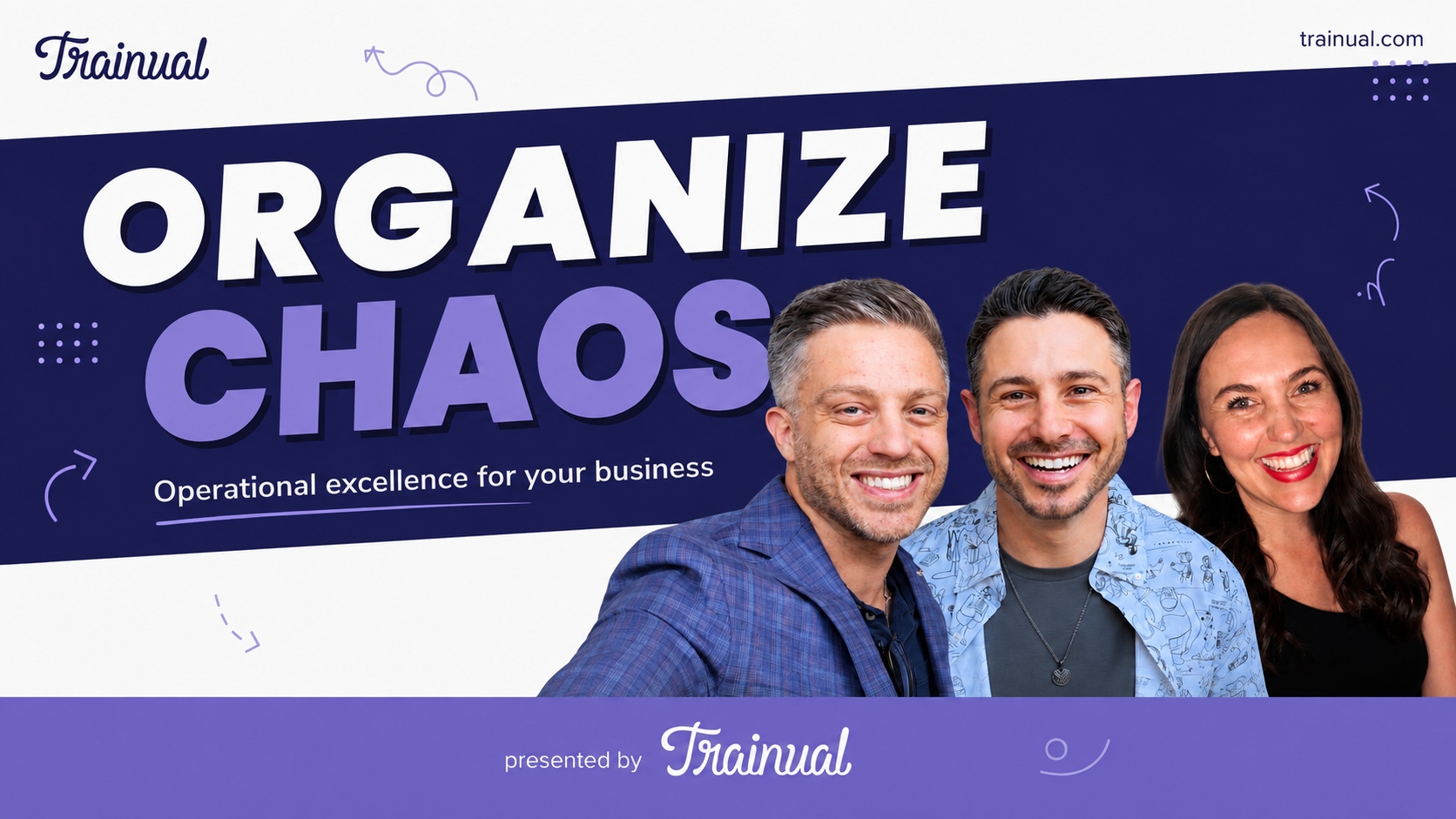
Organize Chaos is where founders and leaders learn how to build businesses that scale. Hosted by Chris Ronzio, Jonathan Ronzio, and Sasha Robinson, each episode explores the systems, leadership, operations, performance, and AI strategies behind high-performing organizations. Through candid conversations, practical frameworks, and real-world experience, they help you replace chaos with clarity — so your business can grow with confidence.
This is one of a few podcasts from Trainual, a software platform that helps businesses build playbooks to train and grow their team. You can check out the rest of our shows here: Podcasts