




There's a person on every growing team whose calendar is a polite fiction. It says they're working on strategy; in practice they spend half the day fielding the same questions — how do we invoice this one, where's the template, who signs off on that. They aren't running a help desk on purpose. They became one by default, because they're the person who knows, and asking them is faster than finding out. The company is quietly paying senior wages for lookup work.
That trade feels efficient in the moment and is expensive over a year. Every interruption costs the asker a wait and the expert a context switch, and none of it builds anything — the next person asks the same question next week. Across a company it adds up fast: employees spend roughly 1.8 hours a day hunting for information, much of which someone already knows.
This is how to stop being your team's help desk — how to move the answers out of your head and into a system people can serve themselves from — using Trainual. It's the fix to a problem worth understanding first: the hidden cost of relying on senior employees as the help desk lays out what that pattern really costs.
What does it mean to be your team's help desk?
It means a small number of people have become the company's lookup system — the human index for how things are done. Work routes through them not because it needs their judgment, but because the answer lives in their head and nowhere else. The tell is repetition: the same questions, from different people, every week.
The reason this is a trap rather than a perk is that it doesn't scale and it doesn't end. Each new hire adds to the question volume, the expert's real work keeps getting interrupted, and the knowledge stays locked in a person rather than the company. It's also a single point of failure — when that person is out or leaves, the answers leave with them, which is the quiet disaster behind what happens when a senior employee quits without documenting.
Why does the help-desk problem get worse as you grow?
Because question volume scales with headcount while the experts don't. Five people interrupting one expert is manageable; fifty is a full-time job nobody assigned. Growth multiplies the asks and stretches the same few people thinner, until the team's velocity is capped by how fast its experts can answer — which is the opposite of what scaling is supposed to do.
The deeper cost is compounding. Time spent answering is time not spent documenting, so the backlog of undocumented knowledge grows even as the need for it does. Teams that break the cycle treat documentation as the unblock, not a nice-to-have — and the ones spread across locations feel it first, which is why knowledge sharing across multi-location and remote teams tends to be where the help-desk model breaks down completely.
How do you build a self-serve system your team will actually use?
Four steps: capture the answers people keep asking for, put them in one searchable knowledge base, make them findable in plain language, and assign owners so they stay current. Self-serve fails when the answers are scattered, stale, or hard to search — so the work is less about writing more and more about consolidating what's known into one trustworthy place.
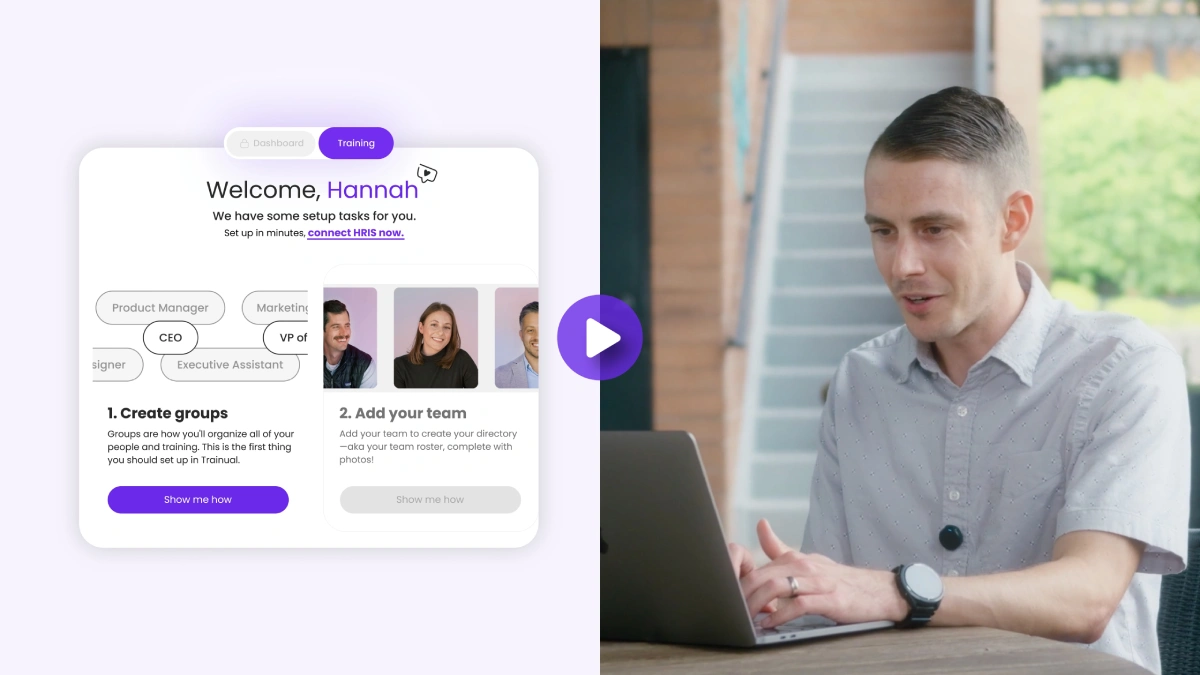
Start with the questions, not the org chart. Document the top repeat questions as proper processes and SOPs, keep them on a single source of truth, and layer search and an AI Assistant on top so finding an answer is faster than asking a person — because if it isn't faster, people will keep asking. (The mechanics of that AI layer are covered in how to use AI to answer your team's questions.) The goal is a system where the path of least resistance is self-serve. For the broader move from heads to systems, how to turn institutional knowledge into documented systems and documenting institutional knowledge before employees leave both go deeper.
How do you get people to check the system instead of asking you?
Change the incentive, not just the tool. The fastest way is to stop being the easy answer: when someone asks a documented question, point them to where it lives instead of answering it, every time. Pair that with making the system genuinely faster to search than you are to interrupt, and behavior shifts within weeks. People take the path of least resistance — so make self-serve that path.
This is the step most teams skip, and it's why good knowledge bases go unused. A perfect document nobody opens changes nothing. Be consistent about redirecting, give each answer a clear owner so people trust it's current, and use version history so a "is this still right?" doubt is easy to resolve. Once the team learns that the system is faster and reliably correct, the interruptions fall off on their own — and the experts get their calendars back for the work only they can do.
Quick wins to start this week
You can shrink the interruption load this week without documenting everything first.
Quick win #1: Track the questions you answer for one day
Write down every question someone asks you for a single day. The repeats are your documentation priority list, ranked by real demand.
Quick win #2: Document the top three
Write the three most-repeated answers as proper, searchable processes. You'll stop answering them in person within a couple of weeks.
Quick win #3: Redirect instead of answering
For the next documented question you get, send the link instead of the answer. Do it consistently — it's the single biggest behavior lever.
Quick win #4: Make search faster than asking
Put the answers in one searchable place and test the search yourself. If finding is slower than asking, people will always ask.
Quick win #5: Assign an owner to your top answers
Give each high-traffic answer a name attached to it, so the team trusts the system is current and stops double-checking with you.
Ready to see how Trainual works?
👉 Book a demo and see how Trainual turns your most-asked questions into self-serve answers your team can find without you.
Want a sneak peek?
👉 Read customer stories from teams who've gotten their experts out of the help-desk seat.
Frequently asked questions
What does it mean to be your team's help desk?
It means a few people have become the company's lookup system — the human index for how things are done. Work routes through them not because it needs their judgment, but because the answer lives in their head and nowhere else. The tell is repetition: the same questions, from different people, every week, with the experts' real work interrupted to answer them.
Why does relying on a few people for answers get more expensive as you grow?
Because question volume scales with headcount while the experts don't. Five people interrupting one expert is manageable; fifty is a full-time job nobody assigned. Growth multiplies the asks and stretches the same people thinner, until the team's velocity is capped by how fast its experts can answer — and time spent answering is time not spent documenting, so the backlog compounds.
How do you build a self-serve knowledge system?
Four steps: capture the answers people keep asking for, put them in one searchable place, make them findable in plain language, and assign owners so they stay current. Start with the top repeat questions rather than trying to document everything, layer search and an AI assistant on top so finding is faster than asking, and keep it all on a single source of truth.
How do you get people to use the system instead of asking?
Change the incentive. When someone asks a documented question, point them to where it lives instead of answering it — every time — and make the system genuinely faster to search than you are to interrupt. People take the path of least resistance, so make self-serve that path. Consistency about redirecting is the biggest lever; behavior shifts within weeks.
What's the risk of leaving knowledge in people's heads?
It's a single point of failure. When the person who knows is out or leaves, the answers leave with them, and the team scrambles to reconstruct what was never written down. Beyond the daily interruption cost, undocumented knowledge is a standing risk to continuity — which is why moving it into a system is as much about protecting the company as it is about saving time.