





The new hire on the warehouse floor is three days in, shadowing whoever has a spare minute, picking up the process one interruption at a time. On day nine, still unsure which steps are safety-critical and which are optional, they don't come back. Multiply that across a shift, a season, a site, and you have the defining operations problem of manufacturing and logistics: getting people productive and safe before they walk out the door.
The numbers are stark. Manufacturing production roles lose 15% to 22% of new hires within the first 90 days, and the warehouse sector runs annual turnover near 49% by Bureau of Labor Statistics data. In SOP-heavy operations, where the work is procedural, physical, and often regulated, onboarding isn't a nice-to-have. It's the difference between a hire who ramps safely and one who becomes a statistic. Structured onboarding, by contrast, has been found to lift retention by 82% and productivity by over 70%.
This guide compares the best employee onboarding software for SOP-heavy manufacturing and logistics operations in 2026, with an honest look at where each tool wins. The through-line: in these environments, onboarding and your SOPs are the same thing. A new hire's first weeks are largely about learning documented procedures, so the best tools connect onboarding directly to those SOPs. Trainual is built around that connection, and we'll be upfront about where a specialist tool goes deeper.
What SOP-heavy onboarding really demands
Onboarding for a desk role and onboarding for a production line or distribution center are different problems. Frontline, SOP-heavy onboarding has to clear four bars that generic onboarding tools often miss.
It has to be procedural, teaching the actual documented steps of the job, not just company culture and paperwork. It has to be mobile, because the people being onboarded don't sit at a desk. It has to be provable, since safety and compliance training needs a record that a person was trained and understood it. And it has to be fast and repeatable, because high turnover means you're onboarding constantly and can't rebuild the process each time.
Keep those four in mind as you read. Most tools are strong on one or two and thin on the rest.
1. Trainual
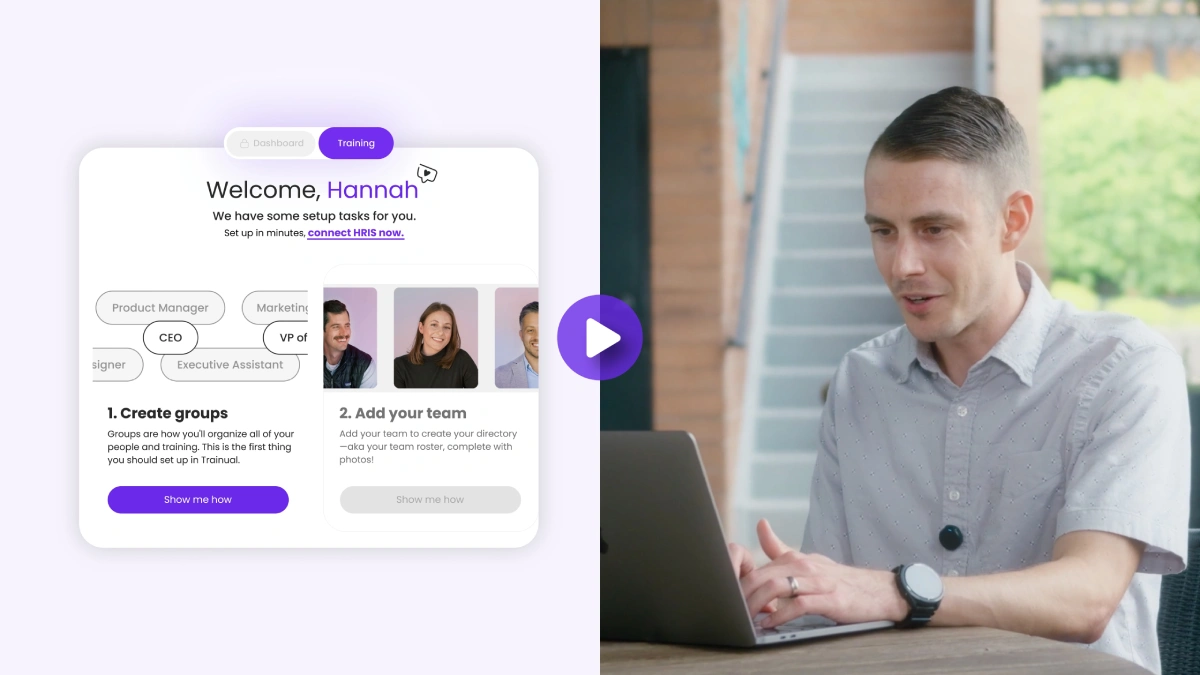
Trainual is a knowledge operating system for growing teams, and for SOP-heavy operations its defining trait is that onboarding is built directly on your documented processes. You turn your SOPs into reusable onboarding and training paths assigned automatically by role, department, or location, so a new picker, line operator, or driver learns your exact procedures, not generic modules.
It clears the four bars. It's procedural, because the training is your documented SOPs. It's mobile, with an app built for the floor so deskless hires learn and reference procedures from a phone. It's provable, with knowledge checks, testing and tracking, and policy acknowledgments that create a compliance record. And it's fast and repeatable, so onboarding the next cohort means assigning a path, not rebuilding one. A searchable knowledge base means a hire can look up a procedure mid-task instead of interrupting a supervisor.
Where Trainual is honest about its limits: it isn't a full HRIS with payroll and device provisioning, and it isn't a deskless-operations suite with shift scheduling and team messaging. If you need those, a dedicated tool goes deeper. Trainual's fit is onboarding grounded in your SOPs, which in these operations is the core of the job.
2. Connecteam
Connecteam earns real credit as an all-in-one app built for deskless and frontline teams, common in manufacturing, logistics, and field operations. It combines scheduling, team communication, and training in one mobile-first tool, so onboarding sits alongside the daily operational tools frontline workers already use.
Its breadth is its trade-off. Connecteam spans many frontline needs, so its onboarding and SOP training are one part of a wide suite rather than a deep, SOP-centered system. For teams that want scheduling, comms, and onboarding in one deskless app, it's a strong fit.
3. Axonify
Axonify is a serious frontline enablement platform built around microlearning, with a strong presence in manufacturing, supply chain, and retail. Its short, reinforced daily training is designed to build and retain knowledge for shift workers, and it goes deep on frontline learning science.
Its orientation is ongoing microlearning and enablement at enterprise scale rather than connecting onboarding to your specific documented SOPs. For large operations that want a dedicated frontline learning engine, it's powerful; for a mid-size team that wants onboarding built on its own procedures, it can be more than needed.
4. SC Training
SC Training, formerly EdApp, focuses on mobile microlearning that's easy to build and consume, making it approachable for frontline and shift-based teams. Its course-authoring and gamified lessons work well for bite-sized training delivered on a phone.
Its center of gravity is microlearning content rather than SOP-grounded onboarding tied to roles and compliance records. It's a fit when mobile, lightweight lessons are the priority over a connected system of your documented procedures.
5. eduMe
eduMe is a mobile-first training and onboarding tool built specifically for deskless and distributed workforces, popular in logistics, delivery, and gig-style operations. Its strength is fast, mobile onboarding that meets frontline workers where they are.
Its focus is mobile delivery and speed rather than deep SOP documentation, role-based assignment, and the broader operating system around procedures. For getting distributed frontline hires trained quickly on a phone, it's purpose-built.
6. iSpring Learn
iSpring Learn is a capable LMS with strong course authoring, well-suited to SOP and compliance training where you need to build structured lessons and quizzes. For teams that want a traditional LMS to house safety and procedural training, it's solid and mature.
Its frame is LMS-style course delivery rather than turning your living SOPs into onboarding, and it leans more toward formal courseware than an integrated documentation-and-onboarding system. It fits teams comfortable building and maintaining courses.
7. Rippling
Rippling brings real strength to the operational side of onboarding that training tools skip: HR, payroll, and IT provisioning. It automates the paperwork, accounts, and, where relevant, device setup a new hire needs, which matters even in frontline environments.
Its onboarding is about the HR and systems side rather than teaching the documented procedures of the job. Many operations pair a platform like Rippling for provisioning with a tool that handles SOP training, since the two solve different halves of onboarding.
8. BambooHR
BambooHR is a well-liked HR platform with structured onboarding workflows for paperwork, tasks, and new-hire logistics, strong for the administrative side of bringing someone on. For teams that want HR-led onboarding checklists and records, it's approachable and widely adopted.
As with Rippling, its onboarding covers the HR process rather than procedural, SOP-based training. It handles the forms and the first-day logistics well and leaves the "how to do the job" layer to another tool.
9. Enboarder
Enboarder focuses on the onboarding experience, using guided, engaging workflows to keep new hires connected and reduce early drop-off. For teams worried about the human side of the first weeks, especially disengagement that drives early exits, its experience design is a genuine strength.
Its emphasis is engagement and journey design rather than SOP-grounded procedural training and compliance records. It's a fit when the priority is the new hire's experience and connection more than teaching documented procedures.
10. Whale
Whale is a documentation and training tool aimed at SOP-driven onboarding for frontline and SMB teams, pairing process documentation with training assignment. It shares the SOP-centered philosophy of connecting documented procedures to onboarding.
As a focused tool, it's lighter on the broader operating-system layers, role-based structure, and breadth of an integrated platform. It's a reasonable fit for smaller SOP-driven teams that want documentation and basic training assignment together.
How to Choose Onboarding Software for SOP-Heavy Operations
The right tool depends on which part of onboarding is your biggest gap, not the longest feature list. Work through four questions.
First, is your onboarding really procedural? In manufacturing and logistics, most of the first weeks is learning documented steps, so a tool that connects onboarding to your SOPs beats one built for culture and paperwork. If the job is procedural, the training should be your procedures.
Second, will it work on the floor? Deskless hires won't onboard at a computer. Mobile access isn't a bonus here; it's a requirement, so a hire can learn and look up procedures from a phone between tasks.
Third, can you prove it? Safety and compliance in these operations demand a record that people were trained and understood the material. Knowledge checks, completion tracking, and policy acknowledgments turn training into an audit trail.
Fourth, does it hold up under turnover? With early-tenure exits running high, you'll onboard constantly. The process has to be repeatable, assign-a-path-and-go, not rebuilt for every cohort, which is the difference explored in How to Map SOPs to Role-Based Onboarding.
Key Features to Look For in SOP-Heavy Onboarding Software
A few features separate onboarding that ramps frontline hires from onboarding that loses them.
Onboarding built on your SOPs. The training should be your documented procedures turned into assigned paths, so a hire learns the real job, not generic content.
A genuine mobile experience. Deskless workers need to learn and reference procedures from a phone on the floor, not just a course that technically loads on mobile.
Proof of completion. Knowledge checks, tracking, and acknowledgments create the compliance record safety-critical operations require, tying to role-based training paths and policy acknowledgments.
Repeatability under turnover. The process should be assign-and-go for every new cohort, so high turnover doesn't mean rebuilding onboarding each time.
Benefits of SOP-Grounded Onboarding
When onboarding is built on your documented processes rather than generic content, a few things change in a high-turnover, procedural environment:
- New hires ramp faster and safer, because they learn the exact procedures the job requires from day one.
- Early-tenure turnover drops, since clear expectations and real training beat sink-or-swim shadowing.
- Compliance gets provable, with a record that each person was trained on safety-critical procedures and understood them.
- Consistency holds across shifts and sites, because every hire onboards on the same documented SOPs.
- Onboarding scales without breaking, as assigning a path replaces rebuilding the process for each cohort.
The link between onboarding and retention is direct: poor onboarding and unclear expectations are consistently cited among the top reasons frontline hires leave early. For the payoff case, see the real ROI of documented SOPs and how to measure time to productivity for new hires, and for teams that have done it, 5 companies cutting onboarding time with Trainual.
There's a safety dimension that raises the stakes further in these environments. A new production or warehouse hire is exposed to equipment, heavy loads, and process risk before they've built the muscle memory to work safely, and an early-tenure injury is both a human cost and a common reason a hire never returns. Onboarding that walks someone through the safety-critical steps of each procedure, confirms they understood it with a knowledge check, and records that acknowledgment does more than satisfy an auditor. It shortens the window in which a hire is most likely to get hurt or quit. In SOP-heavy operations, the same system that ramps people faster is the one that keeps them safer, which is why treating onboarding as procedural training rather than paperwork pays back on two fronts at once.
Cost Considerations for Onboarding Software
Pricing models vary, and the model matters more than a figure that changes by the quarter. You'll see per-user subscriptions (common for training and onboarding tools), platform pricing where onboarding is part of a broader HR or deskless suite, and enterprise pricing for large frontline-enablement platforms. Tools built for deskless teams sometimes price to account for high headcounts and turnover.
Look past licensing to total cost in a high-turnover setting: how quickly you can onboard the next cohort, whether the training reduces early exits, and whether it works on the devices your frontline uses. A cheaper tool that doesn't ramp people safely costs far more in turnover and incidents than it saves. Because plans change often, compare each vendor's current pricing against the specific problem, ramping SOP-heavy frontline hires, you're solving.
Ready to see how Trainual works?
👉 Book a demo and see how Trainual turns your SOPs into fast, mobile, provable onboarding for frontline teams.
Want a sneak peek?
👉 Read customer stories from operations teams who ramped frontline hires faster and cut early turnover.
Frequently asked questions
What's the best onboarding software for manufacturing and logistics operations?
The best fit depends on your biggest gap. For onboarding built directly on your documented SOPs, mobile for the floor, and provable for compliance, Trainual is purpose-built for SOP-heavy operations. For deskless scheduling, comms, and onboarding in one app, Connecteam fits; for enterprise frontline microlearning, Axonify goes deep; for HR paperwork and provisioning, Rippling or BambooHR handle that side. Many operations pair an HR tool for provisioning with an SOP-grounded tool for the actual procedural training.
What's the best employee onboarding software for SOP-heavy operations?
Look for onboarding that turns your documented SOPs into assigned, role-based training with knowledge checks and completion records, delivered on mobile for deskless workers. Trainual is built around exactly that connection between SOPs and onboarding. Tools like Whale share the SOP-centered approach, while microlearning platforms like SC Training and eduMe focus on mobile lesson delivery over deep SOP grounding.
Why is onboarding so important in manufacturing and logistics?
Because turnover is high and the work is procedural and safety-critical. Manufacturing production roles lose a notable share of new hires within the first 90 days, and warehouse turnover runs near half the workforce annually. Poor onboarding and unclear expectations are consistently among the top reasons frontline hires leave early, so structured, SOP-based onboarding is one of the highest-leverage retention and safety investments an operation can make.
Does onboarding software need to work on mobile for frontline teams?
Yes. Deskless workers in manufacturing and logistics don't onboard at a computer, so mobile access is a requirement, not a nice-to-have. The best tools let a new hire learn procedures and look up an SOP from a phone on the floor, between tasks, rather than pulling them to a desk or a supervisor for every question.
How does onboarding software help with safety and compliance?
By turning safety-critical procedures into trackable training with knowledge checks and acknowledgments, it creates a record that each person was trained and understood the material. In regulated operations, that audit trail matters, and connecting it to your documented SOPs means the training reflects your actual procedures rather than generic safety content.
How do you onboard frontline hires quickly without cutting corners?
Build onboarding on your documented SOPs so it's repeatable, assign a role-based path instead of rebuilding the process each time, deliver it on mobile so hires can learn on the floor, and use knowledge checks to confirm understanding rather than assuming it. That combination ramps people fast while keeping the safety and consistency that shadowing alone can't guarantee.