





In 2026, artificial intelligence has become an essential layer in workplace learning — not just a nice-to-have. For HR leaders and operations managers, the right AI‑powered LMS assistant can be the difference between repetitive, manual training work and a system that builds and updates itself. This guide explores the best AI-powered learning management systems (LMS) for employee training and fast knowledge search. Whether you’re a fast-growing startup or an enterprise optimizing compliance and upskilling, these platforms show where AI is truly delivering measurable results in efficiency, engagement, and performance.
Key Criteria for Evaluating AI‑Powered LMS Assistants
An AI‑powered LMS assistant, or AIPA, is an intelligent layer within your learning system that automates training creation, answers employee questions, and adapts to each learner’s skill level. To evaluate LMS assistants effectively, focus on how well each tool supports personalization, automation, and organizational knowledge reuse.
Common criteria include:
- Document-aware chatbots: Virtual assistants that pull answers directly from your company’s existing training materials or SOPs.
- AI course/content creation: Converting uploaded documents, videos, or policies into structured training modules.
- Adaptive learning and assessments: Adjusting quiz difficulty and topic focus based on learner performance.
- Automated workflows: Managing enrollment, reminders, and certifications without manual input.
- Analytics and insights: Measuring skill gaps and ensuring compliance with real-time dashboards.
Platforms that meet these standards often reduce content production time from weeks to minutes while improving learner satisfaction and retention — an essential benchmark for growing teams scaling quickly.
Overview of AI‑Native vs. Legacy LMS Platforms
Not all AI in LMS tools is built alike. Platforms fall broadly into two categories:
For companies prioritizing content speed, interactivity, and ease of use, AI‑native solutions are typically the better fit. More complex organizations, however, may prefer legacy platforms strengthened by AI for their reporting and multi-system integration capabilities.
Trainual: AI features and ideal use cases
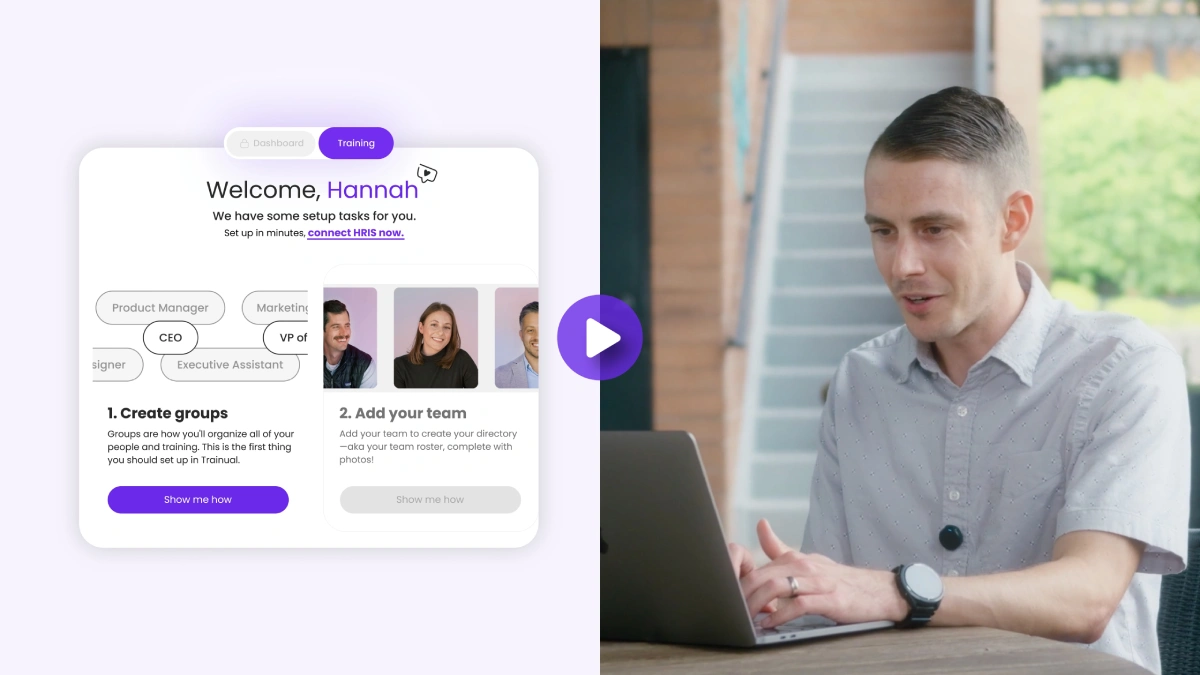
Trainual stands out as the AI-powered training and process documentation platform built for growing teams that need clarity, consistency, and scalability. Its AI assistant helps turn everyday business operations into a clear, repeatable playbook that keeps everyone aligned.
Trainual’s key features include:
- AI-generated SOPs and playbooks that automatically convert existing documents into step-by-step training.
- Mobile knowledge base with AI Q&A so employees can instantly find answers.
- Video-first onboarding that centralizes process walkthroughs and explainer content.
- Integrations with HRIS and payroll tools for seamless user management.
- Role-based org mapping to personalize onboarding paths.
Companies using Trainual typically cut onboarding time by up to 50% while maintaining consistency across distributed teams. It’s ideal for small to mid-size businesses in industries like SaaS, real estate, education, and services — especially when accuracy, engagement, and speed matter most. Trainual keeps training practical and human, helping teams standardize operations without losing culture or momentum.
Absorb LMS
Absorb LMS is a long-standing enterprise solution modernized by AI automation. Its Absorb Create AI engine empowers trainers to generate courses and quizzes quickly. The assistant can personalize learning paths, automate admin work, and surface skill insights.
Pros: Clean interface, wide range of integrations, and enterprise-grade performance.
Cons: May be complex or expensive for smaller organizations, with pricing usually starting around $6–$12 per user per month.
Docebo
Docebo operates as an AI‑first enterprise LMS built for scale. Its proprietary AI engine curates learning paths, recommends resources, and creates intelligent quizzes from existing content. Large organizations use it to automate learning across global teams.
Best for: Enterprises seeking deep analytics and automated skill progression.
Pricing: Starts around $25,000 per year.
While powerful, Docebo’s complexity can be a barrier for smaller teams that need a faster, simpler rollout.
D2L Brightspace
D2L Brightspace combines accessibility, compliance, and AI‑driven adaptive learning. It automatically tailors assessments and feedback based on learner performance, improving long-term comprehension.
Ideal use cases: Higher education, training providers, or corporations needing rigorous accessibility and compliance.
Notable strength: Adaptability and continuous improvement features built directly into its LMS core.
CYPHER Learning
CYPHER Learning offers fully AI‑forward course authoring. With rapid content generation, automatic skills mapping, and multilingual publishing, it’s ideal for global enterprises or educators focused on speed and localization.
Highlights:
- Course drafts created in minutes.
- AI‑driven content recommendations.
- Custom branding and automated reporting.
Its intuitive authoring assistant makes CYPHER Learning a strong option for organizations producing training at scale.
LearnUpon
LearnUpon emphasizes flexibility and automation across multiple learning portals. AI supports auto-enrollment, tailored content recommendations, and smart assessments.
Ideal fit: Businesses training multiple audiences — such as customers, partners, or various internal groups — or those requiring Salesforce and HR integration.
Strength: Balances usability with enterprise functionality at accessible pricing tiers.
TalentLMS
TalentLMS provides approachable AI functionality for smaller teams. Its assistant simplifies quiz creation, recommends content, and evaluates learner progress without requiring heavy technical setup.
Best for: SMBs needing straightforward onboarding or compliance training.
Pricing: Offers free and low-cost plans designed for quick setup and minimal maintenance.
Disco
Disco focuses on employee engagement through AI‑driven community learning. Its assistant recommends modules, automates content suggestions, and analyzes engagement trends. With cohort learning and social tools, Disco fosters collective learning and rapid iteration.
Pricing: From $359 per month.
Best suited for: Companies where collaboration and engagement are central to a learning culture.
Paradiso
Paradiso blends flexibility and automation with strong e-commerce support. Its AI features drive course recommendations, automate reminders, and translate learning paths across multiple languages.
Strengths: Multi-tenant capabilities and gamification.
Weakness: User experience can feel dated compared to others in this list.
It’s particularly suited for global training programs and organizations selling online courses.
Comparing AI capabilities: Content creation, virtual assistance, and adaptive learning
Pricing models and cost considerations for AI LMS
For accurate cost evaluation, test multiple vendors using your real content and audience. Assess ROI by measuring content creation time saved, adoption rates, and training completion metrics. Platforms like Trainual make this easier with built-in analytics tied directly to processes and roles.
How to choose the right AI‑powered LMS for your team
Selecting the best LMS assistant depends as much on your team’s goals as on the features offered. Start by mapping your business requirements:
- Define training objectives and must‑have AI features.
- Shortlist 3–4 platforms that match your workflow.
- Run limited pilots using real content and participants.
- Measure engagement, administrative time saved, and content accuracy.
Ask guiding questions during evaluation:
- Does the AI assistant understand your organization’s documentation and processes?
- Are integrations with HR or performance tools sufficient?
- Is the interface simple enough for consistent employee adoption?
A well-executed pilot reveals not only functionality, but also how employees actually interact with AI-driven learning.
Maximizing ROI with AI assistants in employee training
When used intentionally, AI assistants transform training into a strategic growth engine. Key benefits include:
- Streamlined SOP and course creation.
- Personalized, adaptive learning experiences.
- Reduced administrative tasks and manual enrollment.
- Continuous feedback loops that improve skill mastery.
To maintain long-term value:
- Keep content updated so AI insights stay relevant.
- Teach employees how to use AI Q&A tools effectively.
- Review analytics monthly to uncover knowledge gaps or underused material.
Organizations managing this well see lasting improvements in retention, productivity, and operational alignment — especially when using a unified platform like Trainual.
Frequently asked questions
What key AI features should I look for in an LMS assistant?
Focus on document-aware chatbots, AI course generation, adaptive learning, analytics, and workflow automation to maximize impact and personalization.
How do AI assistants improve employee onboarding and knowledge retention?
They automate repetitive content delivery and personalize learning so new hires ramp up faster and retain more knowledge.
What challenges should I expect when implementing AI-powered LMS features?
Expect a short learning curve connecting systems, structuring content clearly, and keeping materials updated for accurate AI results.
How can I measure the success of AI-driven training programs?
Track engagement, completion rates, onboarding time, and reduced admin workload to see true ROI.
Are AI LMS assistants suitable for small and mid-sized businesses?
Yes. Modern platforms — like Trainual — bring enterprise-level automation, content creation, and clarity to growing teams at a fraction of enterprise complexity or cost.