




AI for employee training in 2026 is no longer about novelty. It comes down to three concrete wins: creating onboarding content faster, onboarding every hire consistently, and helping people retain what they learn. The nine AI features below are the ones that deliver those wins, and they are what to look for when a tool claims to use AI for onboarding and training. Trainual is the reference point, with honest notes on where dedicated learning platforms like TalentLMS fit.
The gap most teams feel is not a lack of AI, it is AI that saves time on creation but does nothing for consistency or retention. A tool that drafts a training module in seconds still fails if every new hire gets a different experience and forgets most of it within a day. People forget roughly 70% of new information within 24 hours without reinforcement, so the features that matter span all three goals, not just speed. Here are the nine, grouped by the win they deliver.
Create onboarding content faster
1. AI-assisted content drafting
The headline feature: AI that drafts a training module or SOP from a prompt, an outline, or a topic, so you start from a real draft instead of a blank page. This is where most of the time savings live, turning hours of writing into minutes of editing. The test is whether the output is specific to your company or generic filler you rewrite anyway, so try it on one real process before believing the demo.
2. Turning existing material into training
Most teams already have the knowledge, scattered across documents, recordings, and people's heads. Look for AI that converts existing material, a policy doc, a recorded walkthrough, a set of notes, into structured training content. This is often faster than drafting from scratch, because it captures how your team really works rather than a textbook version, a point explored in how work is done.
3. AI-generated video and narration
Some onboarding is far clearer shown than written. Look for the ability to create narrated video walkthroughs with AI-generated voiceover and captions, and to host that video alongside the written training. Video lifts engagement for visual and hands-on roles, and AI removes the production overhead that used to make video onboarding impractical for a small team.
Onboard every hire consistently
4. Role-based assignment
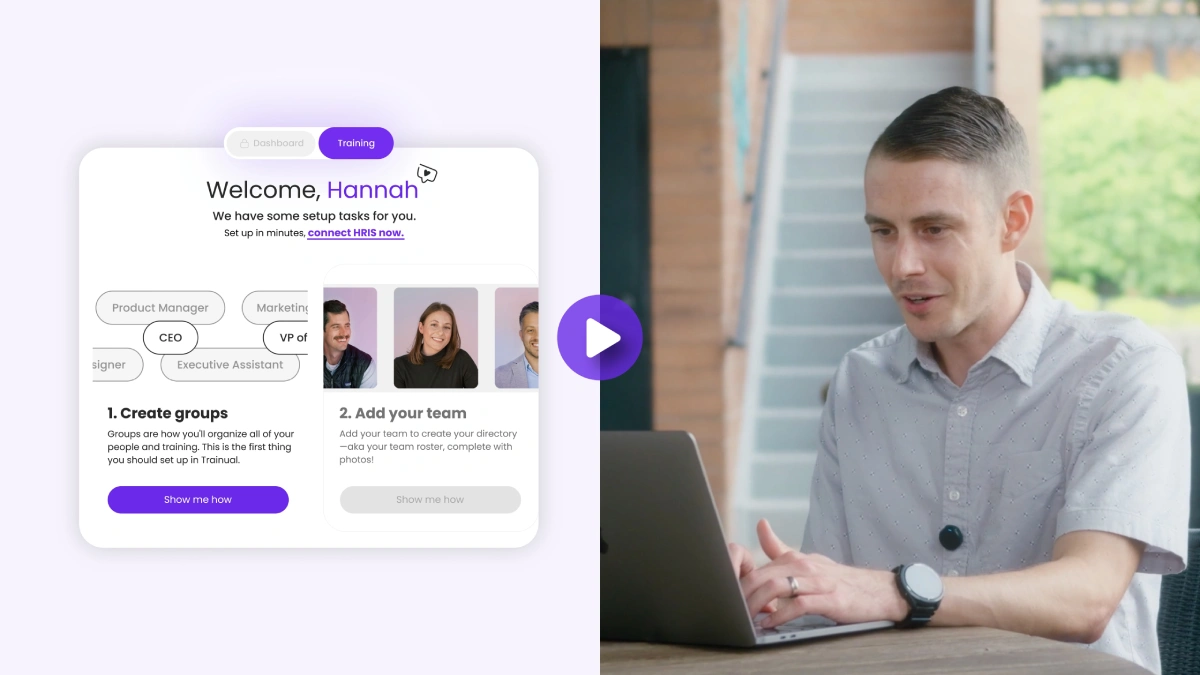
Consistency starts with the right content reaching the right person. Look for the ability to assign training by role, so every new hire in a position gets the same onboarding path, automatically, instead of a manager improvising it each time. This is the single biggest driver of a consistent onboarding experience, and it is what turns documented content into a repeatable program.
5. Structured, personalized learning paths
Dumping everything on a new hire at once slows learning. Look for training paths that sequence content in order and adapt to the role, so foundations come before specifics and each person sees what is relevant to them. Structured sequencing is what makes onboarding feel designed rather than improvised, and it is a common gap in tools that only store content.
6. Progress tracking and completion insights
You cannot call onboarding consistent if you cannot see who completed what. Look for dashboards that track completion across hires, so managers know the standard landed without chasing people. Structured onboarding backed by tracking is tied to materially better outcomes, with structured programs linked to 82% higher new-hire retention. Tracking also tells you which parts of onboarding are working and which need a fix.
Help people retain what they learn
7. AI-generated knowledge checks
Retention requires testing, not just telling. Look for AI that generates knowledge checks from the training content, so you can confirm a new hire understood a procedure rather than assuming they read it. Retrieval practice is one of the most reliable ways to fight the forgetting curve, and AI removes the effort of writing quiz questions by hand, a theme in the psychology of employee training.
8. AI search and an in-app assistant
Retention is not only about the first exposure; it is about finding the answer again later. Look for a searchable knowledge base with AI search that answers a natural-language question instantly, so a new hire reinforces learning in the flow of work instead of interrupting a colleague. Self-serve answers turn every day of work into light reinforcement, which is what makes the training stick past week one.
9. AI-assisted updates that keep training current
Training people retain is training that stays accurate. Look for features that make updating fast and flag potentially outdated content, with version history so changes are tracked. Onboarding content that drifts out of date teaches the wrong thing confidently, so the ability to keep it current is a retention feature as much as a maintenance one.
How the 9 features work together
The nine features map onto the three wins, and the mistake most teams make is buying for only one of them. A tool strong on AI content creation but weak on assignment and tracking makes onboarding faster to build but no more consistent. A tool with great tracking but no AI creation or knowledge checks is consistent but slow to build and weak on retention. The tools worth choosing cover all three, create faster, onboard consistently, and reinforce retention, because onboarding only works when the content is good, everyone gets it, and it sticks. That full picture is what separates a training platform from a content generator, and it is the lens used in the best AI tools for employee onboarding content roundup.
How to choose a tool with these features
Score candidates on all nine, then weight by your weakest link. If building content is your bottleneck, weight the creation features. If new hires get an inconsistent experience, weight assignment and paths. If people forget what they learned, weight knowledge checks and search. Be honest that dedicated learning platforms like TalentLMS are strong on course delivery and formal training, while a documentation-and-training platform like Trainual leans into turning your real processes into onboarding fast and keeping the knowledge searchable and current. The right fit depends on whether your onboarding is course-driven or process-driven, a distinction worth testing against your own material. See the Trainual and TalentLMS comparison for that trade-off in detail.
Ready to see how Trainual works?
👉 Book a demo and see how Trainual uses AI to build onboarding fast, deliver it consistently, and keep it searchable and current.
Want a sneak peek?
👉 Read customer stories from teams that made onboarding faster and more consistent as they grew.
Frequently asked questions
What's the best AI tool for creating employee training and onboarding content?
The best tool depends on whether your onboarding is course-driven or process-driven. Dedicated learning platforms like TalentLMS are strong for formal courses and structured curricula, while a documentation-and-training platform like Trainual is strong for turning your real processes and existing material into onboarding fast, then keeping it searchable and current. For creating content specifically, look for AI that drafts from a prompt or existing material, generates knowledge checks, and supports video, then confirm the tool also delivers content by role and tracks completion so the content you create quickly is also used consistently.
What AI features improve employee onboarding?
The features that matter fall into three groups: creating content faster (AI drafting, turning existing material into training, AI video), onboarding consistently (role-based assignment, structured paths, completion tracking), and improving retention (AI knowledge checks, AI search, and updates that keep content current). Speed features get the attention, but consistency and retention features are what make onboarding effective. A tool that only creates content faster leaves the two hardest problems, consistency and retention, unsolved.
Can AI help new hires retain what they learn?
Yes, in two ways. AI-generated knowledge checks let you test understanding rather than assume it, which uses retrieval practice to fight the forgetting curve, and AI search lets new hires find answers instantly in the flow of work, reinforcing learning day to day. People forget most new information within a day without reinforcement, so features that test and re-expose knowledge are what turn a first exposure into lasting retention. Content creation speed alone does nothing for retention.
How does AI make onboarding more consistent?
AI and automation make onboarding consistent by assigning the same role-based path to every new hire in a position, sequencing content in a designed order, and tracking completion so managers can see the standard landed. The alternative, a manager improvising onboarding each time, produces a different experience for every hire and no way to know what stuck. Consistency comes from the delivery and tracking features, not the content-creation features, which is why teams should weight those when improving onboarding at scale.
Do you need a dedicated AI tool for onboarding or is a general LMS enough?
It depends on your onboarding. If it is mostly formal courses and curricula, a dedicated learning platform may fit well. If it is mostly your real processes, SOPs, and role-specific know-how, a documentation-and-training platform that turns that material into onboarding tends to fit better, because it captures how your team works rather than requiring you to build courses from scratch. Many growing teams find process-driven onboarding is the larger need, so they prioritize tools that document and train together.